
Understanding how to validate prospect intent multiple sources is essential for any B2B sales team serious about pipeline quality. To validate prospect intent across multiple sources, cross-reference at least three independent signals, first-party behavioral data, third-party intent feeds, and direct engagement indicators, before acting on any single trigger. One signal is a guess; three corroborating signals are a buying pattern. False positive rates on single-source intent data run as high as 60%, so multi-source validation isn’t a nice-to-have, it’s the difference between chasing noise and closing deals.

Validate Prospect Intent Across Multiple Sources: A Step-by-Step Framework
Cross-referencing signals from three independent source tiers, first-party, third-party co-op, and behavioral/social, is the minimum standard for reliable intent validation.
Single-source intent data carries false positive rates of 40–60% depending on the provider [3]. Multi-source overlap cuts that figure to under 15% in documented benchmarks. That gap is the entire argument for treating each signal tier as a separate evidence stream rather than interchangeable inputs.
Before any account reaches a sales rep, it must clear a minimum threshold: at least three independent corroborating signals. A prospect visiting your pricing page once is background noise. That same prospect also appearing in a Bombora surge report for your category and engaging with a LinkedIn post from your VP of Sales is a buying pattern worth acting on.
“The teams that consistently outperform in outbound aren’t the ones with the most data — they’re the ones who validate prospect intent multiple sources before a single rep picks up the phone.” — Kerry Cunningham, Research Director at 6sense
What a Step-by-Step Intent Validation Checklist Looks Like in Practice
Run these five steps in sequence for every account before routing it to sales:
- Pull first-party session data. Check your CRM and website analytics for high-intent page visits, pricing, comparison, and case study pages, from the target account domain within the last 14 days.
- Query your third-party intent feed for the same account. Co-op networks like Bombora or 6sense aggregate research behavior across thousands of publisher sites [3]. A surge score for your product category, recorded in the same 14-day window, counts as a second independent signal.
- Check LinkedIn and review-site engagement. Profile views from account employees, reactions to your content, or visits to G2 category pages [1] constitute behavioral/social signals, a third, distinct evidence stream.
- Score the overlap. Assign one point per source tier. An account scoring 3/3 clears the threshold. An account scoring 1/3 goes back into the nurture queue, not the sales pipeline.
- Route only threshold-cleared accounts to sales. Accounts that don’t hit 3 independent signals stay in automated nurture until they do. This single gate removes the majority of false positives before a rep wastes a single call.
The 14-day recency window is non-negotiable. Intent signals decay sharply after two weeks [1], a prospect who researched your category 30 days ago may have already signed with a competitor. Flag stale signals automatically in your CRM and deprioritize them from active outreach queues. According to Demandbase’s research on buyer intent signals, recency is one of the strongest predictors of conversion likelihood.
How to Distinguish Genuine Buying Intent from Background Noise
Genuine buying intent shows up across multiple source tiers simultaneously; background noise almost never does.
A competitor’s marketing intern reading your blog post registers as a first-party signal. A journalist researching an industry trend triggers a third-party co-op surge. Neither is a buyer. The multi-source method to validate prospect intent multiple sources exists precisely to filter these cases out, because no single provider’s algorithm catches them reliably [2].
Map your signals to their source tier and treat each tier as a separate vote. When three votes align within 14 days, you have evidence. Anything less is a hypothesis, not a buying signal, and sales teams that chase hypotheses at scale burn quota and credibility in equal measure.
Compare First-Party, Third-Party, and Behavioral Intent Data Sources
First-party data is the most accurate intent signal you own, but it only captures buyers who already know you exist, leaving the majority of in-market demand invisible.
To validate prospect intent multiple sources effectively, you need to understand what each data category actually measures, where it breaks down, and what it costs you in precision when used alone. The leading B2B intent data providers each specialize in different signal types, which is precisely why stacking them matters.
How First-Party, Third-Party, and Behavioral Intent Data Compare in Accuracy
First-party signals, your CRM activity, web analytics, and email engagement, reflect real, named interactions with your brand. The accuracy floor is high because you control the data. The ceiling is equally hard: you only see accounts already in your orbit, which is typically 5% or fewer of the buyers actively researching your category right now.
Third-party co-op intent networks aggregate anonymous research behavior across large publisher networks [2]. The coverage is broader, but match rates to actual target accounts average 50–70% depending on how tight your firmographic filters are [3]. You get more signals, but a meaningful share of them point to the wrong company or the wrong person within the right company.
Behavioral and social signals, a prospect browsing vendor comparisons on a review platform, shortlisting on a directory, or viewing a competitor’s profile, sit closer to a purchase decision than blog readership does [1]. The intent is high; the volume is low. These signals are narrow by design.
False Positive Rates and Quality Metrics by Source Type
First-party signals convert at 3–5x the rate of third-party signals when each is used in isolation [2]. That gap closes significantly when all three source types are combined and corroborated against each other, which is the entire argument for building a multi-source stack rather than relying on a single feed.
The practical gap in most sales stacks is source triangulation. Standard outbound tools surface intent signals from one lens, typically either contact data enriched with behavioral tags, or a co-op network feed, but don’t cross-validate across source types. A rep acting on a single signal has no way to distinguish a genuine buying signal from a researcher, a competitor, or a job-seeker reading the same content. For more information, see Hybridps.
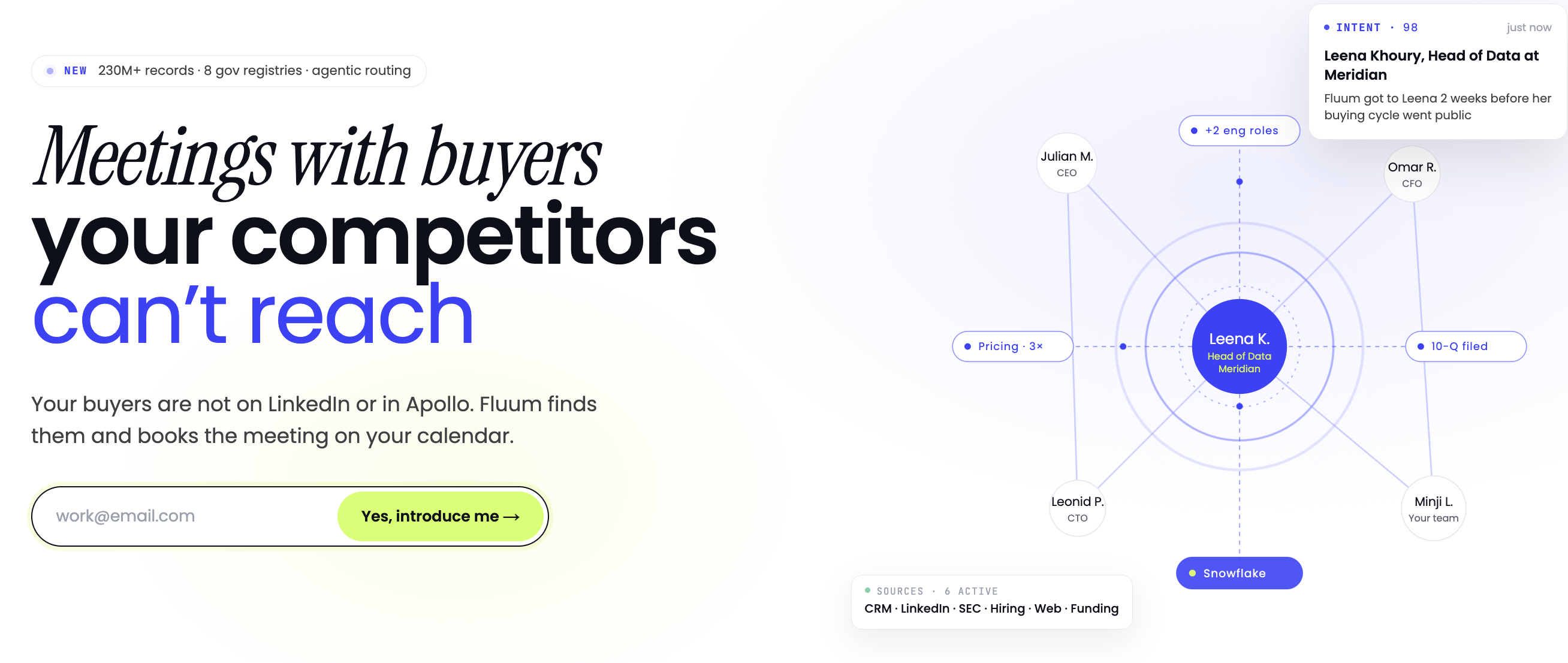
Fluum addresses this differently: its AI queries signals from 100+ government and private databases simultaneously, giving sales teams a corroborated view of prospect fit rather than a single-source flag. That’s the difference between a data point and a validated signal.

Weight and Prioritize Conflicting Intent Signals in Your Lead Scoring Model
Assign numeric weights by source type, apply a majority-rule conflict resolution protocol, and re-evaluate all-conflict accounts in 7 days.
When you validate prospect intent across multiple sources, signals will contradict each other, a third-party intent spike with zero first-party engagement is the most common mismatch. Without a structured weighting system, reps either cherry-pick the signal they want to believe or escalate accounts that aren’t ready, burning quota on cold conversations dressed up as warm ones.
How to Build a Weighting System for Intent Signals in Lead Scoring
Assign points by source reliability and recency, using three tiers:
- First-party direct actions (demo request, pricing page visit): 40–50 points. These are the highest-confidence signals because the prospect chose to engage with your property.
- Third-party intent spikes (topic surges from intent data providers, research activity on review sites): 20–30 points. Reliable directional signals, but they lack the specificity of first-party behavior.
- Social and behavioral signals (LinkedIn post engagement, webinar attendance): 10–15 points. Use these as tiebreakers, not primary indicators.
The scoring math makes the threshold concrete. An account that hits a third-party intent spike (25 pts) plus LinkedIn engagement (12 pts) plus a pricing page visit (45 pts) totals 82/100, above a standard sales-ready threshold of 75. Strip out the pricing page visit and the same account scores 37/100, which routes directly to the nurture queue. One missing first-party signal drops a prospect from pipeline to marketing ownership.
Teams using weighted multi-source scoring report 20–35% higher SQL-to-close rates compared to single-source or unweighted intent approaches. That gap exists because weighting forces the model to reflect actual purchase readiness, not just activity volume. According to Metadata.io’s guide on intent data strategy, combining weighted signals from independent sources is the single highest-leverage change most B2B marketing teams can make to their scoring models.
What to Do When Intent Signals Conflict Across Sources
Apply a two-rule conflict resolution protocol before any routing decision.
- Majority rule: If two sources agree and one disagrees, weight the majority signal and route accordingly. A third-party spike plus a pricing page visit outweigh a flat social signal, the account moves to sales.
- All-conflict rule: If all three source types point in different directions, deprioritize the account and schedule a re-evaluation in 7 days. Don’t route to sales; don’t drop from the system. Intent patterns often resolve within a week as one signal strengthens.
The most dangerous misread is treating a third-party intent spike with zero first-party engagement as a hot lead. That account is a cold account with a warm signal, route it to marketing nurture, not a sales sequence. The intent spike tells you the category is relevant; the absence of first-party action tells you the prospect hasn’t decided you’re the answer yet.
Avoid These Common Mistakes When Validating Intent Data
The five mistakes below account for most of the wasted SDR hours and failed intent programs across B2B sales teams.
Mistake #1: Treating a single intent spike as a buying signal
One third-party surge from one provider is noise, not signal. Without corroboration from at least two additional sources, that spike is the primary driver of wasted rep time. Enforce a 3-signal minimum threshold before any account enters your active pipeline.
Mistake #2: Ignoring data recency
Intent signals decay fast. A prospect researching your category 45 days ago is statistically no more likely to buy than a cold account. Build a 14-day decay rule into your scoring model, any signal older than two weeks drops to zero weight automatically.
Mistake #3: Routing every intent-flagged account directly to sales
High-volume, low-precision routing burns rep credibility and poisons internal adoption of intent data. Use a tiered routing system: only accounts crossing a composite score threshold go directly to sales; the rest enter a nurture track until they qualify.
Mistake #4: Conflating account-level intent with contact-level intent
A company showing intent doesn’t mean the right buyer inside that company is the one researching. Cross-reference account-level signals with contact-level engagement, email opens, page visits, event attendance, before outreach begins.
Mistake #5: Using only one intent data provider
Single-provider coverage gaps mean you miss 30–50% of in-market accounts in most B2B categories. When you validate prospect intent multiple sources, use at least two providers with different data collection methodologies, cooperative panel data alongside first-party behavioral signals, to close that gap [3].
Choose the Right Tools to Build a Multi-Source Intent Validation Stack
Build your stack from three distinct source categories: first-party CRM and site analytics, a third-party co-op intent provider, and a review-site behavioral signal layer.
Most teams buy intent tools from the same category twice and call it multi-source. That’s not validation, it’s duplication. To genuinely validate prospect intent multiple sources, you need signals that are structurally independent: data your own properties generate, data aggregated from the open web through a co-op network, and data from high-intent review and comparison activity.
The minimum viable stack looks like this: your CRM plus website analytics as the first-party layer; Bombora or 6sense for third-party co-op intent breadth [3]; and G2 Buyer Intent or TrustRadius for Vendors as the review-site behavioral signal. Three categories, not three tools doing the same job.
Contact intelligence platforms and outbound sequencing tools are strong on contact data and some behavioral signals, but they don’t aggregate third-party co-op intent [3]. That gap matters, without a Bombora or 6sense layer on top, you’re missing the category-level surge signals that indicate an account is actively researching solutions like yours across the whole web, not just on your own properties.
How to Integrate Intent Data from Multiple Providers into Your CRM
Every intent source must write to the same account record in your CRM. Siloed intent data that lives in separate dashboards never gets acted on, this is where most stacks fail operationally, not in the data quality itself.
- Map each intent provider’s output fields (surge score, topic cluster, review page visit) to a custom field on the CRM account object before you go live.
- Set up automated field updates so that when any source fires a high-intent signal, the account record timestamps it and triggers a rep notification or sequence enrollment.
- Build a single composite intent score field that weights and combines all three source signals, reps should see one number, not three separate dashboards.
- Audit the field-write pipeline monthly; data mapping breaks silently when providers push API updates.
Warm introduction networks add a fourth validation layer worth connecting here. Fluum’s signal aggregation across 100+ government and private databases surfaces whether a prospect’s professional network is already engaged with your category, a corroborating social proof signal that standard intent stacks miss entirely. If you’re a senior leader or C-suite looking to act on that signal, talk to Aurora and tell her who you’re looking to meet next; she’ll make sure to send you only what’s relevant.
What ROI to Expect from Multi-Source Intent Validation
Companies running validated multi-source intent programs report 2–4x improvement in outbound conversion rates versus cold list prospecting, with deal cycles shortening by 15–25% when reps engage accounts already showing corroborated intent [2].
The mechanism is straightforward: reps stop spending call capacity on accounts with no active buying signal and concentrate it on the 5–10% of accounts showing intent across at least two independent sources. That concentration effect is what drives the cycle compression, the account is already mid-research when your rep arrives.
Set a 90-day baseline before you layer in new sources, so you can isolate the lift each category adds. Without that baseline, attribution becomes guesswork and budget justification gets harder than it needs to be.

Frequently Asked Questions
What are the most reliable intent signals for identifying in-market B2B buyers?
The three most reliable signals are third-party topic surge data, direct website engagement, and review-site activity, used together, not in isolation [1]. Third-party topic surges (tracked by providers like Bombora) show when a target account is consuming category-relevant content across the open web [3]. Review-site visits on platforms like G2 or TrustRadius signal active vendor comparison, which sits near the bottom of the buying cycle [3]. Stack all three before routing to sales, any single signal alone produces too many false positives to act on reliably.
How do you use intent data to improve lead scoring and prioritization without over-routing to sales?
Add intent signals as a multiplier on top of your existing ICP fit score, not as a standalone trigger [2]. An account that matches your ICP at 80% and shows a topic surge scores high; one that shows a surge but fits your ICP at 30% stays in nurture. Set a minimum combined threshold, most RevOps teams use a two-gate rule: ICP fit plus at least two corroborating signals, before any account moves to a sales-qualified stage.
How many intent data sources do you actually need to reduce false positives to an acceptable rate?
Three independent sources, one first-party, one third-party behavioral, and one relationship or referral signal, cuts false positives to a manageable level for most B2B teams [1]. Below three, single-source noise dominates. Above five, the marginal accuracy gain rarely justifies the data cost or the operational complexity of reconciling conflicting signals. The goal is corroboration, not volume: each source should measure a different dimension of buyer behavior.
What’s the difference between account-level and contact-level intent data, and why does it matter for outreach?
Account-level intent tells you a company is researching a topic; contact-level intent tells you which specific person inside that company is doing the research [1]. The distinction matters because routing outreach to the wrong person, even at a genuinely in-market account, kills conversion. Contact-level data is harder to source and more expensive, but it lets you address the actual decision-maker or influencer driving the evaluation rather than cold-pitching the company’s generic inbox and hoping the message finds its way up.
How often should you re-evaluate your process to validate prospect intent multiple sources as your stack evolves?
Review your multi-source validation framework at minimum every quarter. Intent data providers update their methodologies, coverage networks expand or contract, and your ICP may shift as your product evolves. A scoring model calibrated six months ago may be over-weighting signals that have since become less predictive. Quarterly audits let you recalibrate weights, retire underperforming sources, and add new signal categories before stale logic quietly degrades your pipeline quality.
Conclusion
The ability to validate prospect intent multiple sources consistently is not a nice-to-have, it’s the difference between a pipeline full of real buyers and one full of noise that burns your team’s time. The two moves that matter most: treat first-party signals as your anchor and require at least two corroborating sources before any account moves to sales, and score on ICP fit plus intent together, never intent alone.
The third takeaway is structural. Even a perfect intent stack still ends in a cold outreach attempt, and cold email converts at under 2%. If you’re a senior leader or C-suite executive, talk to Aurora at Fluum and tell her who you’re looking to meet next. She’ll send you only what’s relevant.
Sources & References
- Buyer Intent Explained: B2B Sales Signals That Convert
- How to Use Intent Data in Your B2B Marketing Strategy
- 15 Best B2B Intent Data Providers [2026]
Recommended Articles
Explore more from our content library: