
Understanding fintech sales prospecting regulated is essential. You identify and reach decision-makers at regulated fintech companies by combining verified regulatory data (FCA Register, SEC EDGAR, Companies House filings) with compliance-aware outreach that respects data protection law and each buyer’s approval hierarchy. Cold email and generic LinkedIn outreach underperform here because compliance officers and risk owners sit outside standard org-chart data, and regulated buyers expect a documented, consent-based first contact. The mechanism that works: verify the role against a public filing, then warm-introduce through a channel where both parties opted in, rather than cold-blasting a scraped list. For teams building this muscle from scratch, this fintech companies prospecting guide is a useful companion reference.
How Do You Identify and Verify Decision-Makers at Regulated Fintech Companies?
Finding the right person means mapping the approval chain first, then verifying that person’s authority against a public filing before you ever send a message. A commercial champion who loves your product still can’t sign, that authority sits somewhere else in the org, and finding it is the real work of fintech sales prospecting regulated buying committees demand.
How Do You Distinguish Compliance Officers, Risk Officers, and Traditional C-Suite Buyers?
A VP of Partnerships can champion your deal internally, but a Money Laundering Reporting Officer (MLRO) or Head of Compliance often has to sign off before procurement moves. That’s structural, not political, regulators hold specific named individuals accountable for vendor risk, data handling, and AML exposure, so the buying committee routes final approval through them regardless of who initiated the conversation.
Risk officers matter for a different reason. They own operational and financial risk assessments, which means a vendor touching payments infrastructure, customer data, or transaction monitoring triggers their review even if the deal originated in a product or engineering conversation. Selling to fintech means selling to at least three distinct functions, commercial, compliance, and risk, often in sequence, not in parallel.
In practice, a buying committee for a regulated fintech deal typically includes some combination of the following roles, each with a different veto power:
- Commercial champion (VP of Partnerships, Head of Product) — wants the tool, can’t approve it alone.
- Compliance officer or MLRO — signs off on vendor risk, data handling, and AML exposure.
- Risk officer — reviews operational and financial risk when the vendor touches payments, data, or transaction monitoring.
- Legal counsel — reviews contract terms and data processing language.
- Security lead — assesses infrastructure, access controls, and data residency.
What Government Registries and Private Data Sources Reveal Decision-Maker Hierarchies?
LinkedIn titles lag reality constantly. Someone listed as “Head of Partnerships” may need sign-off from a named MLRO who doesn’t maintain an active LinkedIn presence at all, regulatory roles are frequently filled by people who avoid public visibility precisely because their name carries personal liability.
Public registries close that gap. The FCA Register lists every FCA-authorized firm’s approved persons and controlled functions in the UK. SEC EDGAR discloses officers and directors for U.S.-listed and filing entities. Companies House filings in the UK show statutory directors and persons of significant control. None of these were built for sales prospecting, but all three give you a verified name tied to a real regulatory function, something no scraped LinkedIn export can confirm. This is one of the core reasons fintech sales requires a different playbook than standard B2B outreach.
Verification is a cross-reference exercise: take the registry-listed name and function, then check current employment signals, recent filings, active company registration, press mentions, to confirm the person still holds that authority today, since registries update on regulatory timelines, not real-time hiring cycles. Fluum’s matching pulls from over 100 government and private databases specifically to close this gap, surfacing contacts whose regulatory standing is current, not contacts who merely look senior on a profile.
What Compliance and Regulatory Constraints Shape Fintech Sales Prospecting in Regulated Markets?
Four regulatory regimes, GDPR, FCA conduct rules, SEC disclosure expectations, and MAS guidelines, each define outreach legality differently, so no single playbook works across jurisdictions. Fintech sales prospecting regulated by these overlapping frameworks means the same cold email that’s compliant in Texas can trigger a complaint in Frankfurt.
How Do GDPR, FCA, SEC, and MAS Regulations Differ for B2B Sales Outreach?
GDPR governs the mechanism of contact itself. It requires either explicit consent or a documented “legitimate interest” basis before a seller processes a European contact’s personal data for outreach, meaning a cold email to a Berlin-based compliance officer needs a recorded justification on file, not just a polite subject line. Get this wrong and the exposure isn’t a spam complaint; it’s a regulatory one.
FCA conduct rules in the UK work differently. They don’t primarily police the outreach channel, they police what gets said once contact is made. Claims about a product’s risk profile, performance, or regulatory status have to hold up to the same standard the FCA applies to the fintech’s own customer communications, which means a vendor’s sales deck can become a compliance liability for the buyer if it overstates certification or endorsement.
SEC disclosure expectations apply a third lens entirely, focused on public-company and broker-dealer fintechs where any sales claim touching financial performance or material information carries securities-law weight. A seller pitching a fintech’s investor relations or finance team needs to know that loose language around “guaranteed returns” or “proven ROI” isn’t just marketing hyperbole, it’s a documentable statement someone might have to defend later.
What Compliance Documentation Do Fintech Buyers Expect During the Sales Cycle?
Singapore’s MAS adds a fourth variable: outcome-focused guidelines that hold licensed fintechs accountable for third-party vendor conduct, including how those vendors were sourced and vetted. A MAS-regulated payments firm evaluating a new vendor will ask who introduced them and why, an unsolicited cold email from an unverified sender is a harder sell than a warm, documented introduction.
That’s why fintech buyers request data processing agreements and SOC 2 reports before the first call is even booked, not after a deal is close. Procurement and compliance teams at regulated fintechs treat vendor security posture as a gating question, and a seller who can’t produce that documentation stalls before the pipeline conversation starts. Regulatory record-keeping obligations compound this: fintechs must maintain auditable trails of who contacted them, on what consent basis, and when, which is exactly the kind of double opt-in, timestamped introduction that Fluum’s matching system generates by default, rather than the untraceable cold-send history most CRMs accumulate.
Why Do Traditional Cold Outreach and LinkedIn Prospecting Fail for Regulated Fintech Targets?
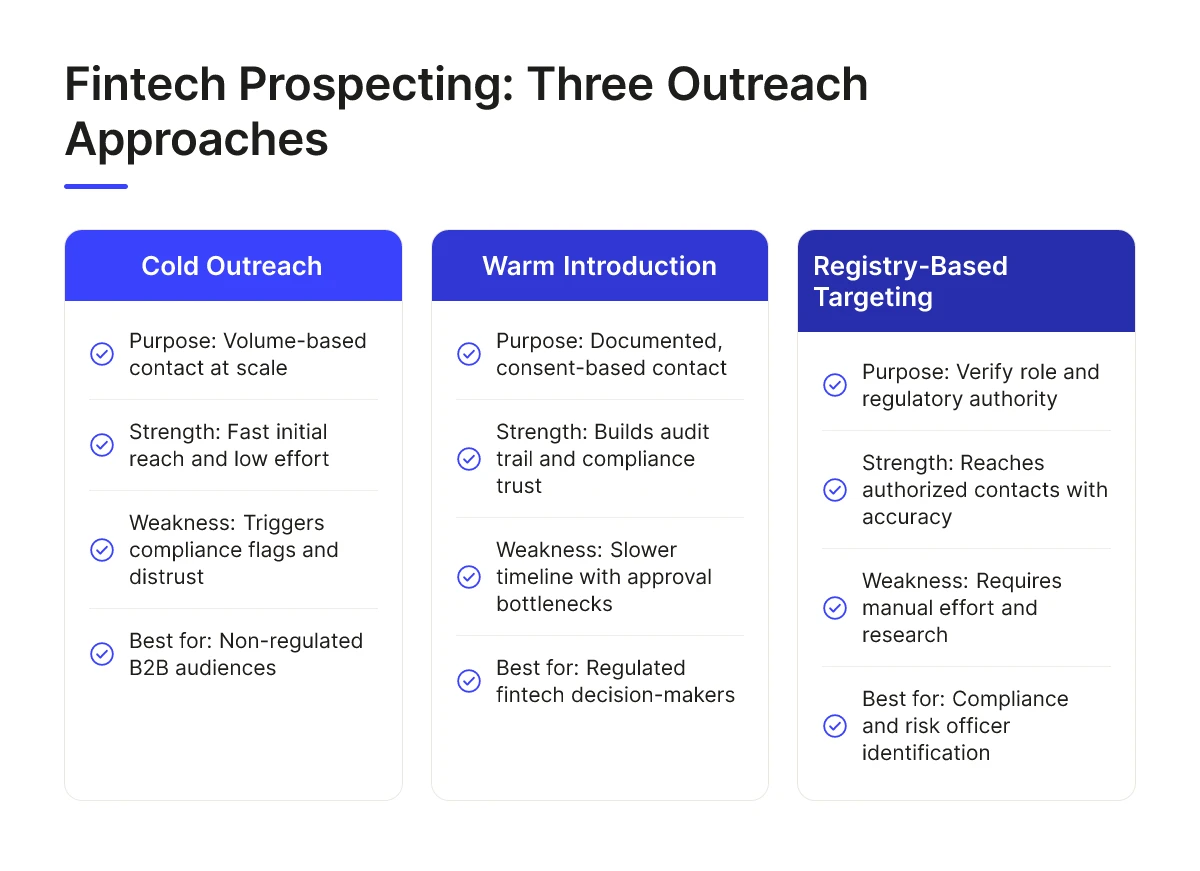
Cold email and LinkedIn prospecting fail here because the target is trained, contractually and culturally, to treat unsolicited contact as risk rather than noise. That single fact explains most of the reply-rate collapse sales teams see when they run fintech sales prospecting regulated targets through a standard outbound sequence.
Every regulated fintech runs a compliance function whose job includes monitoring external communications. Employees at these companies are onboarded into a culture where accepting a random connection request or replying to a cold email carries a small but real career cost. It’s not that they’re too busy to answer, it’s that answering is a policy question before it’s a preference question.
Which Fintech Buyer Segments Are Underindexed by LinkedIn and Conventional Sales Intelligence Tools?
Compliance officers, risk leads, and heads of regulatory affairs are the buyers who matter most on many fintech deals, and they’re also the buyers least visible in standard databases. They rarely optimize LinkedIn profiles, rarely accept connection requests from sales contacts they don’t recognize, and often keep a deliberately thin public footprint. Tools built to scrape job titles and infer seniority from public activity systematically underweight exactly the people who sign off on vendor risk.
Contrast that with a marketing ops manager or a mid-market sales director, who post, network, and accept requests freely. Generic prospecting tools are tuned for that behavior. Applied to fintech, they surface the wrong 80% of the org chart while missing the roles that actually gate a purchase.
Volume-based cold email compounds the problem. Fintech companies, given their own regulatory exposure, tend to run stricter email filtering and domain reputation monitoring than a typical B2B target. A sequence tool blasting variations of the same message across dozens of contacts at one firm trips spam thresholds faster and gets the sending domain flagged sooner.
The deeper issue is trust, not attention. A fintech buyer’s risk calculus doesn’t file an unverified inbound contact under “annoying”, it files it under “liability,” a vendor-vetting problem before it’s ever a sales conversation. This is precisely why fintech sales prospecting regulated by strict conduct rules requires a fundamentally different approach than standard SaaS outbound.
How Do You Build Warm Introductions to Fintech Decision-Makers Within Regulatory Boundaries?
A compliant introduction starts with mutual confirmation, not a message sent into the void, both sides say yes before any contact details change hands. That single mechanic changes everything about how fintech sales prospecting regulated by compliance teams needs to work.
What Does a Compliant Warm Introduction Workflow Look Like Versus Cold Outreach?
Cold outreach is one-sided by design. A rep finds a name, guesses an email pattern, and fires off a sequence, the fintech buyer never agreed to be contacted, and there’s no record of interest on their end. If a compliance officer later asks how that conversation started, the honest answer is “we bought a list and hoped.”
A double opt-in model works differently. The seller expresses interest in reaching a specific type of buyer, say, a Head of Product Operations at a payments company evaluating vendor risk tools. The platform matches that request against a buyer who has separately indicated openness to that exact kind of conversation. Neither side gets the other’s contact information until both confirm. This is how Fluum runs its introductions: AI matching against signals from 100+ government and private databases, followed by a mutual yes before any names or emails are exchanged.
That structure produces something cold email never can: a documented consent trail. Both parties opted in before contact. For a compliance officer who has to justify every vendor conversation to an internal audit function, that record isn’t just convenient, it’s the difference between an approach that satisfies their own documentation requirements and one that creates a new problem for them to explain.
How Do Regulatory Approval Milestones Extend Fintech Sales Cycles?
Fintech deals rarely move at the pace of a standard B2B sale because regulatory sign-off sits inside the process at three predictable points:
- Legal review of contract terms and data handling language.
- Compliance sign-off confirming the vendor meets the buyer’s regulatory obligations.
- Security review covering infrastructure, access controls, and data residency.
Each stage is a natural bottleneck, not because anyone is slow, but because each function has its own queue and its own risk tolerance. Apollo’s research notes that fintech buying decisions typically span finance, IT, and operations stakeholders [1], and each additional reviewer adds a checkpoint the deal has to clear before it can advance.
Sales teams who treat these milestones as obstacles to push past lose weeks. Teams who anticipate them win time back. That means looping in a compliance contact during early discovery, before a commercial agreement is even on the table, rather than surfacing them only once legal is ready to sign. An introduction that starts with mutual interest already clears the trust bar that would otherwise consume the first several weeks of that review cycle.
If you’re a senior sales or C-suite leader mapping this out for your own pipeline, talk to Aurora and tell her who you’re looking to meet next, we’ll send you only what’s relevant.
What Data Sources Reach Fintech Buyers That Conventional Prospecting Tools Miss?
Public regulatory filings expose title changes, ownership structures, and compliance roles months before that information reaches LinkedIn or a purchased contact list.
Most contact databases sell you data that started as a scraped profile or a self-reported form field. Nobody at the company confirmed it, nobody’s legally required to keep it current, and nobody gets penalized if it’s wrong. That’s the entire problem with fintech sales prospecting regulated by bodies that demand a different standard of accuracy, the buyers you’re trying to reach live inside a paper trail your vendor never reads.
How Do Companies House, the FCA Register, and SEC EDGAR Surface Decision-Makers Private Data Vendors Cannot?
Registries like Companies House in the UK, the FCA Register, and SEC EDGAR in the US capture information because the law requires it, not because someone remembered to update a bio. Director appointments, controller changes, and authorized-person status get filed on statutory deadlines. A firm regulated by the FCA has to notify the register when it appoints a new senior manager under the Senior Managers and Certification Regime, that filing exists whether or not the person has touched their LinkedIn account.
Here’s the gap in practice: a newly appointed compliance officer at a payments firm can show up in an FCA filing months before their LinkedIn title catches up. Sales teams working off scraped social data are pitching the outgoing contact, or worse, an unauthorized one, a real risk when the entire pitch depends on reaching someone with actual regulatory sign-off.
Neither source wins alone. Registry data confirms who holds a role and when it changed, but it rarely comes with an email address or a reason to reply. Private enrichment data supplies contact details and context, but goes stale the moment someone changes jobs. Layering registry-verified hierarchy on top of enrichment data is what turns a name into a confirmed, reachable, currently-authorized decision-maker, which is exactly the matching problem Fluum’s AI is built to solve, querying signals from 100+ government and private databases rather than trusting either category in isolation.
The trade-off is effort, not cash. Cross-checking a registry filing against an enrichment record takes more manual work than exporting a generic list from a contact database. But that work eliminates the outreach that never should have gone out, messages to departed executives, unauthorized signatories, or roles that no longer exist. In a regulated market, that reduction in wasted, potentially non-compliant contact attempts matters more than list volume ever will, which is why fintech sales prospecting regulated by multiple overlapping frameworks demands this extra layer of verification as standard practice, not an optional step.
Frequently Asked Questions
Can you use LinkedIn Sales Navigator-style tools at all for regulated fintech prospecting?
Yes, but treat them as a research layer, not an outreach engine. They’re useful for confirming a person’s title and tenure, but their reply rates on cold InMail to compliance and risk leaders are poor because those roles get pitched constantly and have little incentive to respond to a stranger.
How long does it typically take to get a first meeting with a compliance officer at a regulated fintech?
Cold outbound usually takes six to twelve weeks of sequencing, if it converts at all. A warm, double opt-in introduction can compress that to days, because the meeting only happens once the compliance officer has already agreed they want the conversation.
Do data processing agreements need to be signed before a first sales call?
No, a DPA covers actual data processing, not a discovery conversation. It becomes relevant once you’re exchanging customer data, running a pilot, or connecting systems, which is usually well past the first meeting.
What’s the difference between prospecting a fintech startup and a regulated bank-partnered fintech?
A standalone fintech startup often has one decision-maker who can say yes; a bank-partnered fintech has that same buyer plus a sponsor bank’s risk and compliance team who can veto the deal. Selling to the second group means identifying and satisfying both sets of stakeholders, not just the one holding the budget.
If you’re a senior leader evaluating vendors, how should you approach this?
Skip the generic outbound and go straight to the people who can qualify your fit fastest. If you’re a senior leader or C-suite exec, talk to Aurora and tell us who you’re looking to meet next, we’ll only send what’s relevant to you.
Conclusion
Regulated fintech prospecting rewards precision over volume. Map the real buying committee, including sponsor bank risk teams where they exist, verify every contact against a current regulatory filing, and lead with context that proves you understand their compliance obligations before you ask for their time.
Cold email still converts under 2% in this space; warm, double opt-in introductions built on verified decision-maker data change that math entirely. Start by auditing your current pipeline: how many of this quarter’s fintech contacts were confirmed against a primary source in the last 90 days?
Sources & References
- What Is Fintech Sales? Strategies, Process, Best Practices | Apollo
- Fintech Companies Prospecting Guide (2026)
Recommended Articles
Explore more from our content library: