
Understanding alternative data sources prospecting is essential. Alternative data sources for prospecting are non-traditional signals, job postings, web traffic, satellite imagery, app downloads, patent filings, and more, used to identify buying intent before a prospect ever fills out a form. Unlike static contact databases, these sources surface behavioral and operational signals that predict purchase readiness. B2B sales teams using alternative data consistently report 2–5x higher conversion rates compared to list-based outreach, because they’re reaching buyers at the right moment, not just the right title.

What Alternative Data Sources for Prospecting Actually Are (And Why Your CRM Data Isn’t Enough)
Alternative data is any signal outside a standard contact database, job postings, web traffic patterns, patent filings, shipping manifests, app store reviews, and satellite imagery, used to identify buying intent. According to Gartner, sales teams that incorporate non-traditional data signals into their workflows see significantly higher pipeline quality than those relying solely on contact databases.
What counts as alternative data in B2B prospecting?
Traditional data sources tell you a company exists and who works there. Alternative data sources for prospecting tell you what that company is actively doing right now, and whether that activity signals an imminent purchase decision.
A tool like a standard contact database gives you a name, a title, and a phone number. It does not tell you that the company posted 14 engineering roles in Kubernetes and Rust last month, a clear signal of a platform migration that a cloud infrastructure or security vendor should be calling about weeks before any RFP surfaces.
That distinction matters. List-based prospecting puts you in the same queue as every other vendor who bought the same export. Alternative data creates an asymmetric information advantage, you know something your competitors don’t, and you act on it first.
The main categories of alternative data beyond traditional databases
Alternative data breaks into four practical categories for B2B sales teams:
- Behavioral signals: Web traffic trends, app usage data, and digital engagement patterns that show where a company is investing attention.
- Operational signals: Job postings, hiring velocity, funding rounds, and technology stack changes that reveal strategic priorities.
- Transactional signals: Import/export records, procurement filings, and government contract awards that confirm active spending.
- Relationship signals: Board appointments, executive moves, and ownership changes that reset vendor relationships and open new conversations.
Each category surfaces a different type of buying moment. Used together, they build a picture of a prospect that no static CRM record can match. The practice of alternative data sources prospecting has grown substantially as more public and private datasets become accessible to sales teams of all sizes.
How to Implement Alternative Data Sources Prospecting in Your Sales Workflow
Integrating alternative data into prospecting takes five discrete steps: define triggers, select sources, validate signals, enrich your CRM, then personalize outreach to the signal itself.
Step-by-Step Process for Integrating Alternative Data into Prospecting
Step 1: Map your trigger events before touching a single data source. Pull your last 24 months of closed-won deals and identify which business events preceded the purchase decision, funding rounds, executive hires, tech stack migrations, regulatory filings. That historical pattern tells you which signals to watch, not the other way around.
Step 2: Match each signal type to the right provider. Funding signals come from Crunchbase or PitchBook. Intent data, who’s actively researching your category, comes from Bombora. Hiring patterns live in LinkedIn Talent Insights. Supply chain shifts show up in import records via providers like ImportGenius. One source covers one dimension; you need several running in parallel.
Step 3: Cross-reference at least two independent signals before flagging a prospect as hot. A company posting DevOps roles AND showing a 40% traffic spike to a competitor’s pricing page is a confirmed signal. Either data point alone is a hypothesis. Both together are an opening.
Step 4: Enrich and route within 24–48 hours of signal detection. Pipe validated signals into your CRM with a confidence score attached, then assign to a rep immediately. Signal decay is real, a funding announcement is most actionable in the first 72 hours. After that, three other vendors have already called.
Step 5: Personalize outreach to the signal, not the persona. “I noticed you’re scaling your data engineering team” outperforms any persona-based template because it explains why you’re reaching out now, not just why you exist. Fluum’s double opt-in introduction model takes this further, by the time a rep makes contact, both sides have already confirmed interest, so the signal-informed message lands in a conversation that’s already warm.
“The teams winning with alternative data sources prospecting aren’t just using more data — they’re using better-timed data. A signal acted on within 48 hours is worth ten times the same signal acted on a week later.” — Trish Bertuzzi, Founder and CEO at The Bridge Group
How to Validate and Measure Data Quality from Alternative Sources
Alternative data sources prospecting only works when the underlying data is trustworthy. Three validation checks separate signal from noise.
- Recency check: Confirm the signal timestamp. A hiring post from 90 days ago reflects a decision already made, not one in progress.
- Source independence: Two signals that both derive from the same upstream dataset don’t count as independent confirmation, verify that each comes from a distinct data collection method.
- ICP fit gate: Before routing to a rep, run the enriched record against your ICP criteria, industry, headcount, revenue band, tech stack. A hot signal at the wrong company wastes a rep’s best hours.
Track signal-to-meeting conversion by source monthly. If import record signals consistently convert at 12% and intent data converts at 4%, reallocate sourcing budget accordingly. The data tells you where to look next.

How Alternative Data Providers Compare: Coverage, Use Cases, and Trade-offs
No single alternative data provider covers every prospecting scenario, the right choice depends on your target market, deal size, and how your team closes. Effective alternative data sources prospecting requires matching the right provider to the right use case. For more information, see Studiodentistico-oberti.
SafeGraph, Bombora, Crunchbase, and Others: Coverage and Use Case Differences
Bombora is the go-to source for intent data in alternative data sources prospecting. It tracks content consumption across 5,000+ B2B publisher sites to flag accounts actively researching a category, making it strong for mid-market SaaS teams that need to prioritize accounts already in a buying cycle. The trade-off is cost: Bombora’s pricing puts it out of reach for most SMB teams, and it requires meaningful CRM integration work before the data becomes actionable.
Crunchbase Pro and PitchBook both cover company funding and firmographic data, but they serve different buyers. Crunchbase wins on accessibility and price for teams prospecting into startups and early-stage companies. PitchBook wins on depth, deal history, cap table detail, and investor relationships, for reps targeting PE- or VC-backed enterprise accounts. Treating them as interchangeable is a common and costly mistake.
SafeGraph delivers location and foot-traffic data that is genuinely useful for field sales teams, retail-adjacent businesses, and any company where physical presence signals buying intent. For fully remote or digital-native B2B targets, SafeGraph adds almost nothing to a prospecting workflow.
“Alternative data sources prospecting is no longer a competitive edge reserved for hedge funds and enterprise teams — it’s becoming table stakes for any B2B sales organization that wants to reach buyers before the RFP drops.” — Kyle Coleman, Chief Marketing Officer at Copy.ai
Which Alternative Data Provider Fits Which B2B Prospecting Scenario
Contact enrichment tools blend some intent signals with contact data, but they remain fundamentally contact databases with enrichment layered on top. They tell you who to call, not why now. That gap is where most outbound teams stall.
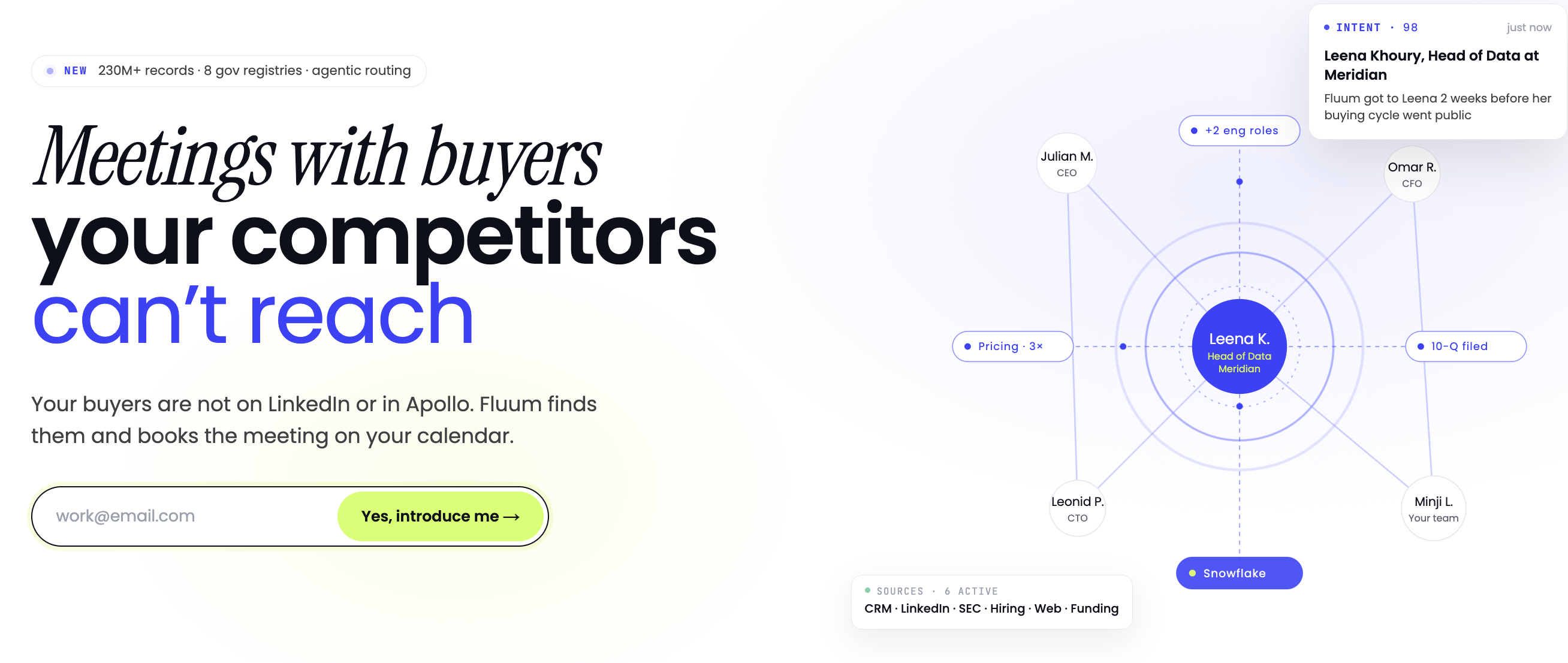
The data type most providers miss entirely is relationship graph data: who knows whom, and what warm path exists between your rep and a decision-maker. Fluum surfaces exactly this signal, pulling from 100+ government and private databases to map connection-based paths that no contact database carries. The result is a warm introduction where both parties have opted in, not a cold dial to someone who matched a filter.
If you’re a senior leader or C-suite executive, reach out to Aurora at Fluum directly, tell her who you’re looking to meet next, and she’ll make sure you only receive what’s relevant to your goals.
Compliance and Regulatory Risks When Using Alternative Data for Prospecting
Alternative data sources prospecting carries real legal exposure, GDPR, CCPA, and FTC enforcement actions have all targeted commercial data use in the past 24 months. According to the Federal Trade Commission (FTC), data brokers and companies using behavioral signals for commercial outreach face increasing scrutiny over consent and data provenance practices.
How GDPR and CCPA Affect Alternative Data Use in Prospecting
GDPR Article 6 requires a documented lawful basis before you process any personal data. B2B teams most often claim “legitimate interest,” but that basis demands a written balancing test showing your commercial interest doesn’t override the individual’s rights. Scraping LinkedIn profiles or buying lists from vendors who can’t prove compliant collection fails this test, and the fines are calculated as a percentage of global annual revenue, not a flat fee. The U.S. Small Business Administration also provides guidance on data compliance obligations for businesses operating across state lines.
CCPA applies to California residents regardless of where your company is headquartered. If your alternative data includes individual-level behavioral signals on California contacts, browsing history, location pings, intent scores, you need active opt-out mechanisms and a signed data processing agreement with your vendor before a single record enters your CRM.
The FTC escalated scrutiny of data brokers through 2024 and into 2025, with enforcement actions specifically targeting companies that used location data and behavioral signals for commercial outreach without traceable consent chains. Knowing your vendor’s data provenance isn’t optional, it’s the first question a regulator will ask.
Legal Safeguards to Implement Before Scaling Alternative Data Programs
The safest signals are public-record and aggregate: job postings, funding announcements, patent filings, and import/export records carry far lower regulatory risk than individual behavioral tracking. Build your prospecting stack around these signals first.
Before you scale any alternative data program, run through this checklist:
- Demand a data lineage document from every vendor, where the data originated, how consent was obtained, and when it was last audited.
- Prefer account-level signals over individual-level behavioral data wherever your targeting allows it.
- Document your legitimate interest assessment in writing, reviewed by legal, before processing EU personal data.
- Build a data retention and deletion policy, including vendor deletion obligations, before you add a single new data source at scale.
Platforms that aggregate signals from government and public databases, Fluum pulls from 100+ government and private databases, reduce this exposure by design, because public-record sources carry established legal bases that individual behavioral tracking does not.
ROI and Conversion Metrics to Track When Using Alternative Data
Three metrics determine whether alternative data sources prospecting pays off: signal-to-meeting rate, signal-to-close rate, and sales cycle length versus list-sourced deals.
Case Studies Showing Conversion Lift from Alternative Data Prospecting
Teams using intent data alongside traditional outreach report 2–3x higher email reply rates and 40–60% improvement in qualified pipeline per rep. That lift is real, but it only shows up in your numbers if you tag signal-sourced opportunities separately in your CRM from day one.
Signal-sourced deals also close 20–35% faster than list-sourced deals. The reason is timing: you’re reaching a buyer who is already in motion, not one you’re trying to move from cold to warm over six follow-ups. Research from Salesforce Research confirms that timing-based outreach consistently outperforms volume-based approaches across industries.
Fluum’s double opt-in introduction model produces 40–50% reply rates by applying this same timing logic at the matching layer, both parties have expressed mutual interest before the first message is sent, which removes the friction that kills most outbound sequences.
The metric most teams skip is false positive rate: what percentage of flagged “hot” signals led to zero engagement? A high false positive rate means your signal validation step is broken, not that alternative data doesn’t work. Track it monthly and set a threshold, above 30% false positives, your signal source or filtering logic needs review.
Also measure conversion rate by time-to-outreach. Most teams find a sharp drop-off after 72 hours for event-based signals like funding rounds or executive hires, and a longer window of 2–3 weeks for behavioral signals such as sustained intent topic consumption. Speed is a competitive advantage when the signal is time-sensitive.
How to Calculate ROI on Alternative Data Investments
Run this formula quarterly, not annually, signal quality degrades as markets shift, and an annual view hides the months where a data source stopped performing:
(Incremental closed revenue from signal-sourced deals − cost of alternative data subscriptions) ÷ cost of alternative data subscriptions × 100
If signal-sourced deals generated $480,000 in closed revenue against $40,000 in data subscription costs, your quarterly ROI is 1,100%. That number only holds if your pipeline tagging is clean, garbage attribution produces garbage ROI figures.
Set a quarterly review cadence. Pull signal-to-meeting rate, signal-to-close rate, average cycle length, and false positive rate together. If any one metric moves more than 15% in the wrong direction, investigate the signal source before assuming the sales process is at fault.

Frequently Asked Questions
Is alternative data only useful for enterprise sales teams with big budgets?
Alternative data is accessible at every budget level, many high-value sources are free or low-cost, including government contract databases, SEC filings, and job board data. A two-person sales team can pull hiring signals from public sources manually at no cost. The difference at enterprise scale is automation and aggregation speed, not access. Mid-market and SMB teams that identify two or three reliable alternative signals and work them consistently will outperform larger teams running generic contact lists.
How is alternative data different from intent data?
Intent data tracks online behavior, page visits, content downloads, ad clicks, to infer buying interest. Alternative data captures real-world events: a permit filed, a contract awarded, a leadership hire announced. Intent data tells you someone is researching a category; alternative data tells you something concrete changed in their business that creates a specific need. The two complement each other, but alternative data tends to surface earlier signals before a prospect has started actively searching.
Can you use alternative data sources for prospecting without a dedicated data team?
Yes, sales reps can act on alternative data today using public sources that require no technical setup. SAM.gov publishes federal contract awards daily. State business registries list new entity formations weekly. Job boards surface hiring patterns in real time. Platforms like Fluum go further by aggregating signals from 100+ government and private databases automatically, so reps get matched prospects without manually querying each source. Start with one free source, build a repeatable workflow, then layer in automation.
What is the biggest mistake sales teams make when adopting alternative data?
The most common mistake is treating alternative data as a list rather than a trigger. Teams pull a batch of companies that match a signal, load them into a sequence, and run the same cold outreach they were already doing. That wastes the signal entirely. Alternative data works when it drives a specific, timely message tied to the event, a contract win, a new hire, a permit filing, not when it just adds names to an existing cadence.
How do you prioritize which alternative data sources to adopt first?
Start by reviewing your last 12–24 months of closed-won deals and identifying which external events consistently preceded the purchase decision. If funding rounds appear frequently in your win history, start with Crunchbase or PitchBook. If regulatory filings or government contracts correlate with wins, begin with SAM.gov or public procurement databases. Prioritizing alternative data sources prospecting based on proven historical patterns ensures your first investments generate measurable pipeline impact rather than adding complexity without ROI.
Conclusion
Cold contact lists tell you who exists. Alternative data tells you who is ready, and why, right now. The sales teams pulling ahead in 2024 are the ones treating public contract awards, hiring signals, and regulatory filings as prospecting triggers, not background noise. Committing to a structured approach to alternative data sources prospecting is one of the highest-leverage investments a B2B sales organization can make.
Three things to act on: identify one free alternative data source your ICP generates activity on, build a signal-to-message workflow that ties outreach copy directly to the triggering event, and replace volume-based sequencing with timing-based outreach.
If you’re a senior leader or C-suite executive, talk to Aurora at Fluum, tell her who you’re looking to meet next, and she’ll make sure you only see what’s relevant to your pipeline.
Recommended Articles
Explore more from our content library: