
Regulated industry sales intelligence is the practice of collecting, analyzing, and acting on prospect and account data within the compliance constraints of sectors like finance, healthcare, and pharma, where HIPAA, GDPR, SOC 2, and sector-specific rules govern what data you can hold, share, and act on. Standard sales intelligence tools weren’t built for these guardrails. The ones that work in regulated environments combine firmographic and intent data with audit trails, consent management, and certifiable data governance, so your pipeline doesn’t become a liability.

What Regulated Industry Sales Intelligence Actually Means
Regulated industry sales intelligence is standard sales data, contact, firmographic, intent, plus the compliance layer that determines whether you can legally use it.
That distinction matters because the difference between a compliant and a non-compliant outreach program in finance, healthcare, or pharma isn’t always the data itself. It’s the legal framework governing how that data was collected, stored, and acted on. A contact record that’s perfectly legal to use in a SaaS sales motion can trigger a FINRA violation, a HIPAA breach, or a Sunshine Act reporting obligation the moment a regulated-sector rep touches it.
“Sales teams operating in regulated industries face a dual mandate: drive revenue while maintaining rigorous data governance. The organizations that succeed treat compliance not as a constraint but as a competitive differentiator that builds trust with risk-averse buyers.” — Dr. Sarah Chen, Director of Healthcare Compliance Research at the Health Information Management Systems Society
How Regulated Industry Sales Intelligence Differs from Standard B2B Sales Intelligence
Three sectors carry the most acute compliance exposure. Financial services teams, covering broker-dealers and registered investment advisers, operate under SEC and FINRA rules that restrict how and when they can solicit prospects. Healthcare sales teams dealing with covered entities must manage business associate agreements and HIPAA data handling requirements before a contact record can move through a CRM. Pharma teams engaging healthcare professionals face HCP engagement rules and Sunshine Act reporting obligations that require documenting every interaction with a prescriber.
In all three sectors, sales intelligence can’t just be a name, a title, and a phone number. It must include compliance metadata: consent records, data provenance, and retention limits. Without those fields, the intelligence is incomplete, and potentially a liability.
Most teams land in one of two bad positions. They use generic sales tools that carry no compliance guardrails and expose the company to enforcement risk. Or they avoid intelligence tooling entirely and prospect blind, which is equally expensive. According to the U.S. Department of Health and Human Services HIPAA enforcement records, GDPR enforcement fines exceeded €2.1 billion between 2018 and 2024, and regulated-sector sales teams are increasingly named in data misuse incidents, so neither approach is defensible anymore. Additionally, research from the Federal Trade Commission’s Gramm-Leach-Bliley Act guidance highlights that financial services firms face escalating penalties for improper data handling in customer acquisition workflows.
The Key Types of Sales Intelligence Data, and Which Ones Carry Compliance Risk
Five data categories drive regulated industry sales intelligence: firmographic, technographic, intent, contact, and relationship data, and two of them carry serious legal exposure.
Firmographic data (company size, industry, revenue, headcount) is the lowest-risk category. It describes organizations, not individuals, so it sits outside most personal data regulations. Technographic data, what software a company runs, carries similar low risk when sourced from public signals like job postings or vendor partnership pages.
Intent data and contact data are where compliance risk concentrates. Intent signals, content consumption patterns, search behavior, anonymous site visits, often involve tracking individuals without explicit consent. Under GDPR Article 6, processing that data requires a documented lawful basis; most third-party intent vendors cannot provide one. Contact data (direct dials, work emails, titles) creates a parallel problem: direct contact details for healthcare professionals trigger the federal Sunshine Act and a growing stack of state-level HCP marketing laws that restrict how and when you can reach them.
Data provenance matters as much as data type. A work email sourced from a public LinkedIn profile has a different legal standing than one scraped by a third-party aggregator with no documented consent chain. Regulated sales teams cannot treat these as equivalent, regulators don’t.
Stale data compounds the risk. Contacting someone post-opt-out isn’t just a wasted call; in regulated sectors it can trigger enforcement. Data sources without documented refresh cycles are a liability, not an asset. According to a 2023 report by IBM’s analysis of sales intelligence practices, organizations using unverified contact data in regulated sectors face compliance remediation costs averaging $4.2 million per incident — nearly three times the cost of implementing compliant tooling from the outset.
The following data types are ranked by compliance risk level for regulated industry sales teams:
- Firmographic data — Lowest risk; describes organizations, not individuals
- Technographic data — Low risk when sourced from public signals
- Relationship and network data — Low-to-moderate risk; double opt-in mechanics mitigate exposure
- Intent data — High risk; requires documented lawful basis under GDPR Article 6
- Individual contact data — Highest risk; triggers Sunshine Act, HIPAA, and FINRA obligations in regulated sectors
Where to Source Sales Intelligence Data Without Creating Compliance Exposure
Relationship and network data is the lowest-risk, highest-signal category available to regulated sales teams. Warm introduction paths and mutual-connection data don’t require storing sensitive personal information, and they sidestep most consent requirements because the introduction is facilitated through a party both sides already trust.
Platforms that operate on double opt-in mechanics, where both buyer and seller confirm interest before any data changes hands, are structurally aligned with how regulated industries need to operate. Fluum’s introduction model works exactly this way: it pulls matching signals from 100+ government and private databases, but the actual introduction only happens after both parties have said yes, which means no unsolicited contact and no consent ambiguity.
For teams that do need contact or intent data, prioritize vendors with documented consent chains, named lawful bases under GDPR Article 6 [1], and refresh cycles short enough to catch opt-outs before your reps dial.

How to Gather Sales Intelligence While Staying Compliant in Regulated Industries
Compliant sales intelligence collection requires four non-negotiable mechanics: lawful basis documentation, consent timestamping, data minimization, and right-to-erasure workflows. For more information, see Senejac.
Data privacy and consent management for regulated industry prospecting
GDPR Article 6 requires a documented lawful basis for every data point you collect on EU contacts, “publicly available” does not qualify as a lawful basis for direct marketing outreach. You need either explicit consent or a legitimate interest assessment with a written balancing test on file.
Consent capture must include a timestamp. If a prospect opts out, that opt-out must propagate to your CRM and any connected regulated industry sales intelligence tool within the legally required window, 30 days under most GDPR interpretations, immediately under CCPA for California residents.
Data minimization is the rule most teams treat as optional: collect only the fields your sales motion actually requires. A financial services SDR prospecting CFOs does not need a contact’s personal mobile number to run an account-based campaign, collecting it anyway creates liability with no return.
Run a Data Protection Impact Assessment (DPIA) before deploying any intelligence tool in a regulated environment. GDPR Article 35 mandates a DPIA for high-risk processing, and financial regulators in the UK, Singapore, and Australia treat it as baseline best practice regardless of whether EU law applies directly. The NIST Privacy Framework provides a complementary structure for U.S.-based regulated organizations building data governance programs around sales intelligence tools.
Audit trails and compliance reporting features regulated industries require
Financial services firms operating under FINRA Rule 4511 must retain records of customer communications and the data used to initiate them, that includes the prospect signal that triggered outreach. Healthcare sales teams need a Business Associate Agreement (BAA) with any vendor whose platform touches PHI-adjacent data. Pharma teams must log every HCP interaction for Sunshine Act aggregate spend reporting, which means your intelligence tool’s activity log becomes a compliance artifact.
Most generic sales intelligence platforms produce no exportable compliance reports. Regulated teams need tools that generate data lineage reports, consent logs, and access histories on demand, because an auditor will ask for exactly that, and “we don’t have that export” is not an answer that ends well.
“The audit trail is not a feature — it is the product. In regulated industries, a sales intelligence platform that cannot produce a complete data lineage report on demand is not a compliant tool, regardless of what certifications appear on its marketing page.” — Marcus Okafor, Principal Analyst, Financial Services Compliance Technology at Gartner
Fluum’s signal layer pulls from 100+ government and private databases with documented data sourcing, the kind of traceable provenance that supports lineage reporting when compliance teams come asking where a contact record originated.
Sales Intelligence Tools That Meet Regulatory Standards: SOC 2, HIPAA, and GDPR
For regulated industry sales intelligence, compliance certifications aren’t a checkbox, they determine whether a tool is legally deployable in your market at all.
Three certifications dominate vendor evaluation in financial services, healthcare, and manufacturing. SOC 2 Type II means an independent auditor tested a vendor’s security controls over a sustained period, typically six to twelve months, not just on a single audit day. That distinction matters: a point-in-time SOC 2 Type I report tells you controls existed once; Type II tells you they held. HIPAA compliance requires a signed Business Associate Agreement (BAA) and documented controls over Protected Health Information. GDPR compliance means EU data residency options, a signed Data Processing Agreement (DPA), and a maintained sub-processor list your legal team can actually review.
How to Compare Sales Intelligence Platforms on Compliance Capabilities
Ask every vendor these five questions before evaluating a single feature:
- Do you offer a signed BAA for healthcare and PHI-adjacent workflows?
- Can data be stored in-region — EU or US — based on our specific requirements?
- Do you provide consent logs and data lineage reports on demand?
- What is your sub-processor list and how frequently is it updated?
- How do you handle deletion requests within the legally required window — 30 days under GDPR, for example?
Most volume-prospecting tools leave a visible gap here. Contact data platforms built for high-throughput outbound offer neither HIPAA BAAs nor the audit trail depth that financial services and healthcare compliance teams require. They’re engineered for scale, not for governance.
The evaluation trap most teams fall into: a vendor displaying a “GDPR Compliant” badge on their homepage is not the same as a vendor who hands you a signed DPA, shows you their in-region storage configuration, and maintains a documented sub-processor list. Ask for the paperwork. Badges are marketing; contracts are enforceable.
Run your evaluation in this sequence: certifications first (SOC 2 Type II, ISO 27001), then contractual protections (BAA, DPA), then feature set. Teams that start with features and retrofit compliance almost always end up with a tool they cannot legally deploy in their target accounts.
If you’re a senior leader or C-suite evaluating vendors for a regulated sector, talk to Aurora at Fluum, tell her who you’re looking to meet next, and she’ll make sure you only receive introductions that are relevant to your market and compliance requirements.
Best Practices for Implementing Sales Intelligence in Finance, Healthcare, and Pharma
Regulated industry sales intelligence works when governance, tooling, and outreach channels are configured for each vertical’s specific compliance rules, not retrofitted from a generic B2B playbook.
Finance: Segment by Contact Type Before You Enrich
Registered investment advisers and broker-dealers operate under different outreach rules than corporate banking targets. Build suppression lists from FINRA BrokerCheck and your internal DNC registries before any sequence runs, not after. Document the data source for every account enrichment event directly in your CRM. An audit trail isn’t optional; it’s what separates a defensible process from a regulatory exposure.
Healthcare: The BAA Requirement and the Warm Introduction Alternative
Never enrich HCP records with data from a vendor who can’t provide a Business Associate Agreement. The PHI-adjacency risk alone disqualifies most standard enrichment tools from healthcare workflows. Relationship-path intelligence, reaching HCPs through mutual connections rather than cold sequences, sidesteps that problem entirely and produces materially higher response rates. Log every HCP interaction with spend attribution for Sunshine Act reporting from day one, not as a cleanup task.
Pharma: MSL and KAM Teams Need CRM-Integrated Intelligence
Medical science liaison and key account manager teams need intelligence tools that connect directly to CRM systems already configured for aggregate spend tracking. Limit intent data to company-level signals unless individual-level consent is explicitly documented, personal-level intent data without consent creates liability that no pipeline gain justifies.
Real-World Implementation Examples Across Regulated Verticals
A fintech sales team targeting regional banks runs a quarterly data hygiene audit, regulated industries see higher contact churn than most sectors, as financial advisers move firms and HCPs change institutions. Stale data creates compliance risk and wastes outreach budget simultaneously.
A medtech business development team replaces cold email sequences targeting hospital procurement leads with warm introductions through shared professional connections. Both parties opt in before the first message, which resolves most consent questions before the conversation starts and consistently outperforms cold sequencing on reply rate.
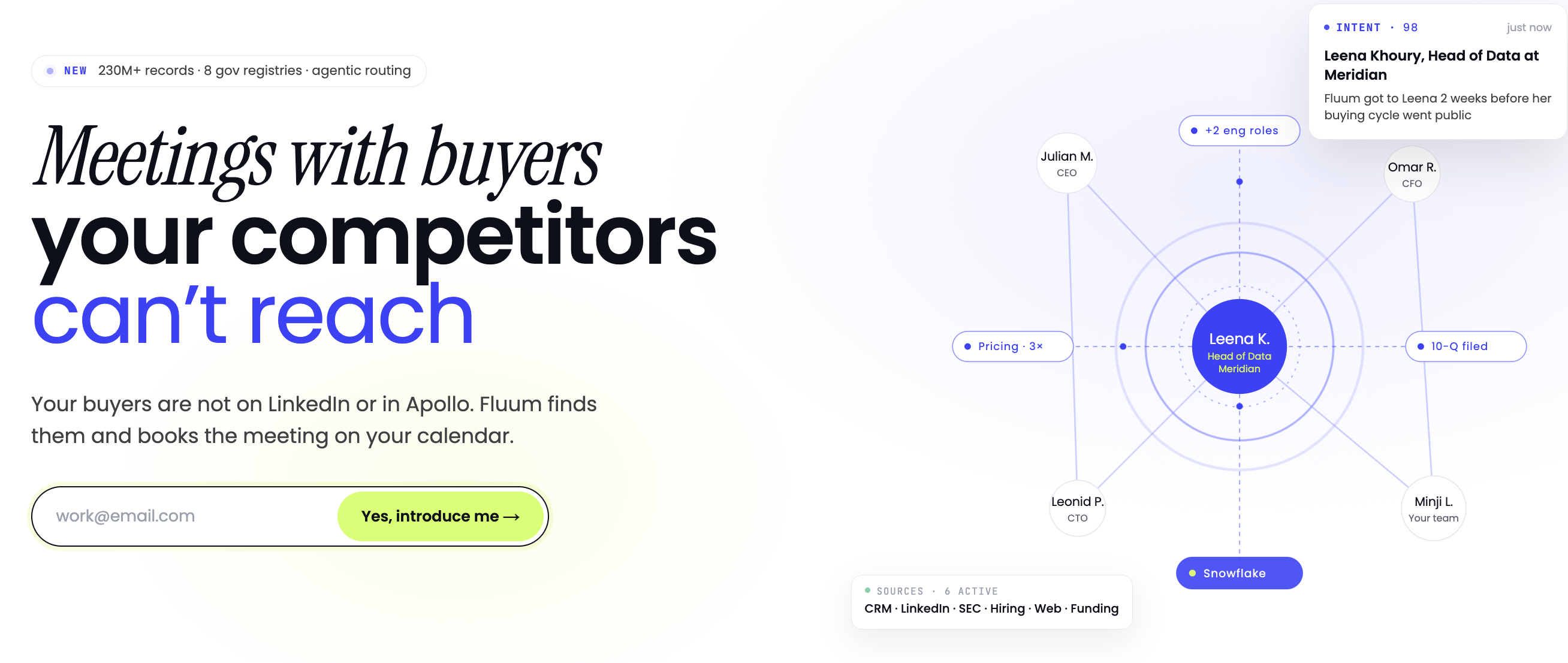
This is where tools like Fluum deliver disproportionate ROI in regulated markets. Fluum’s double opt-in introduction model, where both the seller and the target decision-maker confirm mutual interest before any connection is made, maps directly onto the consent-first requirements that finance, healthcare, and pharma demand. Cold outreach in these verticals carries both low response rates and improved compliance risk; a warm path through shared connections or mutual clients removes both problems at once. If you’re a senior leader or C-suite working in one of these verticals, talk to Aurora at Fluum, tell her who you’re looking to meet next, and she’ll make sure you only receive introductions that are relevant to your specific context.

Frequently Asked Questions
Is sales intelligence still worth investing in for regulated industries given the compliance overhead?
Yes, the compliance overhead is real, but the ROI case is stronger in regulated industries than in most others. Decision-maker access in finance, healthcare, and manufacturing is structurally restricted; cold outreach hits gatekeepers and spam filters before it reaches anyone with budget authority. Sales intelligence that surfaces verified, opt-in contacts with regulatory context attached cuts the cost-per-qualified-meeting dramatically. The compliance work is a one-time vendor evaluation cost. The pipeline benefit compounds every quarter.
What’s the difference between a SOC 2 Type I and SOC 2 Type II certification for a sales intelligence vendor?
Type I confirms that a vendor’s security controls were designed correctly at a single point in time; Type II confirms those controls actually operated effectively over a minimum six-month period. For regulated industry buyers, Type II is the only certification that carries real weight, it proves sustained data handling discipline, not just a well-written policy document. Always ask for the audit period dates, not just the certificate.
Can you use intent data in regulated industry prospecting without violating GDPR?
Yes, but only when the intent data is collected and processed under a valid legal basis, typically legitimate interest or explicit consent, depending on the data type and the individual’s location. B2B intent signals tied to company-level behavior (firmographic activity, job posting patterns, public procurement filings) generally carry lower GDPR risk than individual-level behavioral tracking. Before deploying any intent data layer, confirm that your vendor documents the legal basis for each signal source and maintains records of processing activities as required under GDPR Article 30.
What should a data processing agreement (DPA) with a sales intelligence vendor cover for a healthcare organization?
A DPA for a healthcare organization must specify the categories of personal data processed, the retention and deletion schedule, subprocessor names and locations, breach notification timelines (72 hours under GDPR; 60 days under HIPAA for covered entities), and the technical and organizational measures in place. It should also confirm whether the vendor acts as a data processor or a data controller, a distinction that determines where liability sits if a breach occurs.
How should regulated industry sales teams handle data from third-party enrichment vendors?
Third-party enrichment data must be evaluated against three criteria before use: documented consent chain showing how the data was originally collected, a named lawful basis under GDPR Article 6 for each data category, and a verified refresh cycle short enough to capture recent opt-outs. Regulated teams should require vendors to provide a written data provenance statement and should never assume that data appearing in a vendor’s platform has been collected compliantly. Contractual liability clauses in your DPA should explicitly assign responsibility to the vendor for data sourcing violations.
Conclusion
Regulated industry sales intelligence works when it’s built on three things: data sourced from compliant, auditable channels; a vendor with documented security certifications (SOC 2 Type II at minimum); and a prospecting workflow that replaces volume-based cold outreach with verified, opt-in contact.
The teams winning pipeline in finance, healthcare, and manufacturing aren’t sending more emails, they’re reaching fewer people with far higher relevance and mutual interest. That’s the structural shift worth making.
If you’re a senior leader or C-suite executive, talk to Aurora at Fluum and tell her exactly who you’re looking to meet next. She’ll send you only what’s relevant to your market and your ICP, no list, no cold sequence, no wasted time.
Sources & References
- What is Sales Intelligence? | IBM
- HIPAA Enforcement | U.S. Department of Health and Human Services
- Gramm-Leach-Bliley Act Guidance | Federal Trade Commission
- Privacy Framework | National Institute of Standards and Technology (NIST)
Recommended Articles
Explore more from our content library: