
Private data vendors B2B are companies that compile, license, and sell business contact and company intelligence to sales, marketing, and revenue teams. They aggregate records from public filings, web crawls, third-party partnerships, and proprietary sources, then package that data as searchable databases, API feeds, or enrichment layers. The catch: data quality, freshness, and legal compliance vary wildly between vendors, and buying the wrong list can cost more than it earns.
What Private Data Vendors B2B Actually Sell (and How the Model Works)
B2B private data vendors sell structured access to business contact and company records, packaged as subscriptions, API calls, or one-time bulk exports.
The underlying model is consistent across most vendors: they aggregate records from public filings, court documents, web scrapes, user-contributed networks, and licensed third-party sources, then resell that aggregated access. The revenue model sits on top, typically a subscription tier with credit limits, a per-record API fee, or a flat-rate export for a defined dataset [2].
“The best private data vendors B2B teams rely on are those that can demonstrate a clear, auditable chain of consent from data collection through to delivery — anything less is a liability waiting to surface.” — Jules Polonetsky, CEO at Future of Privacy Forum
How B2B data vendors collect and maintain their databases
Most vendors pull from four source types: government and company registries, open web crawls, data contributed by their own user base (email signatures, calendar syncs), and partnerships with other data brokers. The mix determines both coverage and accuracy.
Delivery format matters as much as source. Static list exports, CSV or bulk download, suit batch prospecting where a team loads records into a sequencing tool and works through them over weeks. Live API enrichment feeds real-time data into a CRM or pipeline tool as records are created, keeping fields current without manual work. Teams that need accuracy at the moment of outreach need the API model; teams running quarterly campaigns can tolerate the static approach.
The uncomfortable truth about private data vendors B2B: most claim 95%+ accuracy but rarely disclose the methodology or the sample set behind that figure. B2B contact data decays at roughly 20–30% annually [2], job changes, company restructures, and domain migrations erode records faster than most vendors refresh them.
Common use cases for B2B company data in sales and marketing
Three use cases dominate how teams actually consume this data:
- Outbound sales prospecting: An SDR team filters by industry, headcount, and job title, exports a contact list, and loads it into an email sequence. The data is the starting point, the rep still has to earn the conversation.
- Account-based marketing (ABM) targeting: A marketing team builds an audience of named accounts matching a specific firmographic profile, then runs paid ads or direct mail against that list. Accuracy at the company level matters more here than individual contact freshness.
- CRM enrichment and hygiene: A RevOps team pipes vendor data into Salesforce or HubSpot to fill missing fields, phone numbers, technographic data, funding rounds, and flags stale records for review. Here, decay rate is the critical variable; a record that was accurate 18 months ago is often wrong today.
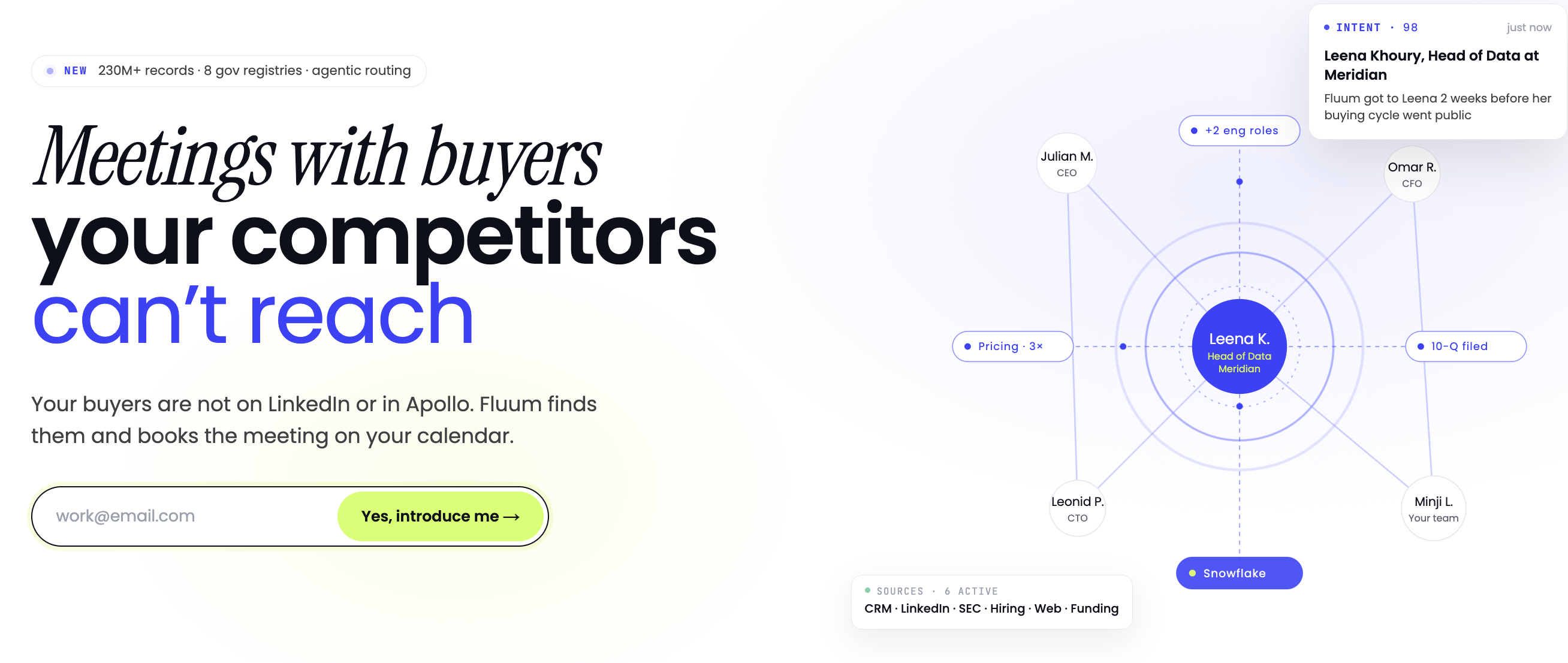
If you are a senior leader or C-suite, there is a different model worth knowing. Talk to Aurora at Fluum and tell us who you are looking to meet next, Fluum queries signals from 100+ government and private databases and sends you only what’s relevant, rather than handing you a list to work through alone.
The Four Types of B2B Data You Can Buy, and Which One You Actually Need
Private data vendors B2B buyers can choose from four distinct data categories: firmographic, technographic, intent, and contact-level, and picking the wrong one wastes budget before a single outreach is sent.
What is the difference between firmographic, technographic, and intent data?
Firmographic data describes a company’s structural profile: industry, headcount, revenue band, location, and legal entity type. It’s the right starting filter for territory planning and ICP definition, before you know who to call, you need to know which companies belong on your list.
Technographic data maps the software stack a company runs. For SaaS sellers, this is high-signal: knowing a target account already runs a complementary or competing tool tells you they have the budget category, the workflow, and the problem you solve. The B2B data marketplace is projected to grow from $863 million in 2024 to $3.2 billion by 2030 [2], and technographic coverage is one of the fastest-expanding data types driving that growth.
Intent data captures behavioral signals, content consumption, category searches, review site visits, that indicate a company is actively researching a purchase. The key limitation: most third-party intent data is modeled from panel-based co-op networks [2]. Signal quality depends entirely on the vendor’s panel coverage in your specific target market, and thin coverage produces false positives that burn SDR time.
Contact-level data, direct dials, verified business emails, LinkedIn profiles, is where most buyers focus first and where most disappointment lives.
According to the Federal Trade Commission’s guidance on data brokers, buyers of third-party contact data share accountability for how that data is used — a responsibility that applies directly to anyone working with private data vendors B2B.
How data freshness and update frequency affect your pipeline quality
Database size is not the differentiator at the contact layer. Update frequency is [1]. A vendor refreshing records daily outperforms one with twice the database but quarterly updates, people change roles every 18 months on average, and a stale direct dial is just noise in your sequence.
The practical decision is straightforward. If you’re working a known account list, technographic plus contact data is the right combination. If you’re building a net-new ICP from scratch, start with firmographic filters to define the universe, then layer intent signals to prioritize who’s in-market now.
How to Choose a B2B Data Provider Without Getting Burned
Ask three questions before signing with any private data vendor B2B: How do you verify records? How often is each data type refreshed? What happens to my data if I cancel?
Every other evaluation criterion, database size, integrations, UI, comes second. Vendors who can’t answer those three questions with specifics are telling you something important about their data quality. For a side-by-side comparison of leading options, CoreSignal’s breakdown of the top company data providers is a useful independent reference.
“When evaluating private data vendors B2B organizations shortlist, the single most predictive quality signal is not database size — it is how transparently a vendor can document their verification methodology and refresh cadence.” — Andrei Hagiu, Professor of Information Systems at Boston University Questrom School of Business
What are the common mistakes companies make when buying B2B data?
The most expensive mistake is evaluating vendors on total record count. A vendor with 300 million records [2] but thin, unverified coverage in mid-market EMEA manufacturing is a worse choice than a smaller vendor with dense, accurate coverage in that exact segment. Match your evaluation to your ICP, not to a headline number.
The second mistake is trusting the vendor’s published accuracy stat. Run your own proof-of-concept instead: pull 500 sample records, push them against your existing CRM, and measure match rate and email bounce rate directly. That benchmark reflects your database, your market, and your definition of a good record, not a figure from a marketing page.
Pricing tiers add another layer of complexity. Contact-level data tools range from budget-friendly self-serve plans to premium enterprise contracts with custom data licensing. The right tier depends on team size, CRM volume, and whether you need API access or CSV exports, two very different cost structures.
Vendor lock-in risks and how to protect data portability
Many providers export data in proprietary formats or restrict bulk exports on cancellation [2]. Buyers discover this clause after signing, not before. Negotiate data portability terms, specifically the right to export all enriched records in a standard format, before the contract is executed.
Some vendors also tie historical enrichment data to an active subscription, meaning cancellation effectively deletes months of work from your CRM. Ask explicitly: does my enriched data remain in my CRM if I cancel? If the answer is ambiguous, treat it as a red flag and get the answer in writing.
Legal and Compliance Risks Every B2B Data Buyer Needs to Understand
Buying third-party B2B contact data makes you a data controller under GDPR, and a vendor’s “compliant” badge does not transfer their liability to you.
How GDPR, CCPA, and Privacy Regulations Affect B2B Data Vendor Compliance
Under GDPR, the buyer and the private data vendor occupy distinct legal roles: you are the controller, they are the processor. A vendor claiming GDPR compliance does not absorb your exposure. You must sign a Data Processing Agreement (DPA) that defines each party’s obligations, without one, you are processing personal data without a lawful basis, regardless of what the vendor told you on a sales call.
CCPA and the growing patchwork of US state laws add a second layer of risk. Virginia’s VCDPA, Colorado’s CPA, and Texas’s TDPSA all apply to personal data, and B2B contact records are not automatically exempt when they include personal email addresses or direct mobile numbers. Assuming “it’s business data, so it’s fine” is the fastest way to a compliance failure.
EU and UK regulators are tightening scrutiny of data broker practices in 2026, and buyers who cannot demonstrate vendor due diligence face the same fines as vendors who collected the data improperly. The ICO and CNIL have both signaled that downstream buyers are accountable. The European Data Protection Board’s guidelines on data breach notification are essential reading for any team working with private data vendors B2B in EU markets.
How to Evaluate a Vendor’s Compliance with International Data Privacy Laws
Ask every shortlisted vendor three specific questions before procurement: What is the lawful basis for processing each data type you sell? Do you maintain opt-out suppression lists? Can you provide documentation of your data sourcing methodology for audit purposes?
Then request a sample DPA and privacy policy before any contract discussion. If a vendor cannot produce both documents within 48 hours, treat that as a disqualifying signal, not a negotiating point. Vendors who have built compliance into their operations keep these documents ready; vendors who haven’t will stall.
The International Association of Privacy Professionals (IAPP) resource on B2B data and privacy law provides a practical framework for assessing whether a vendor’s compliance posture meets the standard regulators now expect from buyers as well as sellers.
Third-Party Data Vendors vs. Alternative Sources: What the ROI Math Actually Shows
Third-party data scales your prospect list fast, but conversion rates from purchased lists consistently land between 1–3% for cold outbound, a ceiling that alternative sourcing strategies routinely break.
What real-world ROI and conversion metrics should you expect from B2B data vendors?
The ROI tension with private data vendors B2B teams rely on is structural, not fixable with better copy. The B2B data marketplace is projected to grow from $863 million in 2024 to $3.2 billion by 2030 [2], which means more vendors, more lists, and more reps competing for the same inboxes with the same data.
Cold email reply rates from purchased contact lists average 1–3% across the industry. Warm introductions, where both parties have confirmed mutual interest before the first message, consistently return 40–50% reply rates. That gap is not a messaging problem. It’s a channel problem.
Senior buyers are the hardest segment to reach via list-based outreach. A C-suite executive who ignores 50 cold emails a week will respond to a trusted mutual introduction. That’s the structural advantage warm networks hold over any data vendor, regardless of how fresh their records are.
“The companies getting the most value from private data vendors B2B are not using them as a replacement for relationship-driven sales — they are using them to identify and prioritize the accounts where a warm introduction is worth pursuing.” — Trish Bertuzzi, Founder of The Bridge Group and author of The Sales Development Playbook
Alternative data sources to evaluate alongside third-party vendors
First-party data, collected through gated content, webinar registrations, and product-led growth signals, produces smaller lists but higher intent. It also carries no third-party compliance risk under GDPR or CCPA, which matters when selling into regulated industries like finance or healthcare.
Partnership and co-marketing data sharing is the underused middle path. Two non-competing vendors sharing anonymized audience overlap data can surface targeting precision that no third-party vendor can replicate, because the signal comes from actual buying behavior rather than firmographic inference.
Warm introduction networks address the accounts where list-based outreach has already failed. If you are a senior leader or C-suite, talk to Aurora at Fluum and tell us who you are looking to meet next, Fluum’s model pulls signals from 100+ government and private databases and matches you to decision-makers who have opted in, so the introduction arrives with context, not a cold pitch.
The practical sourcing stack: use third-party vendors for ICP discovery and CRM enrichment, first-party data for nurture sequences, and warm introduction channels for high-value accounts where volume-based outreach has returned nothing worth reporting. For a curated overview of how leading private data vendors B2B buyers are currently evaluating, see Bright Data’s ranked comparison of the best B2B data providers.
Frequently Asked Questions
How often do B2B data vendors update their records, and why does it matter?
Top-tier vendors refresh contact records every 30–90 days; anything slower produces decay rates that kill outreach ROI. B2B contact data degrades at roughly 22–30% per year as people change roles, companies, and email addresses. A database last verified six months ago can carry a 10–15% error rate by the time your SDR runs a sequence, meaning one in seven dials or emails hits a dead end before the conversation even starts. Verify the vendor’s stated refresh cadence and ask for a sample accuracy audit before you commit.
What is the difference between a B2B data vendor and a B2B data broker?
A B2B data vendor collects and maintains proprietary datasets; a data broker resells data sourced from third parties, often without direct control over quality or compliance. The distinction matters because brokers add a layer of distance between you and the original data source, making it harder to verify consent chains, refresh schedules, or GDPR/CCPA compliance. When legal accountability for data accuracy is on the line, buying direct from the vendor who owns the collection infrastructure is the lower-risk path.
Can you use purchased B2B contact data for cold email outreach legally?
Yes, in most jurisdictions, but the legal basis and obligations differ significantly by region, so blanket assumptions are dangerous. Under GDPR, you need a documented legitimate interest basis and must offer a clear opt-out in every message. Under CAN-SPAM in the US, the bar is lower, but you still must honor unsubscribe requests within 10 business days. Canada’s CASL is stricter still, requiring express or implied consent. Always confirm the vendor’s data was collected with compliant consent mechanisms before building any outreach sequence on top of it.
What should a B2B data vendor’s Data Processing Agreement (DPA) include?
A compliant DPA must specify the legal basis for processing, data retention limits, sub-processor names, breach notification timelines (72 hours under GDPR), and your right to audit. It should also define exactly what the vendor can and cannot do with data after your contract ends, including whether they can use your query inputs to enrich their own database. If a vendor resists providing a signed DPA or offers only a generic privacy policy in its place, treat that as a disqualifying signal.
How do you run a proof-of-concept evaluation when comparing private data vendors B2B?
Request a sample of 500 records matching your ICP from each shortlisted vendor. Push those records against your existing CRM to measure match rate, then run the email addresses through a validation tool to check bounce rate. Compare the results across vendors using the same ICP criteria — not the vendor’s own accuracy claims. A structured proof-of-concept run against your actual target market is the only reliable way to predict real-world performance before committing to a contract.
Conclusion
Private data vendors are not interchangeable. The gap between a vendor with verified, consent-documented records refreshed every 30 days and one reselling stale third-party lists is the gap between a pipeline that converts and one that burns budget on bounced emails and legal exposure.
Three things to act on now: audit the refresh cadence and compliance documentation of every vendor you currently pay for; demand a signed DPA before renewing any contract; and pressure-test whether raw contact data alone is actually moving your pipeline numbers.
If you’re a senior leader or C-suite executive, talk to Aurora at Fluum, tell her who you’re looking to meet next, and she’ll make sure you only see introductions that are relevant to you.
Sources & References
- 16 of the Best B2B Data Providers and Vendors [2026]
- 15 Best B2B Data Providers of 2026: Compared & Ranked
- Top 4 Company Data Providers in 2026
Recommended Articles
Explore more from our content library: