
Government registry data prospecting means using publicly available government records, business filings, UCC liens, licensing databases, permit records, to identify and qualify B2B sales targets before they ever appear on a purchased list. Because these records are filed directly by businesses, the data reflects real commercial activity, not a data broker’s best guess. That makes it one of the most accurate and legally defensible lead sources available to B2B sales teams.
What Government Registry Data Prospecting Is and How It Actually Works
Government registry data prospecting mines publicly filed government records to build prospect lists anchored in verified commercial activity, not resold contact databases.
The records in question are documents businesses file directly with government agencies: Secretary of State business registrations, UCC-1 financing statements, contractor licenses, building permits, and tax liens. When a company files any of these, it creates a public record containing the company name, registered agent, address, and often officer names. A prospector queries those databases and extracts that information as a lead signal.
That distinction, filed by the business itself, not aggregated by a third party, is what separates this approach from conventional list-buying. Each record has a clear audit trail back to a specific government agency on a specific date.
How government registry data differs from data broker information
Data brokers collect personal and business information from dozens of sources, social media, loyalty programs, app usage, purchase histories, and other brokers [1], then package and resell it. The freshness of that data is rarely guaranteed, and the chain of custody is opaque. According to the Privacy Rights Clearinghouse, data brokers operate with minimal transparency, making it difficult for businesses to verify the accuracy or provenance of the records they purchase.
Government registry data is a primary source. A UCC-1 filing signals a capital event or equipment purchase, a company just secured financing and is actively deploying capital. A new LLC registration signals a business in formation, a buying cycle that hasn’t started yet. A contractor license renewal signals active operations and an upcoming procurement window. These are buying-intent triggers, not static contact records.
That signal logic is the core value of government registry data prospecting: you’re not finding contacts, you’re finding companies at a specific, identifiable moment in their commercial lifecycle.
“Government records represent one of the most underutilized sources of business intelligence available. The data is authoritative, timestamped, and reflects real commercial decisions — qualities that purchased lists simply cannot replicate.” — Dr. Michael Kearns, Professor of Computer and Information Science, University of Pennsylvania
Privacy and compliance rules that apply when using government registry data for prospecting
In the US, most Secretary of State filings and UCC data are explicitly public record, accessible without restriction and intended for commercial use. The legal basis for accessing and querying this data is well established.
Outside the US, the picture is more nuanced. UK Companies House and Germany’s Handelsregister are both public registries, but GDPR governs how you use any personal data extracted from them for outreach. The fact that a director’s name appears in a public filing does not automatically create a lawful basis for direct marketing. Under GDPR, you still need a legitimate interest assessment or another recognized legal basis before contacting an individual whose details you sourced from a public registry.
Sales teams operating across jurisdictions need to treat data access and data use as two separate compliance questions, the first is almost always permissible; the second requires deliberate legal review.
Which Government Registries Are Actually Useful for B2B Lead Generation
Four registry types drive the majority of actionable B2B signals: Secretary of State filings, UCC records, license databases, and permit records.
The Difference Between Secretary of State Filings, UCC Filings, and Other Public Records for Prospecting
Secretary of State business registrations are the foundation of government registry data prospecting. Every new LLC or corporation formation, registered agent change, and annual report filing creates a timestamped record you can filter by entity type, jurisdiction, and formation date, letting you target companies at exactly the stage where they’re most likely buying.
UCC filings work differently. A lender files a UCC-1 form when it takes a security interest in a debtor’s assets, equipment, inventory, receivables. That filing signals a financing event. A business that just secured an equipment loan or inventory line is actively spending, which makes UCC data a strong trigger for vendors selling machinery, software, or logistics services to recently capitalized companies.
Contractor and professional license databases are maintained at the state level, California’s CSLB and Florida’s DBPR are two of the most complete, and they publish active license holders with verified contact details, trade classifications, and renewal dates. These records surface construction firms and regulated service providers that cold contact lists routinely miss.
Building and permit records, issued by county and municipal governments, signal construction activity, facility expansion, or renovation before a project appears anywhere else. For suppliers, insurers, and equipment vendors, a freshly issued commercial building permit is one of the clearest buying signals available in public data. As detailed in research on unlocking the potential of government records data, permit and licensing records consistently outperform aggregated commercial datasets for identifying businesses in active procurement cycles.
How Government Registry Data Quality and Completeness Vary by State or Country
Data quality varies sharply enough to change your entire sourcing strategy. Delaware and Wyoming, two of the most popular incorporation states, publish minimal officer and member data by design. California and Texas, by contrast, require officer names and addresses on public filings, making them far more useful for direct outreach.
Internationally, UK Companies House sets the standard: structured fields, consistent formatting, and free bulk downloads updated daily. Many EU registries demand local-language queries, charge access fees, and have inconsistent field completeness across member states, Germany’s Handelsregister and France’s RCS both require navigation in the local language with variable officer disclosure rules.
Build these gaps into your workflow from day one. A registry that looks comprehensive at the national level can be nearly empty at the contact level once you filter for the states or countries where your ICP actually operates.
How to Legally and Safely Access Government Registry Data for Sales Prospecting
Access government registry data through official state portals and bulk export programs, scraping shortcuts create legal exposure that can sink your entire outreach effort.
Step-by-step process to access and download Secretary of State and UCC databases
Most US states publish a public business search portal directly through their Secretary of State office. California, Texas, and Florida are the three most data-rich starting points for government registry data prospecting at scale.
- California: Visit bizfile.sos.ca.gov for entity search and bulk data exports in CSV or XML format. Bulk downloads are available through the California Open Data portal at a budget-friendly processing fee.
- Texas: The Texas Secretary of State at sos.state.tx.us offers a searchable business database and periodic bulk data files for registered entities.
- Florida: dos.myflorida.com provides Sunbiz, one of the most accessible state portals in the country, bulk annual report data is downloadable at no cost.
For UCC filings, each state maintains its own searchable portal. Search by debtor name to identify businesses with active equipment liens or financing arrangements, a reliable signal of capital activity. The U.S. Small Business Administration and FDIC also publish related public datasets that are particularly useful for financial services teams prospecting into commercial lending or banking relationships.
One rule applies across all of these: use official bulk export programs or licensed data aggregators that have already extracted the data legally. Automated scraping of government portals, even when the underlying data is public, frequently violates the portal’s terms of service and can expose your organization to legal action.
Legal risks to watch for when using government registry data in sales campaigns
Three legal frameworks create real liability for sales teams that treat public registry data as a free-for-all.
GDPR: If any EU-resident individual appears in your prospecting list, even if you pulled their data from a US public registry, GDPR applies. You need a documented legitimate interest basis for processing, and you must honor erasure requests. Ignoring this because the data came from a “public source” is not a defense regulators accept.
CAN-SPAM and CASL: Both laws govern outbound email regardless of where you sourced the contact. CAN-SPAM requires a clear opt-out mechanism and honest subject lines. Canada’s CASL is stricter, it requires express or implied consent before the first commercial message, not after.
State-level commercial use restrictions: Some registries explicitly prohibit commercial use of their data. California’s DMV records, for example, are protected under the Driver’s Privacy Protection Act (DPPA), which bars their use for marketing. Always read the permitted use clause of each registry before downloading, this step is the one most guides skip entirely.
“The distinction between lawful access to public records and lawful use of that data for commercial outreach is one of the most commonly misunderstood compliance issues in B2B sales. Access is almost always permitted; contact is where the legal analysis begins.” — Lisa Sotto, Partner and Chair of the Global Privacy and Cybersecurity Practice, Hunton Andrews Kurth LLP
If you’re a senior leader or C-suite executive working through compliance-heavy prospecting environments, talk to Aurora at Fluum and tell her who you’re looking to meet next. Fluum pulls signals from 100+ government and private databases and handles the data sourcing work on your behalf, so you get relevant introductions without the legal exposure of building raw registry lists yourself.
How to Integrate Government Registry Data into Your CRM and Sales Workflow
Raw registry exports are unusable in a CRM until you clean, enrich, and score them, that three-step process is where government registry data prospecting either pays off or stalls.
The Raw Data Problem and Enrichment Workflow
Government registry exports arrive as flat files, CSV or XML, with inconsistent field names, missing values, and zero contact-level data. A new LLC filing tells you the company name and registered agent address. It does not tell you the founder’s email or direct phone number.
The fix is a two-pass enrichment workflow. First, match the company name and address against a business identity graph to append decision-maker contacts. Second, validate every email and phone before import, bad data in a CRM compounds fast, and most teams lose days here when they run this manually instead of automating it. According to research from Gartner, poor data quality costs organizations an average of $12.9 million per year — a figure that underscores why enrichment and validation are non-negotiable steps before any registry data enters your CRM.
Tools and Automation Platforms That Work Best for Syncing Government Registry Data with Your CRM
Most major CRMs, Salesforce, HubSpot, Pipedrive, accept CSV imports with custom field mapping. That works for a one-time pull, but it doesn’t scale.
Sophisticated teams use middleware like Zapier or Make to automate recurring registry pulls and push net-new records directly into a defined pipeline stage. Custom API pipelines go further, querying specific state or federal registry endpoints on a set schedule and writing enriched records to the CRM without manual intervention.
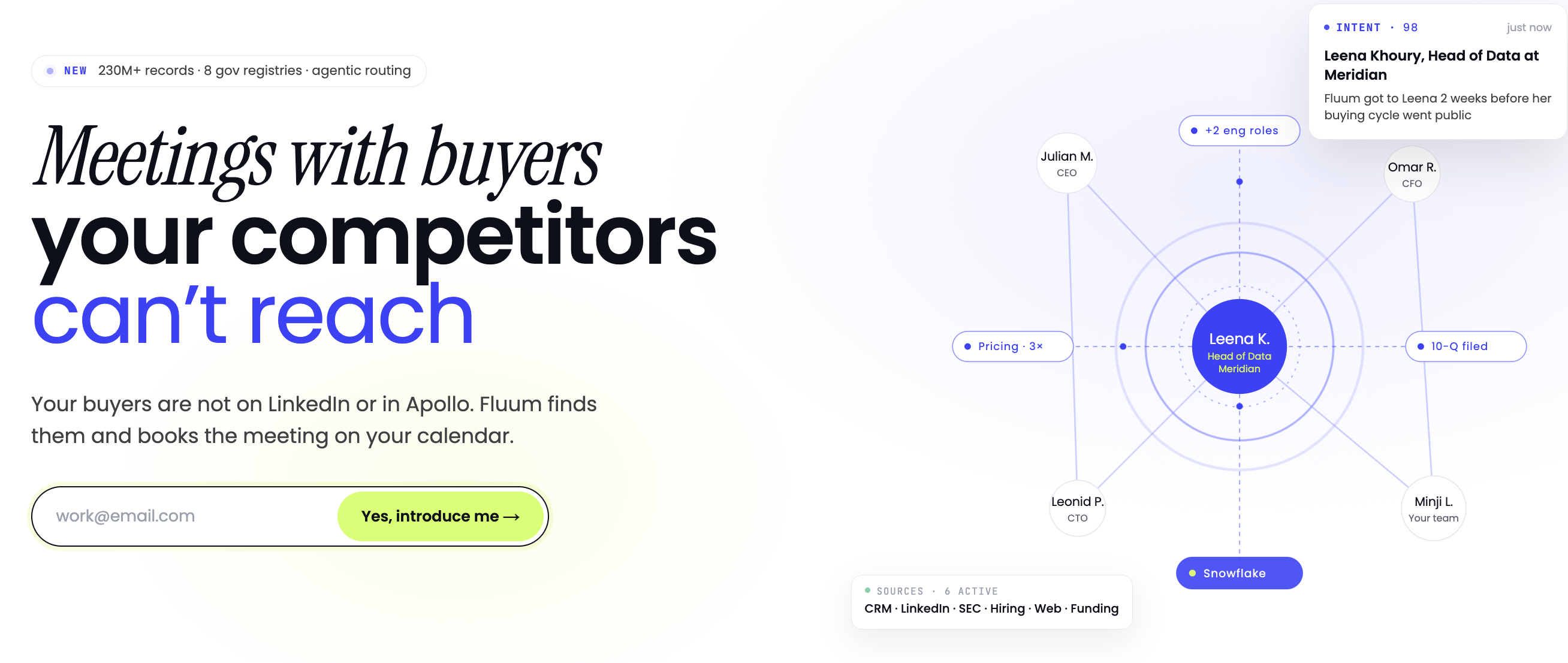
Platforms like Fluum take this further still, pulling signals from 100+ government and private databases simultaneously, so the enrichment and identity-matching layer is built in rather than bolted on.
How to Automate Lead Scoring and Qualification from Government Registry Data
Not every registry filing carries equal intent. Assign score weights by trigger type: a new LLC formation signals early-stage buying potential, while a UCC lien filed against an existing business signals financial stress, two very different outreach angles that should never share the same sequence.
Layer firmographic filters on top of the trigger score. Employee count, revenue estimate, and NAICS industry code narrow a raw filing list down to the accounts that actually fit your ICP. Set these filters inside your CRM or scoring tool so they apply automatically on import.
The final step is cadence automation. Schedule recurring queries, weekly for high-velocity registries like new business formations, monthly for slower-moving sources like annual report filings, so net-new records enter your pipeline continuously. That shift turns a one-time list pull into a live signal feed your sales team can work every Monday morning.
What ROI and Conversion Results to Expect from Government Registry Prospecting
Government registry data prospecting consistently delivers higher contact accuracy and better conversion timing than cold purchased lists, at a lower long-term cost per qualified lead.
The accuracy advantage starts with the data itself. Business owners self-report their information when they file formation documents, UCC liens, or licensing applications. That self-reported data has fewer bad phone numbers and fewer dead email addresses than aggregated commercial lists, which means higher deliverability from the first outreach attempt.
How government registry prospecting compares to other B2B lead generation methods in cost and results
The conversion lift from registry data isn’t just about accuracy, it’s about timing. Reaching a newly formed LLC within days of filing, or a business that just recorded a UCC lien, puts you in front of a decision-maker during a window of active commercial activity. That’s a fundamentally different conversation than contacting the same business six months later from a static list.
Compare that to the alternatives. Inbound content marketing takes three to six months to compound into meaningful pipeline. Paid advertising requires continuous spend the moment you stop. Cold list buying produces bounce rates that damage sender reputation and reply rates that rarely exceed 2%. Registry-based prospecting carries a higher setup cost in data processing and automation infrastructure, but once the workflow runs on recurring pulls, the cost per qualified lead compresses steadily.
Teams that layer registry triggers with intent signals, a new LLC formation combined with a job posting for a relevant role, report reply rates that outperform cold outreach to static lists by a wide margin. The signal specificity does the qualification work before any message is sent. Industry analysis on the potential of government records data confirms that trigger-based outreach anchored in public filings consistently outperforms static list prospecting across multiple verticals.
Platforms like Fluum pull signals from 100+ government and private databases to surface exactly these trigger moments, then deliver double opt-in introductions where both sides have already agreed to connect, producing 40–50% reply rates versus the 2% industry standard for cold email. If you’re a senior leader or C-suite executive looking to put this approach to work, talk to Aurora and tell us who you’re looking to meet next. Fluum will make sure to send you only what’s relevant.
The cost structure for registry prospecting sits in the mid-range to premium tier depending on enrichment tooling and automation depth. But the pipeline becomes self-refreshing, every new filing cycle adds fresh, pre-qualified prospects without additional acquisition cost.
Frequently Asked Questions
Is government registry data legal to use for cold outreach and sales prospecting?
Yes, government registry data is public record, and using it for B2B prospecting is legal in most jurisdictions, provided you respect applicable privacy regulations. In the US, the CAN-SPAM Act governs commercial email, while GDPR applies when contacting individuals in the EU, even using public data. The key distinction: legal access to data doesn’t automatically grant permission to contact. Business entity registrations, licensing records, and permit filings are fair game for identifying companies, but how you reach out still carries compliance obligations. When in doubt, focus outreach on business roles rather than personal contacts, and always include a clear opt-out mechanism.
How often is government registry data updated, and how do you keep your prospect lists current?
Update frequency varies by registry type, some update daily, others quarterly or annually. Secretary of State business registrations typically refresh within days of a filing. Licensing boards and permit databases often lag by 30–90 days. The practical answer: never treat a static export as a live list. Build a refresh cadence into your process, pull new data monthly at minimum, and cross-reference against private data signals to catch changes the registry hasn’t yet recorded. Platforms that aggregate across 100+ databases, like Fluum, surface these updates automatically rather than requiring manual re-pulls.
What industries benefit most from government registry data prospecting?
Finance, manufacturing, and construction gain the most from government registry data because their regulatory footprints are large and well-documented. Financial services firms file with the SEC, FINRA, and state regulators. Manufacturers hold environmental permits, export licenses, and facility registrations. Construction companies pull building permits before every project, a reliable trigger signal for vendor outreach. Healthcare and legal services also generate dense licensing data. Industries with minimal regulatory requirements, such as early-stage software startups, produce thinner registry footprints and are better reached through private data sources.
Can you use government registry data to prospect internationally, or is it mainly a US strategy?
Government registry prospecting works internationally, it’s not a US-only strategy. The UK’s Companies House publishes director and filing data for every registered company. Australia’s ASIC, Canada’s Corporations Canada, and Germany’s Handelsregister all offer comparable public records. The EU’s beneficial ownership registers, mandated under the 4th Anti-Money Laundering Directive, added another layer of accessible business data across member states. Coverage depth varies by country, and some registries require local-language navigation or API access. Combining international registry data with private database signals closes the gaps where public records are thin.
How do you handle duplicate or outdated records when building prospect lists from government registry data?
Duplicate and stale records are the most common quality problem in raw registry exports. The best practice is a three-step deduplication process: first, normalize company names and addresses to a consistent format; second, match records against a business identity graph to merge duplicates tied to the same entity; third, flag any record where the filing date exceeds your freshness threshold — typically 12 months for licensing data and 90 days for formation filings. Automating this process inside your CRM or enrichment platform prevents bad data from compounding across pipeline stages and ensures your sales team works only verified, current prospects.
Conclusion
Government registry data is one of the most underused prospecting assets in B2B sales, not because it’s hard to access, but because most teams don’t build a system around it. Three things matter most: identify the registry types that match your target market’s regulatory footprint, treat trigger events like new business filings and permit pulls as entry points rather than static lists, and layer private data signals on top to fill the gaps public records leave.
The next concrete step: pull your target industry’s most relevant registry for a single metro area this week and map the filing events from the past 90 days against your ICP. If you’re a senior leader or C-suite executive looking to turn that data into warm, pre-qualified introductions, talk to Aurora at Fluum, tell her who you’re looking to meet next, and she’ll make sure you only see what’s relevant.
Sources & References
- Data Brokers | Privacy Rights Clearinghouse
- Unlocking the Potential of Government Records Data — Access Sciences
- U.S. Small Business Administration — Public Business Datasets
Recommended Articles
Explore more from our content library: