
Understanding multi-source intent signals is essential. Buyer intent signals show up across dozens of disconnected places, a company registering a new subsidiary, a decision-maker changing jobs, a firm searching for a category of vendor, a filing hitting a government registry. No single source catches all of it, which is why combining signals from private data vendors with public registries matters: it turns scattered, ambiguous clues into a clear picture of who’s actually in-market right now, and, more importantly, who can introduce you to them instead of leaving you to cold-email a stranger.
What Are Buyer Intent Signals and Why Do They Matter for B2B Sales?
A buyer intent signal is any observable action or event suggesting a company or person is moving closer to a purchase decision. A content download, a job change, a funding round, a hiring surge, a regulatory filing, each one is a data point, not a guarantee.
None of these events, on its own, tells you much. A VP switching companies might be building a new tech stack from scratch, or might just be settling into the role. That’s the core problem with treating any single event as proof of intent, and it’s the reason multi-source intent signals, read together rather than in isolation, do the real predictive work.
What Types of Buyer Intent Signals Predict Purchase Readiness?
Sales teams typically encounter three tiers of intent data:
- First-party signals from your own website or product, such as pricing page visits and trial sign-ups.
- Second-party signals shared by a partner or platform you have a data relationship with.
- Third-party signals aggregated by vendors who pool activity across thousands of sites and public sources, including government registry filings, hiring surges on job boards, and funding announcements [1].
How Do Intent Signals Differ From Traditional Lead Scoring or Firmographic Data?
Firmographic data describes what a company is, industry, headcount, revenue band. Intent signals describe what it’s doing right now. A firm can match your ideal customer profile on paper for years without ever buying; intent signals are the evidence that timing has shifted.
Traditional lead scoring often blends the two into a single number, which flattens the distinction sales reps actually need: is this account a fit, or is this account in-market this quarter? Watching one signal type alone, say, job-change alerts without a matching registry filing or hiring pattern, produces noise dressed up as a lead. The skill that separates a full pipeline from a wasted quarter isn’t spotting one signal. It’s reconciling several that point the same direction [3].
How Do You Combine Multi-Source Intent Signals to Find Decision-Makers?
Combining multi-source intent signals means matching the same person across sources, weighting each signal by age, and letting strong signals outvote weak ones before you act.
Most teams never get past step one. They collect data from five or six places and let it sit in five or six tabs. Nobody reconciles it, so nobody acts on it with confidence.
How Do You Normalize and Reconcile Signals From 40+ Vendors and Government Registries?
Reconciliation starts with entity resolution, deciding that “J. Smith, VP Sales” in one vendor feed and “Jonathan Smith, Head of Revenue” in a government filing are the same human being at the same company. Job titles change. Company names get abbreviated one place and spelled out another. Addresses go stale the moment someone relocates a headquarters or opens a second office.
A registry might list a company’s old legal name for a filing made 18 months ago, while a private data vendor tracks the same firm under its current brand. Without a matching layer that accounts for name variants, title changes, and outdated location data, you end up with duplicate or fragmented records instead of one coherent buyer profile.
Timing compounds the problem. A signal from three months ago, a whitepaper download, a stale job posting, carries far less weight than one from three days ago, like a new executive appointment surfacing in a regulatory filing. Recency needs a weighting model, not a simple tally. Counting signals equally regardless of age produces false confidence in contacts who’ve already moved on.
What Technical Steps Turn First-, Second-, and Third-Party Data Into a Single Buyer Graph?
A working buyer graph pulls three layers into one profile per decision-maker: first-party CRM history, second-party data shared through partners, and third-party signals from vendor databases and public registries. Fluum’s approach queries signals from 100+ government and private databases specifically to build that unified view, rather than leaving reps to cross-reference spreadsheets manually.
Corroboration logic decides what gets acted on. One weak signal, a single webpage visit, means almost nothing alone. Pair it with one strong signal, like a regulatory filing naming a new decision-maker, and the combination outweighs five weak signals stacked on top of each other. Strength and independence of sources matter more than volume. For more information, see Automated Demo Scheduling And Coordination.
What Data Sources Build a Complete Buyer Intent Picture?
A complete picture blends three source types, private commercial vendors, government registries, and offline behavioral signals, because each catches what the others structurally cannot.
Private data vendors are the layer most sales teams already know. They track web research behavior, the searches, comparison pages, and review-site visits a buyer leaves behind. They also flag technographic changes, like a company swapping CRM providers or adding a new security tool, and content consumption patterns across whitepapers, webinars, and product pages [1]. This is useful data. It’s also incomplete, because it only sees the buyer once they’ve started researching online.
Which Offline Intent Signals Should You Layer With Online Sources?
Offline signals catch intent that never touches a website at all. Event attendance and conference speaker lists show who’s actively positioning themselves as a category expert or budget holder months before any digital footprint appears. Sales call transcripts from adjacent deals, even ones that didn’t close, often contain named stakeholders and stated priorities that no web-tracking tool will ever surface. A VP who speaks on a fintech compliance panel is signaling intent just as strongly as one who downloads a whitepaper, but only one of those shows up in a typical intent data feed [2].
How Do Government Registries Reveal Intent That Commercial Vendors Miss?
Government registries expose public-record events that precede a buying decision by months, long before any commercial vendor picks up a signal. Common examples include:
- New incorporations and business formations
- Director appointments and leadership changes
- Regulatory filings and licensing changes
- Companies House records showing new UK company formations and director changes
- FCA Register updates flagging newly authorized or restructured financial firms
- SEC EDGAR filings surfacing material events from US public companies signaling expansion, acquisition, or new leadership
None of this depends on someone visiting a website.
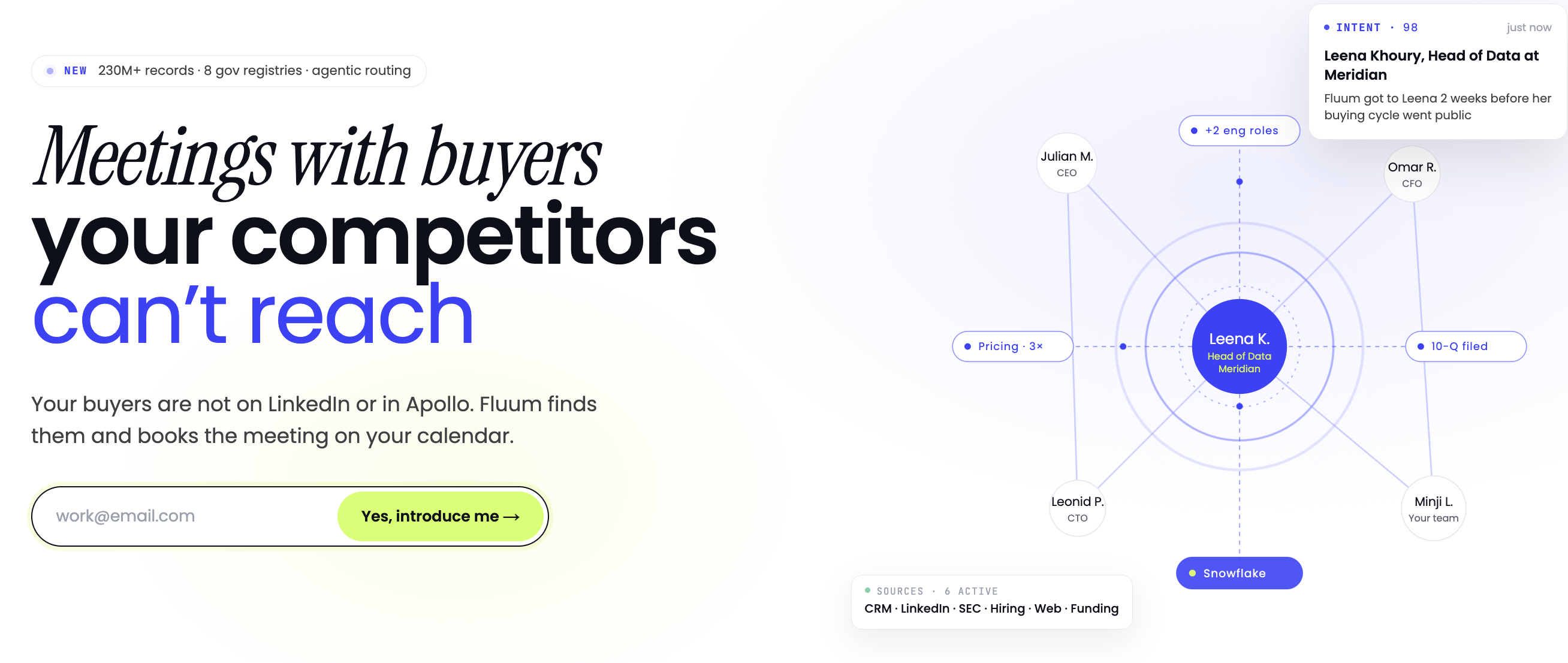
Combining public-record signals with private vendor data catches decision-makers earlier than either source alone, a registry filing can show buying intent before a single person on that team has searched for a solution. This is the logic behind Fluum’s approach: it queries signals from 100+ government and private databases to build multi-source intent signals into confirmed, double opt-in introductions, rather than a cold list built from one data type.
How Do You Turn Multi-Source Intent Signals Into Warm Introductions Instead of Cold Outreach?
You turn multi-source intent signals into pipeline by routing the match into a double opt-in introduction, not a templated email into a stranger’s inbox.
Here’s the behavior that wastes all that aggregation work: a sales team pulls signals from a dozen sources, correctly identifies the CFO who’s actively evaluating a new vendor, and then sends her the same cold email she’s already deleted three times this week from competitors doing the same math. The hard part, knowing who to contact, gets solved. The easy part, how to contact them, gets botched. All that signal precision buys nothing if the outreach still looks like everyone else’s outreach [3].
Fluum exists to close that gap. Once its AI matches a decision-maker across finance, technology, or manufacturing against your ideal customer profile, both sides have to confirm interest before any conversation gets scheduled. That’s the double opt-in mechanic: the prospect sees a context-rich reason the introduction makes sense and agrees to it, just as you do. The intent signal stops being a data point sitting in a spreadsheet and becomes an actual meeting on a calendar.
What Pipeline Impact Can You Expect From Multi-Source Intent vs. Single-Source Approaches?
Teams that combine signals across sources and pair them with a warm, consented introduction consistently see higher reply and meeting-acceptance rates than teams running cold sequences off a single database. The mechanism is straightforward: a message someone agreed to receive gets opened and answered at a fundamentally different rate than one they didn’t.
How Do Opted-In Networks Reach Decision-Makers That Cold Tools Don’t Index?
Plenty of senior decision-makers have gone quiet on LinkedIn and stopped responding to any inbox that looks like a sequence tool touched it. They’re not gone, they’re just unreachable through the channels every other vendor is already using. Opted-in networks and relationship-based paths get around that wall because the introduction comes from a mutual signal of interest, not a scraped email address.
If you’re a senior leader or part of the C-suite, talk to Aurora and tell her exactly who you’re looking to meet next. Fluum sends only what’s relevant to that ask.
What Compliance and Privacy Challenges Come With Aggregating Intent Data?
Combining multi-source intent signals means combining multiple legal bases at once, and treating them as interchangeable is how compliance reviews fail. Private vendor data and government registry data are not governed the same way, and stitching them together without checking that changes your risk profile.
How Do You Handle GDPR, CCPA, and Industry-Specific Regulations Across Multiple Sources?
GDPR and CCPA set the floor, not the ceiling, for teams selling into finance, cybersecurity, or manufacturing. Fintech buyers often sit under additional data-handling rules tied to financial services supervision; cybersecurity vendors sell to security teams who scrutinize a vendor’s own data practices before taking a meeting; manufacturing procurement frequently touches export-controlled or supply-chain-sensitive information. Layering sector rules on top of general privacy law means a signal source that’s compliant for one buyer type can be a liability for another. Any vetting process needs to ask which regulatory regime the target account operates under, not just which one the data vendor claims to follow.
What Consent Requirements Apply to Registry Data vs. Private Vendor Data?
Private vendor data typically relies on consent or legitimate interest, while government registry data is public record, but public record doesn’t mean unrestricted use. GDPR’s purpose limitation principle still applies: data collected for a public filing purpose can’t automatically be repurposed for commercial outreach without a documented legal basis [1]. Data minimization applies too, pulling more fields than the outreach use case requires increases exposure without adding value.
Before combining any feed with others, ask the source directly: how was consent obtained, how long are records retained, and does their original use case match yours. Fluum’s approach to this is to query signals across 100+ government and private databases but route every match through a double opt-in step, so no introduction happens without both parties actively agreeing, which sidesteps the risk of acting on stale or improperly-sourced data that over-aggregation tends to create.
Frequently Asked Questions
What’s the difference between first-party, second-party, and third-party intent data?
First-party data comes from your own website and product, visits, sign-ups, feature usage. Second-party data is another company’s first-party data shared directly with you, which is rare in practice. Third-party data comes from external aggregators tracking behavior across thousands of sites, review platforms, and content networks, useful for scale, but weaker on context than data you collect yourself.
Can small B2B teams use multi-source intent signals, or is this only for large sales organizations?
Small teams benefit more, not less, because they can’t afford wasted outreach volume. A five-person sales team at a Series B company has no room for a low cold email reply rate. Combining a few well-chosen signal sources, firmographic, government registry, and behavioral, lets a lean team focus effort on the accounts most likely to convert.
How fresh does intent data need to be before it’s useful?
Most buying signals lose relevance within a matter of weeks, so recency matters more than volume. A funding announcement or leadership change from six months ago tells you far less than one from last week. Prioritize sources that refresh on a rolling basis over static annual datasets.
Do government registries update fast enough to be useful for sales timing?
Yes for structural signals, no for moment-to-moment timing, registries are best paired with faster-moving sources. Filings like UCC liens, corporate registrations, or regulatory disclosures often update within days to weeks, which works well for detecting expansion or compliance triggers. Pair them with real-time behavioral data to catch the exact window when a prospect is actively evaluating.
Is buying intent data the same as buying a contact list?
No, a contact list gives you a name and email, while intent data tells you whether that person is likely to care right now. Fluum’s approach goes further than either: it pulls signals from 100+ government and private databases and only surfaces a contact once both sides have agreed to connect, which a static list can never guarantee.
Conclusion
No single database tells you who’s ready to buy, that picture only forms when firmographic records, government filings, and behavioral signals get read together. Teams that rely on one source end up either flooding inboxes with guesses or missing the window entirely. The fix isn’t more data; it’s better-matched data delivered as a real introduction instead of another cold email.
If you’re a senior leader or C-suite exec, talk to Aurora and tell her exactly who you’re looking to meet next, she’ll make sure what lands in your inbox is relevant, not another list to sort through.
Sources & References
- Different Types of Intent Signals for B2B Marketing | Demandbase
- How Multi-Source Intent Data Helps Identify and Engage High-Value Leads
- Buyer Intent Signals: Examples, Types and Use Cases
Recommended Articles
Explore more from our content library: