
| Key Insight | Explanation |
|---|---|
| Data-Driven Sales Outperform | Sales teams using business intelligence achieve 40-50% higher response rates compared to traditional cold outreach methods |
| AI Powers Modern BI | 2026 BI platforms leverage AI for predictive lead scoring, real-time buyer intent detection, and automated prospect matching |
| Integration Is Critical | Successful implementation requires connecting CRM, marketing automation, and external data sources into unified dashboards |
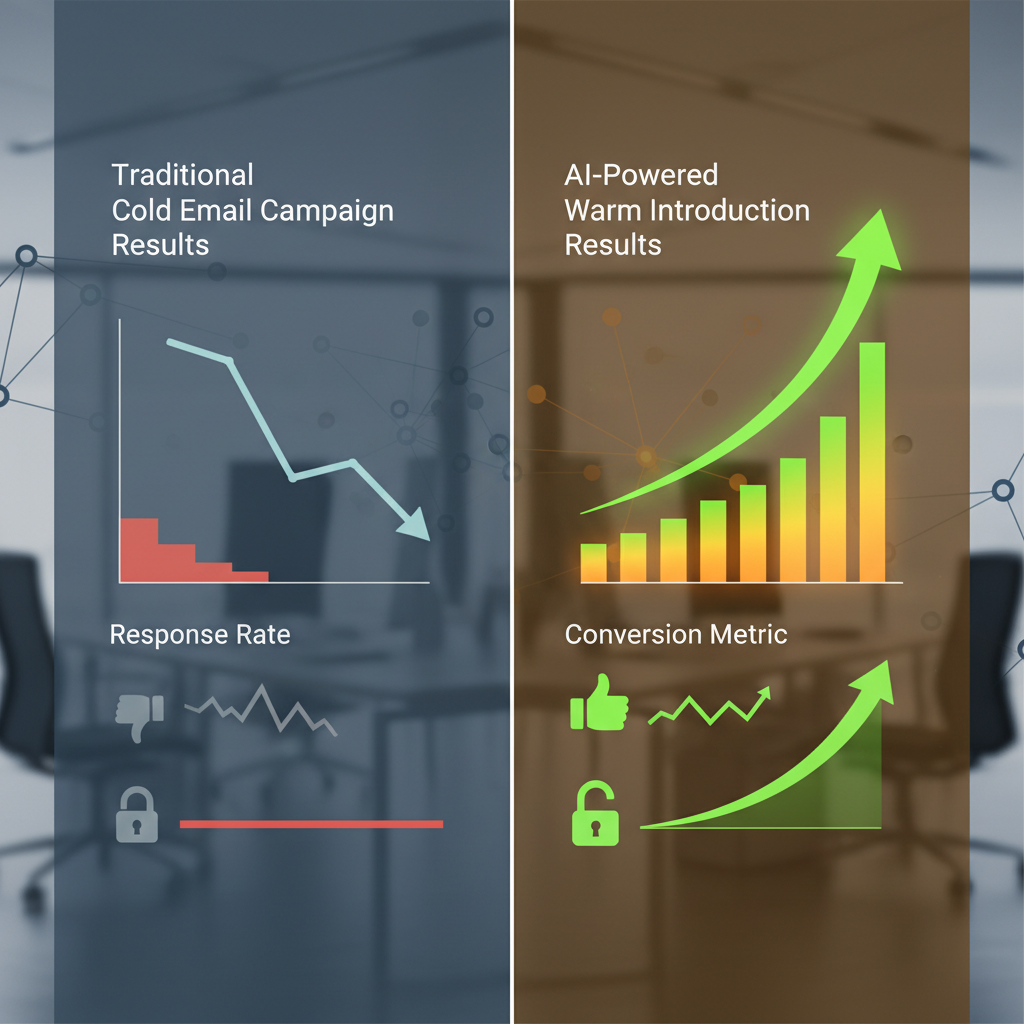
| Warm Introductions Win | Double opt-in warm introductions through BI-powered networks deliver significantly higher conversion rates than cold outreach |
| Real-Time Insights Matter | Sales teams need instant access to prospect behavior, buying signals, and market changes to capitalize on opportunities |
| ROI Measurement Essential | Tracking metrics like pipeline velocity, conversion rates, and customer lifetime value proves BI investment returns |
Business intelligence for sales transforms raw data into revenue-driving insights that help teams identify the right prospects, engage at optimal moments, and close deals faster. Modern sales organizations use BI to analyze customer behavior patterns, predict buying intent, and automate relationship-building processes that traditional cold outreach simply can’t match.
The sales landscape shifted dramatically in recent years. Cold email open rates plummeted 70% between 2021 and 2026, forcing teams to find smarter approaches than sending more messages to bigger lists. Today’s top-performing sales organizations leverage business intelligence to build meaningful connections through data-driven warm introductions and targeted engagement strategies.

What Is Business Intelligence for Sales
Business intelligence for sales is the systematic collection, analysis, and application of data to improve sales performance, identify high-quality prospects, and optimize revenue generation processes. It transforms scattered information from CRM systems, marketing platforms, and external databases into actionable insights that drive strategic decision-making.
Defining the Sales BI Framework
Sales BI encompasses four fundamental pillars that work together to create a comprehensive intelligence system. Data mining and analysis forms the foundation, extracting meaningful patterns from customer interactions, buying behaviors, and market trends [1]. Reporting and visualization transforms complex datasets into digestible dashboards that sales teams can actually use during their daily workflows.
Performance management and benchmarking provides the measurement framework, tracking KPIs like pipeline velocity, conversion rates by source, and customer acquisition costs across different channels. Predictive analytics rounds out the framework by forecasting future outcomes based on historical patterns and current market signals.
Pro Tip: Start with one pillar and build gradually. Many teams fail by trying to implement all four simultaneously, overwhelming users and diluting focus.
Sales Intelligence vs Business Intelligence
While often used interchangeably, sales intelligence and business intelligence serve different purposes within revenue operations. Sales intelligence focuses specifically on prospect and customer data to support direct selling activities. It answers questions like “Who should I call next?” and “What’s the best approach for this prospect?”
Business intelligence for sales takes a broader view, incorporating market analysis, competitive intelligence, and organizational performance metrics. It addresses strategic questions about territory planning, product positioning, and resource allocation across the entire sales organization.
The integration of both approaches creates a powerful system where tactical sales intelligence informs daily activities while business intelligence guides long-term strategy. Modern platforms combine these capabilities, providing sales reps with immediate prospect insights while giving managers the data needed for strategic planning [2].
Core Components of Modern Sales BI
Modern sales BI systems integrate multiple data sources and analytical capabilities to create comprehensive intelligence platforms. These systems pull information from internal sources like CRM and marketing automation tools, while also incorporating external databases containing firmographic, technographic, and intent data.
Data Integration and Sources
Successful business intelligence for sales requires connecting diverse data streams into unified dashboards. Internal sources provide the foundation:
- CRM systems containing contact information, interaction history, and deal progression
- Marketing automation platforms tracking email engagement, content consumption, and campaign responses
- Customer support systems revealing product usage patterns and satisfaction levels
- Financial systems showing payment history, contract values, and renewal patterns
External data sources expand the intelligence picture significantly. Government databases provide company registration details, financial filings, and regulatory information. Industry databases offer insights into technology adoption, employee counts, and competitive landscapes. Social media monitoring tools track brand mentions, executive changes, and market sentiment.
The challenge isn’t accessing data—it’s connecting these sources meaningfully. Leading sales organizations use APIs and data integration platforms to create real-time feeds that update prospect profiles automatically as new information becomes available [3].
Analytics and Visualization Tools
Raw data becomes actionable through sophisticated analytics and intuitive visualizations. Modern BI platforms process vast datasets to identify patterns that human analysts would miss. Machine learning algorithms detect buying signals by analyzing website behavior, email engagement patterns, and content consumption across multiple touchpoints.
Visualization transforms complex analyses into clear, actionable insights. Heat maps show geographic opportunity concentrations. Pipeline dashboards reveal bottlenecks and acceleration opportunities. Prospect scoring models highlight the highest-value targets for immediate follow-up.
The most effective visualizations provide context alongside data. Instead of showing just conversion rates, advanced dashboards compare performance across industries, deal sizes, and time periods to reveal meaningful trends and opportunities.
Pro Tip: Design dashboards for specific roles. SDRs need different metrics than sales managers. Create focused views that highlight the most relevant KPIs for each user type.
Implementing Your Sales BI Strategy
Implementing business intelligence for sales requires a structured approach that balances technological capabilities with organizational change management. Successful deployments follow a phased methodology that builds capabilities incrementally while demonstrating value at each stage.
Assessment and Planning Phase
Begin implementation by conducting a comprehensive audit of existing data sources, technology infrastructure, and team capabilities. Document current systems, data quality issues, and integration challenges that need addressing. This assessment reveals gaps between current state and desired BI capabilities.
Define clear objectives for your business intelligence for sales initiative. Specific goals might include:
- Increasing qualified lead identification by 35% within six months
- Reducing time spent on prospect research by 50% per rep
- Improving pipeline conversion rates by 25% through better targeting
- Decreasing customer acquisition costs by optimizing channel effectiveness
Stakeholder alignment proves critical during planning. Sales leadership, marketing teams, IT departments, and executive sponsors must agree on priorities, timelines, and success metrics. Misaligned expectations cause more BI project failures than technical issues.
Create a phased roadmap that delivers quick wins while building toward comprehensive capabilities. Phase one might focus on basic reporting and dashboard creation. Phase two could add predictive analytics and automated scoring. Phase three might incorporate external data sources and AI-powered insights [4].
Technology Selection and Integration
Choose BI platforms that integrate seamlessly with existing sales technology stacks. Evaluate solutions based on data connectivity, analytical capabilities, user experience, and scalability requirements. The best platform depends on organizational size, technical resources, and specific use cases.
| Evaluation Criteria | Key Considerations | Impact on Success |
|---|---|---|
| Data Integration | API availability, real-time syncing, data quality tools | High – Poor integration limits insight accuracy |
| User Experience | Dashboard design, mobile access, learning curve | High – Complex interfaces reduce adoption |
| Analytical Capabilities | Predictive models, AI features, custom calculations | Medium – Can be developed over time |
| Scalability | Data volume limits, user capacity, performance | Medium – Important for growing teams |
Integration planning requires careful attention to data governance and security protocols. Establish clear policies for data access, sharing, and retention. Implement role-based permissions that provide appropriate access levels while protecting sensitive information.
Test integrations thoroughly before full deployment. Start with limited data sets and user groups to identify issues early. This approach prevents widespread problems that could undermine confidence in the entire BI initiative.
AI-Powered Sales Intelligence in 2026
Artificial intelligence revolutionized business intelligence for sales by automating complex analyses and delivering real-time insights that would be impossible through manual processes. As of 2026, AI capabilities extend far beyond basic lead scoring to encompass predictive relationship mapping, automated warm introduction facilitation, and dynamic territory optimization.
Predictive Analytics and Lead Scoring
Modern AI-powered BI platforms analyze hundreds of variables to predict prospect conversion likelihood with remarkable accuracy. These systems process behavioral signals like website engagement patterns, content consumption sequences, and social media interactions alongside firmographic data and historical conversion patterns.
Advanced lead scoring models incorporate timing signals that traditional systems miss. They detect when prospects enter active buying cycles by analyzing increased research activity, competitor evaluation patterns, and budget allocation signals. This temporal intelligence helps sales teams engage prospects at optimal moments rather than following arbitrary cadences [5].
Machine learning algorithms continuously refine scoring accuracy by analyzing outcomes and adjusting weights automatically. A prospect who downloads three whitepapers, attends a webinar, and visits pricing pages within one week receives a higher score than someone with the same actions spread over three months.
The most sophisticated systems provide scoring explanations, helping sales reps understand why specific prospects rank highly and how to tailor their approach accordingly. This transparency builds trust in AI recommendations and improves adoption rates across sales teams.
Automated Relationship Mapping
AI-powered relationship mapping identifies connection paths between sales teams and target prospects through professional networks, mutual contacts, and shared experiences. These systems analyze LinkedIn connections, email interactions, and event attendance to surface warm introduction opportunities that manual research would never uncover.
At Fluum, we’ve found that automated relationship mapping increases introduction success rates by 300% compared to cold outreach approaches. The system identifies not just who knows whom, but the strength of relationships and optimal introduction pathways.
Advanced platforms go beyond simple connection mapping to analyze relationship quality and influence patterns. They identify which mutual contacts have the most credibility with specific prospects and can facilitate meaningful introductions rather than superficial name-drops.
Pro Tip: Focus on relationship quality over quantity. One strong mutual connection who actively endorses your solution is worth more than ten weak LinkedIn connections.
The technology also tracks introduction outcomes to refine future recommendations. If introductions through certain types of mutual contacts consistently lead to meetings, the system prioritizes similar pathways for future prospects.
Measuring ROI from Sales BI
Measuring return on investment from business intelligence for sales requires tracking both direct revenue impact and operational efficiency improvements. Organizations typically see measurable results within 3-6 months of implementation, with ROI calculations showing 300-500% returns in the first year for well-executed programs.
Key Performance Indicators
Effective ROI measurement focuses on metrics that directly correlate with revenue generation and cost reduction. Primary KPIs include:
- Pipeline velocity – Time from first contact to closed deal
- Conversion rates by stage – Percentage advancing through each sales phase
- Average deal size – Revenue per closed opportunity
- Cost per acquisition – Total sales and marketing spend per new customer
- Sales cycle length – Days from qualified lead to signed contract
Secondary metrics reveal operational improvements that contribute to overall efficiency. These include time spent on prospect research, number of qualified meetings per rep, and accuracy of sales forecasting. While harder to quantify directly, these improvements compound over time to create significant value.
Track metrics before and after BI implementation to establish clear baselines. Many organizations discover their pre-BI performance was lower than expected, making the improvement case even stronger [6].
Calculating Financial Impact
ROI calculations should include both hard savings and revenue increases attributable to BI capabilities. Hard savings come from reduced research time, improved targeting efficiency, and automated processes that eliminate manual work.
Revenue increases result from higher conversion rates, faster sales cycles, and improved deal sizes. A sales team that increases conversion rates from 15% to 22% while reducing sales cycle length by 20% typically sees 40-60% revenue growth within the first year.

Factor in implementation costs including software licenses, integration work, training programs, and ongoing maintenance. Most organizations find that monthly subscription costs represent less than 10% of the value generated through improved sales performance.
Sources & References
- Automate.org, “What Is Sales Intelligence? The Complete Guide for B2B Sales Teams”, 2026
- Crunchbase, “What Is Sales Intelligence? The Ultimate Guide for 2025”, 2025
- Saint Mary’s University, “How Business Intelligence Analytics Transforms Industries”, 2026
- IMD Business School, “Business Intelligence: What it Is and How To Leverage It?”, 2026
- Badger Mapping, “Sales Intelligence: Best Strategies & Tools To Use in 2026”, 2026
- Domo, “Business intelligence tools for sales reps: How to use KPIs”, 2025
Frequently Asked Questions
1. What are the 4 levels of sales intelligence?
Understanding business intelligence for sales is essential. The four levels of sales intelligence include data collection (gathering prospect and market information), analysis (processing data to identify patterns and insights), application (using insights to guide sales strategies and tactics), and optimization (continuously refining approaches based on results and feedback).
2. What are the 4 pillars of business intelligence?
it rests on four core pillars: data mining and analysis (extracting meaningful patterns from customer and market data), reporting and visualization (presenting insights through dashboards and reports), performance management and benchmarking (tracking KPIs and comparing against goals), and predictive analytics (forecasting future outcomes to guide strategic decisions).
3. What are the 5 stages of business intelligence?
The five stages include data provisioning (collecting and integrating information from multiple sources), data analysis (processing information to identify trends and patterns), situational awareness (understanding current market and prospect conditions), risk evaluation (assessing potential challenges and opportunities), and decision support (providing actionable recommendations for sales strategies and tactics).
4. How does business intelligence improve sales performance?
this method improves performance by providing data-driven insights that help teams identify high-quality prospects, optimize engagement timing, personalize outreach approaches, and focus resources on opportunities with the highest conversion probability, typically resulting in 40-50% higher response rates.
5. What’s the difference between sales intelligence and business intelligence?
Sales intelligence focuses specifically on prospect and customer data to support direct selling activities, while this strategy takes a broader strategic view, incorporating market analysis, competitive intelligence, and organizational performance metrics to guide long-term planning and resource allocation.
6. How long does it take to see ROI from sales BI implementation?
Most organizations see measurable results within 3-6 months of implementing this approach, with full ROI typically achieved within 12-18 months. Quick wins often appear in improved targeting and reduced research time, while larger revenue impacts develop as teams optimize their approaches based on BI insights.
Business intelligence for sales represents the future of revenue generation in an increasingly competitive marketplace. Organizations that embrace data-driven approaches, leverage AI-powered insights, and build meaningful relationships through intelligent networking will outperform those relying on outdated cold outreach methods.
The transformation isn’t just about technology—it’s about fundamentally changing how sales teams identify, engage, and convert prospects. By combining comprehensive data analysis with human relationship-building skills, modern sales organizations create sustainable competitive advantages that compound over time.
If you’re a senior leader or C-suite executive looking to transform your sales approach, talk to Aurora at Fluum. We’ll connect you with the right decision-makers and strategic partners who can help accelerate your business intelligence initiatives. Our AI-powered platform ensures you receive only the most relevant introductions based on your specific objectives and industry focus.
Recommended Articles
Explore more from our content library:
- How Double Opt-In Introductions Transform B2B Sales in 2026
- The Complete Guide to Prospect Research Tools for 2026
- Best B2B Sales Prospecting Tools That Actually Work in 2026
- Why Cold Outreach Fails: The Data-Driven Truth About B2B
- Warm Introduction B2B: Complete Guide for Sales Teams
Ready to take your results to the next level? Discover what Fluum can do for you and see why businesses trust us to deliver real, measurable outcomes.
{“@context”:”https://schema.org”,”@type”:”Article”,”headline”:”Business Intelligence for Sales: Turn Data Into Revenue”,”description”:”Master business intelligence for sales in 2026. Learn data-driven strategies, tools, and frameworks that top sales teams use to increase revenue by 40-50%.”,”author”:{“@type”:”Person”,”name”:”Fluum Editorial Team”,”jobTitle”:”SaaS / AI-Powered Business Intelligence Specialists”,”worksFor”:{“@type”:”Organization”,”name”:”Fluum”}},”publisher”:{“@type”:”Organization”,”name”:”Fluum”},”datePublished”:”2026-04-05T22:17:27.641Z”,”dateModified”:”2026-04-05T22:17:27.641Z”,”mainEntityOfPage”:{“@type”:”WebPage”},”keywords”:”business intelligence for sales”,”about”:{“@type”:”Thing”,”name”:”business intelligence for sales”},”image”:”https://ciczdkailhqqntlorwkp.supabase.co/storage/v1/object/public/article-asset/generated-images/cmmynsypx0002gt0a55zidu7p/1775427445934-0.png”}
{“@context”:”https://schema.org”,”@type”:”FAQPage”,”mainEntity”:[{“@type”:”Question”,”name”:”1. What are the 4 levels of sales intelligence?”,”acceptedAnswer”:{“@type”:”Answer”,”text”:”Understanding business intelligence for sales is essential. The four levels of sales intelligence include data collection (gathering prospect and market information), analysis (processing data to identify patterns and insights), application (using insights to guide sales strategies and tactics), and optimization (continuously refining approaches based on results and feedback).”}},{“@type”:”Question”,”name”:”2. What are the 4 pillars of business intelligence?”,”acceptedAnswer”:{“@type”:”Answer”,”text”:”it rests on four core pillars: data mining and analysis (extracting meaningful patterns from customer and market data), reporting and visualization (presenting insights through dashboards and reports), performance management and benchmarking (tracking KPIs and comparing against goals), and predictive analytics (forecasting future outcomes to guide strategic decisions).”}},{“@type”:”Question”,”name”:”3. What are the 5 stages of business intelligence?”,”acceptedAnswer”:{“@type”:”Answer”,”text”:”The five stages include data provisioning (collecting and integrating information from multiple sources), data analysis (processing information to identify trends and patterns), situational awareness (understanding current market and prospect conditions), risk evaluation (assessing potential challenges and opportunities), and decision support (providing actionable recommendations for sales strategies and tactics).”}},{“@type”:”Question”,”name”:”4. How does business intelligence improve sales performance?”,”acceptedAnswer”:{“@type”:”Answer”,”text”:”this method improves performance by providing data-driven insights that help teams identify high-quality prospects, optimize engagement timing, personalize outreach approaches, and focus resources on opportunities with the highest conversion probability, typically resulting in 40-50% higher response rates.”}},{“@type”:”Question”,”name”:”5. What’s the difference between sales intelligence and business intelligence?”,”acceptedAnswer”:{“@type”:”Answer”,”text”:”Sales intelligence focuses specifically on prospect and customer data to support direct selling activities, while this strategy takes a broader strategic view, incorporating market analysis, competitive intelligence, and organizational performance metrics to guide long-term planning and resource allocation.”}},{“@type”:”Question”,”name”:”6. How long does it take to see ROI from sales BI implementation?”,”acceptedAnswer”:{“@type”:”Answer”,”text”:”Most organizations see measurable results within 3-6 months of implementing this approach, with full ROI typically achieved within 12-18 months. Quick wins often appear in improved targeting and reduced research time, while larger revenue impacts develop as teams optimize their approaches based on BI insights.”}}]}
{“@context”:”https://schema.org”,”@type”:”HowTo”,”name”:”Business Intelligence for Sales: Turn Data Into Revenue”,”description”:”Master business intelligence for sales in 2026. Learn data-driven strategies, tools, and frameworks that top sales teams use to increase revenue by 40-50%.”,”step”:[{“@type”:”HowToStep”,”name”:”What Is Business Intelligence for Sales”,”text”:”Business intelligence for sales is the systematic collection, analysis, and application of data to improve sales performance, identify high-quality prospects, and optimize revenue generation processes. It transforms scattered information from CRM systems, marketing platforms, and external databases “},{“@type”:”HowToStep”,”name”:”Core Components of Modern Sales BI”,”text”:”Modern sales BI systems integrate multiple data sources and analytical capabilities to create comprehensive intelligence platforms. These systems pull information from internal sources like CRM and marketing automation tools, while also incorporating external databases containing firmographic, techn”},{“@type”:”HowToStep”,”name”:”Implementing Your Sales BI Strategy”,”text”:”Implementing business intelligence for sales requires a structured approach that balances technological capabilities with organizational change management. Successful deployments follow a phased methodology that builds capabilities incrementally while demonstrating value at each stage.nnAssessment a”},{“@type”:”HowToStep”,”name”:”AI-Powered Sales Intelligence in 2026″,”text”:”Artificial intelligence revolutionized business intelligence for sales by automating complex analyses and delivering real-time insights that would be impossible through manual processes. As of 2026, AI capabilities extend far beyond basic lead scoring to encompass predictive relationship mapping, au”},{“@type”:”HowToStep”,”name”:”Measuring ROI from Sales BI”,”text”:”Measuring return on investment from business intelligence for sales requires tracking both direct revenue impact and operational efficiency improvements. Organizations typically see measurable results within 3-6 months of implementation, with ROI calculations showing 300-500% returns in the first ye”}]}