
Understanding Warm Introduction Software for B2B Sales is essential. Warm introduction software connects you with buyers through an opted-in network and AI-scored intent signals instead of cold contact lists, so the person on the other end already expects to hear from you. It works by matching your ideal customer profile against a pool of buyers who’ve agreed to be introduced, then using intent data to time the outreach when they’re actually looking. The result is access to decision-makers who ignore cold email but respond to a mutual, pre-qualified introduction, because both sides said yes before the first message ever went out.
How Does Warm Introduction Software Differ from Cold Outreach in B2B Sales?
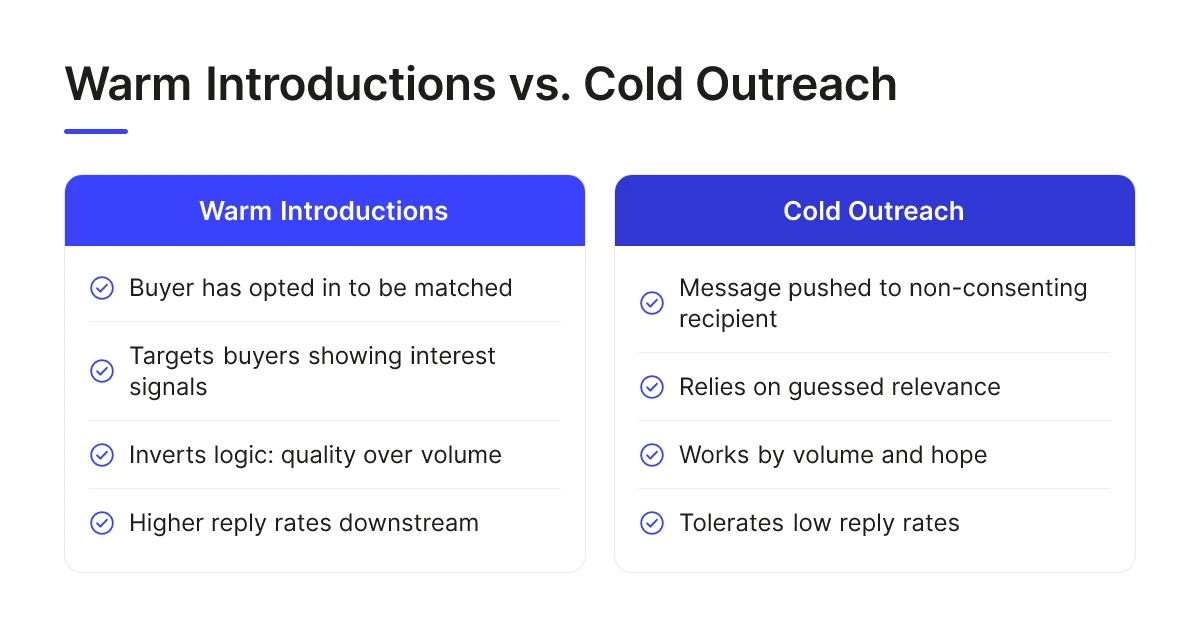
Cold outreach pushes a message at someone who never agreed to hear from you; Warm Introduction Software for B2B Sales matches you to a buyer who opted in and is already showing signals of interest. That single distinction, consent before contact, changes everything downstream, from reply rates to how the message gets read.
A cold email sequence works by volume. You build a list, guess at relevance, and hope enough recipients tolerate the interruption to generate a handful of replies. Warm introduction software inverts that logic entirely. It starts with a buyer pool that has already agreed to be matched, then layers intent data on top so the timing isn’t a guess, it’s a signal.
Why Is Cold Email Becoming Less Effective for Reaching High-Intent Decision-Makers?
Senior buyers now recognise a cold sequence within the first line and delete it before reading further. Three forces compound this: inbox fatigue from years of templated pitches, spam filters that have grown far better at flagging bulk-sequence patterns, and decision-makers who’ve simply learnt to pattern-match against the “quick question” opener.
None of this is a messaging problem you can fix with a better subject line. It’s structural. A VP of Sales at a fintech or manufacturing scaleup gets prospected by dozens of vendors a week, all pulling from the same three data providers and running the same five-touch cadence. The channel isn’t underperforming because the copy is weak, it’s underperforming because the mechanic itself (unsolicited, unscored, unopted) has been trained out of the recipient.
What Role Do Private Data Vendors and Government Registries Play in Bypassing Cold Outreach Channels?
Most prospecting tools scrape the same public sources, LinkedIn profiles and a handful of resold databases, which means every SDR targeting a given account is working off an identical, over-contacted list. Warm introduction software breaks that cycle by pulling signal from a wider base. Fluum, for instance, queries over 100 government and private databases to surface buyers in finance, technology, and manufacturing who aren’t sitting in the same recycled contact exports everyone else is using.
That matters because it’s not just about finding a name, it’s about finding one that hasn’t already been burnt by three competitors’ sequences this quarter.
The trust mechanism is what makes the reply happen. When both sides have said yes before the first message is sent, the buyer expects contact, they’re not screening an unknown sender, they’re opening a conversation they already agreed to have.
What Makes an Introduction ‘Warm’ and How Do Intent Signals Identify the Right Buyers?
An introduction only counts as warm when two things overlap: the person has opted in to be matched, and something in their recent behaviour signals they’re actively buying. Neither one alone is enough.
A contact who agreed to be matched six months ago but shows no current buying activity is just a stale opt-in. A company showing every intent signal in the book but no consent to be approached is just a cold prospect with better data behind it. Warm Introduction Software for B2B Sales exists precisely because most vendors solve for one half of that equation and call it done. Fluum’s double opt-in mechanic is built around the other missing piece, nobody gets introduced until both sides have said yes, and that yes only means something when it’s paired with a live signal, not a dormant profile.
How Do AI Agents Score Intent Signals to Surface the Right Decision-Maker Paths?
AI agents weigh several signal types together rather than trusting any single one in isolation. A job change at a target account, a funding round, a hiring surge in a relevant function, or a new technology adoption each carries different weight depending on the account’s industry and buying cycle.
A finance firm that just hired its first Head of Compliance Technology, for instance, is a stronger signal than a generic “VP of Operations” title change. Fluum’s matching layer pulls this kind of signal from over 100 government and private databases, which lets it surface contacts that never show up on a standard prospect list because they haven’t posted, published, or applied for anything public-facing. The ranking isn’t static either, an account that scores high today because of a funding event can drop in priority within weeks if no further activity follows.
What Data Sources and Scoring Methods Distinguish Genuine Buyer Intent from Surface-Level Engagement?
A whitepaper download or a form-fill tells you someone was curious for thirty seconds. It doesn’t tell you a company has budget allocated, a buying committee forming, or a timeline attached to a decision.
Genuine intent shows up as clustered, corroborating activity: multiple stakeholders at the same account researching the same category, a procurement role recently filled, or a compliance mandate creating urgency. A manufacturing procurement lead who’s been quietly evaluating three vendors over eight weeks, surfaced through hiring and technology-adoption signals rather than a single email click, is exactly the kind of decision-maker path a generic contact list would never distinguish from noise.
How Do AI and Buyer Intelligence Networks Reach Introductions Cold Outreach Tools Can’t?
Combining dozens of private and government data feeds builds a fuller company picture than any single public database can offer, exposing buyers cold tools never surface.
A LinkedIn profile shows you a job title. A public company registry shows you incorporation dates and filing history. Neither shows you which of the twelve people in a manufacturing procurement chain actually signs off on a six-figure vendor contract. That’s the structural gap Warm Introduction Software for B2B Sales is built to close, not by scraping harder, but by combining sources that were never designed to talk to each other.
Which Buyer Segments and Industries Benefit Most from Warm Introductions Powered by Unconventional Data Channels?
Complex, high-consideration purchases with multiple stakeholders benefit most, because a single cold email to one contact almost never reaches the real buying committee.
Think about how a mid-market manufacturer buys a new ERP module, or how a regional bank selects a fraud-detection vendor. These aren’t single-decision-maker sales. They involve procurement, finance, IT security, and an operations lead who all need to say yes before a deal moves. Regulated and lower-digital-footprint industries, manufacturing, healthcare, public sector, compound the problem further, because the people who control budget in these sectors rarely post on LinkedIn, rarely attend webinars, and rarely respond to inbound anything. Cold outreach tools built around social and web activity simply don’t see them.
How Does a Buyer Graph Built from Many Private and Government Sources Reach Prospects Other Tools Miss?
Breadth of source, not depth of scraping, is what lets a buyer graph surface contacts single-source tools structurally cannot see.
A tool relying on one or two data sources, a professional network and a public filing database, say, inherits that source’s blind spots. Fluum’s approach pulls signals from over 100 government and private databases, cross-referencing procurement records, corporate filings, and industry-specific registries that sit outside the usual prospecting stack. That aggregation is what turns a flat contact list into an actual buyer graph: a map of who reports to whom, who’s recently taken budget authority, and which accounts are showing real buying signals right now. For finance, technology, and manufacturing accounts especially, this means reaching the operations director or compliance lead who never shows up in a Sales Navigator search, because no single public source ever indexed them in the first place.
What Does It Take to Build and Maintain an Opted-In Buyer Network?
An opted-in network runs on double opt-in matching, CRM-native data sync, and continuous refresh, not a static list bought once and reused for years.
This is the operational backbone that separates Warm Introduction Software for B2B Sales from a repackaged contact database. Anyone can scrape a directory and call it a network. Building one where every contact has actively agreed to be matched, and every introduction reflects live signal data, is a different undertaking entirely.
How Do Double Opt-In Mechanisms Protect Data Privacy and Compliance While Scaling Warm Introductions?
Double opt-in means the buyer has agreed to be matched against relevant sellers, the seller has agreed to the terms of that introduction, and no message goes out to either party until both signals are confirmed. Fluum’s platform is built around exactly this mechanic, it won’t surface an introduction until mutual interest is established on both sides. Nobody gets contacted cold, and nobody’s details move without their say-so.
This structure solves a compliance problem most outreach tools never address. When consent is captured at the source, the buyer opting in, the seller opting in, you’re not relying on inferred permission from a scraped LinkedIn profile or a purchased list of “verified” emails. That distinction matters more as data protection regulation tightens across finance, technology, and manufacturing, the exact sectors where Fluum concentrates its network. Consent-first architecture isn’t a compliance bolt-on; it’s the mechanism that makes the introduction warm in the first place.
What Integration Requirements Exist Between Warm Introduction Platforms and Existing CRM and Sales Stack Tools?
A warm introduction is only useful if the rep working it doesn’t have to leave their existing pipeline to find it. That means matched introductions and the signal data behind them need to sync into whatever CRM the team already runs, Salesforce, HubSpot, Pipedrive, or equivalent, so reps work from one system of record rather than toggling between a networking tool and their actual pipeline.
This is a genuine integration requirement, not a nice-to-have. A platform that dumps introductions into a separate dashboard adds another tab to check rather than removing friction from the sales process.
Maintenance is the less glamorous half of this. Opt-in status changes, people leave roles, change buying authority, or withdraw consent, and signal data needs continuous refresh rather than a one-time import. A network that isn’t kept current degrades into exactly the stale-contact problem it was meant to replace.
How Do You Measure ROI and Pipeline Impact from Warm Introduction Programs?
Track three numbers before and after you switch channels: reply rate, meeting-to-opportunity conversion, and sales cycle length, the gap between them is your ROI case.
Most sales leaders already track reply rate because cold email makes it impossible to ignore, it’s the metric that exposed the problem in the first place. But reply rate alone doesn’t prove a warm-intro channel is working. You need to watch what happens after the reply: does the meeting turn into a qualified opportunity more often, and does that opportunity move through the pipeline faster than one sourced from a cold sequence or a purchased list.
What Conversion Rate and Pipeline Velocity Improvements Should You Expect from Warm Introductions Versus Cold Outreach?
Expect the biggest gap in cycle time, not just reply rate, trust that’s already been established cuts out the early qualification and skepticism that stalls cold deals.
A cold prospect spends the first one or two calls deciding whether you’re credible and whether the conversation is worth their time. A warm introduction skips that step because someone both sides trust has already vouched for the fit. That’s the mechanic behind Fluum’s double opt-in model, both parties confirm interest before the first message is ever sent, so the call starts at “how do we work together” rather than “why are you contacting me.” Sales leaders evaluating Warm Introduction Software for B2B Sales should model cycle length as the primary ROI lever, with reply rate and conversion rate as supporting evidence.
What Implementation Timeline and Metrics Matter Most When Evaluating Warm Introduction Platforms?
Budget for three stages: network and integration setup, an initial matching period to validate fit, then scaled volume once conversion holds steady.
The first stage connects your CRM, defines your ideal customer or partner profile, and lets the platform’s matching engine start surfacing candidates. The second stage is about validating quality over quantity, a handful of confirmed introductions tells you more than a flood of unqualified ones. Only once conversion and cycle-time gains are consistent should you push volume up. Rushing this sequence is the most common reason programmes get judged as underperforming before they’ve had a fair test.
Cost should be evaluated in tiers rather than a single number: budget-friendly options typically offer narrower network reach and lighter integration, mid-range tools balance network size with CRM connectivity, and premium or enterprise platforms combine deeper database coverage, Fluum draws from 100+ government and private databases, with dedicated matching support. Finally, isolate pipeline sourced through the warm-intro channel in your CRM with a distinct source tag, so gains aren’t blended with unrelated outbound activity and the ROI comparison stays honest.
Frequently Asked Questions
Can warm introduction software replace cold outreach entirely?
For most sales teams, warm introduction software can replace the bulk of cold outreach, though not every single motion overnight. Fluum’s double opt-in model targets 40–50% reply rates against cold email’s roughly 2%, which means reps redirect time from list-building and sequencing toward actual sales conversations. Some long-tail prospecting may still run in parallel during the transition.
How long does it take to build a usable opted-in buyer network?
With a platform pulling from an existing curated network, usable introductions can start within weeks rather than the months it takes to build personal relationships manually. Fluum’s approach, matching against signals from 100+ government and private databases, skips the slow networking phase entirely, since the decision-maker network already exists and both sides opt in before contact.
Do warm introduction platforms work for niche or regulated industries?
Yes, provided the platform’s signal sources cover that sector’s decision-makers specifically. Fluum focuses its matching on finance, technology, and manufacturing, industries where compliance, procurement rules, and long buying cycles make cold outreach especially weak, and surfaces contacts that generic list tools and LinkedIn often can’t reach.
What happens if a matched buyer isn’t actually ready to talk?
The double opt-in step exists precisely to filter this out before an introduction happens. Both the buyer and seller confirm interest first, so a mismatch on timing or fit gets caught early rather than wasting a sales rep’s time on a conversation neither party wanted.
How does intent data stay compliant with privacy regulations?
Reputable platforms source signals from government and private databases with established compliance practices rather than scraping personal data indiscriminately. The double opt-in mechanic adds a further layer of consent, nobody gets contacted, let alone introduced, without agreeing to the conversation first, which sidesteps the grey areas that plague cold-contact data brokers.
Conclusion
Cold outreach economics won’t recover, inbox filters keep tightening and reply rates keep falling. The fix isn’t a better cold email template; it’s a different mechanism entirely: matching against real signals, confirming mutual interest, then introducing. That’s the shift from list-buying to double opt-in relationships covered throughout this piece.
If your team has missed pipeline targets for two quarters running, don’t add another sequencing tool to the stack. Instead, audit how many of last quarter’s “qualified” conversations started cold versus warm, then test a double opt-in introduction against your next ten target accounts and compare the reply rate directly.
Recommended Articles
Explore more from our content library: