
Understanding top sales prospecting tools for sdrs who need higher response rates from decision makers is essential. SDRs get higher response rates from decision-makers by replacing cold, indexed contact data with intent signals and warm, opted-in introductions, because a message that arrives after mutual interest is confirmed gets read differently than one that arrives cold. Tools built around buyer graphs, government and private data registries, and double opt-in networks consistently outperform standard cold-outreach platforms because the decision-maker has already signaled relevance or agreed to the conversation before an SDR ever reaches out. The mechanism, not the tool brand, is what drives the lift: consent and relevance beat volume.
Top Sales Prospecting Tools for SDRs Who Need Higher Response Rates from Decision-Makers: What Makes Them Different
Cold prospecting tools and intent-based platforms solve entirely different problems, and confusing the two is why most outbound programs stall at a 2% reply rate.
A tool like a standard contact database indexes publicly available information, job titles, emails, company size, then hands it to an SDR to dial or email at scale. The mechanism is volume: send enough messages to enough people and a fraction will reply. Intent-based tools work backward from a different question entirely. Instead of asking “who fits our target profile,” they ask “who is already showing behavior that suggests they’re in-market right now.” That’s the mechanical fork this whole category splits on, and it’s why the best of the top sales prospecting tools for SDRs who need higher response rates from decision makers don’t compete on database size, they compete on signal quality and relationship proximity.
Why Do Warm Introductions and Intent-Based Targeting Produce Higher Response Rates Than Cold Outreach?
Cold outreach loses because it competes for attention inside an inbox already flooded with hundreds of unsolicited pitches, response rates on that channel have been falling for years as filters and skepticism both tighten [3]. A warm introduction skips that competition entirely. It arrives with context attached: who’s asking, why, and what shared connection or interest justifies the message.
The core reason response rates rise isn’t cleverer copywriting, it’s that relevance and consent change what the message actually is. A cold email is an interruption. A warm introduction, especially one built on a double opt-in mechanism where both parties have already agreed the conversation is worth having, is an expected conversation. Fluum’s approach reflects this directly: instead of surfacing a list for an SDR to cold-pitch, it confirms mutual interest between buyer and seller before either side sends a first message, which is a structurally different starting point than any volume-based sequence.
What Role Do Buyer Graphs and Intent Scoring Play in Reaching the Right Decision-Maker at the Right Time?
A buyer graph maps the actual relationships and shared interests connecting people and companies, who worked where, who’s invested in whom, who shares a mutual connection, so a message can travel through a relevant node instead of landing in a stranger’s inbox. This is the infrastructure behind warm introductions: it identifies the path, not just the person.
Intent scoring does the second half of the job. It ranks accounts by observable behavior, content engagement, hiring surges, funding events, competitor research, rather than static firmographic fit like headcount or industry code [1]. A company can match every column in a firmographic filter and still not be in-market; intent scoring catches the accounts that are actively moving, which is exactly where decision-makers become reachable.
What Data Sources and Targeting Methods Help SDRs Reach Decision-Makers That LinkedIn and Standard Tools Miss?
The best decision-maker data comes from sources that don’t depend on someone remembering to update their job title, government filings, opted-in networks, and cross-referenced signal aggregation. Any evaluation of the top sales prospecting tools for SDRs who need higher response rates from decision makers has to start with where the data actually comes from, not just how it’s delivered.
Most sales tools pull from the same well: professional networking profiles, scraped websites, and purchased contact lists. That well has a structural flaw. It relies on people self-reporting their own job status, and people are slow to update that information after a promotion, a departure, or a reorg.
How Do Private Data Vendors and Government Registries Surface Decision-Makers That Cold Outreach Platforms Cannot Reach?
Company registration filings, financial regulator registers, and securities disclosures capture executive and officer information because the law requires it, not because someone felt like updating a profile. A newly appointed CFO at a regulated bank shows up in a filing well before that person edits their own social profile, if they ever do. These registries index board appointments, officer changes, and beneficial ownership shifts that never touch a networking platform at all.
This matters most for SDRs selling into finance, manufacturing, and other regulated markets, where compliance requirements force companies to file leadership changes as a legal obligation. A private equity firm’s portfolio company reporting a new managing director to a securities regulator creates a verified, timestamped record. Cold platforms indexing public web pages simply don’t have access to that filing, and even if they did, they’re not built to parse it.
What Is the Difference Between Indexed Buyer Data and Opted-In Networks for Decision-Maker Prospecting?
Indexed data is a list someone built by scraping or buying contact records; an opted-in network is a group of people who’ve already agreed to be introduced when the conversation is relevant to them. The distinction changes everything downstream. A scraped list gets you an email address and a guess at seniority. An opted-in network gets you a person who has said, in advance, that they’re open to a specific kind of conversation.
Fluum builds its matching layer on more than 100 government and private databases specifically to close the gap indexed lists leave open, then requires double opt-in before any introduction happens, both the buyer and the seller confirm interest before a message is sent. No single data source covers every blind spot. Combining registry data, private signal feeds, and opted-in network confirmation is what separates a tool that generates names from one that generates conversations decision-makers actually respond to.
How Should SDRs Evaluate Prospecting Tools for Decision-Maker Contact Accuracy and Data Freshness?
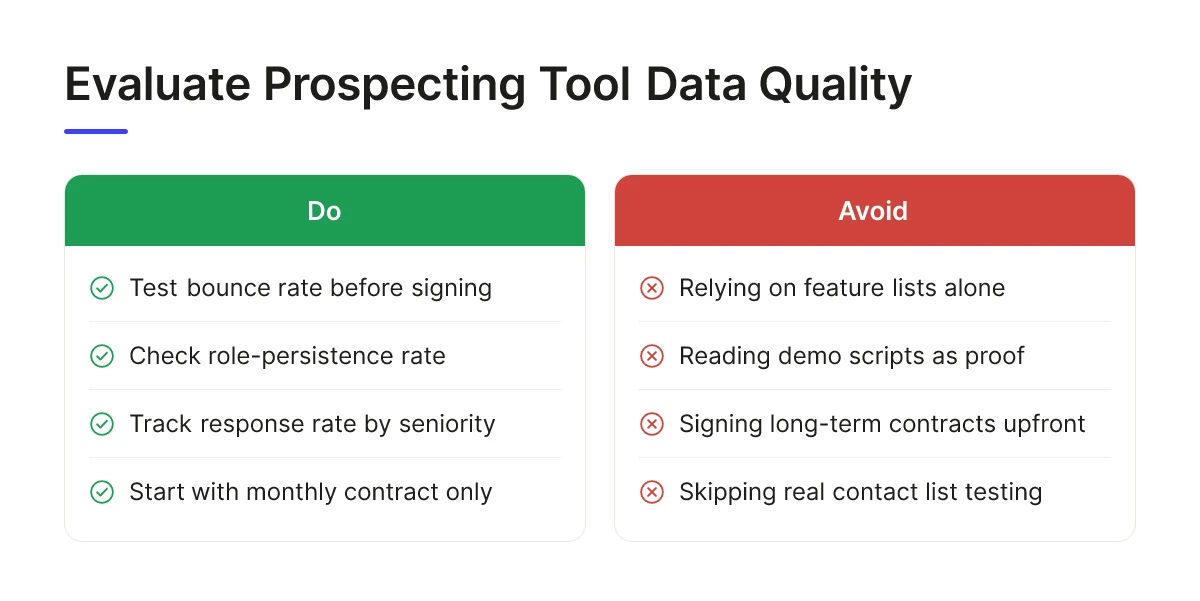
Test data quality with three numbers, bounce rate, role-persistence rate, and response rate by seniority, before you sign anything longer than a monthly contract.
Most SDR teams evaluate the top sales prospecting tools for SDRs who need higher response rates from decision makers by reading feature lists and demo scripts. That’s backwards. Feature lists don’t bounce when you send to them. Real contact lists do, and the bounce rate is the first honest signal you’ll get.
What Metrics Should You Track to Compare Decision-Maker Contact Quality and Accuracy Across Prospecting Platforms?
Track three metrics on every trial list before you compare vendors on anything else. First, bounce rate on outbound sends, anything above single digits tells you the database hasn’t been scrubbed recently. Second, the percentage of contacts still in the same role 60 to 90 days after the list was pulled; this catches vendors who sell you last year’s org chart. Third, response rate broken down by seniority level, not blended across the whole list, a tool that gets you replies from managers but goes silent on VPs and above isn’t solving the problem you actually have.
Run these three side by side and the differences between vendors stop being theoretical.
How Does Data Freshness Impact Response Rates When Targeting Regulated Industries Like Fintech and Cybersecurity?
Stale data costs more in regulated sectors because the actual decision-maker changes hands faster there than almost anywhere else. Fintech and cybersecurity companies restructure buying committees after funding rounds, audits, and compliance reviews, a CISO who owned vendor selection in Q1 might be reporting to a new head of risk by Q3. Procurement processes in these sectors also route approval through more people, so the named contact on a list is often one step removed from the person who signs.
Test freshness directly before you commit. Pull a sample list and cross-check it against recent public filings, funding announcements, or leadership press releases. If ten percent or more of your sample has already moved roles, the vendor’s refresh cycle is slower than your sales cycle, and you’ll find out the hard way, mid-sequence.
Vendors that rely on self-reported profiles or scraped web data tend to decay faster than those cross-referencing verified registries or government filings, simply because nobody updates a LinkedIn bio the day they change jobs. This is where Fluum’s approach differs: it pulls signals from over 100 government and private databases rather than a single scraped source, which matters most in exactly these high-turnover, high-compliance sectors.
Before a full rollout, run a rolling trial against a small segment of your ICP and compare cost-per-meeting-booked qualitatively across vendors, not contract length, not seat price, not feature checklists.
Which Prospecting Platforms Deliver Warm Introductions and Opted-In Access to Decision-Makers?
A distinct category of platforms now exists that confirms mutual interest before any conversation starts, replacing the guesswork of cold contact with verified, two-sided consent. This is the category worth understanding if you’re evaluating the this strategy, because the mechanism, not the contact database, is what determines whether a decision-maker actually replies.
How Do Double Opt-In Introduction Models Improve Decision-Maker Engagement Compared to Direct Cold Outreach?
A double opt-in introduction requires both the target decision-maker and the requesting SDR to confirm interest before any contact details or conversation gets shared. Neither side sees a name or a calendar link until both have said yes. This is a mechanical difference, not a marketing distinction, the introduction simply doesn’t happen without confirmation from both parties.
Compare that to direct cold outreach, where an SDR sends an email or a LinkedIn message with zero confirmation that the recipient is open to the conversation, interested in the category, or even the right person to talk to. Every cold email is a bet placed without information. A double opt-in model removes that bet entirely, by the time a message lands, the decision-maker has already agreed to receive it. That’s the structural reason these platforms report reply rates far above what cold sequencing produces. Fluum, for example, builds its entire workflow around this mechanic: both sides confirm interest before an introduction is made, and the message that follows is written with context about who’s connecting and why, not a templated opener.
What Unconventional Channels and Networks Reach Decision-Makers Outside Traditional Sales Prospecting Tools?
Standard databases and contact-scraping tools only reach people who are findable, decision-makers who’ve filled out a public profile or shown up in a firmographic export. Warm-introduction platforms often pull from channels those tools never touch: curated professional communities organized around industry or function, invite-only groups where membership itself signals seniority, and relationship-based referral networks built on trust rather than data scraping. Fluum’s approach layers signal aggregation from over 100 government and private databases on top of this, surfacing finance, technology, and manufacturing decision-makers who don’t show up through cold-outreach tools or LinkedIn searches alone.
Pricing across this category splits into two clear tiers. Budget-friendly, self-serve platforms let smaller teams run matching and introductions with minimal setup. Premium, managed introduction services add more curation and account management for enterprise teams with complex, high-stakes buyer lists. Neither tier is inherently better, the right choice depends on how much hands-on matching your pipeline actually needs.
If you’re a senior leader or C-suite decision-maker reading this, don’t start with a generic list request. Talk to Aurora directly and tell us specifically who you’re looking to meet next, that specificity is what keeps every introduction relevant instead of another name on a spreadsheet.
How Do You Integrate Decision-Maker Prospecting Tools into Your SDR Workflow for Measurable Response Rate Gains?
Wire the tool into your CRM, sequencer, and calendar first, then run a small pilot before you touch your whole team’s workflow.
Most SDR teams don’t fail at decision-maker prospecting because the tool is weak. They fail because nobody built the plumbing to get warm intros into a pipeline the rest of the org can see, measure, and act on. Adding another disconnected tab to an already-crowded stack is how good response rates get buried under bad process.
What CRM and Tech Stack Integrations Are Required to Operationalize Decision-Maker Prospecting at SDR Scale?
Three integration points determine whether a new tool actually changes your numbers or just adds another login.
- CRM sync: Every matched contact and every introduction status needs to log automatically into Salesforce or HubSpot as an activity, not sit in a separate dashboard your reps forget to check.
- Sequencing handoff: Once a decision-maker opts in, that contact should flow directly into whatever sequencing tool your reps already use for follow-up, no manual copy-paste between systems.
- Calendar booking connection: A warm introduction that doesn’t convert into a scheduled call within days loses momentum. Connect booking links directly to the introduction workflow so a “yes” from both sides turns into a meeting on the calendar, not a stalled email thread.
Fluum’s double opt-in introductions are built to plug into this exact chain, both parties confirm interest before a rep ever sends a message, and that confirmed match needs to land in the CRM the same way a cold-sourced lead would, just tagged differently.
How Do You Measure Cost-Per-Meeting-Booked and ROI When Adding a Decision-Maker Targeting Tool to Your Sales Process?
Tag every contact and meeting sourced from the new channel with a distinct campaign source field so response rate and meetings-booked data never mix with cold outreach numbers. Without that separation, you can’t prove the lift, you’re just guessing.
Calculate cost-per-meeting-booked by adding total tool spend to the SDR hours invested, then dividing by meetings actually booked and attended. Run the same formula for your existing cold email and LinkedIn channels. When reply rates on cold channels sit near the industry-standard 2% and warm introductions land in the 40–50% range, the cost-per-meeting gap becomes obvious within a single quarter, even before factoring in win rates further down the funnel.
Roll out in phases. Pilot with one SDR or one market segment, fintech accounts, for example, if that’s where your ICP concentrates, and measure response rate lift over four to six weeks before expanding. Among the this approach, the ones that win adoption are the ones that prove out on a small sample before asking reps to change their whole routine. Response rate gains compound when reps stop splitting attention across five disconnected tools and start working one channel that consistently converts.
Frequently Asked Questions
Can decision-maker prospecting tools replace cold email entirely?
For most SDR teams, yes, but the transition happens in stages, not overnight. Cold email still has a role for early-stage awareness plays, but when reply rates sit under 2% [4], the math no longer justifies the headcount hours spent writing and sending it. Teams that shift budget toward warm introductions and intent signals typically keep a small cold-outreach lane running while the warm channel scales.
How long does it take to see response rate improvements after switching prospecting approaches?
Most SDR teams notice a shift within the first two to four weeks of running a warm-introduction or intent-based channel alongside cold outreach. Because double opt-in introductions only surface once both sides confirm interest, the calls booked in that window tend to convert faster than a cold pipeline built over the same period, even though total volume starts lower.
Do warm introduction tools work for SDRs targeting enterprise accounts, or only small and mid-market companies?
They work particularly well for enterprise accounts, where cold outreach struggles most because gatekeepers and inbox filters block unsolicited messages before a rep ever gets seen. Fluum’s network is built around finance, technology, and manufacturing, industries where buying committees are large and verified decision-maker access is scarce. A confirmed introduction skips the multi-touch sequence that enterprise gatekeeping usually forces.
What’s the biggest mistake SDRs make when adopting intent-based or warm-introduction tools?
Treating the new tool like a bigger list to blast instead of a different mechanic entirely. Intent data and warm introductions work because they replace volume with relevance and mutual consent, reps who paste the same templated pitch into a “warmer” channel just recreate the 2% cold-email problem [4] with better-looking contacts. The fix is rewriting the approach, not just the target list.
Conclusion
Cold outreach economics keep getting worse, not better, sub-2% reply rates [4] aren’t a messaging problem, they’re a channel problem. The SDR teams pulling ahead in 2026 are pairing intent signals with warm, double opt-in introductions instead of adding another sequencing tool to an already crowded stack. Start by auditing what percentage of this quarter’s booked calls came from a channel where the decision-maker said yes first, versus one where they were interrupted. If that number is low, test a warm-introduction channel on your hardest-to-reach segment first, not your easiest. If you’re a VP of Sales or CRO evaluating this shift, talk to Aurora at Fluum and tell us who you’re looking to meet next.
Sources & References
- 15 Best Intent Data & Intent-Based Marketing Tools for 2026
- – YouTube
- 11 Best Sales Prospecting Tools with Records of Success | AiSDR
Recommended Articles
Explore more from our content library: