
Understanding what tools do b2b sales teams use to build pipeline without cold outreach is essential. Understanding what tools B2B sales teams use to build pipeline without cold outreach starts with recognizing three functional categories working together: warm introduction networks that connect buyers and sellers who’ve both opted in, sales intelligence platforms that surface intent signals and decision-maker paths, and public or private data sources, like government registries and verified firmographic databases, that identify qualified buyers without a single cold email or dial. The common thread is consent and relevance: every contact starts from mutual interest or a real signal, not a purchased list. Teams that sequence these correctly typically see higher reply and meeting-booked rates than cold channels, because the person on the other end already has a reason to engage.
What Tools Do B2B Sales Teams Use to Build Pipeline Without Cold Outreach?
Three functional categories replace cold email and cold calling: warm introduction platforms, opted-in professional networks, and sales intelligence tools built on public and private data. This is particularly relevant for what tools do b2b sales teams use to build pipeline without cold outreach.
Each category solves a different piece of the problem. Warm introduction platforms match buyers and sellers who’ve both agreed to connect before anyone sends a message. Opted-in networks, think curated communities or membership groups where members have signaled they’re open to relevant business conversations, give sales teams a pool of contacts who aren’t starting from zero. Sales intelligence tools pull from public registries, private firmographic databases, and intent signals to identify who’s actually in-market, so a rep isn’t guessing which of 10,000 accounts to chase first.
Anyone researching this approach will find that none of these three categories works alone. A warm intro platform without decision-maker data can’t tell you if the “warm” contact has buying authority. A data tool without an opt-in mechanism just gives you a better list to cold-email, which defeats the point.
Why Do Warm Intros and Referrals Convert at Higher Rates Than Cold Outreach?
Warm intros convert better because mutual opt-in removes the trust gap that every cold message has to overcome before the conversation even starts.
A cold email arrives with zero context. The recipient has to do the work: figure out who’s sending it, whether it’s relevant, and whether it’s worth five minutes. That’s the trust gap, and it’s why cold email reply rates have collapsed as inbox filters tighten and buyers get more selective about what they open [1].
Warm-channel tools flip that sequence. Relevance gets established before the first message, both sides have already indicated interest, so the conversation opens with “here’s why this makes sense for you” instead of “please consider hearing me out.” Fluum builds its entire matching model around this: a double opt-in system where both the buyer and seller confirm interest before any introduction happens, targeting reply rates in the 40–50% range instead of the sub-2% norm for cold email.
What Are the Common Challenges in Scaling Warm Introduction Programs?
The biggest challenge is that a founder’s or exec’s personal network is finite and burns out fast once you lean on it for every deal.
Manual warm-intro programs work great for the first ten conversations. A CEO calls a former colleague, gets an intro, closes a deal. But that well runs dry, most networks max out well before a sales team hits its quarterly pipeline number. Scaling introductions manually requires the exact relationship density that most B2B teams don’t have, especially outside their founder’s immediate circle.
Platforms solve this by matching double opt-in networks at scale, using AI to query decision-maker signals across thousands of potential connections instead of one person’s contact list. That’s the shift this article breaks down layer by layer: no single tool replaces cold outreach. It’s a stack, and each layer plays a distinct role in getting a qualified buyer to say yes before your team ever reaches out.
What Role Does Content and Community Play in Warm Pipeline Generation?
Content and community aren’t separate from the tool stack, they’re often the mechanism that feeds it. A prospect who’s engaged with a webinar, downloaded a benchmark report, or participated in an active community thread has already signaled interest in a way a purchased list contact never has. Sales intelligence tools can pick up on that engagement and route it into the same scoring and matching logic used for registry and firmographic data.
The distinction worth holding onto is that content-driven interest only counts as a warm signal if the prospect opted into the exchange. Gated content that gets treated as an excuse to cold-call the downloader defeats the purpose; the value is in letting the signal, and the opt-in behind it, do the qualifying work before a rep ever reaches out.
If you’re a senior leader or C-suite executive reading this to solve your own pipeline problem, talk to Aurora and tell us who you’re looking to meet next, we’ll make sure to send you only what’s relevant.
What Data Sources and Platforms Surface Qualified Buyers Outside Cold Outreach Channels?
Qualified buyers outside cold channels come from three sources: government registries, private data vendors, and opted-in networks, each verifying interest or accuracy in a way scraped lead lists cannot.
The underlying question always comes back to the same answer: it’s not one tool, it’s a data layer. The quality of your pipeline depends entirely on where the underlying contact and company data comes from, not how polished your sequencing software looks.
How Do Private Data Vendors and Government Registries Reach Buyers That Cold Tools Cannot?
Government registries, Companies House in the UK, SEC EDGAR in the US, the FCA Register for regulated financial firms, publish verified company and leadership data because businesses are legally required to file it accurately. That’s a structural advantage traditional lead databases can’t replicate. A director’s name filed with Companies House hasn’t been scraped from a stale LinkedIn profile or self-reported on a form three years ago; it’s a legal record, updated because the law requires it.
Traditional lead databases work the opposite way. Contact records get scraped from public web pages or submitted through gated content forms, then resold without any obligation to keep them current. That’s why open rates keep falling and spam complaints keep rising, the underlying data decays the moment it’s collected, and nobody’s accountable for refreshing it.
Private data vendors sit in a third category, filling gaps registries were never designed to cover. Technographic signals (what software a company runs), hiring signals (roles a company is actively recruiting for), and funding events all indicate buying readiness without requiring a single outbound email to test the theory. For fintech, cybersecurity, and manufacturing sales teams working regulated or hard-to-reach markets, this combination, public registry data plus private signal layers, often surfaces buyers that never show up in a purchased list at all.
What’s the Difference Between Opted-In Networks and Traditional Lead Databases?
The structural difference is consent: opted-in networks require both the buyer and seller to agree to be discoverable before any introduction happens, while lead lists contact people who never agreed to anything. That single distinction changes everything downstream, response rates, spam risk, and regulatory exposure.
A cold lead list is built on one-sided intent: someone decided you’re worth contacting, but the person on the receiving end had no say. An opted-in network, the model Fluum runs on, flips that. Fluum’s AI matches a described ideal customer or partner profile against signals pulled from over 100 government and private databases, then requires double opt-in confirmation from both sides before any introduction gets made. Nobody’s cold-pitched; both parties already said yes.
There’s a compliance dimension too. Data sourced from public registries or genuine opt-in mechanisms carries materially lower regulatory risk than purchased contact lists, which increasingly run into consent and data-protection scrutiny across regulated industries.
How Do Firmographic and Technographic Filters Sharpen Targeting Once Consent Is Established?
Once a network is built on consent, the next question is precision: which of the opted-in accounts actually match your ideal customer profile. Firmographic filters, company size, industry, revenue band, geography, narrow the pool to accounts that fit structurally. Technographic filters go a layer deeper, showing what systems a company already runs, which can indicate both fit and readiness to switch or add a complementary tool.
Layering these filters on top of an opted-in pool is different from applying them to a purchased list. In a cold context, firmographic and technographic data just tells you who to interrupt next. In a warm, consent-based context, it tells you which already-interested accounts deserve priority, so limited sales capacity goes toward the matches most likely to close.
How Do Sales Intelligence Tools Identify Decision-Maker Paths and Intent Signals?
These tools score intent by weighting multiple behavioral and firmographic signals together, then cross-reference relationship data to build a map of who actually holds buying authority.
That’s the mechanical answer buried inside the bigger question of this method, and it’s worth unpacking, because the scoring and mapping logic is what separates a real opportunity from a name on a list.
What AI-Powered Scoring Methods Distinguish Genuine Buying Intent from Surface-Level Engagement?
A LinkedIn like or a single pricing-page visit tells you almost nothing, it’s noise dressed up as a signal. Genuine intent looks different: a compliance officer at a mid-market bank researching vendor risk frameworks, a new VP of Sales hired specifically to fix a broken pipeline, or a manufacturing procurement lead pulling RFP documentation from a public tender database.
Intent scoring models weigh these signals against each other instead of trusting any single proxy. A role change three weeks ago combined with active research behavior and a firmographic match on company size and industry carries far more weight than page views alone. That’s how the model separates someone window-shopping from someone with a mandate and a budget.
How Do Buyer Graphs Built from Multiple Data Sources Improve Accuracy Over Single-Source Intelligence?
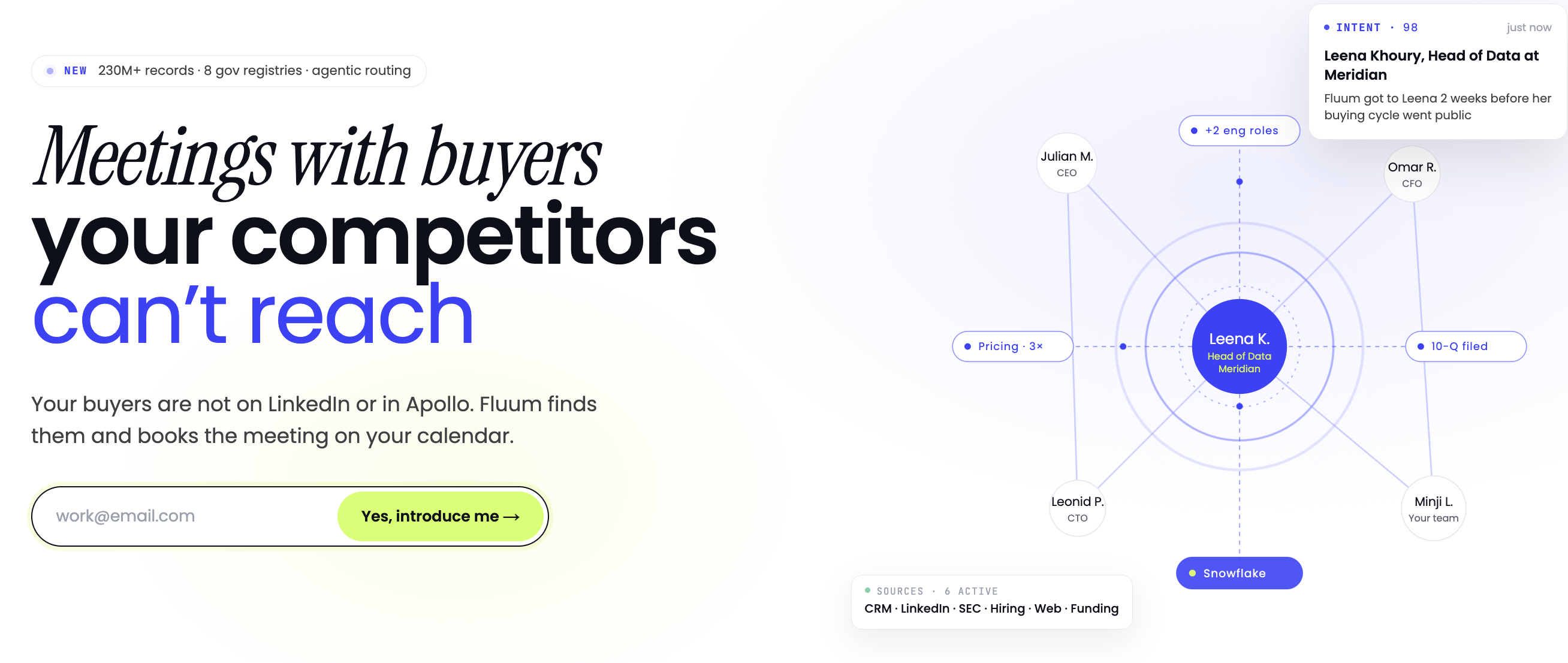
A buyer graph is a network built by cross-referencing multiple data sources to reconstruct actual reporting lines and relationships, not a title match pulled from one directory. It answers a harder question than “who has the right job title”: who actually influences the decision, who reports to whom, and who has approved similar purchases before.
Single-source intelligence produces false positives constantly. A title-only search returns every “VP of Sales” regardless of whether that person controls budget, reports into a CRO who actually signs off, or sits in a division with no authority over the purchase in question. Cross-referencing corporate filings, funding data, and organizational signals across sources corrects for that. When considering what tools do b2b sales teams use to build pipeline without cold outreach, this point stands out.
This is where Fluum’s approach diverges from list-based tools: it queries signals from 100+ government and private databases to identify prospects and map the real path to a decision-maker, rather than handing sales teams a list to cold-pitch. For fintech, cybersecurity, and manufacturing sellers working in regulated markets where the actual buyer is rarely the obvious title, that mapping work replaces weeks of guesswork with a confirmed, mutually interested introduction.
If you’re a senior leader or C-suite executive, talk to Aurora and tell us who you’re looking to meet next, we’ll make sure to send you only what’s relevant.
Which Tools and Strategies Work Best for Building Pipeline in Regulated Industries?
Regulated buyers need pipeline tools that produce a documented, opted-in trail, not just a warm feeling, vendor risk teams need proof of consent, not just proof of relevance.
Why Do Fintech, Cybersecurity, and Manufacturing Buyers Respond Differently to Warm Introductions vs. Cold Outreach?
A cold email to a compliance officer at a bank isn’t just annoying, it’s a flag. Fintech, cybersecurity, and manufacturing buyers often sit inside procurement structures where any unsolicited vendor contact triggers a review before a conversation can even happen. That’s a fundamentally different risk calculation than the one facing a mid-market SaaS buyer who can just archive an email.
This is the gap most guides on this topic skip entirely. Manufacturing procurement answers to supplier-vetting policies. Cybersecurity buyers assume every inbound pitch is either spam or a phishing test. Fintech compliance teams have to document why a vendor conversation started at all. Volume-based outbound doesn’t just underperform here, it actively works against the sales team using it.
How Do Compliance-Aware Platforms Ensure Introductions Meet Regulatory and Opted-In Requirements?
A warm introduction changes the equation because mutual interest does the pre-vetting compliance would otherwise have to do manually. When both sides opt in before contact, the vendor arrives already screened by relevance and consent, not as a stranger compliance now has to investigate.
Mechanically, that requires more than a shared LinkedIn connection. Fluum builds this in directly: every introduction runs through a double opt-in system, so both parties confirm interest before any message is sent, and the match itself draws from signals across 100+ government and private databases rather than scraped contact lists. For regulated buyers, sourcing from registries with a verifiable trail matters as much as the match quality, it’s the difference between an introduction procurement can approve and one they have to interrogate.
Company size shifts what “compliant enough” looks like. An enterprise fintech buyer with a formal vendor risk program will want documented consent records behind every match. A ten-person cybersecurity startup selling into that same fintech may only need the introduction itself, the audit trail can come later, once diligence formally starts.
One note for senior readers specifically: if you’re a C-suite leader or senior sales executive, talk to Aurora and tell us exactly who you’re looking to meet next. We’ll only send matches relevant to that mandate, not a broad list to sort through.
How Should You Sequence Warm Introductions, Opted-In Networks, and Intelligence Tools Into a Pipeline System?
Sequence them in three layers: data and intelligence tools identify and score the right accounts first, opted-in network platforms match those accounts to warm paths in, and the introduction itself is the final trigger that opens first contact.
This order matters because each layer filters the work for the next one. Skip the intelligence layer and your network matching wastes cycles on accounts that were never a fit. Skip the matching layer and you’re back to manually chasing favors from your own contact list, which doesn’t scale past a handful of deals a quarter. The question of this approach comes down to how well these three layers pass clean signal to each other, messy handoffs between layers are where most implementations stall.
What Implementation Timeline and Learning Curve Should You Expect When Combining Multiple Non-Cold-Outreach Channels?
Data and intelligence tools go live fast, often within days, since they’re pulling from existing databases and don’t need relationship-building to function. Opted-in network and warm introduction volume builds more slowly, because it depends on network density growing around your account list. Expect the first few weeks to look thinner than steady-state performance once matches start compounding.
The learning curve is less about the tools and more about what your team measures. Reps trained on volume-based cold metrics, sends, opens, connect requests, need to recalibrate around match quality and introduction acceptance rate instead. A rep who’s used to judging a week by 200 emails sent will initially feel like warm channels are “slow,” even when the pipeline they generate converts at a far higher rate. That mental shift, not the software setup, is usually the longer part of onboarding.
How Do You Measure Pipeline Velocity and ROI When Building Through Warm Channels Instead of Traditional Prospecting?
Reply rate stops being useful once cold email leaves the mix, there’s no send volume to divide by. Track time from introduction to meeting booked and meeting-to-opportunity conversion instead. Fluum, for instance, is built around double opt-in introductions that hit 40–50% response rates, so the meaningful ROI question shifts from “how many did we contact” to “how many introductions turned into real conversations.”
Budget shapes how many layers you can run at once. A budget-friendly setup might mean one intelligence source plus manual referral asks from existing customers. Mid-range and enterprise setups layer in a dedicated matching platform alongside multi-source intelligence pulling from dozens or hundreds of data feeds, which is where tools querying 100+ government and private databases earn their keep for regulated or hard-to-reach markets like finance and manufacturing.
What Team Structure and Roles Best Support a Non-Cold Pipeline Motion?
Shifting away from cold outreach usually changes who owns which part of the pipeline motion. RevOps or a data-focused role typically owns the intelligence layer, keeping scoring models and data feeds current. Sales or partnerships owns the network and matching relationships, making sure the ideal customer profile fed into the platform stays accurate as the market shifts. Reps, in turn, spend less time prospecting and more time preparing for and running the conversations that opted-in introductions produce.
That reallocation is often the biggest organizational change: fewer hours spent building and cleaning cold lists, more hours spent on account research and deal strategy once a warm conversation is already on the calendar. Teams that don’t adjust role expectations accordingly tend to under-resource the intelligence layer, which is the one part of the system that has to stay accurate for the rest of it to work.
Frequently Asked Questions
Can warm introductions fully replace cold outreach for B2B pipeline, or do teams still need both?
Most enterprise sales teams still run both, but the mix shifts heavily toward warm channels once they’re available. Cold outreach can still fill gaps in accounts outside your matched network, but with reply rates under 2% versus 40–50% for double opt-in introductions, the warm channel should carry the bulk of qualified pipeline, not the leftovers.
Do opted-in networks work for early-stage companies with small networks?
Yes, because the value comes from the platform’s network, not yours. Tools like Fluum match you against a curated pool of decision-makers pulled from 100+ government and private databases, so a founder-led sales team with zero personal connections in finance or manufacturing can still get introduced.
How long does it take to see pipeline results from warm introduction platforms compared to cold outreach?
Warm introduction platforms typically produce qualified conversations within the first few weeks, since matching and double opt-in confirmation happen faster than building cold sequence credibility. Cold outreach usually needs months of domain warming, list testing, and sequence iteration before reply rates stabilize, and even then they often land near industry-standard 2% rates.
Are government registries like SEC EDGAR or Companies House useful outside of finance and legal sectors?
Yes, registries like these surface buying signals, new filings, leadership changes, funding events, that apply to manufacturing, technology, and other sectors. Sales and RevOps teams use them to spot trigger moments long before a prospect shows up in a CRM or LinkedIn search.
What should a sales team measure in the first 90 days of moving away from cold outreach?
Focus on leading indicators rather than final pipeline dollar value in the first quarter: introduction acceptance rate, time from match to first conversation, and meeting-to-opportunity conversion. These metrics show whether the warm-channel system is functioning before enough deals have closed to judge revenue impact directly.
Conclusion
Building pipeline without cold outreach means treating relationship data as seriously as contact data. Pull signals from registries and public filings, prioritize double opt-in mechanics over volume, and measure success by reply rate and conversation quality rather than emails sent. Teams stuck below 2% cold reply rates don’t need a better sequence, they need a different channel entirely.
If you’re a VP of Sales or CRO deciding where to shift next quarter’s pipeline budget, start by auditing how many of last quarter’s closed deals began with a warm introduction versus a cold touch. If you’re a senior leader or C-suite executive, talk to Aurora at Fluum and tell her who you’re looking to meet next, she’ll send only what’s relevant.
Sources & References
Recommended Articles
Explore more from our content library: