
| Key Insight | Explanation |
|---|---|
| Government registries are underused data goldmines | Companies House, SEC EDGAR, FCA Register, and SIRENE publish verified company and officer data that most sales teams never query. |
| Registry data reveals intent signals cold lists don’t | Filings like new incorporations, director appointments, and regulatory authorizations signal buying readiness before a company appears on any commercial list. |
| Cold outreach reply rates average 2% in 2026 | Registry-sourced warm introductions consistently achieve 40–50% reply rates when combined with AI matching and double opt-in mechanics. |
| 8+ government registries feed Fluum’s buyer graph | Fluum aggregates data from Companies House, FCA Register, SEC EDGAR, SIRENE, and others alongside 40+ private vendors for full coverage. |
| Regulated industries are the richest hunting ground | Fintech, cybersecurity, and manufacturing companies must file with regulators, making their decision-makers traceable through public records. |
| AI converts raw registry data into pipeline | Without AI scoring, registry data is noise. With it, filing events become ranked, actionable prospect lists with decision-maker paths attached. |
Government registry prospecting is the practice of mining publicly filed corporate, regulatory, and officer data from official government databases to identify and prioritize high-quality B2B sales prospects. Unlike purchased contact lists, registry data is verified, timestamped, and legally mandated, making it one of the most reliable sources of pipeline intelligence available. For enterprise sales teams selling into regulated industries, it’s not a nice-to-have. It’s a structural advantage most of your competitors are ignoring.
Cold outreach built on scraped email lists converts at roughly 2% in 2026. Government registries, when queried intelligently, surface companies at the exact moment they’re most likely to buy: a new FCA authorization, a fresh SEC filing, a director appointment at a Series B company. These are intent signals, not guesses. This guide covers what government registry prospecting actually is, how it works mechanically, why it outperforms traditional outbound, and the exact practices that separate teams doing it well from teams drowning in raw data.

What Is Government Registry Prospecting?
Government registry prospecting is the systematic use of public official filings, from corporate registries to regulatory databases, to identify companies and decision-makers that match a defined ideal customer profile (ICP). The data comes from government-mandated sources, making it inherently more accurate than third-party scraped lists.
The Registries That Matter Most for B2B Sales
Not every government database is equally useful for sales intelligence. The ones with the highest signal density for B2B prospecting include:
- Companies House (UK): Mandatory filing for all UK-registered companies. Reveals incorporation dates, director names, registered addresses, SIC codes, and financial filings. Over 5 million active companies are searchable as of 2026 [1].
- FCA Register (UK): Lists all firms authorized by the Financial Conduct Authority. A new FCA authorization is a near-perfect signal that a fintech or financial services firm is operationally ready to spend.
- SEC EDGAR (USA): The Securities and Exchange Commission’s public filing system. 10-K and 10-Q filings reveal revenue, headcount changes, technology investments, and strategic priorities [2].
- SIRENE (France): France’s national business registry, maintained by INSEE. Covers over 10 million business units with NACE activity codes and legal structure data.
- National Archives (USA): Broader federal records including procurement history and government contractor data [3].
Why “Registry” Data Differs From Commercial Lists
Commercial lead databases aggregate and resell contact data, often sourced from web scraping, job boards, and LinkedIn. Government registries are different. Companies are legally required to file accurate information. Penalties for false filings exist. That legal accountability is what makes registry data structurally superior for prospecting: the company name, director, address, and activity code are verified at source, not inferred.
Industry analysts consistently note that data accuracy degrades by 20–30% annually in commercial databases as people change roles and companies restructure. Registry data, by contrast, reflects legally binding current state. For regulated industries like fintech, cybersecurity, and manufacturing, this accuracy gap is the difference between a warm conversation and a bounced email to someone who left the company eight months ago.
Pro Tip: Start your registry prospecting with SIC or NACE codes rather than company names. Filtering by industry classification code across a full national registry surfaces companies you’d never find by searching for named competitors or known accounts.
How Government Registry Prospecting Works
Government registry prospecting works by extracting structured filing events from official databases, scoring those events against an ICP, and routing the highest-intent matches to sales or introduction workflows. The raw data is public; the intelligence comes from the layer on top.
The Five-Stage Registry Prospecting Process
- Define your ICP parameters: Translate your ideal customer profile into registry-queryable variables. Company size (employee count or revenue band), industry classification code (SIC, NACE, or NAICS), jurisdiction, legal structure, and filing recency all filter cleanly against registry data.
- Select and connect to relevant registries: Choose the registries that match your target geography and sector. A fintech team selling into Europe needs Companies House, FCA Register, and SIRENE. A team targeting US public companies needs SEC EDGAR. Platforms like Fluum aggregate 8+ government registries alongside 40+ private data vendors, removing the need to query each source manually.
- Monitor filing events as intent signals: Set up event-based triggers rather than static exports. A new director appointment, a fresh FCA authorization, a first annual return, or an SEC 8-K filing indicating a major acquisition all signal that a company is in motion and likely evaluating new vendors.
- Score and rank matches: Raw filing events need AI scoring to become actionable. An AI layer cross-references filing events against your ICP, firmographic data, and behavioral signals to rank prospects by fit and timing. This is where government registry prospecting shifts from research to pipeline intelligence.
- Route to warm introduction, not cold outreach: The highest-scoring matches feed into an introduction workflow. At Fluum, we’ve found that registry-sourced prospects introduced through a double opt-in mechanism convert at 40–50% reply rates, compared to 2% for cold email sent to the same type of contact.
Is Prospecting the Same as Mining?
No. Prospecting and mining are sequential, not synonymous. Prospecting is the identification and evaluation phase: finding where valuable targets exist and assessing their quality. Mining (or extraction) is what happens after a viable target is confirmed. In B2B sales terms, government registry prospecting is the identification phase. It tells you which companies to pursue and why, based on verified signals. The actual sales conversation, the “mining,” comes after a warm introduction has been made.
According to the Govology government market training program, effective prospecting requires uncovering both visible and hidden opportunities, a principle that applies equally to government contractor markets and B2B sales intelligence [4].

Key Benefits for B2B Sales Teams in 2026
Government registry prospecting gives sales teams verified, intent-rich prospect data that commercial lists and social platforms simply don’t carry. The structural advantages compound across pipeline quality, conversion rates, and compliance posture.
Pipeline Quality and Conversion Advantages
- Verified decision-maker identity: Registry filings name directors and officers with legal accountability. You know the actual decision-maker, not a job title scraped from a LinkedIn profile that may be six months out of date.
- Timing precision: Filing events are timestamped. A company that filed for FCA authorization 30 days ago is in a fundamentally different buying window than one that filed three years ago. Registry prospecting lets you reach them at the right moment.
- Access to companies not indexed by LinkedIn: Millions of companies, particularly in manufacturing, professional services, and regulated finance, have minimal LinkedIn presence. They do, however, have mandatory registry filings. Government registry prospecting reaches buyers that cold outreach tools and LinkedIn don’t index.
- Lower competition for attention: Most sales teams rely on the same commercial data providers. Registry-sourced prospects haven’t received 300 cold emails this week from your competitors, because your competitors aren’t querying Companies House.
- Compliance-friendly data sourcing: Under GDPR and equivalent frameworks, using publicly filed government data as a basis for outreach is on significantly firmer legal ground than using scraped personal data. This matters for teams selling into financial services and healthcare.
The Numbers That Make the Case
| Prospecting Method | Average Reply Rate | Data Accuracy | Buyer Awareness |
|---|---|---|---|
| Cold email (purchased list) | ~2% | Degrades 20–30%/year | Recipient did not opt in |
| LinkedIn outreach | 3–8% | Self-reported, unverified | Recipient did not opt in |
| Registry-sourced warm intro (double opt-in) | 40–50% | Government-verified at source | Both parties confirmed interest |
| Grant/government contractor prospecting | Varies by program | Registry-verified | Buyer actively seeking vendors |
Research from Bain and Company consistently shows that B2B buyers are 5x more likely to engage when introduced through a trusted third party rather than receiving unsolicited contact. Registry prospecting identifies the right targets; warm introduction mechanics deliver the engagement rate.
For teams in regulated sectors, the Project on Government Oversight’s guide to public records tools outlines how structured public data can be used to build accurate, legally grounded contact intelligence [5].
Pro Tip: Layer FCA Register authorization dates against Companies House incorporation dates for UK fintech targets. Companies that received FCA authorization within 12 months of incorporation are in rapid-growth mode and typically evaluating 3–5 new vendor categories simultaneously. That’s your window.
Common Challenges and Mistakes to Avoid
Government registry prospecting fails most often not because the data is bad, but because teams treat raw registry exports as finished prospect lists. The data is the starting point, not the output.
The Four Most Common Mistakes
- Treating a registry export as a contact list: A Companies House export gives you company names and director names. It doesn’t give you email addresses, phone numbers, or context about whether this company is actually in your ICP. Teams that skip the enrichment and scoring step end up with a spreadsheet that’s technically accurate and practically useless.
- Ignoring filing recency: A director appointment from 2019 is not an intent signal. A director appointment from last month is. Without filtering by filing date, registry prospecting produces the same stale-data problem as purchased lists. Always filter by recency, and set up ongoing event monitoring rather than one-time exports.
- Querying only one registry: A manufacturing company with UK operations, a French subsidiary, and US investors will appear in Companies House, SIRENE, and SEC EDGAR. Querying only one registry gives you a partial picture. Multi-registry aggregation, the approach Fluum uses across 8+ government sources, surfaces the full organizational structure and the right entry point.
- Skipping the warm introduction layer: Registry data identifies who to reach. It doesn’t solve the cold outreach problem. A team that pulls FCA-authorized fintechs from the register and then sends cold emails to their directors has done good prospecting and bad sales execution. The data advantage evaporates the moment you hit send on a generic cold message.
Compliance Considerations as of 2026
Using government registry data for outreach sits in a legally nuanced space. In the UK and EU, GDPR applies to personal data including director names even when that data is publicly available. The legitimate interest basis (under GDPR Article 6(1)(f)) is the most commonly applied legal basis for B2B prospecting from public records, but it requires a documented balancing test. For teams selling into financial services, healthcare, or any regulated sector, a brief legal review of your outreach methodology is worth the hour it takes.
The Grant Ready Kentucky prospect research framework offers a useful parallel: even in grant prospecting, identifying the right funder requires structured research methodology, not just data access [6]. The same discipline applies to commercial registry prospecting.
For teams looking to understand how structured public data intersects with senejac.com and similar business intelligence workflows, the key principle is that data quality upstream determines pipeline quality downstream.
Best Practices for Government Registry Prospecting in 2026
The teams getting the most from government registry prospecting in 2026 share three characteristics: they’ve defined precise ICP parameters that translate into registry queries, they treat filing events as triggers rather than static filters, and they route matches into warm introduction workflows rather than cold sequences.
Building a Registry Prospecting Stack That Scales
- Map your ICP to registry variables first. Before touching a database, translate your ideal customer description into queryable fields: SIC code range, jurisdiction, company age band, director appointment recency, and filing type. This translation step is where most teams skip ahead and then wonder why their results don’t match their ICP.
- Set event triggers, not one-time exports. The highest-value registry signals are time-sensitive. New FCA authorizations, fresh incorporations in your target sector, and director appointments all have a window of relevance. Configure ongoing monitoring so your team sees these events within days, not months.
- Enrich registry data before scoring. Government registries give you structure and verification. They don’t give you email addresses or LinkedIn profiles. Layer a data enrichment step between registry extraction and ICP scoring to add contact-level data from opted-in sources.
- Score for fit AND timing simultaneously. A company that’s a perfect ICP fit but filed its last relevant event 18 months ago scores lower than a slightly less perfect fit that filed last week. Build timing weight into your scoring model.
- Route top matches to warm introduction, not cold outreach. The entire point of the registry prospecting advantage is reaching verified, relevant buyers. Don’t throw that advantage away by cold-emailing them. Use a double opt-in introduction mechanism to ensure the first contact is warm, mutual, and context-rich.
The Role of AI in Scaling Registry Prospecting
Manual registry prospecting doesn’t scale. A single analyst querying Companies House can process hundreds of records per week. An AI layer processing the same registry across millions of records, cross-referencing 40+ private data sources, and scoring every match against a dynamic ICP can do it continuously and in real time.
The Govology government prospecting training program emphasizes that uncovering hidden opportunities requires systematic methodology, not just access to data [7]. AI scoring is what converts systematic methodology into pipeline at scale.
According to the National Archives research guidance, structured public records have been used for institutional research for decades. The shift in 2026 is applying that same structured approach to real-time commercial prospecting, with AI doing the heavy lifting [8].
Pro Tip: If you’re a senior leader or C-suite executive reading this, talk to Aurora at Fluum and tell us who you’re looking to meet next. We’ll make sure to send you only the introductions that are actually relevant to your pipeline goals, sourced from the exact registry signals described in this article.
Sources and References
- aINSIGHT, “Government and Registry Searches,” 2026
- Govology, “Prospecting for Government Market Opportunities,” 2025
- National Archives, “Research Our Records,” 2026
- Govology, “Government Market Prospecting Training,” 2025
- Project on Government Oversight, “5 Great Online Tools for Mining Public Records,” 2026
- Grant Ready Kentucky, “Grant Prospect Research Part I,” 2026
- McNulty Center, “GOVOLOGY: Winning Strategies for Government Prospecting,” 2026
- The Grant Plant NM, “Grants Prospecting: Basic Tips and Tools,” 2026
Frequently Asked Questions
1. Is prospecting the same as mining?
No. Prospecting and mining are distinct, sequential phases. Prospecting is the identification and qualification stage: determining where valuable targets exist and whether they meet your criteria. Mining is the extraction phase that follows a confirmed find. In B2B sales, government registry prospecting identifies which companies and decision-makers are worth pursuing based on verified filing signals. The actual sales engagement, the “mining,” only begins after a qualified prospect has been identified and a warm introduction has been made.
2. Which government registries are most useful for B2B sales prospecting?
The most useful registries depend on your target geography and sector. For UK-focused teams, Companies House (corporate filings) and the FCA Register (financial services authorizations) are the highest-signal sources. For US markets, SEC EDGAR provides detailed public company filings including revenue, headcount, and strategic disclosures. For France and broader EU coverage, SIRENE offers national business unit data. Teams selling across multiple geographies benefit most from platforms that aggregate multiple registries simultaneously rather than querying each source manually.
3. How does government registry prospecting differ from buying a lead list?
The fundamental difference is data provenance and accuracy. Purchased lead lists aggregate contact data from web scraping, job boards, and third-party sources, with accuracy degrading 20–30% annually as people change roles. Government registry data is legally mandated, filed by the company itself, and carries penalties for inaccuracy. Registry data tells you a company exists, what it does, who leads it, and when key events happened. A purchased list tells you someone’s job title as of the last scrape date. For regulated industries, that accuracy gap is significant.
4. Is it legal to use government registry data for sales outreach?
Generally yes, but with important nuances. Government registries are public by design, and using publicly filed data as the basis for identifying potential business contacts is legally recognized in most jurisdictions. Under GDPR (applicable in the UK and EU), the legitimate interest basis under Article 6(1)(f) covers B2B outreach where there’s a genuine business relevance between the contact and your offer. That said, cold outreach to personally identified directors still requires a documented legitimate interest assessment. Using a double opt-in introduction system, where both parties confirm interest before contact is made, sidesteps most of these compliance concerns entirely.
5. What filing events make the strongest intent signals in government registry prospecting?
The highest-intent filing events, in approximate order of signal strength, are: new regulatory authorizations (FCA, SEC registration), director appointments at the C-suite or VP level, new company incorporations in target sectors, first annual return filings (indicating a company has survived its first year and is scaling), and M&A-related filings such as SEC 8-K disclosures. Each of these events indicates organizational momentum. A company that just received FCA authorization is actively building its vendor stack. A company with a new CFO appointment is likely reviewing financial technology and services contracts. Timing your outreach to these events is what separates registry prospecting from static list-building.
6. How does AI improve government registry prospecting outcomes?
AI transforms registry prospecting from a research task into a pipeline engine. Without AI, a team manually querying registries can process hundreds of records per week and will miss most relevant filing events. With AI, millions of records across multiple registries are processed continuously, scored against your ICP in real time, and ranked by fit and timing simultaneously. AI also cross-references registry data with signals from private databases, including technographic data, funding events, and behavioral signals, to produce a richer prospect profile than any single source can provide alone. The output isn’t a data dump. It’s a ranked list of warm, verified prospects ready for introduction.

Conclusion
Government registry prospecting isn’t a niche tactic for compliance researchers. It’s a structural pipeline advantage for any B2B sales team selling into regulated or hard-to-reach markets. The data is verified, the signals are time-sensitive, and the companies you find through registries are invisible to every team relying on the same commercial databases and LinkedIn exports your competitors are using.
The gap between knowing about registry prospecting and actually building pipeline from it comes down to three things: AI scoring that converts raw filings into ranked prospects, multi-registry aggregation that catches companies across jurisdictions, and a warm introduction mechanism that turns a verified prospect into a conversation that actually gets replied to.
Government registry prospecting, done right, isn’t cold outreach with better data. It’s a completely different motion: finding the right companies at the right moment and reaching them through a channel where both sides have said yes before the first word is exchanged. That’s what delivers 40–50% reply rates while the rest of the market argues over subject line A/B tests.
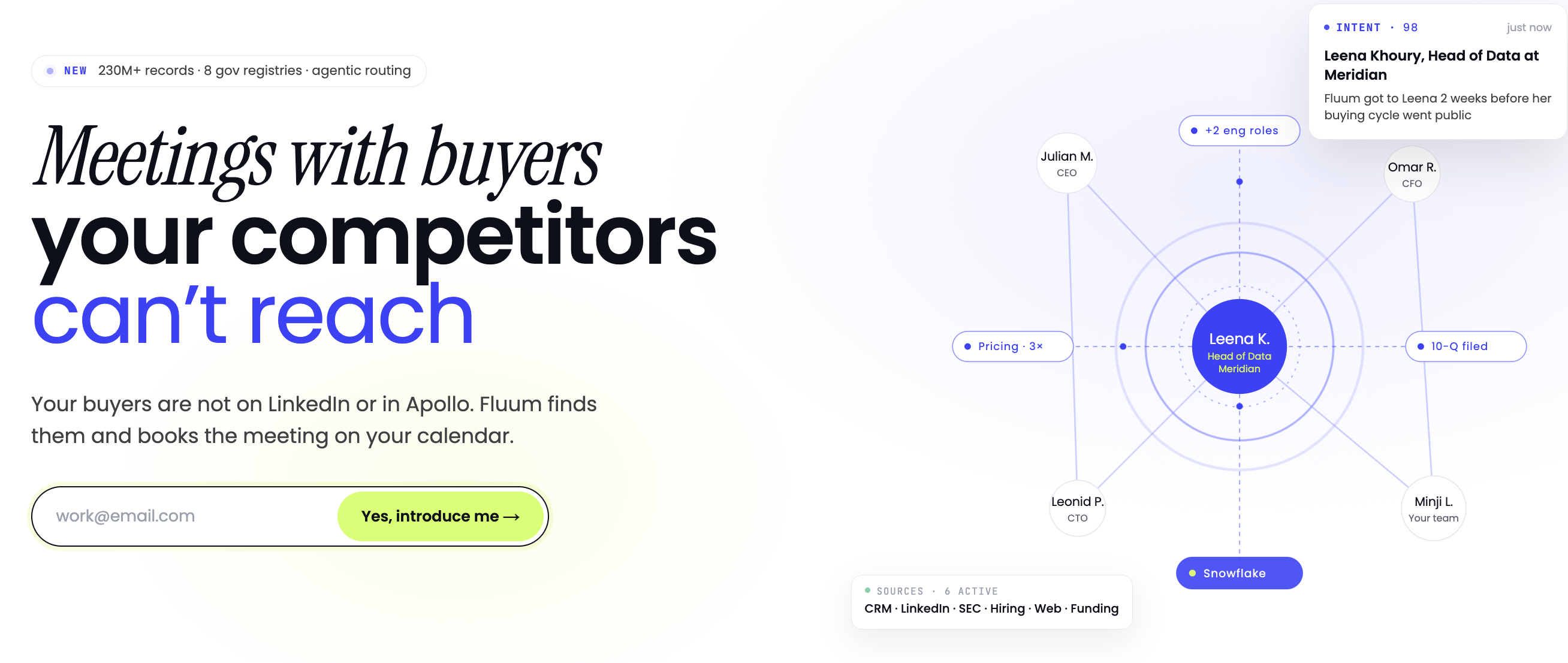
Fluum builds buyer graphs from 8+ government registries and 40+ private data vendors, scores intent signals with AI, and delivers warm double opt-in introductions to the decision-makers your team needs to meet. If you’re ready to replace cold outreach with pipeline that actually converts, Fluum is where that starts.
Recommended Articles
Explore more from our content library: