
Cybersecurity buyer intelligence is the practice of collecting and analyzing real-time behavioral, firmographic, and intent data to identify which organizations are actively evaluating cybersecurity solutions, and why. Unlike static prospect lists, it surfaces buying signals before a vendor ever enters the conversation: job postings, tech stack changes, compliance deadlines, and breach-related search activity. Sales and GTM teams use it to prioritize outreach, shorten sales cycles, and stop wasting quota on accounts that were never going to buy.

What Is Cybersecurity Buyer Intelligence and How Does It Work?
Cybersecurity buyer intelligence aggregates real-time intent signals across dozens of data sources to build a buying-stage profile for every account in your target market.
The inputs are specific: job postings advertising for a new CISO or security architect, tech stack changes detected through job description keywords, regulatory deadlines tied to SEC cybersecurity disclosure rules, dark web mentions of a company’s domain, and spikes in third-party review activity on platforms like G2. Each signal, individually, is noise. Combined and weighted against a target account, they produce a reliable picture of where a buyer sits in their decision process.
The mechanics work like this. A buyer intelligence platform continuously ingests data from LinkedIn hiring patterns, SEC filings, breach news feeds, and review site activity. It then maps those signals to a buying stage, awareness, active evaluation, or vendor selection, and surfaces accounts that cross a threshold your sales team has defined as “in-market.” Your reps don’t guess. They call accounts that are already moving.
How Real-Time Buyer Intelligence Differs from Traditional Sales Assumptions
Most security vendors still build their outreach lists on static firmographic filters: “target CISOs at companies with 500–5,000 employees in financial services.” That approach produces cold email reply rates below 2%, a figure consistent with what Fluum’s own data shows across B2B outbound channels.
Signal-based outreach changes the variable that matters. Instead of targeting a job title at a company size, you’re reaching an account that posted three security engineer roles last month, replaced its SIEM vendor, and had a domain credential appear in a dark web dump. That account is buying. The timing is the intelligence, and outreach timed to active buying signals can reach 40–50% reply rates because the message lands when the problem is live.
Buyer intelligence doesn’t replace outreach. It tells you who to call, when to call, and what problem they’re actively trying to solve right now. The channel is still yours to own; the signal tells you where to point it.
What Data Privacy and Security Certifications Should Buyer Intelligence Platforms Have?
Any platform handling account-level behavioral data, breach signals, and firmographic records must meet a minimum certification baseline before you hand it access to your ICP data.
Demand SOC 2 Type II certification, not Type I, which is a point-in-time audit. SOC 2 Type II covers a rolling period, typically six to twelve months, and tests whether security controls actually operate as designed. ISO 27001 certification confirms the platform runs a documented information security management system. GDPR compliance is non-negotiable if any of your target accounts are based in the EU, and CCPA alignment covers California-resident data processed in the signal layer. For more on data protection standards, the NIST Cybersecurity Framework provides authoritative guidance on security controls and risk management practices that reputable platforms should align with.
Ask vendors for their most recent audit reports, not just a checkbox on a features page. A platform ingesting G2 review spikes, SEC filings, and dark web data is handling sensitive commercial intelligence, the certification stack should reflect that responsibility.
Key Types of Cybersecurity Buyer Intelligence and the Frameworks Behind Them
Cybersecurity buyer intelligence draws from four distinct threat intelligence types, each mapping to a different buyer persona, urgency level, and stage in the purchase cycle.
The 4 Types of CTI and How They Apply to Buyer Intelligence
Cyber threat intelligence breaks into four layers, and each one tells a sales team something different about who is ready to buy and why.
- Strategic CTI speaks to board-level risk narratives, geopolitical exposure, sector-wide attack trends, regulatory pressure. The buyer here is a CISO or CFO building a business case for budget. Their urgency is measured in quarters, not days.
- Tactical CTI covers attacker tactics, techniques, and procedures (TTPs). The buyer is a security architect or detection engineer evaluating whether a vendor’s controls actually stop the methods attackers use against their industry.
- Operational CTI tracks active campaigns, a ransomware group targeting financial services right now. This creates acute, short-cycle urgency. A buyer responding to an active threat moves from evaluation to purchase in days.
- Technical CTI covers indicators of compromise (IOCs), malware signatures, and IP blocklists. The buyer is a SOC analyst or threat hunter. Purchasing decisions here are often delegated rather than executive-led.
Mapping CTI type to buyer persona tells you which conversation to have and how fast to move. Treating every cybersecurity prospect as a single audience type is how pipeline stalls.
Firmographic data alone, company size, industry, revenue, cannot make this distinction. It is a lagging indicator that tells you a company could buy, not that they are actively evaluating. Combining firmographic signals with behavioral data (content consumption, event attendance, RFP activity) and technographic data (current security stack, tool gaps) is what separates useful cybersecurity buyer intelligence from a glorified spreadsheet. The Cybersecurity and Infrastructure Security Agency (CISA) publishes ongoing threat advisories that can inform which CTI signals are most relevant to your target accounts at any given time.
The 5 C’s of Cybersecurity and Why They Drive Buying Decisions
The 5 C’s, Change, Compliance, Cost, Coverage, and Continuity, are the five pressure points that most reliably trigger a cybersecurity purchase.
- Change: A merger, cloud migration, or leadership transition destabilizes the existing security posture and opens budget.
- Compliance: A new regulatory mandate, DORA, NIS2, SEC disclosure rules, creates a non-negotiable deadline. A CISO responding to a compliance mandate is a fundamentally different buyer than one responding to a breach.
- Cost: Rising cyber insurance premiums or a failed audit forces a spend reallocation.
- Coverage: A gap identified in a penetration test or red team exercise creates a specific, scoped purchase.
- Continuity: A near-miss incident or a peer company’s public breach shifts risk tolerance overnight.
Buyers complete 57–70% of their evaluation before contacting a vendor, according to research from Gartner and Forrester. Intelligence that identifies a buyer in the first 30% of that journey, when the 5 C’s trigger is fresh and budget is still unallocated, is worth disproportionately more than data that arrives after a shortlist is already formed. For more information, see Home.
Platforms like Fluum pull signals from 100+ government and private databases to surface exactly these early-stage triggers, matching sellers to buyers before the evaluation window closes.

How Cybersecurity Buyer Intelligence Platforms Compare to the Alternatives
Purpose-built cybersecurity buyer intelligence platforms outperform general-purpose tools because their signals are tuned to security buying events, not generic B2B activity.
CyberSynapse vs. G2, Capterra, and General-Purpose Alternatives
CyberSynapse [1] is designed specifically for cybersecurity GTM. Its signal layer tracks events that actually move security budgets, compliance deadlines, breach disclosures, and CISO replacement cycles. A general-purpose outbound database tracks job changes and company size; it won’t tell you a target account just failed a PCI-DSS audit or hired a new security leader three months ago. Both of those are high-conversion triggers that generic tools miss entirely.
G2 and Capterra intent products show which accounts are actively researching your software category on their platforms. That’s useful, but it captures only buyers already in evaluation mode who already know review sites exist. Early-stage signals, the ones that surface accounts before they’ve started a formal vendor search, are invisible to them.
LinkedIn Sales Navigator surfaces hiring data and connection graphs, but it requires a rep to manually interpret what a CISO hire or a compliance team expansion actually means for pipeline timing. The platform doesn’t connect those dots. Clutch.co sits even further from the seller’s workflow, it’s a destination where buyers research vendors, not a tool that pushes proactive intent signals to your sales team. Specialized platforms like Cyber Buyer illustrate how purpose-built cybersecurity procurement tools differ from horizontal alternatives by focusing exclusively on security software and managed security services.
Pricing Tiers and ROI Models: What to Expect Before You Sign
Dedicated cybersecurity intelligence platforms typically run $1,500–$6,000 per month depending on seat count and signal depth [3]. G2 intent tiers start around $1,000 per month. A general-purpose outbound tool can start as low as $49 per user per month, but vertical specificity is absent at that price point.
The ROI calculation should be anchored to average deal size, not platform cost. A single closed cybersecurity enterprise deal at $150,000 ACV justifies twelve months of a $6,000/month platform if it converts one additional opportunity per quarter. Platforms like Fluum, which pulls signals from 100+ government and private databases and delivers double opt-in introductions, apply the same logic: the metric that matters is cost per qualified conversation, not cost per seat. For a detailed look at platform capabilities, the CyberSynapse platform overview demonstrates how purpose-built signal layers are structured for cybersecurity GTM teams.
What Measurable Results Should You Expect from Buyer Intelligence?
Cybersecurity buyer intelligence delivers pipeline growth of 20–40%, faster sales cycles, and win rates 2–3x higher on high-intent accounts, within two quarters of implementation.
Specific Metrics That Show ROI: Pipeline Growth, Cycle Reduction, Win Rate
Teams using intent-driven outreach report 20–40% pipeline growth within two quarters. The lift comes as much from prioritization as from net-new discovery, fewer wasted touches on cold accounts means reps spend more time on buyers who are actually evaluating.
Sales cycle compression is equally significant. Mid-market cybersecurity deals typically run 60–120 days. Identifying a buyer in the first 30% of their evaluation, before they’ve shortlisted three vendors, can cut that cycle by 15–30 days. That’s not a marginal gain; at scale, it’s the difference between hitting and missing a quarterly number.
Win rate data is where the urgency becomes undeniable. Accounts contacted within 24–48 hours of a high-intent signal, a CISO job posting, a compliance deadline trigger, a new regulatory filing, convert at 2–3x the rate of accounts contacted without that signal context. Speed to signal is now a competitive weapon.
The Revenue Cost of Missing Weak Buyer Signals
Most teams only act on strong signals: demo requests, inbound forms, direct replies. The problem is that 80% of in-market buyers never fill out a form. They research quietly, shortlist internally, and surface only when they’re ready to decide, often with a preferred vendor already in mind.
Put a number on what that costs. If your average cybersecurity deal is worth $80,000 ARR and you lose 3 deals per quarter to competitors who reached the buyer first, that’s $240,000 per quarter in preventable revenue loss. Measure the platform cost against that number, not against a monthly SaaS fee, and the ROI math becomes straightforward.
Platforms like Fluum address this gap by pulling signals from 100+ government and private databases to surface buyers who are in-market but invisible to standard outreach tools, matching them to sellers before the shortlist closes.
How to Implement Cybersecurity Buyer Intelligence in Your Sales Process
Most teams are live and generating actionable pipeline signals within 30–60 days, if they align the right internal stakeholders before day one.
Onboarding Timeline and the First 90 Days
Plan for 2–4 weeks of setup before useful data flows. CRM integration, ICP configuration, and signal calibration all need to complete before your SDRs see anything worth acting on. Set this expectation with leadership on day one, premature ROI pressure in week two kills adoption before the platform has a fair chance.
Three internal stakeholders must be aligned before you go live. Sales ops owns CRM hygiene, without which signal data maps to the wrong accounts. SDR team leads design the sequences that fire when a signal hits. Legal and compliance sign off on data handling, skipping this step in regulated industries like cybersecurity routinely delays launch by three to four weeks.
Threat intelligence analyst roles that include GTM or product marketing scope are commanding $110,000–$145,000 base in 2025, which reflects genuine market demand for people who can translate technical signals into commercial decisions. If you’re staffing this function, hire for that translation skill first. The SANS Institute cybersecurity skills roadmap provides useful context for understanding the competency profiles that make buyer intelligence analysts effective in GTM roles.
Building Signal-Triggered Sequences That Actually Convert
The four-step workflow that makes cybersecurity buyer intelligence operational: define your ICP with signal criteria, not just firmographics like headcount or revenue; connect the platform to your CRM and sequencing tool; build signal-triggered sequences where a compliance deadline fires a different message than a CISO hire; then review and recalibrate signal weights monthly against actual conversion data.
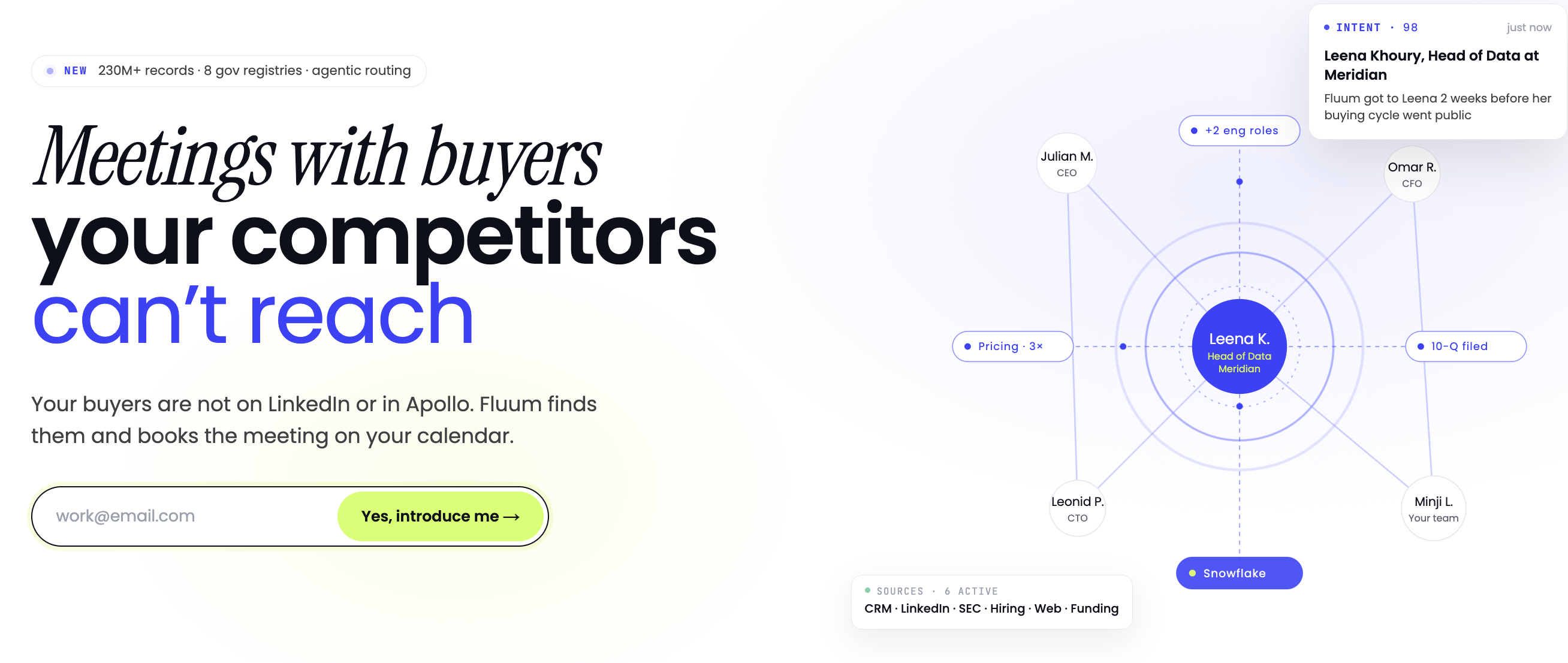
The signal tells you what to say. Your network determines whether they read it. Buyer intelligence collapses into another cold blast if the outreach channel doesn’t match the context the signal provides. Fluum’s double opt-in introduction model, where both parties confirm interest before the first message is sent, is built precisely for this gap: the signal surfaces the right buyer at the right moment, and the warm introduction mechanic ensures the message lands in a conversation, not a spam folder.
If you’re a senior leader or C-suite evaluating how warm introductions fit your GTM motion, talk to Aurora at Fluum and tell us who you’re looking to meet next, we’ll send you only what’s relevant to your ICP.

Frequently Asked Questions
What data privacy certifications should a cybersecurity buyer intelligence platform have?
Look for SOC 2 Type II, ISO 27001, and GDPR compliance at minimum, these confirm the platform handles prospect data under audited controls, not just a privacy policy. If your buyers are in financial services or healthcare, also verify CCPA compliance and ask whether the vendor signs a Data Processing Agreement. Platforms pulling from government and commercial databases, like Fluum’s 100+ source signal layer, should document their data provenance and retention policies explicitly.
How does buyer intelligence differ from traditional lead scoring?
Lead scoring ranks contacts you already have; buyer intelligence surfaces new contacts based on real behavioral and contextual signals before they enter your CRM. Traditional scoring weights fields like job title and email opens, inputs your team controls. Buyer intelligence reads external signals: procurement activity, technology stack changes, hiring patterns, and regulatory filings. The result is a list of accounts showing active buying intent, not just demographic fit.
Can small cybersecurity vendors benefit from buyer intelligence, or is it only for enterprise GTM teams?
Small cybersecurity vendors benefit significantly, the signal advantage matters most when you can’t afford to waste outreach on unqualified accounts. A 10-person sales team running cold sequences at 2% reply rates loses more proportionally than an enterprise with 50 SDRs absorbing the same failure rate. Buyer intelligence lets a lean team concentrate every conversation on accounts showing active purchase signals, which is exactly the efficiency gain that moves a $2M ARR vendor toward $10M without doubling headcount.
What is the typical ROI timeline for a cybersecurity buyer intelligence platform?
Most teams see measurable pipeline impact within 60–90 days, assuming clean ICP definition and consistent signal review. The first 30 days typically go to integration, baseline measurement, and first-signal identification. Deals sourced from buyer intelligence still carry a normal sales cycle, 3 to 9 months in cybersecurity, so full revenue ROI lands at the 6-month mark for most mid-market vendors. Teams using warm introduction channels alongside intent data compress that timeline further.
How should cybersecurity sales teams prioritize which buyer signals to act on first?
Prioritize signals that indicate urgency and budget authority simultaneously. A CISO hire combined with a compliance deadline trigger outranks a single job posting for a security analyst. Rank signals by three factors: recency (signals older than 30 days lose conversion value quickly), seniority of the role or event driving the signal, and alignment with your solution’s core use case. Build a scoring matrix that weights these factors and review it quarterly against actual win data to keep calibration accurate.
Conclusion
Cybersecurity buyer intelligence works when it connects three things: verified behavioral signals, accurate contact data tied to real buying authority, and an outreach channel those contacts will actually respond to. Getting two out of three right still produces a broken pipeline.
The clearest action you can take now is to audit your current outbound data against one question: does it tell you when an account is buying, or only who works there? If the answer is the latter, you’re running on demographics, not intelligence.
If you’re a senior leader or C-suite executive in cybersecurity sales, talk to Aurora at Fluum, tell her who you’re looking to meet next, and she’ll make sure you only see introductions that match.
Sources & References
- Cybersecurity Buyer Intelligence That Fuels Revenue | CyberSynapse
- Cybersecurity Buyer Intelligence Platform | CyberSynapse
Recommended Articles
Explore more from our content library: