
Fintech prospect identification is the process of finding, filtering, and qualifying companies or individuals most likely to buy a fintech product or service, before you spend a single dollar on outreach. It matters because fintech sales cycles are long, compliance requirements are strict, and generic lead lists burn trust fast. The highest-performing fintech sales teams use firmographic filters, behavioral signals, and AI-powered scoring to build a short list of prospects who actually fit, then pursue them with precision.

What Fintech Prospect Identification Actually Is (and Why Most Teams Get It Wrong)
Fintech prospect identification is a pre-pipeline discipline, the quality of every deal you close is decided before your first outreach message is sent.
It’s the systematic process of locating and pre-qualifying buyers using firmographic, technographic, and behavioral data specific to financial services contexts. That last part matters. Fintech isn’t generic SaaS. A prospect who looks perfect on paper, right company size, right title, right geography, can still be a dead end if they’re running a legacy core banking system that’s incompatible with your product, or if they’re locked into a three-year vendor contract with no renewal clause until 2026.
Key Characteristics of a High-Quality Fintech Prospect
A genuinely qualified fintech prospect clears four filters simultaneously. First, company size and revenue tier must match your product’s deployment requirements, a $2M community bank and a $200M regional lender are not interchangeable targets. Second, there’s an active digital transformation budget: not a vague “we’re exploring options” signal, but a confirmed line item or a recent RFP. Third, the tech stack is relevant, a payment processor or core banking platform already in use tells you about integration complexity and vendor relationships. Fourth, there’s a named decision-maker with actual budget authority, not just an influencer who’ll route you to a procurement committee for six months.
How Fintech Prospect Identification Differs from Traditional B2B Sales Prospecting
Generic B2B prospecting assumes a relatively short path from contact to contract. Fintech deals don’t work that way. Compliance gatekeepers, multi-stakeholder procurement committees, and regulatory fit checks, does your product meet SOC 2, PCI-DSS, or GDPR requirements?, add layers that standard SaaS prospecting frameworks ignore entirely [3].
The total addressable market is also smaller than most teams admit. There are roughly 26,000 fintech companies globally as of 2024 (Statista), but the subset that matches a specific product’s regulatory profile, integration requirements, and revenue tier can shrink that number to a few hundred real targets.
Most teams skip this math. They buy a contact export, load it into a sequencing tool, and blast cold email, then wonder why reply rates sit below 2% [3]. That failure isn’t a messaging problem. It’s an identification problem. Cold volume plays collapse in fintech because a generic pitch to the wrong compliance environment signals immediately that the sender hasn’t done the work. Trust erodes before the conversation starts.
The teams that consistently book qualified meetings treat fintech prospect identification as a research function, not a list-generation task. Every contact that enters the pipeline has already cleared firmographic, technographic, and behavioral filters, so the outreach that follows lands in context, not in the spam folder. For a practical overview of how top-performing teams approach this, see how to prospect for new customers from the RMA Blog.
How to Identify and Qualify a Fintech Prospect: Frameworks That Actually Work
Qualifying a fintech prospect requires four layers of fit: firmographic, technographic, intent signals, and relationship proximity, in that order.
Frameworks and scoring models for assessing fintech prospect quality
Start with firmographic fit: company size, sector, and geography. A payments infrastructure vendor selling into regulated markets cares whether a prospect operates under FCA, SEC, or MAS oversight, not just whether they’re in “financial services.”
Technographic fit comes next. If your product requires API integration with a core banking platform, a prospect running a legacy monolith is a poor match regardless of budget. Stack compatibility determines implementation speed, and implementation speed determines whether a deal closes this quarter or next year. Understanding how fintech partners integrate with intelligent banking platforms can help you assess compatibility requirements before outreach begins.
Intent signals are where fintech prospect identification gets specific. Job postings are one of the clearest triggers, a company advertising for a “Head of Compliance” or “VP Payments Engineering” is signaling active infrastructure investment, not theoretical interest. Funding rounds carry equal weight: Series B+ fintech companies actively expanding their stack are 3–4x more likely to be in an active buying cycle than seed-stage companies.
Relationship proximity, warm path versus cold, is the layer most scoring models ignore entirely. A prospect reachable through a mutual connection converts at a fundamentally different rate than one sitting in a purchased list.
BANT and MEDDIC give sales teams a useful baseline for budget and authority qualification. Both frameworks fall short for fintech because neither accounts for regulatory readiness or compliance budget, two factors that routinely kill deals that look qualified on every other dimension.
How AI and machine learning improve fintech prospect qualification
Predictive scoring models trained on closed-won data surface lookalike accounts with 60–70% higher conversion likelihood than manual list-building. The model learns which firmographic and technographic combinations actually closed, not which ones looked good on paper.
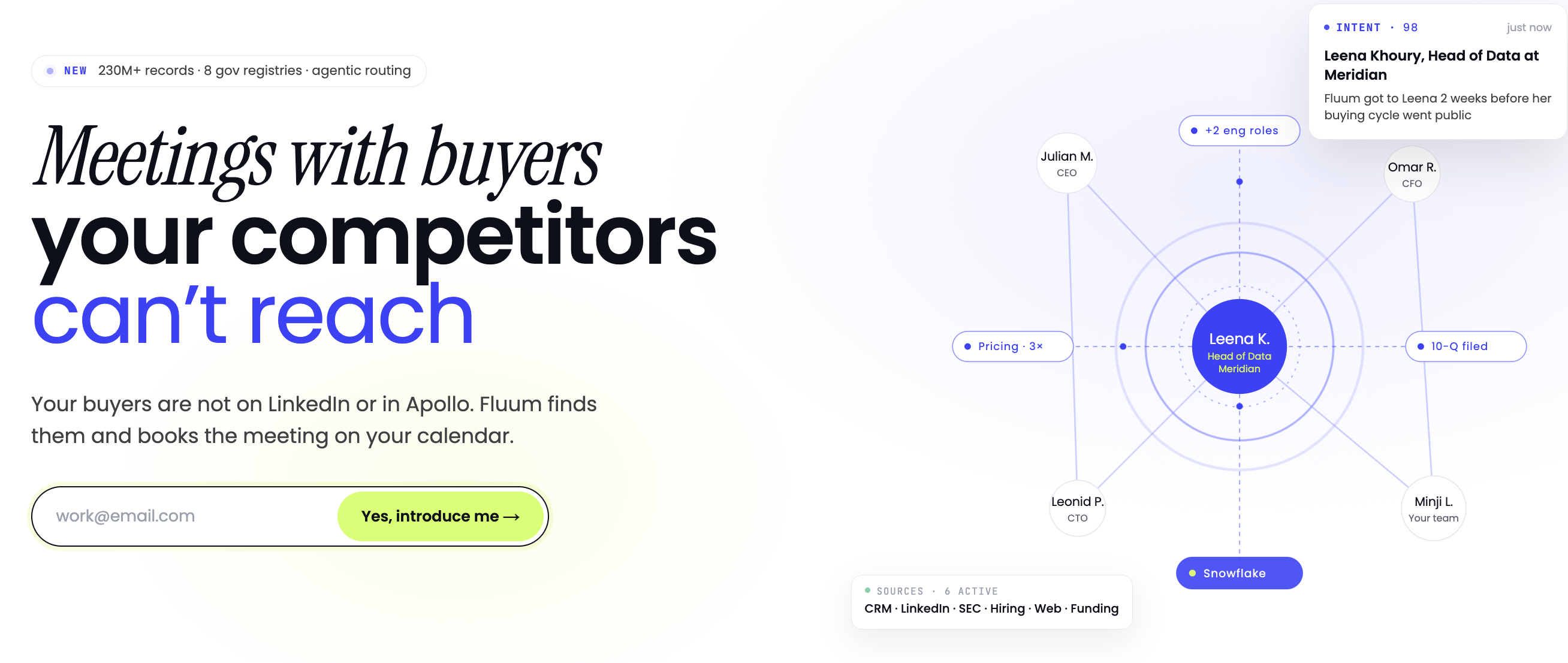
Platforms like Fluum apply this logic at the signal layer, pulling data from 100+ government and private databases to match prospects against a defined ideal customer profile before any outreach happens. The result is a shortlist of accounts that fit on all four qualification layers, not just the two that are easiest to check.
The shift AI enables is from reactive scoring, grading inbound leads after they arrive, to proactive identification of accounts already in a buying motion, before they raise their hand.

Best Tools for Fintech Prospect Identification: Apollo, ZoomInfo, 6sense, and Beyond
For fintech prospect identification, the right platform depends on your deal size, compliance requirements, and whether you need contact volume or account-level intent signals.
How Apollo, ZoomInfo, and 6sense compare for fintech prospect identification
Each platform occupies a distinct position. Apollo wins on price-to-data-volume ratio and performs well when you’re targeting SMB fintech companies, you get broad contact coverage at a cost that doesn’t require CFO sign-off. ZoomInfo leads on enterprise firmographic depth and direct-dial accuracy, making it the default choice when you’re selling into large banks or insurance groups where reaching the right person matters more than reaching many people. 6sense differentiates on account-level intent data and anonymous buyer journey tracking, it tells you which enterprise accounts are actively researching solutions like yours before they raise their hand.
A contact database tool also worth naming: LinkedIn Sales Navigator maps relationships and flags job changes, which helps you time outreach. Its ceiling is real, though, it shows you who exists and who moved roles, but not who is actively in-market or who you can reach through a trusted mutual connection.
The decision matrix is straightforward. ACV under $20K: Apollo. Selling to enterprise banks: ZoomInfo plus a 6sense intent layer. Close rate that depends on trust and referral: add a warm introduction platform on top of either.
None of these platforms fill one critical gap, warm-path introductions. Apollo and ZoomInfo surface contacts, but neither can tell you who in your network already has a trusted relationship with that prospect. That’s where introduction-led platforms create a distinct advantage. Fluum, for example, queries signals from 100+ government and private databases and then facilitates double opt-in introductions, so both parties confirm interest before the first message is sent, delivering 40–50% reply rates against the 2% cold email benchmark.
What features a fintech prospect identification tool must have
Fintech sales teams operate under compliance constraints that generic sales tools ignore. Any platform you deploy must include GDPR- and CCPA-compliant data sourcing with documented consent chains, technographic filters for financial services software stacks, and intent signals tied to regulatory and compliance topics, not just generic “pricing page” visits. CRM sync with audit trails is non-negotiable when your buyers are regulated entities that scrutinize vendor data practices.
If you’re a senior leader or C-suite executive in fintech, talk to Aurora at Fluum, tell her who you’re looking to meet next, and she’ll make sure to send you only what’s relevant.
Building a Fintech Prospect Identification Strategy That Holds Up Under Compliance Scrutiny
Fintech prospect identification carries legal obligations that vary by jurisdiction, data source, and whether your prospect is itself a regulated financial entity.
Compliance and Regulatory Requirements for Fintech Prospect Data Collection
Four frameworks govern most fintech prospecting activity. GDPR requires a documented lawful basis, legitimate interest or explicit consent, before you store or process any EU prospect’s data. CCPA gives California residents the right to opt out of data sales, which affects any enrichment vendor reselling contact records. GLBA applies when prospect data touches US financial institution employees or customers, requiring safeguards on how that data is handled and shared. FCA guidelines in the UK add a conduct layer: commercial communications to regulated firms must be fair, clear, and not misleading.
The compliance gap most teams fall into is data sourcing. Scraping contact profiles or buying unverified lists from data brokers creates direct liability, you cannot document consent chains you never controlled. Platforms that pull from documented, consent-backed sources give you a defensible provenance record if a regulator asks how you obtained a contact’s details.
The 2026 EU AI Act adds a new pressure point. AI-powered scoring tools used in commercial prospecting may fall under the Act’s “high-risk” category if they influence access to financial services. Sales teams using AI matching tools should request compliance documentation from their vendors now, before the enforcement window opens.
How to Integrate Prospect Identification with Banking Compliance Frameworks
When your prospects include contacts at regulated financial institutions, standard CRM hygiene isn’t enough. Any data touching those contacts may require additional handling controls, access restrictions, retention limits, and audit trails.
A compliant workflow runs in this sequence: define your ICP → select data sources with documented consent bases → record the legal basis for each contact in your CRM at ingestion → tag records with data provenance → build outreach cadences that automatically suppress contacts who trigger opt-out signals.
Fluum’s double opt-in introduction model addresses this directly, both parties confirm mutual interest before any data changes hands, which means the consent chain is documented at the point of introduction rather than reconstructed after the fact. For sales teams selling into finance, that distinction matters when compliance teams review outbound activity.
How to Convert Fintech Prospects into Paying Clients: Metrics, Sequences, and What Actually Closes
Fintech B2B sales cycles run 3–9 months depending on deal size, and the channel you use to open the relationship determines whether you spend that time building trust or fighting for attention.
Cold outreach to meeting conversion in fintech sits at 1–3% [3]. Warm introduction-led outreach, where both parties have already agreed to connect, consistently hits 30–50% meeting acceptance. That gap isn’t a marginal improvement; it’s a different category of sales motion entirely.
A Conversion Sequence Built for Fintech
The sequence that closes in fintech follows a predictable structure. Start with a warm introduction or mutual-connection trigger, not a cold first touch. The opening message references a specific regulatory or operational pain the prospect faces, not a product feature list.
The follow-up delivers a relevant case study or compliance proof point. Fintech buyers are risk-averse by professional obligation; showing how a peer institution handled a comparable challenge moves the conversation faster than any demo. The demo itself should be framed around risk reduction and operational cost, not feature count.
Fintech vendors who replaced cold email sequences with warm introduction workflows report 40–50% reply rates versus sub-2% for cold email [3], and shorter sales cycles because trust is established before the first call, not during it. Fluum’s double opt-in introduction model is built on exactly this mechanic: both sides confirm mutual interest before the first message is sent, so the opening conversation starts from agreement, not suspicion.
Generic networking platforms optimize for connection volume. That’s the wrong metric. A tool that books you 50 introductions with people who were merely available produces a worse pipeline than 10 introductions with decision-makers who specifically wanted to meet you. Mutual intent and mutual availability are not the same thing, and fintech prospect identification that conflates the two wastes the sales cycle time you don’t have. For a deeper look at generating qualified leads in this space, review this guide on fintech lead generation strategies to find clients.
Conversion Metrics and ROI Benchmarks Fintech Companies Should Track
Track four numbers, broken out by channel, cold, warm introduction, and inbound:
- Prospect-to-meeting rate: The baseline signal for whether your identification and outreach approach is working. Cold sits at 1–3%; warm introduction should clear 30%.
- Meeting-to-qualified-opportunity rate: Measures whether the meetings you book actually belong in your pipeline. Low rates here signal an ICP problem upstream in your identification process.
- Opportunity-to-close rate: In regulated fintech sales, this rate reflects how well your demo and proof-point sequence addresses compliance and risk concerns, not just product fit.
- Average days from first touch to signed contract: Track this by channel. Warm introduction deals consistently close faster because the trust-building work happens before the first call, not across six follow-up emails.
If you’re a senior leader or C-suite executive looking to accelerate these numbers, talk to Aurora at Fluum, tell us who you’re looking to meet next, and we’ll send you only what’s relevant.

Frequently Asked Questions
What data sources are most reliable for fintech prospect identification?
Regulatory filings, government licensing databases, and verified firmographic data from financial authorities are the most reliable sources for fintech prospect identification. SEC EDGAR filings, FCA registration data, and FinCEN records give you confirmed company details and decision-maker authority that scraped contact lists cannot match. Combining these with real-time funding signals, Series A announcements, M&A activity, new product launches, produces a prospect profile grounded in verified fact rather than guesswork. Platforms that pull from 100+ government and private databases, like Fluum, surface contacts that cold outreach tools and social networks miss entirely.
How often should a fintech company refresh its prospect list?
Refresh your prospect list at least every 90 days, fintech decision-makers change roles faster than most industries, and stale data kills reply rates before a single message is sent. A 2023 study by Salesforce found that B2B contact data decays at roughly 30% per year, meaning a list you built 12 months ago has lost nearly a third of its accuracy. High-velocity fintech segments, payments, lending, crypto, warrant monthly refreshes given the pace of regulatory change and funding activity.
Can small fintech startups afford enterprise prospect identification tools?
Yes, many AI-powered prospect identification platforms now offer subscription tiers accessible to startups, with pricing structured around usage volume rather than seat counts. The real cost calculation isn’t the tool fee; it’s the cost of SDR hours spent on manual prospecting that yields under 2% reply rates. A startup booking 10 qualified meetings per month through a warm introduction platform recovers the subscription cost in the first closed deal. Evaluate tools on cost-per-qualified-conversation, not cost-per-contact.
What is the difference between a fintech lead and a fintech prospect?
A prospect is a company or individual who fits your ideal customer profile but has not yet expressed interest; a lead has taken an action, downloaded a report, attended a webinar, replied to outreach, that signals potential intent. In fintech sales, the distinction matters because compliance-heavy buyers rarely convert from cold contact alone. Prioritizing prospects who have already demonstrated intent, or who enter your pipeline through a double opt-in introduction where both sides have agreed to connect, shortens the sales cycle significantly.
How do you prioritize which fintech prospects to contact first?
Prioritize prospects using a combination of recency signals and fit score. Accounts that have recently raised funding, posted compliance-related job openings, or changed a key decision-maker are in an active evaluation window and should move to the top of your outreach queue. Layer firmographic fit on top of those signals: a prospect with a high intent score but poor technographic alignment still ranks below one with moderate intent and strong stack compatibility. Working down a scored, signal-ranked list consistently outperforms alphabetical or territory-based sequencing. For additional guidance on structuring this process, see best practices for prospecting new customers.
Conclusion
Fintech prospect identification fails when teams treat it as a data problem and ignore the relationship layer. The three moves that separate high-converting pipelines from stale contact lists: build your ICP around regulatory and firmographic signals rather than job titles alone, refresh that list every 90 days to account for the 30% annual decay rate in B2B contact data, and replace cold volume plays with channels where mutual interest is confirmed before the first conversation happens.
If you’re a senior leader or C-suite executive, talk to Aurora at Fluum, tell her who you’re looking to meet next, and she’ll make sure you only receive introductions that are relevant to you.
Sources & References
- How to Find and Generate Qualified Leads for Fintech
- How to Prospect for New Customers | RMA Blog
- Fintech Partners for Intelligent Banking | Candescent
Recommended Articles
Explore more from our content library: