
Understanding private data vendor ecosystems is essential. A private data vendor ecosystem is a network of specialized data providers, technology platforms, and governance frameworks that organizations assemble to collect, share, and activate sensitive data while maintaining privacy compliance. Unlike buying a single data feed, you’re orchestrating multiple vendors, each handling a distinct layer of data processing, consent management, or analytics, under a unified privacy architecture. The result is a system where business value and regulatory obligation aren’t in conflict; they’re engineered to coexist.
What Private Data Vendor Ecosystems Are and How They Work
A private data vendor ecosystem replaces a single-vendor data purchase with a layered network where each vendor owns a distinct, specialized function.
Buying a data list from one provider gives you a static output. A private data vendor ecosystem gives you a living architecture, consent management, data enrichment, identity resolution, and analytics each handled by a specialist, connected through contractual and technical handoffs that define exactly what data moves, where, and why.
That layering exists because no single vendor does all of it well. A consent management platform is built to track and honor user preferences at scale. An enrichment vendor is built to append firmographic or technographic attributes. An analytics layer is built to model behavior. Forcing one vendor to cover all three usually means doing two of them badly.
Who Are the Major Private Data Vendor Categories in the Market Today?
Four actor types define the structure of most private data vendor ecosystems today.
- Data originators, companies or platforms that collect raw signals at the source: web behavior, transaction records, government filings, or device identifiers.
- Data processors, enrichment and identity resolution vendors that clean, append, and match records across sources to build a unified profile.
- Governance platforms, consent management and clean-room environments that control what data can be shared, with whom, and under what contractual conditions.
- Activators, CRMs, sales intelligence tools, and marketing platforms that receive governed data and put it in front of the team that acts on it.
Consent infrastructure is the connective tissue holding these actors together. Without a shared consent layer, every handoff between vendors compounds compliance exposure, a record that was lawfully collected at the originator can become a liability by the time it reaches the activator if consent wasn’t carried through each step [1].
Can You Give Me an Example of a Data Ecosystem in Practice?
A B2B organization building a target account list might start with raw firmographic records pulled from government business registries and commercial databases, the originator layer. Those records pass to an enrichment vendor, which appends technographic signals and contact-level attributes through an API with defined data-use terms in the contract.
Before those enriched records reach anyone’s inbox, they enter a clean-room environment. The clean room matches the enriched data against the organization’s own CRM without either dataset leaving its controlled environment, no raw records are exchanged, only aggregated match results. The governance platform logs the consent basis for each record throughout.
Only after that governed sequence does the data reach the activation layer, the sales team’s pipeline tool, where a rep sees a verified, consent-cleared contact rather than a raw scraped record.
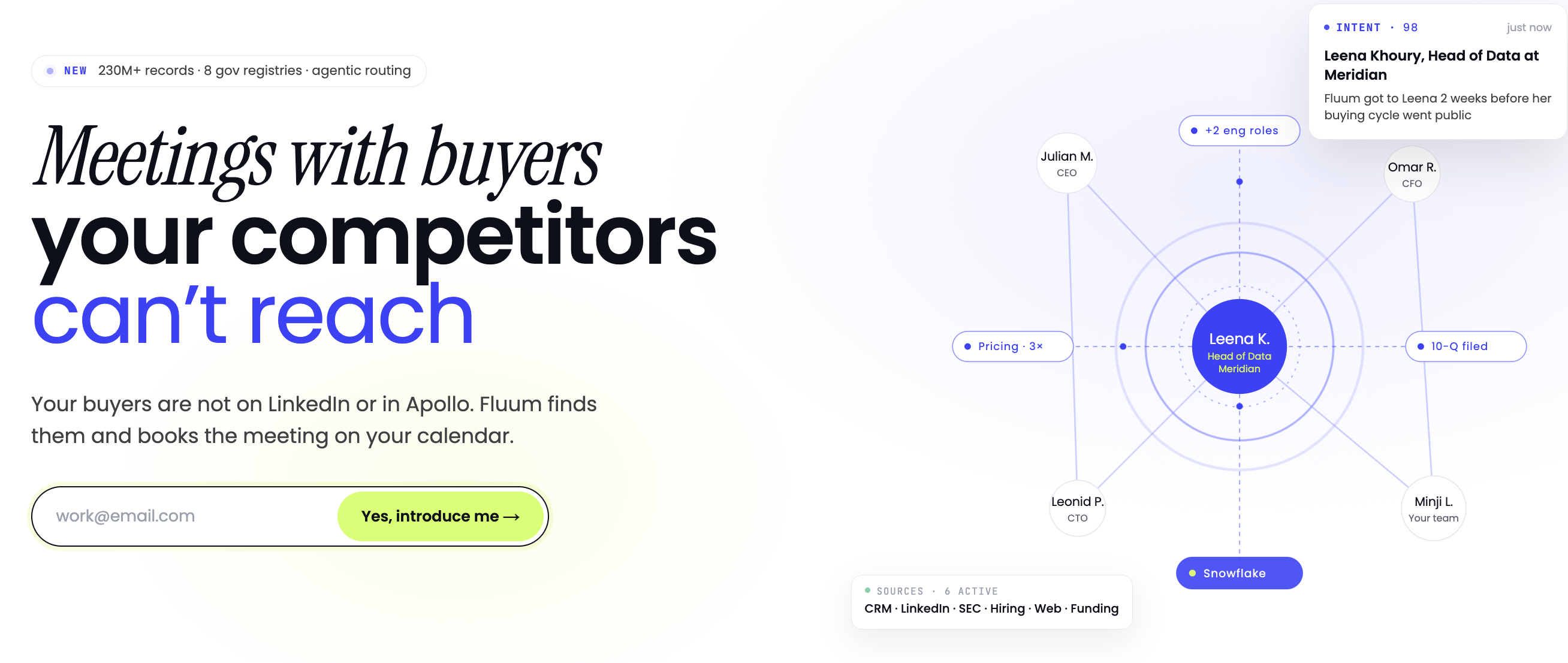
Fluum operates at the activation end of exactly this kind of architecture, pulling signals from 100+ government and private databases and routing them through a double opt-in introduction system, so the contact a sales team receives has already confirmed mutual interest before the first message is sent.
If you’re a senior leader or C-suite executive building or auditing a data ecosystem for your organization, talk to Aurora here and tell us who you’re looking to meet next, we’ll make sure to send you only what’s relevant.
The Technical Architectures Private Data Vendors Use to Protect Privacy
Private data vendor ecosystems rely on three core architectures, clean rooms, federated learning, and differential privacy, each protecting different layers of data exposure.
What Are Clean Rooms, Federated Learning, and Differential Privacy in Vendor Solutions?
Data clean rooms are controlled computation environments where two or more parties run queries on a combined dataset without either party ever seeing the other’s raw records. The mechanism works by keeping each party’s data inside a walled environment, only the query result exits, never the underlying rows. Google’s Ads Data Hub and AWS Clean Rooms operate on this model.
Federated learning takes a different approach: models train locally on each vendor’s data silo, and only the model updates, the gradients, are shared across parties. The raw records never move. This matters most for organizations in regulated industries like healthcare or financial services, where centralizing data across entities is legally prohibited or contractually blocked.
Differential privacy injects calibrated statistical noise into query outputs so that no individual record can be reverse-engineered from an aggregate result. The core trade-off is the privacy budget: tighter privacy protection means more noise, which reduces analytical precision. Apple has applied this technique to usage telemetry since 2016.
How Do These Technical Approaches Differ Across Private Data Platforms?
The three architectures sit at different points on the exposure-versus-utility spectrum. Clean rooms allow rich, cross-party analysis but require both parties to agree on a shared computation layer. Federated learning prevents any data movement but limits the complexity of models you can train. Differential privacy works on outputs alone, making it the lightest integration lift, but the noise penalty grows as queries get more granular.
The more important distinction during vendor evaluation is whether privacy architecture is native to the platform or bolted on afterward. Clean-room-native platforms design their entire data pipeline around restricted computation from the start. Enrichment vendors that add privacy controls post-hoc often have gaps, raw data may still pass through intermediary systems before controls engage. When assessing private data vendor ecosystems, ask vendors to show where in the data pipeline each control activates, not just whether the control exists.
How to Evaluate and Compare Private Data Vendors for Your Organization
Evaluate private data vendors across four dimensions: data provenance, privacy architecture, regulatory coverage, and integration compatibility with your existing stack.
What vendor selection criteria and due diligence checklist should I use?
Start with data provenance. A credible vendor shows a documented consent chain, the exact path from the data subject’s original opt-in to the record sitting in your pipeline. If a vendor can’t produce that chain on request, treat it as a disqualifying signal, not a negotiating point.
Ask for a data processing agreement before you sit through a demo. Request a sample audit log. Verify whether their consent records are portable if you switch vendors, compliance-washing vendors rarely have a clean answer to that last question.
On the regulatory side, confirm coverage across GDPR, CCPA, and any sector-specific rules relevant to your industry (HIPAA for health data, GLBA for financial records). A vendor that covers two of three is a governance gap waiting to surface.
Integration compatibility is where procurement fragmentation becomes a hidden cost driver. When each vendor in your private data vendor ecosystem uses a different data schema, identity resolution method, or API standard, reconciliation overhead compounds fast. Changeover time alone, re-mapping fields, rebuilding identity graphs, retraining downstream models, can consume months of engineering capacity that never appears in a vendor’s quoted cost.
What comparison framework exists for evaluating private data platforms?
The build-vs-buy decision shapes everything downstream. Assembling best-of-breed point vendors gives flexibility but multiplies your governance surface area, every additional vendor is another DPA, another audit cycle, another schema to reconcile. A single platform vendor reduces that friction but creates lock-in that’s expensive to exit.
Match your choice to organizational maturity. Budget-friendly point solutions work for teams with a narrow data need and in-house engineering to stitch them together. Mid-range modular platforms suit organizations that need pre-built connectors and some governance tooling but aren’t ready for enterprise procurement cycles. Premium enterprise ecosystems, with unified identity resolution, built-in consent management, and dedicated compliance support, require a mature data team and cross-functional buy-in to justify the investment.
Tools like Fluum sidestep part of this evaluation burden by aggregating signals from 100+ government and private databases behind a single interface, which reduces the schema reconciliation problem that plagues multi-vendor stacks. That said, no single platform eliminates the need for due diligence, the four-dimension framework above applies regardless of what sits under the hood.
Real-World Implementation Challenges When Building a Private Data Ecosystem
Most private data vendor ecosystems fail not at the strategy stage but during implementation, where three specific failure modes account for the majority of breakdowns.
Three Failure Modes That Derail Ecosystem Builds
The first failure mode is a consent-chain break. A downstream vendor quietly updates its data sourcing practices, switching from opted-in panels to inferred signals, without notifying upstream partners. Every organization that relied on that vendor’s consent representations now carries undisclosed compliance exposure.
The second is identity resolution conflict. When two vendors use incompatible ID graphs, the same individual appears as different records across systems. Deduplication becomes guesswork, and any erasure request that arrives cannot be reliably propagated because the identity isn’t consistently mapped.
The third is governance drift. When no single team owns cross-vendor compliance, legal signs the Data Processing Agreement, engineering picks the API, and sales picks the data set, each decision made in isolation. The compounding risk is that no one holds the full picture of what data flows where, and audits expose the gap.
What Changes for Ecosystems Under Stricter Privacy Regulations?
Regulations that mandate right-to-erasure propagation expose a structural flaw: deletion requests must cascade across every vendor in the chain, which requires each vendor to expose a deletion API [1]. Most data vendors were not built with that capability, so compliance forces architectural rework mid-implementation rather than at design time.
Expanded opt-in requirements and data minimization mandates compound this. A regulation-adaptation playbook built around three mechanisms reduces that rework significantly. Consent-first architecture ensures consent signals travel with the data record from the point of collection. Data minimization by design limits each vendor integration to only the attributes a specific workflow requires, nothing more passes the boundary. Value-linked data sharing agreements tie data exchange to a defined, auditable purpose, so when regulations tighten, the scope of renegotiation is narrow rather than ecosystem-wide. For a deeper look at how ecosystems are adapting to these pressures, see how ecosystems adapt to privacy regulations.
If you are a C-suite executive managing these decisions across vendors and business units, talk to Aurora and tell us who you are looking to meet next, we’ll make sure to send you only what’s relevant.
How Private Data Ecosystems Balance Privacy Compliance with Business Value
Privacy-ready private data vendor ecosystems generate higher data quality, faster pipelines, and lower legal overhead than compliance-as-constraint architectures.
How do privacy-ready ecosystems create value while maintaining consent-first principles?
Organizations that treat privacy architecture as a constraint bolt governance on after the fact. That retrofit approach slows data activation, inflates remediation costs, and creates friction at every vendor renegotiation. Organizations that treat consent as a design principle get the opposite: cleaner records, longer vendor relationships, and governance infrastructure that’s already in place when a new use case arrives.
The mechanism is consent signal quality. A record collected with explicit, documented consent carries more usable metadata, jurisdiction, channel, timestamp, purpose, than a record assembled under ambiguous terms. That metadata directly improves identity resolution match rates, because verified consent records contain fewer gaps and contradictions. Cleaner matches mean less wasted spend on misidentified contacts and higher confidence in the data assets your pipeline depends on.
The ROI levers compound from there. Audit-ready vendor contracts reduce renegotiation cycles, which cuts the legal overhead that erodes relationship longevity. Pre-built governance means new data use cases go live faster, you’re not rebuilding compliance scaffolding from scratch each time. On the cost side, vendor fees, integration overhead, and governance staffing are real line items. But they offset against pipeline acceleration, reduced regulatory exposure, and data assets that remain activatable across more channels and jurisdictions over time.
That last point matters most at the strategic level. Data collected under explicit consent can be applied in markets and contexts where ambiguously sourced data cannot. The addressable use case set expands as consent documentation accumulates, compounding the value of the original investment.
If you’re a C-suite executive thinking about where your next high-value relationship comes from, talk to Aurora here and tell us who you are looking to meet next. We’ll make sure to send you only what’s relevant.
Frequently Asked Questions
What is the difference between a data marketplace and a private data vendor ecosystem?
A data marketplace is a transactional platform where buyers purchase datasets from sellers, the relationship ends at the sale. A private data vendor ecosystem is an ongoing, governed network of data partners, processors, and technology providers that continuously exchange signals under shared contractual and compliance frameworks. Marketplaces are spot markets; ecosystems are operating infrastructure. The distinction matters because ecosystem participants share liability, data governance obligations, and integration dependencies that a one-time marketplace purchase never creates.
How many vendors does a typical private data ecosystem require to function effectively?
There is no universal minimum, but most functional B2B data ecosystems involve at least four distinct vendor categories: a primary data aggregator, an identity resolution layer, a compliance or consent management provider, and one or more delivery or activation partners. Organizations running signal-based prospecting, like Fluum’s model, which queries 100+ government and private databases, demonstrate that depth within each category matters more than raw vendor count.
What happens to your data ecosystem when a vendor changes its privacy policy or gets acquired?
A vendor policy change or acquisition can invalidate your existing data processing agreements and trigger re-consent obligations across your entire downstream pipeline. Leading ecosystems address this by building contractual change-notification clauses and data portability rights into every vendor agreement from day one [1]. Without those provisions, a single vendor acquisition can force a compliance audit across every integration that vendor touches, a process that routinely takes months and disrupts active pipeline operations.
Can small or mid-market organizations realistically build a private data vendor ecosystem, or is it only viable at enterprise scale?
Mid-market organizations can build effective private data vendor ecosystems, the barrier is governance discipline, not budget. The practical path is to start with two or three tightly scoped vendor relationships governed by clear data processing agreements, then expand. Platforms that aggregate signals from multiple sources on your behalf, handling the vendor relationships, compliance layers, and identity resolution internally, let smaller teams access ecosystem-grade data quality without managing dozens of direct vendor contracts. The ecosystem exists; you just don’t have to own it.
How should organizations handle cross-border data transfers within a private data vendor ecosystem?
Cross-border data transfers introduce jurisdiction-specific obligations that must be addressed at the contract level before any data moves. Organizations should confirm that each vendor relationship includes appropriate transfer mechanisms, such as Standard Contractual Clauses under GDPR, and that data residency requirements are documented for every node in the ecosystem. Failing to map transfer paths at design time typically surfaces during audits, when remediation is far more disruptive than proactive architecture would have been.
Conclusion
Private data vendor ecosystems are not a technology project, they are a governance commitment that determines whether your data assets compound in value or become a compliance liability. The organizations that win are the ones that map their vendor dependencies before a policy change forces them to, build contractual protections into every data relationship from the start, and choose aggregation partners who absorb the ecosystem complexity on their behalf.
If you are a senior leader or C-suite executive evaluating how your organization accesses and activates private data signals, talk to Aurora at Fluum, tell us who you are looking to meet next, and we will make sure to send you only what’s relevant.
Sources & References
Recommended Articles
Explore more from our content library: