
Understanding regulatory compliance prospecting fintech is essential. Fintech compliance teams generate some of the clearest buying signals in B2B sales, regulatory filings, hiring surges, license applications, and enforcement actions all point directly to who’s about to spend on compliance solutions and services. Sales teams that track these signals and map them to the right compliance decision-makers build pipeline faster than teams relying on generic firmographic lists. The connection matters because compliance spend at fintechs is triggered by external regulatory events, not internal budget cycles, which makes timing, and knowing exactly who owns the decision, the difference between a cold pitch and a relevant one.
Why Do Fintech Companies Need to Identify and Reach Compliance Decision-Makers?
Compliance ownership at fintechs is often split across three or four titles at once, which is exactly why finding the real decision-maker matters more than finding a department.
At a 40-person fintech, the “compliance function” might be one person wearing three hats. At a 400-person fintech, it might be a Head of Compliance who reports to a General Counsel who reports to a board committee. Nobody outside that fintech knows which structure applies until they look, and that ambiguity is the opening. Sales teams doing regulatory compliance prospecting fintech work correctly treat org-chart confusion as a research problem to solve, not a reason to send a generic pitch to a generic inbox.
What compliance failures cost fintechs the most, and who owns remediation?
A compliance failure at a fintech triggers fines, license suspension, or forced product shutdowns, and someone specific is accountable for fixing it fast.
That someone is usually the Head of Compliance or Chief Compliance Officer at companies large enough to have one. At smaller fintechs, pre-Series C, often under 150 employees, the General Counsel absorbs the role, and at seed and Series A companies, remediation frequently lands on the CEO’s desk directly because there’s no one else to own it. Each of these people has a personal stake in avoiding a repeat failure, which makes them receptive to tools and services that reduce that risk. Selling into a “compliance department” ignores this: failures are personal and career-relevant to a named individual, not abstract department-level problems.
How does regulatory pressure create urgency for compliance hiring and procurement?
New rules, enforcement actions, and license renewals force fintechs to hire and buy compliance solutions off-cycle, outside normal annual budget planning.
A state regulator tightening money-transmitter requirements, a card network updating its rules, or a competitor’s enforcement action becomes public, any of these can turn a “maybe next year” compliance project into a “we need this signed by next month” mandate. That shift doesn’t wait for Q1 budget season. It shows up as a sudden compliance hire, an RFP that appears with no warning, or a General Counsel suddenly taking calls they would have ignored six weeks earlier. Sales teams that only prospect on firmographics, headcount, funding stage, industry code, miss this entirely. Teams that track the regulatory trigger itself catch the buyer at the exact moment budget appears.
This is also where misidentifying the buyer costs the most. Pitching an IT director or a generic “info@” compliance inbox when the real decision sits with the Head of Compliance or GC wastes the outreach cycle twice over, once on the wrong contact, and again because compliance purchases triggered by regulatory pressure often bypass standard procurement entirely, moving through direct approval from whoever owns the risk. A named contact who owns that risk will answer. A department inbox, staffed by whoever picks up the ticket that week, usually won’t.
How Do Compliance Obligations Differ Across Fintech Business Models?
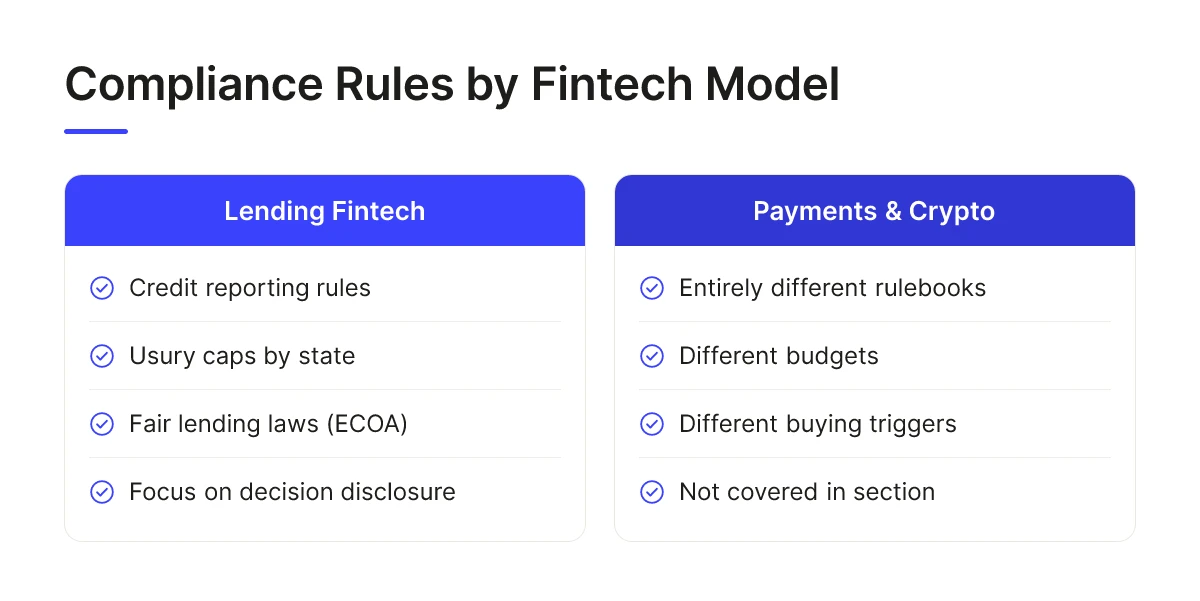
A lending fintech, a payments company, and a crypto platform face entirely different rulebooks, budgets, and buying triggers, treating them as one market is the fastest way to waste a quarter of pipeline. Effective regulatory compliance prospecting fintech work starts with recognizing that “fintech” is a label, not a segment.
What compliance requirements do lending fintechs face versus payments or crypto platforms?
Lending fintechs answer to credit reporting rules, usury caps that vary by state, and fair lending laws like the Equal Credit Opportunity Act, obligations that center on how a decision gets made and disclosed, not just how money moves.
Payments fintechs carry a different weight entirely: money transmission licensing in every state they touch, plus anti-money-laundering (AML) programs that require transaction monitoring, suspicious activity reporting, and a designated compliance officer under the Bank Secrecy Act.
Crypto platforms sit on the least settled ground. Securities classification questions, custody requirements, and state-by-state money transmitter interpretations shift often enough that compliance teams there budget for legal counsel the way other fintechs budget for software.
Each model produces a different buyer. A lending fintech’s compliance conversation runs through a general counsel or chief credit officer. A payments company’s runs through a Bank Secrecy Act (BSA) officer. A crypto platform often has outside counsel doing work an internal hire would do elsewhere.
Why do early-stage fintechs allocate resources differently for compliance than established players?
Early-stage fintechs usually can’t justify a full compliance headcount, so a founder, COO, or ops lead absorbs the function alongside a dozen other jobs. Established players build dedicated compliance teams with layered reporting, analysts feeding a director, a director feeding a chief compliance officer, a CCO reporting to the board.
That structural gap changes how each buys. A founder wearing the compliance hat needs education and a low-commitment way in, a short pilot, a clear explanation of what a tool actually automates, proof it won’t create more work than it saves. A dedicated compliance team, by contrast, wants integration detail: how a platform sits inside the existing case management system, and evidence it holds up at scale across thousands of monitored accounts.
Licensing footprint multiplies all of this. A single-state lender manages one regulator’s expectations. A company licensed across 40+ states, or one operating in multiple countries, faces a compliance budget several times larger, because every added jurisdiction adds its own filing calendar, examiner relationship, and reporting format. Sales teams that map licensing footprint before outreach are targeting budget, not just headcount.
What Compliance Signals Indicate a Fintech Is Actively Buying Solutions or Services?
A fintech’s regulatory filings, license applications, and job postings signal compliance spending months before any public announcement confirms it. Reading those signals correctly is the difference between cold-calling a company that already bought a solution and reaching one that’s actively evaluating vendors right now.
Generic firmographic data, employee count, funding round, industry tag, tells you a company exists in your target market. It doesn’t tell you whether that company has a compliance gap it’s trying to close this quarter. Regulatory compliance prospecting fintech requires a different data layer entirely: government registries, enforcement databases, and licensing records that most sales teams never touch because they sit outside the CRM and outside LinkedIn.
Which regulatory filings and government registry changes signal compliance investment?
A new money transmitter license application, a state registration filing, or a change in registered agent status is a leading indicator, it shows up in public records well before the company posts a job or issues a press release. Fintechs applying for licenses in new states, filing for a banking charter, or registering with a new regulatory body are committing budget to compliance infrastructure whether or not they’ve hired for it yet.
These filings are forward-looking by design. A company doesn’t file for a money services business license on a whim, it’s preparing to launch a product that requires one, which means a compliance stack (KYC, transaction monitoring, reporting tools) has to be in place before launch, not after. Sales teams who monitor registry status changes are effectively watching the buying decision get made in real time, months ahead of a hiring announcement or an RFP.
How do you spot fintechs moving from in-house compliance to outsourced or automated solutions?
Watch for a fintech posting several compliance-related roles, compliance analyst, BSA officer, KYC lead, within a tight window, then quietly pulling those postings without a hire announced. That pattern usually means one of two things: the company is scaling fast enough to need a bigger team, or a remediation effort triggered by an audit finding or near-miss made hiring urgent, then budget or talent scarcity redirected the effort toward outsourced or automated tooling instead.
Job posting language often gives this away before anything else does. A shift from “build and manage our compliance program” to “manage vendor relationships and oversee automated monitoring tools” signals the company has decided headcount is the wrong answer to its compliance problem. Vendor page changes, a new integrations page, a case study removed, a partner logo added, confirm the pivot.
It’s worth separating reactive signals from proactive ones. A consent order or enforcement action is reactive, the company is buying under pressure, on a compressed timeline, with an active mandate. A new market entry or product line requiring fresh licensing is proactive, the buying window is longer, but the intent is just as real. Fluum’s matching layer pulls signals from both categories across 100+ government and private databases, surfacing the fintechs where compliance investment is happening now, not the ones that already closed the deal.
How Can Sales Teams Build Pipeline by Mapping Fintech Compliance Organizational Structures With Regulatory Compliance Prospecting Fintech Data?
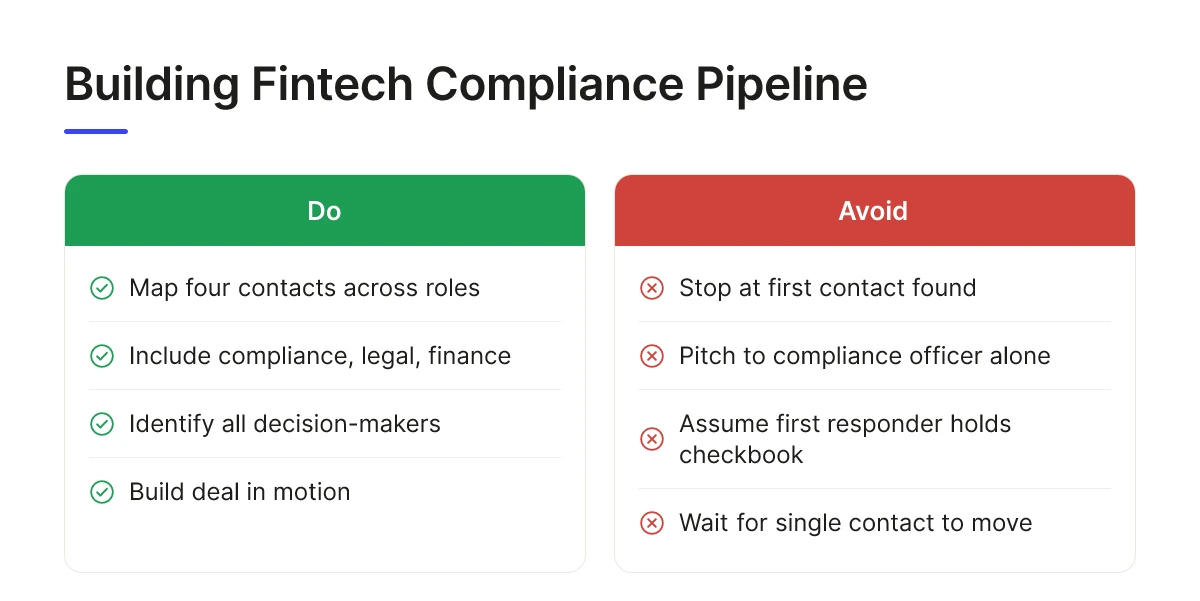
One compliance contact is a lead. Four contacts across compliance, legal, and finance who all know why you’re calling is a deal in motion, and that’s the real payoff of regulatory compliance prospecting fintech done properly.
Most reps stop at the first name they find. They get a Compliance Officer on a call, pitch hard, and wait. Nothing moves, because the person who answered the phone rarely holds the checkbook.
Who are the decision-makers and influencers in a fintech’s compliance function?
Four roles show up in almost every fintech compliance structure, and each plays a different part in a deal. The Compliance Officer or MLRO (Money Laundering Reporting Officer) usually spots the problem first, a gap flagged in an audit, a new regulation on the horizon, a control that failed a spot check. The Head of Risk sits adjacent, often co-owning the business case once it moves past “we have a problem” into “here’s what it costs us if we don’t fix it.”
General Counsel enters when the fix touches contracts, vendor liability, or data-sharing terms, which, in fintech, is almost always. Procurement or finance signs off last, once the spend crosses a threshold that requires budget approval outside the compliance team’s own discretionary line.
The mistake is assuming rank equals authority. It doesn’t.
How do you trace the path from compliance officer to procurement and budget holders?
Influence and budget authority split apart constantly in fintech. The Compliance Officer initiates the search because the pain is theirs, a looming audit, a regulator’s letter, a board question they couldn’t answer cleanly. But the COO or CFO approves the check once the deal crosses a meaningful spend threshold, because compliance tooling and services routinely get bundled into broader risk or operational budgets they control.
Tracing that path takes work most reps skip. Start with the compliance contact’s reporting line, leadership pages and registry filings often disclose whether the Compliance Officer reports to the CEO, the board’s audit committee, or a CFO-controlled risk function. That reporting line tells you who has to say yes before money moves. Company filings, executive bios, and org announcements around funding rounds or leadership hires fill in the rest, a newly appointed Head of Risk, for instance, usually signals a budget cycle in motion.
This is exactly the kind of signal Fluum’s matching pulls from the 100+ government and private databases it queries, surfacing not just a compliance contact, but the reporting structure around them, so a warm introduction lands with someone who actually has standing to move the deal forward.
Multi-threading across compliance, legal, and finance shortens the cycle because it removes the single point of failure. A deal championed by one Compliance Officer stalls if that person goes quiet, changes roles, or loses the internal argument. A deal with three people already nodding along, because each got their own context-rich introduction, not a forwarded email, survives a change in champion and moves at the pace of the fastest approver, not the slowest one.
If you’re a senior leader or C-suite executive reading this, talk to Aurora and tell us exactly who you’re looking to meet next, compliance, risk, legal, or finance. We’ll only send what’s relevant to your pipeline.
What Data Sources Help You Find the Right Compliance Buyer at a Fintech?
The right sources for regulatory compliance prospecting fintech split into two types: public registries that show regulatory status, and verified networks that show willingness to talk.
What public registries tell you, and what they don’t
The FCA Register and SEC EDGAR are the closest thing to a paper trail on a fintech’s compliance maturity. The FCA Register shows license status, permissions, and the individuals registered against a firm, useful for spotting a company that just secured authorization and needs to staff up its compliance stack. SEC EDGAR filings reveal changes in ownership, new risk disclosures, and leadership transitions that often precede a buying cycle for compliance tooling or advisory services.
Both are free, both are public, and both are backward-looking. A registry entry confirms a firm is regulated, it doesn’t tell you whether the head of compliance is fielding vendor calls this quarter or has budget signed off. That’s the gap most prospecting lists never close.
Why registry data alone doesn’t convert
A list of FCA-registered fintechs is a market map, not a pipeline. It shows you who’s obligated to comply, not who’s actively evaluating a new solution, frustrated with an incumbent, or under a board mandate to fix a gap. Compliance buyers are also some of the hardest people in a fintech to reach cold: they’re targeted constantly by vendors selling risk software, KYC tools, and audit platforms, and their inboxes reflect it.
That’s the structural problem with treating registry data as a finish line. It needs to be paired with a way to actually start a conversation.
Where opt-in networks change the response math
Cold outreach to a compliance officer competes with dozens of other cold emails making the same pitch, which is a large part of why reply rates across cold channels have fallen industry-wide. A double opt-in model works differently: both the seller and the compliance buyer confirm relevant interest before any meeting gets proposed, so the person on the other end already expects, and wants, the conversation.
This is where Fluum’s matching model fits directly into regulatory compliance prospecting fintech work. Fluum takes a description of the buyer you need, say, a Head of Compliance at a Series B payments fintech that just filed a new FCA permission, and cross-references signals from over 100 government and private databases against its network of verified decision-makers. Nothing gets sent until both sides say yes, which is why introductions through this model land 40–50% reply rates instead of the low single digits typical of cold compliance outreach.
Narrowing a broad list to an active buying window
Combined, registry signals and verified opt-in data do something neither can alone: they narrow a broad universe of regulated fintechs down to the handful showing both regulatory change and a real person ready to engage. A new registration, a leadership hire, or a fresh filing becomes a trigger, verified interest turns that trigger into a meeting.
If you’re a senior leader or C-suite executive, talk to Aurora and tell us exactly who you’re looking to meet next, a Chief Compliance Officer, a Head of Risk, a specific seniority at a specific type of fintech. We’ll only send introductions that match.
Frequently Asked Questions
What compliance failures cost fintechs the most, and who owns remediation?
Failed KYC/AML controls and unlicensed money transmission cost fintechs the most, often triggering regulator fines and forced product shutdowns [1]. Remediation ownership sits with the Chief Compliance Officer or General Counsel, but budget approval usually runs through the CEO or CFO, which is why sales teams should map both the compliance owner and the executive who signs the check.
Why do early-stage fintechs allocate resources differently for compliance than established players?
Early-stage fintechs treat compliance as a bolt-on until growth forces the issue, while established players fund it as a standing function [1]. That shift, from “we’ll deal with that later” to dedicated headcount and tooling budget, is the exact trigger moment sales teams should track when prioritizing accounts.
How do you spot fintechs moving from in-house compliance to outsourced or automated solutions?
Watch for compliance job postings freezing while RFPs for outsourced monitoring or RegTech platforms appear, a classic build-to-buy signal. Bank-fintech partnership announcements are another marker, since partnering banks push their fintechs toward third-party compliance tooling to satisfy regulator scrutiny [2]. Funding rounds tagged for “compliance infrastructure” in press releases confirm the shift is budgeted, not just discussed.
Why are private data vendors and opted-in networks more effective than cold outreach for reaching compliance buyers?
Compliance and legal buyers are among the least responsive to cold email because they’re trained to distrust unsolicited contact, reply rates for cold outreach sit near 2% industry-wide. Networks built on double opt-in, like Fluum, work because both the compliance officer and the seller confirm interest before any message is sent, replacing a guessing game with a conversation two people already agreed to have.
Conclusion
Compliance pressure inside fintech isn’t a backdrop for your outreach, it’s the timing signal itself. Track the trigger moments (new licensing, bank partnerships, funding tagged for compliance infrastructure), identify who owns remediation versus who owns budget, and stop routing all of it through cold email that compliance buyers are trained to ignore.
If you’re a VP of Sales or CRO trying to build pipeline into regulated fintech accounts, the next step isn’t another list, it’s a conversation with Aurora at Fluum about exactly who you’re trying to meet next, so we only send you introductions that are already warm.
Sources & References
- Key Compliance Challenges for Fintech Companies
- Five best practices for FinTech Compliance | Thomson Reuters
Recommended Articles
Explore more from our content library: