
| Key Insight | Explanation |
|---|---|
| Intent signal scoring AI defined | It assigns dynamic, AI-computed scores to prospects based on real-time behavioral, firmographic, and third-party signals — far beyond static form fills or demographic filters. |
| Cold outreach is broken | Cold email averages a 2% reply rate in 2026. Intent-scored, warm introductions consistently reach 40–50% reply rates. |
| Signal types matter | First-party signals (your site, CRM) and third-party signals (content consumption, job postings, government filings) combine for the most accurate scoring. |
| AI vs. traditional lead scoring | Traditional scoring uses fixed rules. AI scoring learns from closed-won patterns, updates continuously, and surfaces accounts humans would miss. |
| Regulated industries need deeper data | Fintech, cybersecurity, and manufacturing buyers don’t always appear in LinkedIn or standard databases. Government registries and private data vendors fill that gap. |
| Warm introductions close the loop | Intent scoring identifies who’s ready. A double opt-in introduction system converts that readiness into a real conversation — without a single cold message. |
Intent signal scoring AI is the practice of using machine learning models to collect, weight, and rank behavioral and firmographic signals from prospects — producing a dynamic score that tells your sales team exactly who is in-market right now, not who was warm six weeks ago. It replaces gut instinct and static lead scoring rules with a continuously updated, data-driven prioritization engine. For B2B teams selling into fintech, cybersecurity, manufacturing, and other regulated industries, it’s the difference between chasing cold lists and reaching buyers who are already looking for what you sell.
Cold outreach reply rates have collapsed to roughly 2% as of 2026. That number isn’t a fluke — it’s the result of inbox providers tightening spam filters, buyers training themselves to ignore unsolicited messages, and the sheer volume of identical “personalized” sequences hitting the same inboxes simultaneously. Intent signal scoring AI exists to solve the upstream problem: identifying which prospects are actually in a buying motion before your team spends a single minute on outreach.

What Is Intent Signal Scoring AI?
Intent signal scoring AI assigns dynamic, machine-learning-computed scores to prospects by aggregating real-time behavioral, firmographic, and third-party signals — then ranking accounts by their likelihood to buy, so sales teams know exactly where to focus.
Intent signals are observable behaviors that indicate a prospect is actively researching, evaluating, or preparing to purchase in your category [1]. The “AI” part is what separates modern intent scoring from the static, rules-based lead scoring that’s been around since the early CRM era. A traditional lead scoring model assigns fixed point values — 10 points for a webinar registration, 20 points for a pricing page visit — and never questions whether those weights still reflect reality. An AI-powered intent scoring model learns from your actual closed-won data, adjusts weights continuously, and surfaces patterns a human analyst would never spot.
The Three Signal Categories
Intent signals generally fall into three buckets, and the best scoring models pull from all three simultaneously [2]:
- First-party signals: Behaviors on your own digital properties — website visits, pricing page views, content downloads, demo requests, email engagement, and CRM interaction history.
- Second-party signals: Behavioral data shared directly by a partner platform, such as intent data from a publisher network or a content syndication partner.
- Third-party signals: External data aggregated from across the web — review site activity, job postings, technology stack changes, regulatory filings, funding announcements, and content consumption patterns tracked by data vendors.
Why the Definition Matters for Regulated Industries
For sales teams in fintech, cybersecurity, and manufacturing, the standard first-party signal set is often insufficient. Buyers in these sectors don’t always browse your website before they’re ready to buy. They research through regulatory bodies, trade publications, and peer networks that standard tracking tools don’t touch [3].
That’s why platforms pulling from government registries — Companies House, the FCA Register, SEC EDGAR, SIRENE — capture intent signals that LinkedIn and conventional outreach tools simply can’t index. A fintech firm filing for a new FCA authorization category is broadcasting a clear intent signal. A manufacturing company posting six new procurement roles is doing the same. AI scoring models that ingest these signals give sales teams a genuine information advantage.
Pro Tip: Don’t limit your signal sources to what’s easy to track. The highest-value intent signals in regulated industries often come from government filings, licensing changes, and procurement announcements — not website visits. Build your scoring model to ingest these from the start.
How Intent Signal Scoring AI Works
Intent signal scoring AI works by ingesting signals from multiple data sources, applying machine learning to weight each signal based on historical conversion patterns, aggregating those weights into a composite account score, and then continuously recalibrating as new data arrives.
The mechanics are more sophisticated than most sales teams realize. It’s not a spreadsheet with a SUM formula. The underlying process typically follows this sequence [4]:
- Signal collection: Data pipelines pull behavioral and firmographic signals from first-party sources (CRM, marketing automation, website analytics) and third-party vendors (intent data providers, government registries, private databases).
- Feature engineering: Raw signals are transformed into model features — recency, frequency, depth of engagement, account-level aggregation, and signal combination patterns.
- Model training: The AI trains on historical data, learning which signal combinations preceded closed-won deals in your specific market. This is where AI diverges from static scoring: the model learns your business, not a generic template.
- Score generation: Each prospect or account receives a composite intent score, typically on a 0–100 scale, reflecting their current likelihood to be in a buying motion.
- Continuous recalibration: As new signals arrive and new deals close (or don’t), the model updates its weights. An account that goes quiet drops in score. One that suddenly starts consuming competitor comparison content rises.
- Workflow triggering: High-scoring accounts trigger defined actions — enrollment in a nurture sequence, assignment to a senior rep, or (in the most advanced setups) initiation of a warm introduction workflow [5].
Account-Level vs. Contact-Level Scoring
Most modern intent scoring AI operates at the account level first, then drills down to the contact level. This matters because B2B buying decisions involve an average of 6–10 stakeholders (per Gartner’s 2024 B2B buyer research). Scoring only the individual who visited your pricing page misses the procurement manager, the CISO, and the CFO who are all part of the same buying committee.
Account-level aggregation combines weak signals from multiple contacts into a strong composite signal [6]. One person reading a blog post is noise. Three people from the same account — including a VP of Finance — consuming competitor comparison content within 10 days is a genuine buying signal.
The Role of Private and Government Data
Standard intent scoring tools work well when buyers are active on indexed web properties. They break down for buyers in regulated industries who conduct research through non-indexed channels. Platforms like Fluum address this by building buyer graphs from 40+ private data vendors and 8 government registries, surfacing intent signals that cold outreach tools and LinkedIn don’t index. That data moat is what separates surface-level intent scoring from genuine pipeline intelligence.
Research published on MarTech confirms that behavioral signals, intent data, and AI together improve personalization, sales alignment, and pipeline performance across complex buying journeys [7] — precisely the kind of journeys that fintech and manufacturing deals involve.

Key Benefits of Intent Signal Scoring AI for B2B Pipeline
Intent signal scoring AI delivers measurable pipeline improvements by ensuring your sales team contacts the right accounts at the right time — reducing wasted outreach, shortening sales cycles, and dramatically increasing reply rates compared to cold prospecting.
The benefits aren’t theoretical. Here’s what they look like in practice: For more information, see Joomag.
Prioritization That Actually Reflects Buying Reality
Traditional lead scoring treats a prospect who downloaded an ebook three months ago the same as one who visited your pricing page yesterday. AI scoring decays signals over time and weights recency appropriately. The result: your reps spend their first hour of the day on accounts that are genuinely in-market, not accounts that were warm in Q1.
- Higher conversion rates: Reaching out to intent-scored accounts produces significantly better conversion rates than working cold lists, because the prospect is already in a research or evaluation phase.
- Shorter sales cycles: Accounts with high intent scores are further along in their buying journey. Less education required, fewer objection cycles, faster time to close.
- Better rep efficiency: SDRs stop spending 70% of their time on prospecting that yields almost no qualified conversations. Intent scoring does the triage work automatically.
- Reduced churn from bad-fit customers: Scoring models that incorporate firmographic fit alongside intent signals filter out accounts that show interest but aren’t actually a good product fit.
The Warm Introduction Multiplier
Intent scoring tells you who’s ready. A warm introduction system converts that readiness into a real conversation. This is where the math gets compelling.
Cold email reply rates sit at approximately 2% as of 2026. Warm introductions facilitated through a double opt-in system — where both the buyer and the seller confirm mutual interest before any message is exchanged — consistently reach 40–50% reply rates. That’s not a marginal improvement. It’s a structural shift in pipeline economics.
A B2B pipeline intelligence platform that pairs intent signal scoring AI with a warm introduction network effectively solves two problems simultaneously: identifying who’s ready to buy, and getting in front of them through a channel they actually respond to. For teams using platforms like Joomag for content distribution, integrating intent scoring data into content targeting decisions adds another layer of precision to the buyer journey.
| Metric | Cold Outreach | Intent-Scored Warm Introduction |
|---|---|---|
| Average reply rate | ~2% | 40–50% |
| Prospect consent | None (unsolicited) | Double opt-in (mutual) |
| Signal basis | Static list, demographic filter | Real-time behavioral + firmographic AI scoring |
| Data sources | LinkedIn, purchased lists | 40+ private vendors, 8 government registries |
| Buyer reach in regulated industries | Limited (indexed contacts only) | Broad (includes non-indexed decision-makers) |
| Rep time on prospecting | High (manual research + sequencing) | Low (AI handles prioritization and matching) |
Pro Tip: If you’re reporting on pipeline quality to a board or CRO, track intent score at time of first contact alongside standard conversion metrics. Accounts with scores above 70 at first contact close at materially higher rates — and that data makes a compelling case for shifting budget from cold volume plays to intent-led outreach.
Common Challenges and Mistakes in 2026
The most common failure mode in intent signal scoring AI isn’t a technology problem — it’s a data quality and model configuration problem that causes sales teams to act on misleading scores and lose trust in the system entirely.
From experience working with B2B sales teams in regulated industries, the mistakes cluster around a few predictable patterns:
Mistake 1: Treating All Signals as Equal
A pricing page visit is not the same as a blog post view. A job posting for a CISO is not the same as a job posting for a junior analyst. Static scoring models assign fixed weights and never question them. AI models should learn from your closed-won data which signal combinations actually predicted a purchase — but many teams configure their models once and never revisit the weights [8].
One pitfall to watch for: over-indexing on first-party signals while ignoring third-party intent data. A prospect who hasn’t visited your website but has been consuming competitor comparison content on G2 and filing new regulatory documents is often more in-market than someone who downloaded your whitepaper six months ago.
Mistake 2: Scoring Contacts Instead of Accounts
B2B purchases are committee decisions. Scoring only the contact who engaged with your content and ignoring the rest of the buying group produces a dangerously incomplete picture. Research from AiSDR’s intent signal guide emphasizes that account-level aggregation — combining signals across all contacts at a target account — is essential for accurate intent scoring in enterprise deals [2].
Mistake 3: No Feedback Loop
An AI scoring model that doesn’t receive feedback from closed deals degrades over time. Your market shifts. Your ICP evolves. The signals that predicted a win in 2024 may not predict a win in 2026. Teams that treat intent scoring as a set-and-forget configuration end up with a model that’s confidently wrong.
- Connect your CRM’s closed-won and closed-lost data back to the scoring model on a quarterly basis at minimum.
- Flag accounts that scored high but didn’t convert — and investigate why. Often, it reveals a missing signal category or a weight that needs adjustment.
- Involve your sales reps in signal validation. They know things the data doesn’t capture.
Mistake 4: Ignoring the Channel Problem
Even a perfectly scored prospect list fails if your outreach channel is broken. this strategy identifies who’s ready. If your delivery mechanism is a cold email sequence, you’re still competing with 300 other unsolicited messages in the same inbox. The signal intelligence is wasted if the introduction isn’t warm.
Best Practices for Intent Signal Scoring AI in 2026
The teams getting the most value from this approach in 2026 share a common approach: they combine deep signal diversity, continuous model feedback, and warm introduction workflows that actually reach the scored accounts.
At Fluum, we’ve found that the biggest performance gap between high-performing and average sales teams isn’t the sophistication of their scoring model — it’s whether they’ve solved the delivery problem. Knowing who’s ready to buy and having no warm path to reach them is a half-solution.
Build a Signal Diversity Framework
The AARRR framework (Acquisition, Activation, Retention, Referral, Revenue) is a useful starting point for mapping which signals belong at each stage of your buyer journey. But in 2026, the most effective intent scoring implementations layer in signal categories that most teams overlook:
- Regulatory and government signals: FCA authorization filings, Companies House director changes, SEC EDGAR disclosures, SIRENE registrations. These are publicly available, rarely exploited, and highly predictive for regulated industry buyers.
- Hiring signals: Job postings for specific roles (e.g., a fintech posting for a Head of Compliance signals regulatory expansion; a manufacturer posting for a Chief Procurement Officer signals a vendor review cycle).
- Technology stack changes: New software installations or removals detected through third-party data vendors often signal a broader vendor evaluation process.
- Content consumption patterns: Third-party intent data from publisher networks showing which topics a prospect’s organization is researching — even on sites you don’t own [9].
- Funding and M&A events: A Series B announcement or an acquisition almost always triggers a technology buying cycle within 90 days.
According to HockeyStack’s B2B intent signal guide, teams that combine first-party and third-party signals in their scoring models consistently outperform those relying on a single signal source [3].
Operationalize Scores Into Warm Workflows
Intent scores are only valuable if they trigger action. The SalesOS buyer intent documentation describes a tiered workflow approach that maps directly to best practice [5]:
- Low intent (0–40): Enroll in long-cycle nurture content. No direct outreach yet.
- Medium intent (41–70): Trigger targeted content sequences and assign to an SDR for monitoring.
- High intent (71–100): Immediately surface to a senior rep and initiate a warm introduction request through your network — not a cold sequence.
The distinction at the high-intent tier matters enormously. A prospect who scores 85 on your intent model has already done significant research. A cold email at that moment is not just inefficient — it’s a missed opportunity. A warm, context-rich introduction that acknowledges their research stage converts at a fundamentally different rate.
Pro Tip: If you’re a senior leader or C-suite executive reading this and want to connect with decision-makers who are already scoring high on intent for your category, talk to Aurora at Fluum and tell us who you’re looking to meet next. We’ll make sure to send you only what’s relevant — no noise, no cold lists.
Research from MarketBetter’s 2026 intent signal orchestration analysis confirms that signal scoring based on historical conversion data, combined with account-level aggregation, produces the strongest composite signals for AI-driven outbound workflows [6].
The Factors.ai intent scoring guide also highlights that website visitor identification combined with third-party intent data creates a more complete picture of in-market accounts than either source alone [4].
Sources & References
- ZoomInfo Pipeline, “What Is Intent Data? The Complete Guide to Turning Buyer Signals,” 2026
- AiSDR, “Intent Signals and How to Use Them,” 2026
- HockeyStack, “How to Use Intent Signals for B2B Marketing & Sales,” 2026
- Factors.ai, “Intent Scoring via Website Visitor Identification: How It Works in 2026,” 2026
- SalesOS, “Buyer Intent Signals,” 2026
- MarketBetter, “AI Intent Signals 2026: Why Rationale and Orchestration Beat Simple Scoring,” 2026
- MarTech, “How AI Is Turning Lead Scoring into a Decision Engine,” 2026
- HubSpot Knowledge Base, “Use Intent Signals,” 2026
- Artisan AI, “Intent Signals: Boost B2B Sales and Outreach,” 2026
Frequently Asked Questions
1. What is an intent scoring model?
An intent scoring model is an AI or rules-based system that assigns dynamic numeric values to prospects and accounts by analyzing behavioral signals (pricing page visits, content downloads, demo requests), firmographic data (company size, industry, tech stack), and third-party intent signals (content consumption patterns, regulatory filings, job postings). Unlike static lead scoring, an AI-powered intent scoring model learns from your historical closed-won and closed-lost data to continuously recalibrate which signal combinations actually predict a purchase in your specific market — producing scores that reflect current buying reality, not fixed assumptions set at model launch.
2. What is an intent score?
An intent score is a composite numeric value, typically on a 0–100 scale, that quantifies how actively a prospect or account is engaged in a buying motion for your category right now. It aggregates behavioral signals (recency, frequency, depth of engagement), firmographic fit, and third-party intent data into a single prioritization metric. Crucially, the practice makes this score dynamic — it updates as new signals arrive, decays when engagement drops, and recalibrates based on what your actual closed deals tell the model about which signals matter most.
3. What are some examples of intent AI in B2B sales?
Intent AI in B2B sales includes systems that detect when a target account starts consuming competitor comparison content across third-party review sites, flags a company filing a new FCA authorization as a fintech buying signal, identifies a manufacturing firm posting six procurement roles as a vendor evaluation trigger, or surfaces a Series B announcement as a 90-day technology buying window. Platforms like Fluum use AI agents to score these signals across 40+ private data vendors and 8 government registries, then surface decision-maker paths and facilitate warm introductions — converting intent intelligence into actual conversations.
4. How do you use AI for lead scoring?
Using AI for lead scoring involves four core steps: first, connect your historical CRM data (closed-won, closed-lost, deal stage progression) as the training dataset; second, integrate first-party signal sources (website analytics, marketing automation, email engagement) and third-party intent data (vendor networks, government registries, content consumption platforms); third, configure the AI model to learn which signal combinations preceded your best deals — not generic benchmarks; and fourth, build tiered workflow triggers so that high-scoring accounts automatically surface to senior reps and initiate warm introduction workflows rather than cold email sequences. The model should receive continuous feedback from new deal outcomes to stay calibrated to your evolving ICP.
5. How does intent signal scoring AI differ from traditional lead scoring?
Traditional lead scoring uses fixed, manually configured rules — assign 10 points for this action, 20 points for that attribute — and never questions whether those weights reflect current reality. this practice learns from your actual sales outcomes, updates continuously as new signals arrive, operates at the account level rather than just the contact level, and incorporates third-party behavioral data that traditional scoring tools don’t access. The practical result: AI scoring surfaces accounts that are genuinely in a buying motion right now, while traditional scoring often surfaces accounts that looked interesting months ago.
6. Which industries benefit most from intent signal scoring AI?
Regulated and complex industries benefit most: fintech, cybersecurity, manufacturing, healthcare technology, and professional services. These sectors have longer buying cycles, larger buying committees, and buyers who conduct significant research through non-indexed channels (regulatory bodies, trade publications, government registries) that standard intent tools miss. For these industries, this method that ingests government registry data — FCA filings, Companies House changes, SEC EDGAR disclosures — captures buying signals that cold outreach tools and LinkedIn simply can’t surface.

Conclusion
this strategy isn’t a nice-to-have feature on a sales tech stack. It’s the foundational mechanism that separates teams who know who to call from teams who are guessing. By aggregating behavioral, firmographic, and third-party signals — including the government registry and private vendor data that most tools ignore — AI scoring models surface accounts that are genuinely in a buying motion, not just accounts that fit a demographic profile.
But scoring alone doesn’t close deals. The teams seeing 40–50% reply rates aren’t just better at identifying in-market accounts. They’ve solved the delivery problem too. They’re reaching high-intent buyers through warm, double opt-in introductions where both sides have confirmed mutual interest before a single word is exchanged.
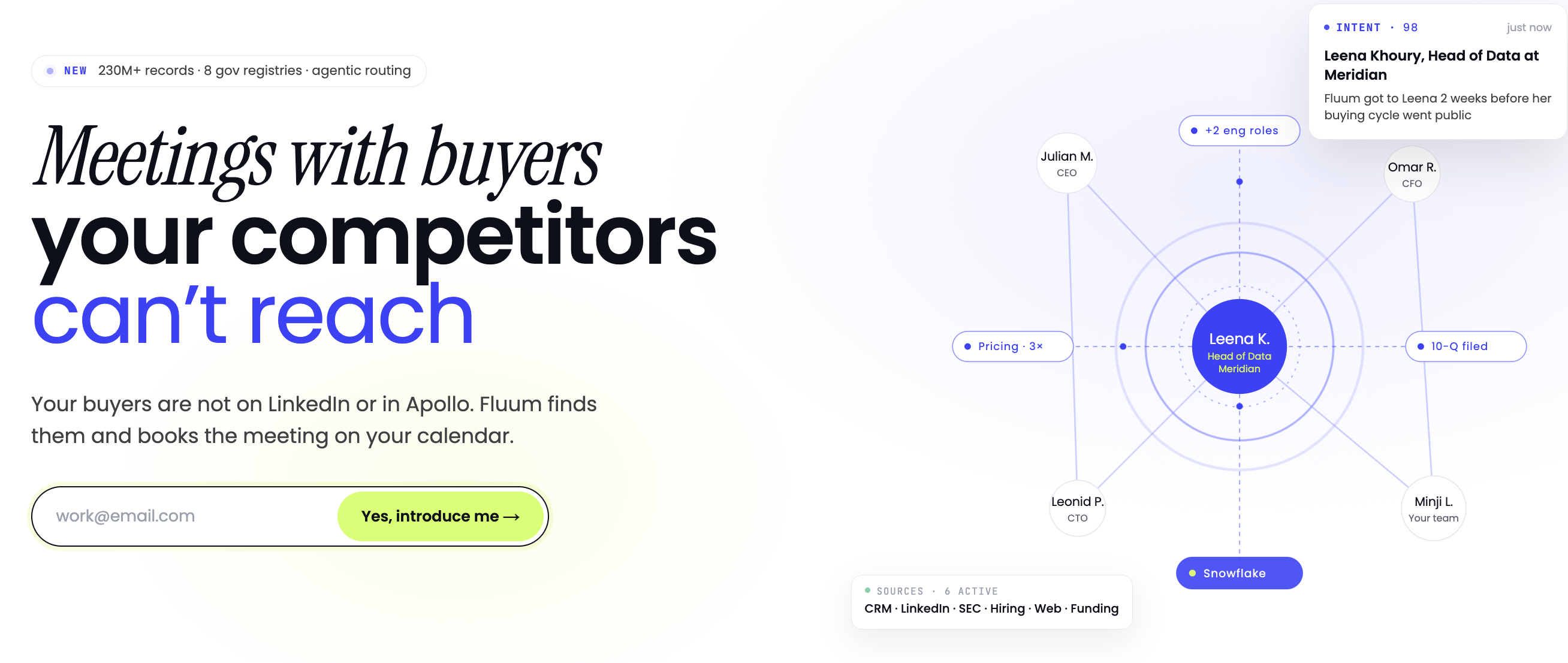
That’s exactly what Fluum is built to do. Our AI agents score intent signals across 40+ private data vendors and 8 government registries, surface decision-maker paths in fintech, cybersecurity, manufacturing, and regulated industries, and then deliver warm introductions that convert at a rate cold outreach never will. The problem was never volume. It was starting from zero every single time. this approach, paired with a warm introduction network, means you never have to start from zero again.
Recommended Articles
Explore more from our content library: