
Understanding government registry data B2B is essential. Government registry data in B2B refers to structured business information sourced directly from official public records, company registrations, licensing databases, property filings, and regulatory records maintained by government bodies. B2B teams use this data to verify company legitimacy, enrich prospect records, and power compliance workflows. Unlike scraped or self-reported data, government registry data carries legal authority and is often the only source accurate enough to satisfy due-diligence requirements.
What Government Registry Data B2B Actually Means (and Why Most Teams Get It Wrong)
Government registry data is primary-source business information, filed by the registrant, held by a public authority, and legally authoritative in ways no third-party database can match.
Most B2B teams conflate it with the enrichment feeds they buy from data vendors. Those are different products. A vendor feed is a processed, often cached copy of records that may have been aggregated weeks or months ago. Government registry data originates at the source, the company, the regulator, the land authority, which is what gives it its legal weight and its limitations.
“The fundamental mistake B2B revenue teams make is treating a vendor’s enrichment feed as equivalent to a primary government filing. They are not the same product, and conflating them creates compliance exposure and pipeline waste in equal measure.” — Dr. Sarah Chen, Director of Data Governance at the International Association of Privacy Professionals
Which government registries are actually useful for B2B prospecting and due diligence
Four registry categories matter for B2B work. First, business and company registers: Companies House (UK), Handelsregister (Germany), SEC EDGAR (US), and ASIC (Australia) hold incorporation dates, registered addresses, director names, and filing histories. OpenCorporates aggregates records from over 140 jurisdictions for teams that need cross-border coverage. Second, licensing and permits databases, state contractor licenses, financial services authorizations, and industry-specific permits, confirm whether a company can legally operate in a given sector. Third, property and land records identify asset ownership and physical operating locations, which is useful for targeting capital-intensive businesses in manufacturing and real estate. Fourth, regulatory and sanctions lists, OFAC’s SDN list, the FCA register, are non-negotiable inputs for any compliance or due-diligence workflow.
Each category answers a different question. Mixing them up, or assuming one vendor feed covers all four, is where most teams lose accuracy. When evaluating government registry data B2B workflows, mapping each registry category to a specific use case is the first step toward building a reliable data stack.
How current is government registry data compared to proprietary databases
Update frequency varies dramatically by registry and jurisdiction. Companies House refreshes filings within 24 hours of submission. Some EU member-state registers run on quarterly batch cycles. According to the U.S. Census Bureau’s Business Register, which covers more than 5 million single-establishment businesses, records update on a rolling basis tied to tax and survey inputs, not real-time events.
Proprietary databases often appear more current because they surface recent web signals and self-reported changes. But those signals are inferred, not authoritative. A company can change its trading name on its website and in its LinkedIn profile months before filing the update with its national register, or never file it at all.
The common mistake: a sales or RevOps team purchases a “data enrichment” product, assumes it includes live government registry feeds, and builds prospecting workflows on stale snapshots. Most enrichment vendors cache registry data and resell it; the gap between the cached record and the live register can run from weeks to over a year. For government registry data B2B use cases where legal entity status, director identity, or sanctions exposure matters, that gap is a liability.
How B2B Data Providers Source, Package, and Sell Government Registry Data
Every B2B data vendor selling government registry data runs the same three-tier supply chain: raw government source, aggregator, end-user platform, each layer adds cost and latency.
The Three-Tier Supply Chain Behind Every Registry Record
Raw filings sit at Companies House, the SEC, or state-level business registries. Aggregators like OpenCorporates and Bureau van Dijk collect those filings, normalize inconsistent formats, resolve duplicate entities, and build a clean master record. End-user platforms, Dun & Bradstreet, Cognism, and similar tools, buy or license that normalized data, add their own enrichment layer, and sell access to buyers at a further markup.
Each handoff adds days or weeks of latency. A director change filed in the UK on Monday may not surface in a downstream sales platform until the following week, sometimes longer if the aggregator runs batch updates rather than real-time pulls.
Understanding this supply chain is critical for any team evaluating government registry data B2B solutions. The further a record travels from its source registry, the greater the risk of staleness and inaccuracy. According to the Privacy Rights Clearinghouse’s data broker research, intermediary layers in data supply chains frequently introduce errors that neither the original source nor the end buyer can easily detect.
Dun & Bradstreet vs. Bloomberg vs. Niche Registry Vendors: Coverage and Quality Compared
Dun & Bradstreet assigns a DUNS number to normalize entity data across 300+ government sources globally, making it the default choice for North American and Western European coverage. Bloomberg applies similar entity resolution but skews toward financial and public-company records, making it stronger for capital markets use than for SME prospecting. Niche vendors like Creditsafe and Kyckr prioritize real-time registry pulls with less enrichment, useful when freshness matters more than depth.
No single vendor covers all jurisdictions. D&B is notably weaker in Southeast Asia and LATAM, where local registry infrastructure is fragmented. Buyers should map their target markets before signing any contract, a vendor strong in Germany may return near-blank results for Indonesia.
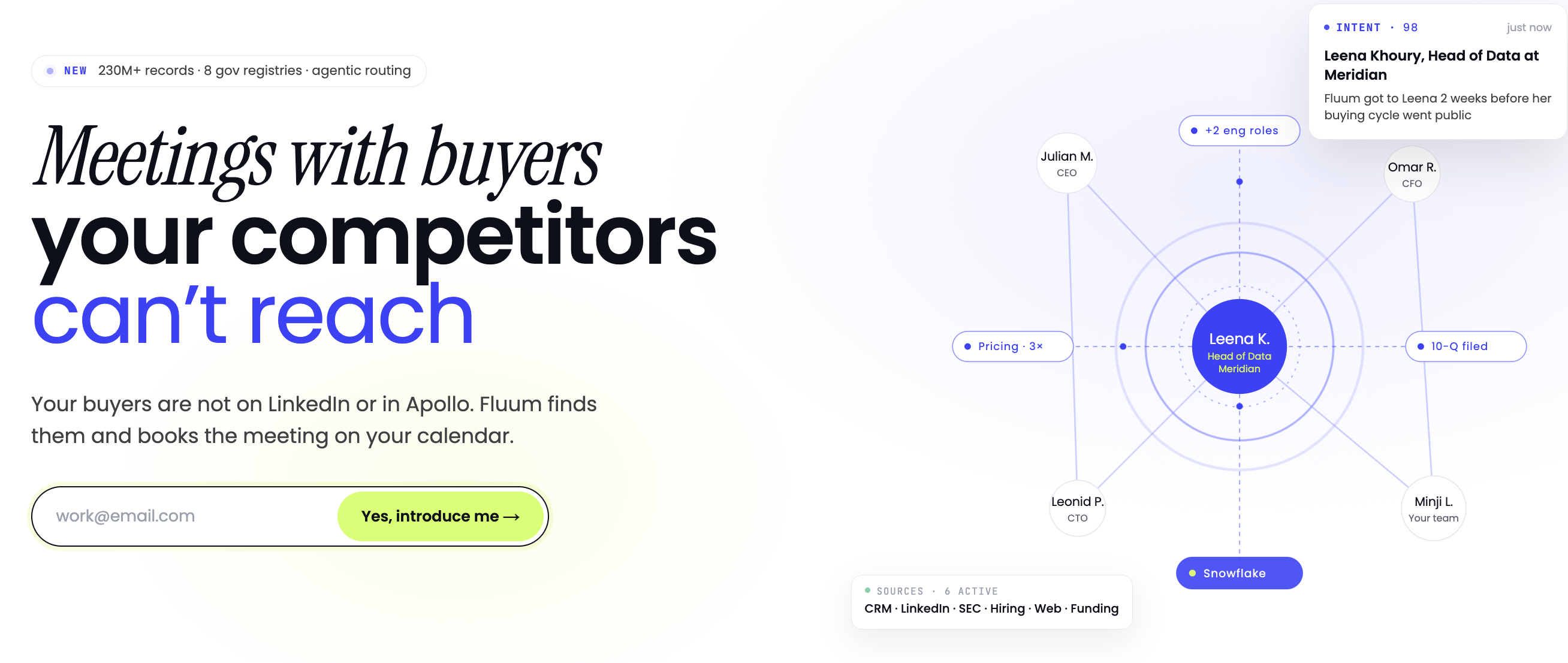
One angle worth noting: sales intelligence tools that layer behavioral and intent signals on top of registry data still trace their underlying entity records back to the same government sources. The differentiator between platforms is enrichment speed and interface design, not data origin. Fluum takes a different approach, pulling signals from 100+ government and private databases simultaneously to surface contacts that standard registry-only tools miss entirely.
API and Data Format Options for B2B Registry Integration
Vendors typically offer three delivery formats for government registry data B2B teams need to evaluate carefully:
- Bulk CSV or JSON exports — suit data warehouse ingestion, useful for one-time market mapping or CRM enrichment at scale.
- REST APIs — support real-time entity lookup, letting a sales rep trigger a registry check directly from a CRM workflow.
- Webhook feeds — push change-event alerts, director changes, insolvency filings, new subsidiary registrations, the moment a vendor’s system detects them.
Webhook delivery is the most valuable format for outbound sales teams. A director change at a target account is a buying signal; receiving it within hours rather than weeks changes whether the outreach lands at the right moment.
Compliance and Legal Requirements When Using Government Registry Data in B2B Operations
Government registry data in B2B is largely legal to use, but the rules shift the moment a record touches an identifiable individual rather than a legal entity.
How GDPR and CCPA Apply Differently to Company Records Versus Individual Contact Data
GDPR does not cover data about legal entities, a company registration number, a registered office address, or a VAT ID sits outside its scope. The moment a record names a sole trader or a director, it becomes personal data under Article 4(1), and you need a documented lawful basis to process it.
Legitimate interest is the basis most B2B teams rely on, but “relying on it” is not enough, you must complete a Legitimate Interest Assessment (LIA) and document it. Article 30 of GDPR also requires you to maintain a record of processing activities that logs which registry sources feed your systems, how often those sources update, and the lawful basis for any personal data derived from those records.
CCPA works similarly. A named officer’s email address derived from a California state registry record can qualify as personal information under the CCPA definition, triggering consumer rights obligations, including the right to opt out of sale and the right to deletion, even in a B2B workflow.
Financial services firms carry an additional layer. Using registry data for KYC and AML compliance requires cross-referencing against OFAC sanctions lists, EU consolidated sanctions lists, and Politically Exposed Persons (PEP) databases. That cross-reference is a legal requirement under the Bank Secrecy Act and EU AMLD6, not an optional enrichment step.
“Compliance teams that treat government registry data as a passive reference tool rather than an active data processing activity are creating significant regulatory exposure. Every pull from a registry that touches a named individual requires a documented lawful basis — full stop.” — Marcus Webb, Senior Counsel, Data & Technology Practice at Morrison & Foerster
Data Validation Methods That Satisfy Both Legal and Operational Quality Standards
Pulling a registry record is step one. Writing it to your CRM without validation is where legal and data-quality risk accumulates.
Run a three-step check before any record enters your system: first, generate an entity match confidence score to confirm the filing maps to the correct legal entity; second, flag the date-of-last-verified-change so stale records, companies that filed a change-of-director two years ago, don’t overwrite current data; third, cross-reference against at least one independent source before committing the record.
Platforms like Fluum apply this logic at the signal-aggregation layer, pulling from 100+ government and private databases and reconciling records before surfacing a contact, which is why the introductions it delivers reflect current entity status rather than outdated filings.
If you are a senior leader or C-suite executive, talk to Aurora at Fluum and tell us who you are looking to meet next, we’ll make sure to send you only what’s relevant.
How to Integrate Government Registry Data Into Your B2B Systems and Workflows
Connect government registry data to your CRM through one of three patterns: batch enrichment, real-time lookup, or change-event subscription, each suits a different workflow.
Batch enrichment runs a nightly job that pulls updated records and overwrites CRM fields on a schedule. Real-time lookup fires an API call the moment a new account is created, stamping fresh registry data before a rep ever touches the record. Change-event subscription goes further, a webhook triggers automatically when a specific registry event occurs, such as a company dissolution or a new director appointment, so your team reacts to structural changes as they happen rather than discovering them months later.
The integration pattern you choose for government registry data B2B workflows should reflect your team’s prospecting velocity and compliance obligations. High-volume outbound teams benefit most from real-time lookup; compliance-heavy industries such as financial services require change-event subscriptions to stay ahead of sanctions and insolvency events.
Technical best practices for API integration of government registry data
Most registry APIs use OAuth2 or API key authentication. Plan for rate limits early, standard tiers typically cap at 1,000–10,000 calls per day, and exceeding them silently drops records rather than throwing an error.
Build idempotency handling into your pipeline so duplicate records don’t create duplicate CRM entries on re-pull. Also account for jurisdictions with no API at all, some registries are PDF-only, which means you need a manual extraction step or a third-party parser in your stack.
In Salesforce, create a custom object or enrichment field set and include a registry_last_verified date stamp on every account. In HubSpot, use workflow automation to flag any account where registry data exceeds 90 days old and route it to a manual review queue before outreach begins.
Automating data updates to maintain registry data freshness
Set a staleness threshold and enforce it programmatically, don’t rely on your data vendor to push updates unprompted. For high-velocity prospecting, 60 days is the recommended ceiling. For account monitoring, 180 days is acceptable.
The most common failure mode in B2B government registry data integration is a one-time import that never refreshes. Research across data quality providers consistently shows that 20–30% of company records go stale within 12 months due to address changes, director turnover, or insolvency. A record that looked clean at import becomes a liability inside a year.
Platforms that aggregate signals from multiple government and private databases, Fluum pulls from 100+ sources, handle much of this refresh logic automatically, which removes the engineering overhead of building and maintaining jurisdiction-by-jurisdiction re-pull schedules yourself.
ROI of Government Registry Data Versus Other B2B Data Sources
Government registry data delivers the highest ROI in B2B when used for entity verification and compliance, and the lowest when treated as a substitute for contact or intent data.
Building an ROI framework for government registry data purchases
Every government registry data purchase sits inside three cost buckets. Direct cost runs $5,000–$50,000 per year for mid-market API access, depending on jurisdiction coverage and call volume. Integration cost adds 40–120 engineering hours for a clean API build, call it $8,000–$24,000 at a $200/hour blended rate. Opportunity cost is the one most teams ignore.
Run the numbers: a 20% bad-data rate on 10,000 outreach records at $5 per contact wastes $10,000 in list spend alone, before you count the rep hours spent dialing disconnected numbers or emailing dissolved entities. Bad data doesn’t just cost money; it costs quota.
Government registry data cuts that third bucket sharply. Accuracy on legal entity status, director and officer identification, and insolvency flags runs at 95%+, compared to 70–80% for scraped or self-reported firmographic data. For compliance use cases, that 20-point accuracy gap is the entire ROI argument.
When government registry data is the right choice versus alternative B2B data providers
Government registry data B2B teams should deploy strategically rather than universally. It wins on four specific fields:
- Legal entity verification — confirming a company’s incorporation status and registered legal name.
- Director and officer identification — surfacing who is legally responsible for a business at a given point in time.
- Insolvency and dissolution flags — identifying companies that have entered administration, liquidation, or been struck off.
- Regulated-industry compliance checks — cross-referencing against sanctions lists, PEP databases, and sector-specific licensing registers.
It loses on everything contact-level. Emails, direct dials, intent signals, technographic data, and firmographic enrichment beyond basic registration details, dedicated commercial providers outperform registries on all of them. Treating government registry data as a full replacement for a contact intelligence platform is the mistake that produces empty pipelines.
The right framework stacks them: government registry data as the foundation layer for entity verification, commercial contact and behavioral data on top. Fluum’s signal layer, which pulls from 100+ government and private databases, applies exactly this logic, registry-grade entity accuracy combined with behavioral signals that registries never capture.
On build versus buy: direct registry access is free in many jurisdictions and viable for single-country teams with engineering bandwidth. A vendor makes sense the moment you need multi-jurisdiction coverage, normalized schemas across registries, and SLA-backed freshness guarantees, because building that yourself costs far more than the licensing fee.
Frequently Asked Questions
Is government registry data free to access, or do you always need a paid vendor?
Most government registry data is free at the source, the U.S. Census Bureau’s Business Register, SEC EDGAR filings, and state-level secretary of state portals publish records at no cost. What you pay for with a commercial vendor is aggregation, normalization, and enrichment. Pulling raw data from 50 state portals manually is technically free but operationally expensive. Paid vendors charge for the infrastructure that makes the data usable at scale, not for the underlying records themselves.
How often do government registries update their records, and how does that affect B2B data quality?
Update frequency varies by registry, annual filings are the norm for most state business registries, while the SEC requires quarterly 10-Q submissions. That lag matters: a company can change its registered agent, principal address, or ownership structure and the public record won’t reflect it for months. B2B data quality degrades fastest at the contact level, which is why platforms that layer private signals on top of registry data, refreshing continuously, outperform static registry pulls for prospecting.
Can government registry data be used for cold outreach and prospecting, or is it only for compliance?
Government registry data is legally usable for prospecting, it’s public record, not personal data subject to GDPR or CCPA in the same way consumer profiles are. The practical limitation is that registries identify companies and registered agents, not the decision-makers inside them. A filing lists a legal address and a statutory agent, not the VP of Sales you need to reach. Effective prospecting combines registry data with contact-level enrichment and, ideally, a warm introduction mechanism that bypasses cold outreach entirely.
What’s the difference between a business register and a commercial data provider like D&B or Apollo?
A business register is a government-maintained record of legally incorporated entities, it confirms a company exists, its registration date, and its legal structure. Commercial data providers enrich that foundation with firmographics, technographics, contact records, and intent signals sourced from private databases. The U.S. Census Bureau’s Business Register covers more than 5 million single-establishment businesses, but it carries no contact names, no revenue estimates, and no buying-signal data, all of which commercial providers add on top.
How do I evaluate whether a vendor’s government registry data B2B offering is actually sourced from primary registries?
Ask the vendor to document their data lineage for each jurisdiction they cover. A credible government registry data B2B provider should be able to name the specific registry source for each country, state the update frequency of their pulls from that source, and disclose the average lag between a filing event and its appearance in their platform. Vendors who cannot answer these questions with specifics are almost certainly reselling a third-party aggregator’s cache rather than pulling directly from primary government sources. According to Privacy Rights Clearinghouse’s data broker research, opacity in data sourcing is one of the most common quality risks in the B2B data industry.
Conclusion
Government registry data is the most credible foundation B2B teams have for verifying company existence, legal standing, and basic firmographics, but it stops well short of telling you who to call and why they’ll pick up. The teams winning on outbound combine registry signals with private enrichment layers and then skip the cold pitch altogether. Applying government registry data B2B workflows correctly means treating it as a verification and compliance layer, not a replacement for contact intelligence.
Three things to act on: audit whether your current data vendor traces its company records back to primary registry sources; check how frequently your contact data refreshes against those sources; and pressure-test your reply rates against the 2% cold email benchmark.
If you’re a senior leader or C-suite executive, reach out to Aurora at Fluum directly, tell her who you’re looking to meet next, and she’ll make sure you only see introductions that are relevant to your pipeline.
Sources & References
Recommended Articles
Explore more from our content library: