
Understanding SEC EDGAR sales prospecting is essential. SEC EDGAR filings turn into a sales prospecting source when you treat 10-Ks, 10-Qs, and 8-Ks as public statements of intent, companies disclose expansions, new executive hires, facility openings, and material risks months before that news hits a press release or a LinkedIn update. Sales teams mine these filings to spot which public companies are actively growing, restructuring, or entering new markets, then map that activity to named decision-makers disclosed in the same documents. The result is a warmer, better-timed outbound list than one built from firmographic filters alone, though EDGAR only covers public companies, so it works best as one layer in a broader prospecting stack.
How Can Sales Teams Use SEC EDGAR Filings for Sales Prospecting?
SEC EDGAR sales prospecting works by treating three filing types as a free, standing feed of buying-intent signals: annual reports, quarterly updates, and event disclosures. Each filing type answers a different question about a company’s trajectory, and together they tell you who’s expanding, who just got a new budget-holder, and who’s under pressure to change vendors.
The 10-K annual report is the deepest document, it covers full-year strategy, risk factors, capital expenditure plans, and segment performance. The 10-Q quarterly report updates that picture every three months, flagging shifts in revenue, headcount, or spending that didn’t exist in the last filing. The 8-K is the most time-sensitive: companies must file it within four business days of a material event, covering executive changes, acquisitions, facility openings, and new credit agreements. For prospecting, the 8-K is often the closest thing to a real-time trigger you’ll get from a regulatory filing.
One limit matters before you build a workflow around this: EDGAR only covers publicly traded and SEC-reporting companies, not private startups or small businesses under reporting thresholds. That makes it a poor fit for early-stage prospecting, but a strong fit for enterprise and mid-market accounts that already carry the disclosure burden of being public.
Which Types of Companies and Industries Are Most Valuable to Prospect via EDGAR Filings?
Capital-intensive, heavily regulated industries generate the richest EDGAR signal because they’re required to document expansion and compliance activity in detail. Consider how the strongest candidates for SEC EDGAR sales prospecting break down by sector:
- Manufacturing: discloses new plant construction and supply-chain shifts in 8-Ks and 10-Ks.
- Energy: reports drilling permits, infrastructure investment, and regulatory exposure on a predictable cycle.
- Financial services: files extensively on compliance, risk, and capital position changes.
- Healthcare and life sciences: discloses clinical trial outcomes, facility expansions, and leadership changes tied to FDA milestones.
If your target account sells into any of these sectors, EDGAR gives you documentation your competitors are probably not reading.
How Do You Build a Target List From EDGAR Data Without Manual, Time-Consuming Searches?
Filter by SIC code to isolate your target industries, then narrow by filing type and date range to surface only recent activity. From there, scan filing text for keywords tied to growth or disruption, “expansion,” “new facility,” “restructuring,” “material weakness,” “chief executive officer”, and flag matches for review. This turns a manual research task into a repeatable filter you rerun on a schedule.
The payoff over a purchased contact list is qualification built in. A generic list tells you a company fits a firmographic profile; an EDGAR-sourced lead tells you the company already put its reason for buying on the public record. This is the core advantage SEC EDGAR sales prospecting has over firmographic-only lead generation.
What Buying Signals and Decision-Maker Clues Can You Extract From 10-K and 10-Q Filings?
Four disclosure types in 10-Ks, 10-Qs, 8-Ks, and DEF 14As tell you who’s expanding, who’s newly in charge of budget, and what they’re worried about, the raw material of SEC EDGAR sales prospecting.
What Specific Expansion Announcements, Executive Hires, and Facility Openings Signal Buying Intent in EDGAR Filings?
Start with the Management’s Discussion and Analysis (MD&A) section of the 10-K or 10-Q. Companies disclose capital expenditure plans here in plain language, a new distribution center, a second manufacturing line, a data center lease in a new region. Any line that reads “we expect to increase capital expenditures” or “we opened a new facility in [location]” is a direct signal that budget is moving toward infrastructure, and infrastructure buildouts almost always drag procurement, IT, and vendor-selection decisions behind them.
Geographic expansion language works the same way. A manufacturer disclosing a new plant in a different state or country is telling you, months ahead of any press release, that it will need new suppliers, compliance tooling, and local partners.
Executive change disclosures matter just as much. Form 8-K Item 5.02 requires companies to report the appointment or departure of a principal officer within four business days. A new CFO, CIO, or VP of Operations almost always means a new budget owner walking in the door, and new leaders typically re-evaluate vendor relationships within their first two quarters.
Risk factor language, buried in Item 1A of the 10-K, is the most underused signal. When a company adds a new risk factor about a technology gap, a supply chain dependency, or an emerging compliance requirement, it’s disclosing a problem it doesn’t yet have a solved answer for, often the earliest public trace of a purchasing decision still months away.
How Do You Surface Decision-Maker Names and Titles From EDGAR Documents for Warm Outreach?
Names and titles surface in three predictable places. The signature page at the end of the 10-K lists the CEO, CFO, and board members who certified the filing. The Summary Compensation Table in the DEF 14A proxy statement names the named executive officers alongside their titles and compensation. And the leadership bios section of the same proxy gives tenure, background, and sometimes the specific initiatives an executive owns.
The outreach angle comes from combining the two: name the disclosure, name the person. “I saw in your 10-K that you’re expanding capacity in Texas, is [name], your newly appointed VP of Operations, leading that build-out?” reads as informed, not cold. That specificity is exactly what a platform like Fluum uses as matching input, describe the buying signal and title you’re chasing, and its AI cross-references 100+ government and private databases to surface the right contact before facilitating a double opt-in introduction, rather than leaving you to cold-email a name off a signature page.
How Does EDGAR-Based Prospecting Compare to Traditional Intent Data and Alternative Sources?
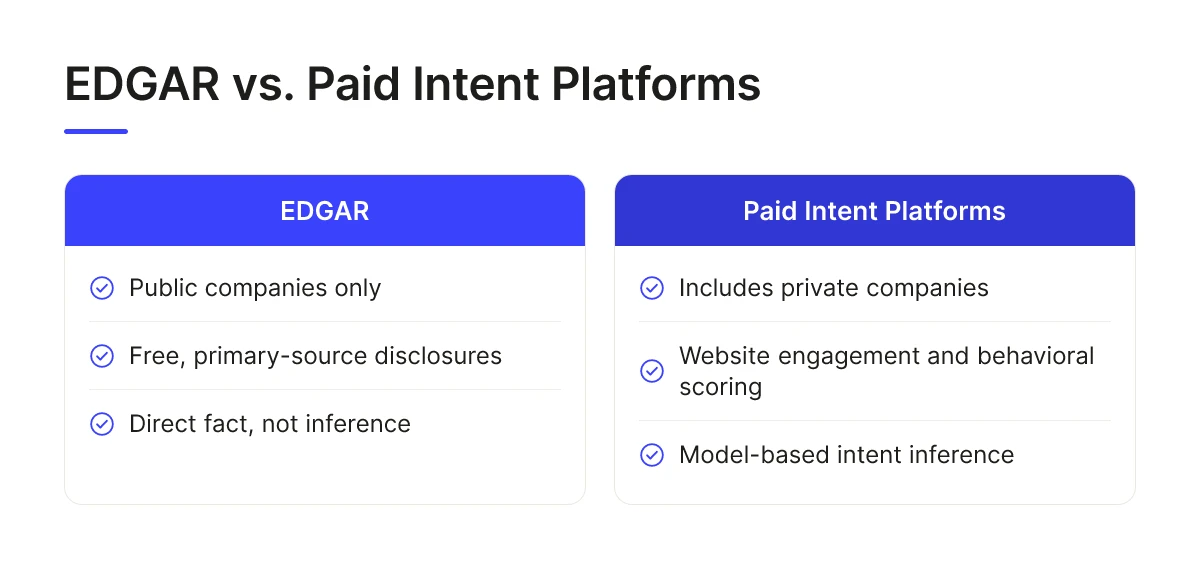
EDGAR gives you free, primary-source disclosures on public companies only, paid intent platforms add private-company coverage and behavioral scoring, at a cost. Neither one replaces the other; they solve different problems.
Tools built for buyer intent data pull from website engagement, third-party research activity, and proprietary firmographic databases to flag accounts that are “in-market” [1]. That’s valuable when your target list includes private companies, which make up most of the mid-market. But it’s inference, a model guessing intent from behavior. EDGAR isn’t inference. A merger agreement, a debt covenant, an executive departure filed on Form 8-K, these are disclosed facts a company was legally required to publish. You’re not guessing intent; you’re reading it. For teams weighing the two approaches, this guide to using intent data to identify sales qualified leads lays out how behavioral scoring is typically layered on top of firmographic data.
The tradeoff runs the other direction on effort. Paid platforms pre-process signals, score them, and route them into your CRM automatically. EDGAR gives you raw filings with no scoring layer, you or your RevOps team have to read the 8-K, understand what it means for budget or authority, and decide if it’s worth an outreach trigger. That’s real analyst time, even with keyword alerts set up. Some practitioners argue that intent data works best as one input among several rather than the sole trigger for outreach, a point covered in this piece on leveraging intent data without over-relying on it.
When Should You Use EDGAR Over Bloomberg, FactSet, or Proprietary Sales Intelligence Platforms?
Use EDGAR directly when your account list is entirely public companies and budget doesn’t stretch to a premium data terminal or sales intelligence subscription. A fintech vendor selling to banks and public asset managers, or a cybersecurity vendor targeting NYSE- and Nasdaq-listed manufacturers, can build a full trigger-event workflow from EDGAR alone at no data cost beyond the tooling to monitor it. Once your ICP includes private, VC-backed, or international companies outside SEC jurisdiction, you need a broader source, EDGAR simply has no visibility there.
What Conversion Rates and ROI Metrics Do Sales Teams See From EDGAR-Based Prospecting vs. Cold Outreach?
Outreach anchored to a specific filing, a leadership change, a new credit facility, an acquisition, tends to land better than generic cold outreach because it references something the prospect already knows happened to their own company. That’s a materially different starting position than a cold email guessing at pain points. Still, a filing reference alone doesn’t make an email warm; it makes it relevant. SEC EDGAR sales prospecting works best as a signal layer feeding a warm-introduction motion, where a platform like Fluum turns the trigger into a double opt-in conversation, rather than as a standalone replacement for outbound.
What Is the Best Way to Automate EDGAR Monitoring for Real-Time Sales Alerts?
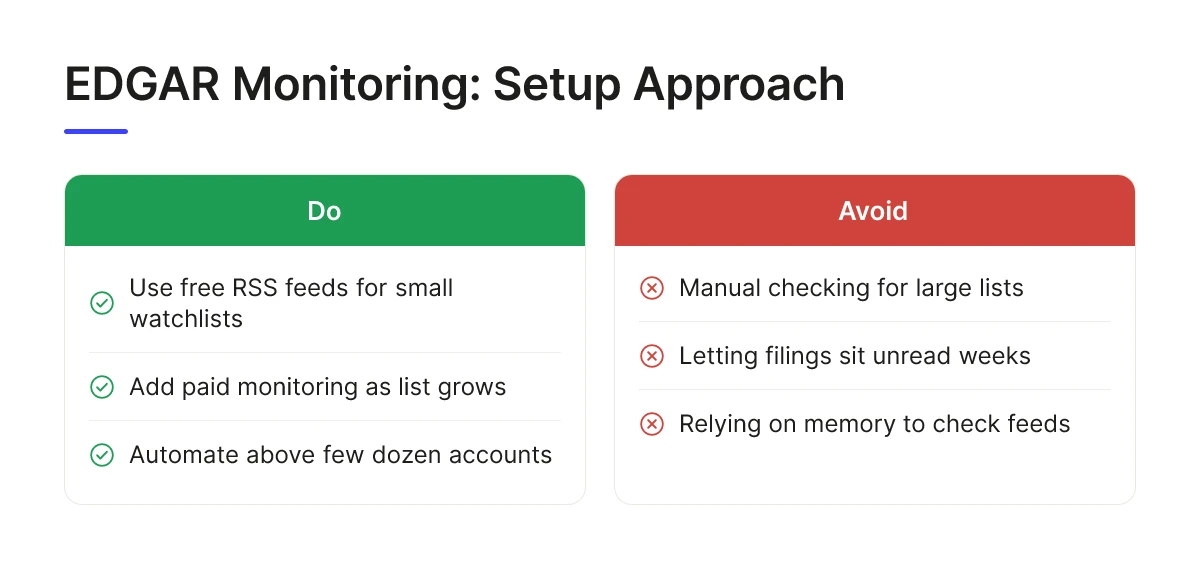
The best setup combines EDGAR’s free RSS feeds for narrow watchlists with a paid monitoring layer once your target list outgrows manual checking. Below a few dozen accounts, a scripted feed works fine. Above that, the manual approach quietly falls apart, someone forgets to check, a filing sits unread for three weeks, and the signal is dead by the time a rep sees it.
How Can You Set Up Automated Alerts for Material Events and Filing Changes in Your Target Accounts?
Start with EDGAR’s own tools, because they cost nothing and cover the basics. The full-text search system lets you query filings by company name, CIK number, or Standard Industrial Classification (SIC) code, and EDGAR publishes RSS feeds keyed to specific filers and form types. Subscribe to the feed for each target account’s CIK, or build a feed around an entire SIC code if you’re tracking a sector like regional banks or industrial manufacturers rather than a fixed list of logos.
Raw feeds get noisy fast, so filter for the 8-K item categories that actually predict a buying window. The highest-signal triggers for most B2B sellers are:
- Item 5.02 — executive officer changes
- Item 2.01 — completion of an acquisition or disposition
- Item 2.05 or 2.06 — facility closures, exit costs, or material asset impairments
A new CFO or a plant consolidation tells you far more about near-term budget movement than a routine Item 8.01 press release filing.
Once filtering works, decide whether to build or buy. A small target list, under 50 accounts, is manageable with a scheduled script pulling the EDGAR feed and writing new hits to a spreadsheet. Teams tracking hundreds of accounts across finance, manufacturing, or tech usually move to a monitoring layer, priced anywhere from budget-friendly to premium enterprise tiers depending on account volume and alert customization. Broader frameworks for combining filing triggers with other signal types are covered in this guide to predictive sales intelligence and intent data for B2B sales.
Either way, route alerts into tools reps already use, a CRM task auto-created against the account record, a dedicated Slack channel, or a shared alert log reviewed daily. SEC EDGAR sales prospecting only pays off if the alert reaches a rep within days, not weeks; a same-week notice on a filing beats a polished monthly digest every time.
What Legal and Compliance Risks Should Sales Teams Know About When Prospecting With EDGAR Data?
EDGAR filings are public record, but the moment you turn a filing into an email or a call script, general privacy and anti-spam law takes over, not SEC rules.
Are There Restrictions on Using EDGAR Data for Cold Outreach and Sales Targeting Under SEC or Data Privacy Rules?
The SEC built EDGAR to be read. Every 10-K, proxy statement, and 8-K is a public disclosure the moment it’s filed, and there’s nothing in securities law that restricts a sales team from reading a named executive’s compensation table, a segment breakdown, or a risk factor and using it to inform outreach. That’s a different category of activity from trading on material non-public information, which is what SEC enforcement actually targets. Researching a public filing to understand a company’s expansion plans or new plant investment carries none of that exposure.
The risk shows up one step later. Once a rep pulls a named executive’s title from a proxy statement and pairs it with an email address sourced elsewhere, general data privacy rules, GDPR for contacts in the EU, CAN-SPAM and state-level privacy laws in the US, govern how that person can be messaged. SEC EDGAR sales prospecting is compliant on the research side by default; it’s the outreach mechanics that need the same scrutiny you’d apply to any contact list.
There’s a second line worth drawing: reading filings manually or through a matching tool is not the same as scraping EDGAR at scale or reselling structured filing data as a dataset. High-volume automated extraction can bump into SEC.gov’s fair access terms of use, separate from any privacy question. Teams building repeatable pipelines should understand which side of that line their tooling sits on. Some of the same governance questions come up in broader discussions of how to leverage intent data for B2B sales responsibly.
Two practices reduce exposure regardless of scale. First, document the specific disclosure referenced in each outreach message, the exact filing, section, and date, which doubles as a compliance record and as the personalization detail that makes the message land. Second, loop in legal or compliance counsel before scaling an EDGAR-sourced outreach program past a handful of reps, particularly if outreach touches regulated sectors like fintech or manufacturing where procurement and vendor-risk teams scrutinize how a vendor found them in the first place.
If you’re a senior leader or C-suite executive evaluating how your team sources pipeline, talk to Aurora at Fluum and tell us who you’re looking to meet next, we’ll make sure to send you only what’s relevant.
Frequently Asked Questions
Can small sales teams realistically use EDGAR without a data or research background?
Yes, the full-text search tool and standard filing sections (10-K, 8-K, DEF 14A) require no technical background to read. A rep can search a keyword like “material weakness” or a vendor name across filings in minutes. The learning curve is finding which filing types matter for your ICP, not decoding financial statements or building models.
How often should you re-check EDGAR filings for an active target account?
Check quarterly at minimum, since 10-Qs post every quarter and 8-Ks can drop anytime a material event occurs. For accounts in active pursuit, set a monthly cadence around 8-K alerts, leadership changes and restructurings signal budget shifts fast, and stale intel makes outreach feel out of touch.
Does EDGAR data work for targeting subsidiaries of public companies?
Partially, EDGAR filings are indexed to the parent entity, so subsidiary-level detail often appears only in risk factors, segment reporting, or acquisition disclosures. You’ll find named subsidiaries and business units, but org charts and division-level buying authority usually require cross-referencing with LinkedIn or a company registry to confirm who actually holds budget.
What’s the biggest mistake sales teams make when using filings for outreach?
Quoting the filing itself instead of translating it into a business problem the reader recognizes. Opening a cold email with “I saw your 10-K mentioned supply chain risk” reads as surveillance, not insight. The stronger move is referencing the underlying pressure, rising costs, a leadership change, a new compliance mandate, without citing the document as your source.
How does SEC EDGAR sales prospecting fit alongside a broader intent data stack?
Treat EDGAR as one signal source among several rather than a complete system on its own. It excels at disclosed, factual triggers for public companies, while behavioral intent data fills the gap for private-company activity and pre-disclosure buying research. Combining both gives sales teams broader coverage and more corroborated signals before an outreach decision is made.
Conclusion
EDGAR gives you facts no cold list provides: who just took over as CFO, which company disclosed a material weakness, where restructuring is underway. But filings only tell you who might need help, they say nothing about who’ll actually take your call. That gap is why cold outreach against even perfect filing-based signals still converts under 2%.
Pair the signal with a warm path in. Fluum matches your ideal customer profile against 100+ government and private databases, then delivers double opt-in introductions to decision-makers in finance, technology, and manufacturing, people who’ve already said yes to the conversation. If you’re a senior sales or partnerships leader, talk to Aurora and tell her exactly who you’re trying to meet next.
Sources & References
Recommended Articles
Explore more from our content library: