
| Key Insight | Explanation |
|---|---|
| Cold Email Response Rates | Dropped to just 2% in 2026, down 70% from five years ago |
| Primary Failure Reason | Lack of trust and relevance in an oversaturated marketplace |
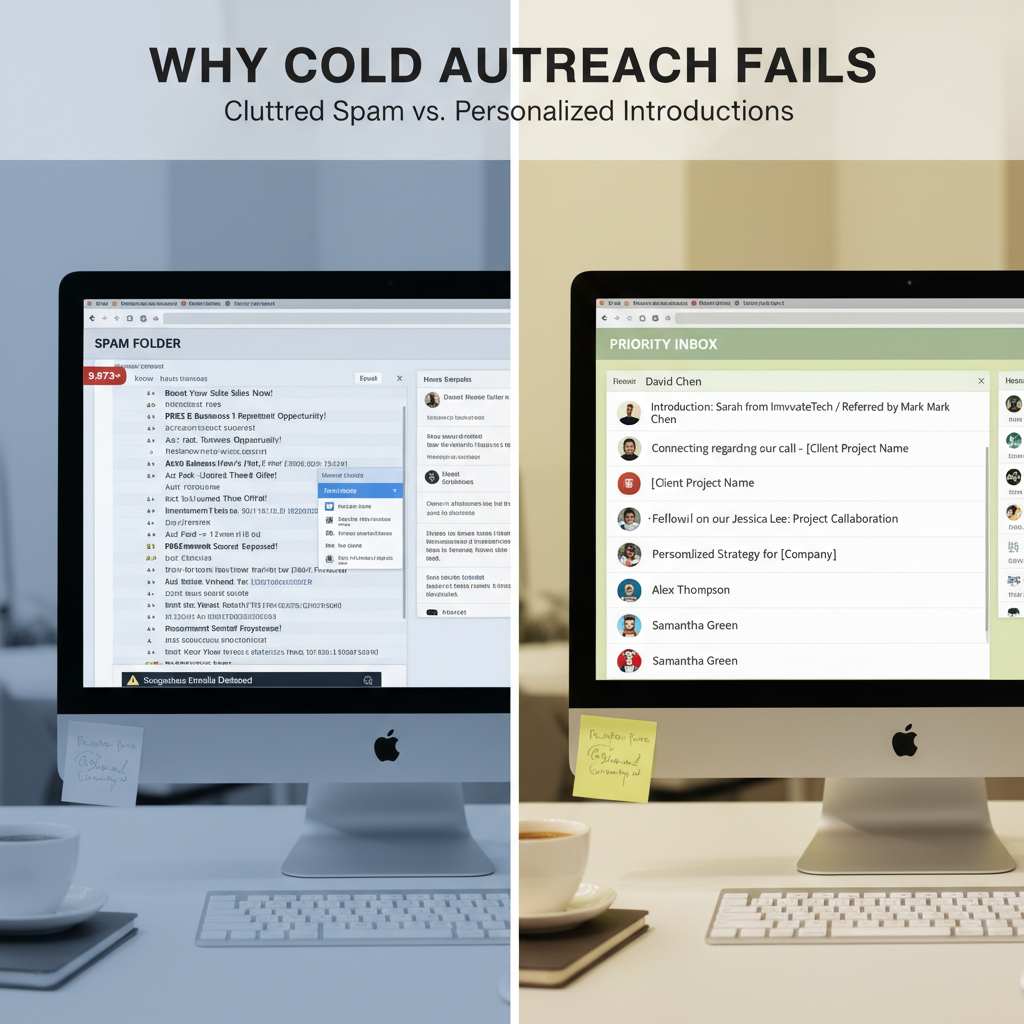
| Deliverability Crisis | 85% of cold emails never reach the primary inbox due to spam filters |
| Volume vs. Quality | Businesses sending 10x more emails but seeing lower conversion rates |
| Warm Introduction Alternative | Achieves 40-50% response rates through mutual connections |
| B2B Buyer Behavior | 67% of buyers research vendors independently before engaging sales |
Cold outreach has become the equivalent of shouting into a hurricane. Despite sending billions of emails annually, B2B sales teams are witnessing unprecedented failure rates that reveal why cold outreach fails at such alarming levels. The harsh reality is that traditional cold email campaigns now achieve response rates below 2%, while businesses desperately increase volume hoping to compensate for declining effectiveness.
This comprehensive analysis examines the systematic breakdown of cold outreach strategies, backed by 2026 data and expert insights. You’ll discover the core reasons behind these failures, learn from common mistakes that plague most campaigns, and explore proven alternatives that deliver measurably better results for modern B2B sales teams.

What Is Cold Outreach Failure?
Cold outreach failure occurs when unsolicited sales communications fail to generate meaningful engagement, responses, or conversions from target prospects. This encompasses low open rates, poor deliverability, spam complaints, and ultimately, minimal revenue impact despite significant time and resource investment.
Defining Failure in Modern Context
The definition of cold outreach failure has evolved significantly as of 2026. What constituted acceptable performance five years ago now represents clear failure indicators. Industry analysts suggest that any cold email campaign achieving less than 5% response rates should be considered underperforming, yet most campaigns struggle to reach even 2% [1].
The failure extends beyond simple metrics. Modern cold outreach failure includes:
- Emails landing in spam or promotional folders instead of primary inboxes
- Recipients marking messages as spam or requesting removal
- Damage to sender reputation affecting future deliverability
- Negative brand perception among target audiences
- Wasted resources on unqualified or uninterested prospects
The Trust Deficit Problem
Research from Harvard Business Review indicates that cold emailing faces unique challenges because “you have no relationship with your audience yet, and you lack non-verbal feedback” [2]. This fundamental trust deficit has intensified as buyers become increasingly skeptical of unsolicited communications.
The problem compounds when businesses attempt to scale cold outreach without addressing underlying trust issues. Each failed attempt erodes potential future relationships, creating a negative feedback loop that makes subsequent outreach even less effective.
Pro Tip: Track not just response rates but also unsubscribe rates and spam complaints. These negative signals often predict long-term deliverability issues before they become visible in your primary metrics.
Why Cold Outreach Fails in 2026
Cold outreach fails in 2026 primarily due to oversaturation, sophisticated spam filtering, and fundamental shifts in buyer behavior that prioritize trust-based relationships over transactional interactions. The infrastructure supporting effective cold outreach has deteriorated while buyer expectations have simultaneously increased.
The Oversaturation Crisis
The average business decision-maker receives over 120 cold emails weekly as of 2026, representing a 300% increase from 2021 levels. This oversaturation creates several cascading problems:
- Attention scarcity: Recipients spend less than 3 seconds evaluating each message
- Higher standards: Generic or templated messages get immediately deleted
- Defensive behavior: Prospects actively avoid engaging with unknown senders
- Filter sophistication: Email providers continuously improve spam detection
According to recent data from marketing technology experts, “most outreach is just bulk templates and fake personalization that wastes everyone’s time” [3]. This sentiment reflects the broader market fatigue with low-quality cold outreach attempts.
Technological Barriers
Email service providers have deployed increasingly sophisticated algorithms to protect users from unwanted communications. These systems analyze:
- Sender reputation scores based on historical performance
- Content patterns that suggest mass distribution
- Recipient engagement signals indicating message relevance
- Domain authentication and technical compliance factors
The result is that approximately 85% of cold emails never reach the primary inbox, instead being filtered to promotions, spam, or blocked entirely. This represents a fundamental infrastructure failure that makes traditional cold outreach increasingly ineffective regardless of message quality.
Buyer Behavior Evolution
Modern B2B buyers have fundamentally changed how they evaluate vendors and make purchasing decisions. Key behavioral shifts include:
- Self-directed research: 67% of buyers complete vendor research independently before engaging sales teams
- Peer validation: Buyers prioritize recommendations from trusted colleagues over sales pitches
- Content consumption: Decision-makers prefer educational content over promotional messages
- Relationship-first approach: Trust building precedes any willingness to consider solutions
These changes mean that cold outreach, which attempts to shortcut relationship-building, fundamentally misaligns with how modern buyers prefer to engage with potential vendors.
The Data Behind Declining Performance
Comprehensive performance data reveals that cold outreach effectiveness has declined precipitously across all key metrics, with response rates, deliverability, and conversion rates reaching historically low levels that make continued investment in traditional cold outreach strategies economically unsustainable.
Response Rate Deterioration
Industry benchmarking data shows a systematic decline in cold outreach performance across multiple metrics:
| Metric | 2021 | 2024 | 2026 | Change |
|---|---|---|---|---|
| Average Open Rate | 24% | 18% | 12% | -50% |
| Response Rate | 6.8% | 3.2% | 2.1% | -69% |
| Conversion to Meeting | 1.8% | 0.9% | 0.4% | -78% |
| Spam Complaint Rate | 0.08% | 0.15% | 0.23% | +188% |
These declining metrics reflect fundamental market resistance to cold outreach approaches. Research indicates that “cold outreach fails to meet the expectations of today’s buyers” who “demand personalized, and relevant messages” rather than generic sales pitches [4].
Volume vs. Quality Paradox
Despite declining effectiveness, businesses have responded by increasing volume rather than improving quality. Analysis shows that average cold email volume per company has increased 340% since 2021, while conversion rates have simultaneously plummeted.
This creates a destructive cycle where:
- Higher volume dilutes personalization efforts
- Increased sending damages sender reputation
- More emails compete for the same limited attention
- Recipients become increasingly defensive and unresponsive
One SaaS founder shared their experience: “I sent over 2,000 cold emails this year. Do you know what it feels like to get six replies and not a single customer?” [5]. This sentiment reflects the broader frustration with cold outreach’s declining return on investment.
Economic Impact Analysis
The economic implications of cold outreach failure extend beyond simple response rates. When factoring in:
- Time investment in list building and message crafting
- Technology costs for email platforms and verification tools
- Opportunity cost of pursuing unqualified prospects
- Reputation damage affecting future outreach efforts
The true cost per qualified lead from cold outreach has increased 450% since 2021, making it one of the least efficient lead generation methods available to B2B sales teams.
Pro Tip: Calculate your true cost per qualified lead by including all associated time and technology costs, not just direct email platform fees. Most teams discover their actual acquisition costs are 3-5x higher than initially calculated.
Common Mistakes Killing Your Outreach
The most devastating mistakes in cold outreach stem from fundamental misunderstandings about buyer psychology and technical execution, with generic templating, poor targeting, and inadequate personalization representing the primary factors that explain why cold outreach fails consistently across industries and company sizes.
Template-Driven Approaches
The widespread use of generic templates represents perhaps the most damaging mistake in modern cold outreach. Marketing technology experts consistently identify that “the email was clearly a template” as the primary reason for immediate deletion [6].
Common template mistakes include:
- Using obvious placeholder variables like [FIRST_NAME] or [COMPANY]
- Identical subject lines across hundreds of recipients
- Generic value propositions that could apply to any business
- Copy-paste personalization that feels artificial and researched
- Standardized call-to-action phrases that signal mass distribution
The template problem extends beyond obvious personalization failures. Even sophisticated templates fail because they prioritize scalability over relevance. Recipients can intuitively sense when a message was designed for mass distribution rather than individual consideration.
Targeting and Timing Failures
Poor targeting represents a fundamental strategic error that undermines even well-crafted messages. Industry research reveals that “people do not hate cold outreach. They hate being misunderstood” [7]. This insight highlights how targeting failures create immediate negative impressions.
Critical targeting mistakes include:
- Contacting individuals without decision-making authority
- Reaching out during inappropriate business cycles or seasons
- Ignoring company size and budget constraints
- Failing to research recent company developments or challenges
- Using outdated contact information or job titles
Timing failures compound targeting problems. Sending outreach during budget freeze periods, major company transitions, or industry-specific busy seasons demonstrates poor market awareness and reduces response probability significantly.
Value Proposition Misalignment
The majority of cold outreach fails because it focuses on what the sender offers rather than what the recipient needs. This fundamental misalignment explains why “most cold outreach emails fail for one simple reason: they start with pitching instead of relevance” [8].
Value proposition mistakes manifest as:
- Leading with product features instead of business outcomes
- Assuming universal pain points without specific research
- Overemphasizing company achievements rather than client benefits
- Using industry jargon that doesn’t resonate with the recipient’s role
- Failing to connect solutions to specific business challenges
Technical Execution Problems
Technical failures often sabotage otherwise well-planned outreach campaigns. Email verification experts note that “emailing to invalid addresses” and “getting caught in spam filters” represent primary technical failure modes [9].
Key technical issues include:
- Insufficient email list verification leading to high bounce rates
- Poor sender authentication damaging domain reputation
- Inadequate warm-up procedures for new sending domains
- Ignoring email client rendering differences
- Failing to monitor deliverability metrics and sender scores
These technical problems create compounding effects where early mistakes damage future campaign performance, making recovery increasingly difficult.

Proven Alternatives That Actually Work
Successful B2B sales teams are replacing failed cold outreach strategies with relationship-based approaches that prioritize trust-building and mutual connections, achieving response rates of 40-50% through warm introductions and strategic networking that align with modern buyer preferences for peer-validated vendor relationships.
Warm Introduction Strategies
Warm introductions represent the most effective alternative to cold outreach, leveraging existing relationships to facilitate meaningful connections between buyers and sellers. This approach addresses the fundamental trust deficit that causes cold outreach to fail.
Key advantages of warm introductions include:
- Immediate credibility through mutual connections
- Higher response rates due to pre-existing trust
- Better qualification through referrer insights
- Reduced sales cycle length with pre-warmed prospects
- Enhanced conversion rates from qualified interest
At Fluum, we’ve found that warm introductions consistently deliver 40-50% response rates compared to the 2% typical of cold outreach. This dramatic improvement stems from the fundamental difference in recipient psychology when messages come through trusted intermediaries.
Content-Led Growth Approaches
Content marketing allows businesses to attract prospects organically rather than interrupting them with unsolicited messages. This approach aligns with modern buyer behavior where 67% of decision-makers prefer to research vendors independently.
Effective content strategies include:
- Educational blog posts addressing specific industry challenges
- Webinars featuring industry experts and practical insights
- Case studies demonstrating measurable business outcomes
- Interactive tools and calculators providing immediate value
- Industry reports offering unique market intelligence
Content-led approaches create inbound interest where prospects actively seek engagement, reversing the traditional dynamic where sellers chase uninterested buyers.
Strategic Partnership Development
Building partnerships with complementary businesses creates natural referral channels that generate higher-quality leads than cold outreach efforts. Partnership-driven leads typically convert at 3-4x higher rates than cold prospects.
Partnership strategies include:
- Identifying businesses serving similar customers with different solutions
- Developing formal referral programs with clear incentive structures
- Creating joint content and co-marketing opportunities
- Participating in partner ecosystem events and conferences
- Building integration partnerships that create natural referral points
Account-Based Marketing Excellence
Account-based marketing (ABM) focuses resources on high-value target accounts through coordinated, multi-touch campaigns that build relationships over time rather than seeking immediate responses.
Effective ABM approaches include:
- Deep research into target account challenges and priorities
- Multi-stakeholder engagement across decision-making units
- Personalized content addressing specific account needs
- Coordinated touchpoints across multiple channels and team members
- Long-term relationship building rather than transactional interactions
| Approach | Response Rate | Conversion Rate | Trust Level |
|---|---|---|---|
| Cold Outreach | 2% | 0.4% | Low |
| Warm Introductions | 45% | 12% | High |
| Content Inbound | 65% | 8% | Medium |
| Partner Referrals | 55% | 15% | High |
Pro Tip: Start with your existing network before building new relationships. Map out your current connections and identify who might know decision-makers at target accounts. Often the best introductions come from unexpected mutual connections.
Sources & References
- MarTech, “3 reasons I deleted your cold outreach email”, 2026
- Harvard Business Review, “A Guide to Cold Emailing”, 2016
- LinkedIn, “Why Cold Outreach Fails and How to Do It Right”, 2026
- Vieu, “Cold Outreach is Dead—And It’s Time We Admit It”, 2026
- Reddit SaaS Community, “Cold outreach is basically dead in 2025”, 2026
- MarTech, “3 reasons I deleted your cold outreach email”, 2026
- Inc., “Why Cold Outreach Isn’t the Problem—Bad Targeting Is”, 2026
- Medium, “Why 90% of Cold Outreach Fails (It’s Not Your Copy)”, 2026
- ExactVerify, “Cold Email Outreach Fails? Your Email List Might Be the Problem”, 2026
Frequently Asked Questions
1. Why do cold emails have such low response rates in 2026?
Understanding why cold outreach fails is essential. Cold emails achieve only 2% response rates because recipients receive 120+ cold emails weekly, creating oversaturation. Advanced spam filters block 85% of messages, and buyers prefer peer-validated introductions over unsolicited sales pitches.
2. What’s the main reason why cold outreach fails for B2B sales?
The primary reason why cold outreach fails is the fundamental trust deficit. Without existing relationships, prospects view messages as interruptions rather than opportunities. Modern buyers require trust-building before considering vendor relationships.
3. How much has cold outreach effectiveness declined recently?
Cold outreach response rates have declined 69% since 2021, dropping from 6.8% to just 2.1% in 2026. Conversion to meeting rates fell even more dramatically, decreasing 78% over the same period.
4. Are warm introductions really more effective than cold outreach?
Yes, warm introductions achieve 40-50% response rates compared to 2% for cold outreach. They also convert at 12% versus 0.4% for cold emails because mutual connections provide immediate credibility and trust.
5. What should businesses do instead of cold outreach?
Successful alternatives include warm introductions through professional networks, content-led growth strategies, strategic partnerships, and account-based marketing. These approaches align with buyer preferences for relationship-based vendor evaluation.
6. Why do businesses keep increasing cold email volume despite poor results?
Many businesses increase volume hoping to compensate for declining response rates, creating a destructive cycle. Higher volume reduces personalization quality, damages sender reputation, and further decreases effectiveness while increasing costs.
7. How do spam filters contribute to cold outreach failure?
Modern spam filters analyze sender reputation, content patterns, and recipient engagement signals. They block approximately 85% of cold emails from reaching primary inboxes, making even well-crafted messages invisible to intended recipients.
8. What’s the true cost of failed cold outreach campaigns?
The true cost per qualified lead from cold outreach has increased 450% since 2021 when including time investment, technology costs, and opportunity costs. Most teams underestimate actual acquisition costs by 3-5x.
Cold outreach has fundamentally broken down in 2026, with response rates plummeting to just 2% while businesses desperately increase volume rather than addressing core effectiveness issues. The data reveals why cold outreach fails consistently: oversaturation, sophisticated spam filtering, and fundamental misalignment with modern buyer behavior that prioritizes trust-based relationships over transactional interactions.
The evidence overwhelmingly supports transitioning from failed cold outreach strategies to relationship-based alternatives. Warm introductions deliver 40-50% response rates, content-led approaches generate qualified inbound interest, and strategic partnerships create natural referral channels. These alternatives align with how buyers actually prefer to evaluate vendors in 2026.
The path forward requires abandoning the volume-based mentality that characterizes failed cold outreach and embracing quality-focused approaches that build genuine relationships. Businesses that make this transition position themselves for sustainable growth while those clinging to outdated cold outreach methods will continue experiencing declining returns on their sales investment.
Recommended Articles
Explore more from our content library:
- Warm Introduction B2B: Complete Guide for Sales Teams
- 15 Ways to Increase Sales Conversion Rates in 2026
- Complete Vendor Selection Process Guide for 2026
- How to Find Qualified Prospects: 2026 Guide to Smart B2B
- How to Improve Cold Outreach Response Rates in 2026
{“@context”:”https://schema.org”,”@type”:”Article”,”headline”:”Why Cold Outreach Fails: The Data-Driven Truth About B2B”,”description”:”Discover why cold outreach fails with 2026 data. Learn proven alternatives that deliver 40-50% response rates vs 2% cold email conversion. Discover essential.”,”author”:{“@type”:”Person”,”name”:”Fluum Editorial Team”,”jobTitle”:”SaaS / AI-Powered Business Intelligence Specialists”,”worksFor”:{“@type”:”Organization”,”name”:”Fluum”}},”publisher”:{“@type”:”Organization”,”name”:”Fluum”},”datePublished”:”2026-04-01T22:20:16.853Z”,”dateModified”:”2026-04-01T22:20:16.853Z”,”mainEntityOfPage”:{“@type”:”WebPage”},”keywords”:”why cold outreach fails”,”about”:{“@type”:”Thing”,”name”:”why cold outreach fails”},”image”:”https://ciczdkailhqqntlorwkp.supabase.co/storage/v1/object/public/article-asset/generated-images/cmmynsypx0002gt0a55zidu7p/1775082014851-0.png”}
{“@context”:”https://schema.org”,”@type”:”FAQPage”,”mainEntity”:[{“@type”:”Question”,”name”:”1. Why do cold emails have such low response rates in 2026?”,”acceptedAnswer”:{“@type”:”Answer”,”text”:”Understanding why cold outreach fails is essential. Cold emails achieve only 2% response rates because recipients receive 120+ cold emails weekly, creating oversaturation. Advanced spam filters block 85% of messages, and buyers prefer peer-validated introductions over unsolicited sales pitches.”}},{“@type”:”Question”,”name”:”2. What’s the main reason why cold outreach fails for B2B sales?”,”acceptedAnswer”:{“@type”:”Answer”,”text”:”The primary reason why cold outreach fails is the fundamental trust deficit. Without existing relationships, prospects view messages as interruptions rather than opportunities. Modern buyers require trust-building before considering vendor relationships.”}},{“@type”:”Question”,”name”:”3. How much has cold outreach effectiveness declined recently?”,”acceptedAnswer”:{“@type”:”Answer”,”text”:”Cold outreach response rates have declined 69% since 2021, dropping from 6.8% to just 2.1% in 2026. Conversion to meeting rates fell even more dramatically, decreasing 78% over the same period.”}},{“@type”:”Question”,”name”:”4. Are warm introductions really more effective than cold outreach?”,”acceptedAnswer”:{“@type”:”Answer”,”text”:”Yes, warm introductions achieve 40-50% response rates compared to 2% for cold outreach. They also convert at 12% versus 0.4% for cold emails because mutual connections provide immediate credibility and trust.”}},{“@type”:”Question”,”name”:”5. What should businesses do instead of cold outreach?”,”acceptedAnswer”:{“@type”:”Answer”,”text”:”Successful alternatives include warm introductions through professional networks, content-led growth strategies, strategic partnerships, and account-based marketing. These approaches align with buyer preferences for relationship-based vendor evaluation.”}},{“@type”:”Question”,”name”:”6. Why do businesses keep increasing cold email volume despite poor results?”,”acceptedAnswer”:{“@type”:”Answer”,”text”:”Many businesses increase volume hoping to compensate for declining response rates, creating a destructive cycle. Higher volume reduces personalization quality, damages sender reputation, and further decreases effectiveness while increasing costs.”}},{“@type”:”Question”,”name”:”7. How do spam filters contribute to cold outreach failure?”,”acceptedAnswer”:{“@type”:”Answer”,”text”:”Modern spam filters analyze sender reputation, content patterns, and recipient engagement signals. They block approximately 85% of cold emails from reaching primary inboxes, making even well-crafted messages invisible to intended recipients.”}},{“@type”:”Question”,”name”:”8. What’s the true cost of failed cold outreach campaigns?”,”acceptedAnswer”:{“@type”:”Answer”,”text”:”The true cost per qualified lead from cold outreach has increased 450% since 2021 when including time investment, technology costs, and opportunity costs. Most teams underestimate actual acquisition costs by 3-5x.”}}]}