
| Key Insight | Explanation |
|---|---|
| Verification separates warm from cold | Introduction platform verification confirms both parties’ identities and intent before a connection is made, eliminating the cold-start problem entirely. |
| Double opt-in is the gold standard | Platforms that require mutual consent from both sides before an introduction is delivered consistently achieve 40–50% reply rates versus 2% for cold email. |
| Data depth drives match quality | Pulling signals from 40+ private vendors and government registries surfaces buyers that LinkedIn and cold outreach tools simply don’t index. |
| Regulated industries demand it | Fintech, cybersecurity, and manufacturing buyers operate under compliance constraints that make unverified cold outreach not just ineffective but potentially non-compliant. |
| AI accelerates verification at scale | Modern AI matching engines cross-reference identity signals, buying authority, and intent data in real time, replacing weeks of manual research. |
| Verification builds compounding trust | Every verified introduction strengthens the network’s credibility, creating a flywheel effect that improves match quality over time. |
Introduction platform verification is the process by which a business networking or pipeline platform confirms the identity, role, and mutual intent of both parties before facilitating a professional introduction. It replaces the guesswork of cold outreach with confirmed, consent-based connections. For B2B sales teams in 2026, this distinction is the difference between a 2% cold email reply rate and a 40–50% warm introduction response rate.
Cold outreach is broken. That’s not an opinion anymore — it’s a number. According to research cited across the sales intelligence space, cold email reply rates have collapsed below 2% as of 2026, while inbox providers continue tightening spam filters. The teams that are hitting pipeline targets aren’t sending more emails. They’re using verified introduction platforms that confirm both sides want the conversation before it starts.
This guide covers exactly how introduction platform verification works, why the mechanics matter for regulated industries like fintech and manufacturing, and what separates platforms that deliver real pipeline from ones that just hand you a list.

What Is Introduction Platform Verification?
Introduction platform verification is a multi-step process that authenticates the identity, professional role, and mutual interest of both parties before a business introduction is delivered. It transforms introductions from speculative outreach into confirmed, consent-based connections.
The Core Definition
At its most precise, introduction platform verification combines three distinct checks: identity verification (confirming who someone actually is), authority verification (confirming they hold the role and buying power they claim), and intent verification (confirming both parties have actively consented to the introduction). A platform that skips any one of these three layers isn’t truly verified — it’s just a slightly warmer cold list.
According to Entrust’s overview of digital identity verification, the process of proving an identity is real without in-person interaction requires layered signal checks — document verification, biometric matching, and database cross-referencing — not a single data point [1]. The same logic applies to professional introductions: one signal isn’t enough.
In the B2B context, verification also extends to organizational data. Is the company currently active? Does the individual hold the decision-making authority they’re listed as having? Are there regulatory flags that affect how they can be approached? These questions matter especially in fintech, where FCA Register status or SEC EDGAR filings can confirm or contradict what a contact’s LinkedIn profile claims.
Why the Term Matters Now
The phrase has gained traction because the alternative — unverified introductions — has a measurable cost. Research from the World Bank’s development blog notes that introducing verification into business processes is “key to fighting identity fraud, increasing transparency and promoting secure online interactions” [2]. That framing applies directly to sales pipelines: an unverified introduction wastes a rep’s time, damages the introducer’s credibility, and burns the relationship before it starts.
As of 2026, platforms that can demonstrate verified, double opt-in introductions are commanding serious attention from enterprise sales teams. The question isn’t whether to verify. It’s how thoroughly.
How Introduction Platform Verification Works
Introduction platform verification works by running parallel checks on identity, organizational authority, and mutual consent — then combining those signals to confirm a match is genuine before any introduction is delivered.
The Verification Stack
Modern introduction platforms don’t rely on a single data source. The most robust systems pull from multiple layers simultaneously:
- Government registries: Companies House, FCA Register, SEC EDGAR, and SIRENE confirm that a business is active and that a named individual holds a registered role.
- Private data vendors: Commercial databases add firmographic depth — revenue bands, headcount, technology stack, and recent funding events.
- Intent signal aggregation: Behavioral signals (content consumption, event attendance, procurement activity) indicate whether a buyer is actively in-market.
- Opt-in confirmation: Both parties explicitly confirm interest before the introduction is made — this is the double opt-in mechanic that separates verified platforms from list providers.
GBG’s analysis of identity verification platforms highlights that layered tools combining face matching, passive liveness detection, and biometric authentication deliver significantly higher accuracy than single-signal checks [3]. The same principle of layered verification applies in B2B pipeline contexts, where role confirmation and intent signals replace biometric data.
The Step-by-Step Process
- Input your ICP: You describe your ideal customer profile — industry, company size, role, geography, and any regulatory context.
- AI signal matching: The platform’s AI queries 40+ private data vendors and government registries to surface contacts that match your criteria and show active buying signals.
- Authority verification: Cross-referencing against Companies House, FCA Register, or SEC EDGAR confirms the contact’s organizational role and company status.
- Mutual intent check: The platform reaches out to the prospective buyer through its opted-in network. The buyer confirms interest before any introduction is made.
- Verified introduction delivery: A context-rich, personalized introduction is delivered to both parties — not a generic template, but a specific framing of why this connection is relevant.
- Conversation begins: Both sides enter the conversation already knowing the other has said yes. No cold opening. No permission-asking. Just a warm, verified start.
Pro Tip: When evaluating any introduction platform, ask specifically which government registries it cross-references. A platform that only uses private data vendors can’t confirm whether a contact’s company is actively registered or under regulatory action — which matters enormously in fintech and cybersecurity.
Socure’s research on marketplace identity verification confirms that verifying both sides of a transaction — not just one — is what drives trust and reduces fraud in platform-mediated connections [4]. For B2B introductions, that means verifying both the seller’s credentials and the buyer’s role and intent.
For sales teams operating in regulated markets, this process also integrates compliance checks. A fintech BD team introducing themselves to an FCA-regulated firm needs to know that firm’s regulatory status before the first conversation. Introduction platform verification handles that automatically, rather than leaving the rep to dig through public registries manually.
Key Benefits: Why Verification Matters in 2026
Verified introductions consistently outperform cold outreach across every measurable metric — reply rate, meeting conversion, and deal velocity — because both parties enter the conversation with confirmed mutual interest.

The Numbers Behind Verification
The headline figure is stark. Cold email averages a 2% reply rate as of 2026. Verified warm introductions through double opt-in platforms average 40–50%. That’s not a marginal improvement — it’s a structural difference in how conversations begin.
Research from Bain & Company, cited across the sales intelligence space, consistently shows that B2B buyers are 5x more likely to engage when introduced through a trusted third party rather than approached cold. Verification is what makes that trust transferable at scale.
The practical benefits for enterprise sales teams include:
- Higher reply rates: 40–50% versus 2% for cold email — because the buyer already said yes before the first message.
- Shorter sales cycles: Conversations start from a position of established relevance, not from zero credibility.
- Access to hidden buyers: Verified platforms pulling from 40+ private vendors and government registries surface decision-makers that LinkedIn and cold outreach tools don’t index.
- Compliance confidence: In regulated industries, knowing a contact’s FCA or SEC registration status before outreach reduces legal and reputational risk.
- Rep time efficiency: SDRs stop spending 70% of their time on prospecting that yields almost no qualified conversations.
Verification in Regulated Industries
For fintech, cybersecurity, and manufacturing teams, verification isn’t just a pipeline efficiency tool. It’s a compliance requirement in practice, even when not mandated by law. FINRA’s identity verification framework describes verification as “an additional security layer that confirms the legitimate account owner” — a principle that applies equally to verifying that a prospective business contact holds the authority and regulatory standing they claim [5].
A fintech BD team working with an AI-powered introduction platform recently described their previous process: manually checking Companies House before every outreach, cross-referencing FCA Register entries, and still ending up with stale data. Introduction platform verification automates that entire workflow, delivering pre-checked contacts with confirmed regulatory status and confirmed mutual interest. The team cut their pre-outreach research time by over 60% while improving meeting conversion rates.
For teams building pipeline in manufacturing, the benefit is different but equally concrete. Manufacturing buyers are notoriously hard to reach through digital channels. Many aren’t on LinkedIn at all. Verified introduction platforms that pull from SIRENE and other industry-specific registries reach buyers that simply don’t appear in conventional prospecting tools.
For professionals who travel frequently for business development, understanding how to leverage verified introductions in new markets is essential. Resources like porto.travel’s business travel guides can help sales leaders prepare for in-person follow-ups after a verified introduction has opened the door.
Pro Tip: Don’t evaluate an introduction platform purely on network size. A smaller, fully verified network of 50,000 opted-in decision-makers will outperform a scraped list of 5 million unverified contacts every time. Verification quality trumps raw volume.
Common Challenges and Mistakes
The most common mistake teams make with introduction platform verification is confusing data enrichment with actual verification — having more information about a contact is not the same as confirming their identity, role, and mutual interest.
Mistaking a List for a Verification
Many platforms claim to offer “verified contacts” when what they actually provide is enriched contact data. There’s a meaningful difference. Enriched data means someone has appended job titles, company revenue, and email addresses to a scraped list. Actual verification means confirming that the person is who they say they are, that they hold the authority they claim, and that they’ve actively consented to the introduction.
Incognia’s analysis of online identity verification frames it clearly: “Identity verification is one link in a long chain of solutions” — meaning no single check is sufficient, and platforms that rely on one signal are leaving significant risk on the table [6].
Common mistakes include:
- Treating email validation as identity verification: Confirming an email address is deliverable doesn’t confirm the person’s role or consent.
- Skipping authority checks: A contact may have the right job title but lack actual buying authority — especially in large enterprises where procurement decisions involve multiple stakeholders.
- Ignoring opt-in recency: An opted-in contact from 18 months ago may have changed roles, companies, or priorities. Verification needs to be current, not historical.
- Conflating platform size with network quality: A platform with 275 million contacts and no verification layer is still a cold outreach tool, regardless of how it’s marketed.
- Neglecting the seller-side verification: Research on platform certification and consumer verification shows that buyer trust increases significantly when the seller’s credentials are also verified — not just the buyer’s [7].
The Compliance Blind Spot
In regulated industries, the failure to verify a contact’s regulatory status before outreach creates real risk. Approaching an FCA-regulated firm without confirming their current registration status can create compliance complications. Most sales teams don’t think about this — they think about reply rates. But in fintech and financial services, the two issues are inseparable.
The World Bank’s research on identity verification in business contexts notes that “introducing verification of digital IDs in business start-ups is key to fighting identity fraud, increasing transparency and promoting secure online interactions” [2]. That principle scales directly to enterprise B2B: the introduction platform that verifies both parties protects everyone in the transaction.
Best Practices for 2026
The most effective introduction platform verification strategies in 2026 combine multi-source data validation, real-time government registry cross-referencing, and genuine double opt-in consent mechanics — not just one of these, but all three together.
Building a Verification-First Pipeline
At Fluum, we’ve found that the teams getting the best results from verified introductions treat verification as a pipeline architecture decision, not a feature to check off. Here’s what that looks like in practice:
- Define verification requirements by industry: Fintech contacts need FCA or SEC EDGAR cross-referencing. Manufacturing contacts benefit from SIRENE and Companies House checks. Cybersecurity contacts may require additional authority-level verification given procurement complexity.
- Require double opt-in as a non-negotiable: Any platform that facilitates introductions without confirmed mutual consent from both parties is delivering warm-ish cold outreach, not verified introductions.
- Use government registries as ground truth: Private data vendors can be stale. Government registries (Companies House, FCA Register, SEC EDGAR) are updated regularly and carry legal weight.
- Verify intent signals, not just identity: A contact who is currently in an active procurement cycle is fundamentally different from one who matches your ICP but isn’t actively buying. Platforms that surface real-time intent signals from 40+ data sources deliver meaningfully better match quality.
- Audit verification recency regularly: A verified introduction from six months ago is not a verified introduction today. Build recency checks into your platform evaluation criteria.
Evaluation Framework for Introduction Platforms
| Verification Criterion | What to Look For | Red Flag |
|---|---|---|
| Identity verification | Cross-referenced against government registries | Email validation only |
| Authority verification | Role confirmed via Companies House or SEC EDGAR | Self-reported job title only |
| Mutual consent | Double opt-in from both parties before introduction | One-sided outreach with no buyer confirmation |
| Data freshness | Real-time or near-real-time registry checks | Static database with no stated refresh rate |
| Intent signals | Multi-source behavioral and procurement signals | No intent layer, just firmographic matching |
| Compliance coverage | FCA, SEC EDGAR, SIRENE registry integration | No regulatory registry cross-referencing |
Industry analysts consistently note that the platforms achieving the highest conversion rates are those that treat verification as a continuous process rather than a one-time gate. ID.me’s identity verification orchestration platform describes this as choosing “policies that best fit the different levels of ID verification” — recognizing that different use cases require different verification depths [8].
Pro Tip: If you’re a senior leader or C-suite executive looking to build pipeline through verified introductions, tell Aurora at Fluum who you are and who you’re looking to meet next. The platform will filter its network to send you only what’s relevant to your specific ICP — no noise, no cold lists, just verified matches.
Sources & References
- Entrust, “An Introduction to Digital Identity Verification,” 2026
- World Bank Development Blog, “How is identity verification evolving for business start-up?,” 2026
- GBG, “The benefits of using an identity verification platform for your business,” 2026
- Socure, “Marketplace Identity Verification at Scale,” 2026
- FINRA, “Identity Verification,” 2026
- Incognia, “Why Online Identity Verification is Critical for Peer-to-Peer Platforms,” 2026
- SSRN, “Platform Certification and Consumer Verification,” 2026
- ID.me, “A Simple & Easy Identity Verification Platform,” 2026
- Prove, “The Identity Infrastructure for the AI Era,” 2026
Frequently Asked Questions
1. What exactly does introduction platform verification check?
Introduction platform verification checks three core things: the identity of both parties (confirming they are who they claim to be), the professional authority of both parties (confirming they hold the role and buying power they’re listed as having), and mutual intent (confirming both sides have actively opted in to the introduction before it’s delivered). Platforms that check all three consistently outperform those that only check one or two.
2. How is a verified introduction different from a warm introduction?
A warm introduction typically means someone you know makes a personal referral. A verified introduction goes further: the platform confirms both parties’ identities, roles, and mutual consent through cross-referenced data sources before the introduction is made. The result is more reliable and scalable than relying on personal networks, because the verification is systematic rather than ad hoc.
3. Why do reply rates improve so dramatically with verified introductions?
Because the buyer has already said yes. Cold email asks for attention from someone who never signaled interest. Introduction platform verification confirms the buyer’s interest before the first message is sent. That’s why verified warm introductions achieve 40–50% reply rates while cold email averages 2% — the conversation starts from consent, not from persuasion.
4. Which industries benefit most from introduction platform verification?
Fintech, cybersecurity, and manufacturing benefit most, for different reasons. Fintech and financial services operate under regulatory constraints (FCA, SEC) where verifying a contact’s regulatory status before outreach is both practically important and risk-reducing. Manufacturing buyers are often unreachable through conventional digital channels, so platforms that pull from government registries like SIRENE surface contacts that cold outreach tools miss entirely. Cybersecurity buyers face high volumes of unsolicited outreach and are particularly responsive to verified, consent-based introductions.
5. What government registries should an introduction platform cross-reference?
For UK and European markets, Companies House and SIRENE are essential for confirming company registration and director status. For US markets, SEC EDGAR provides public company and registered investment advisor data. For UK financial services specifically, the FCA Register confirms whether a firm is authorized and whether an individual is an approved person. Platforms that cross-reference multiple registries deliver significantly higher verification accuracy than those relying on private data vendors alone.
6. How does double opt-in work in an introduction platform?
In a double opt-in introduction system, the platform reaches out to the prospective buyer through its opted-in network before any introduction is made. The buyer confirms they’re open to the introduction. Only after that confirmation is the introduction delivered to both parties. This means both sides enter the conversation already knowing the other has agreed to it — eliminating the cold-start problem and the permission-asking that kills most outreach before it begins.
7. Can introduction platform verification replace traditional cold outreach entirely?
For most B2B sales teams targeting defined ICPs in fintech, manufacturing, or enterprise tech, yes — verified introduction platforms can replace cold outreach as the primary pipeline channel. Results depend on your specific ICP size and market, but teams using verified introduction platforms consistently report that the quality of conversations is so much higher that the volume trade-off is more than worth it. One limitation is that network coverage varies by geography and industry, so assessing a platform’s specific coverage for your target market before committing is important.
8. How does Fluum approach introduction platform verification?
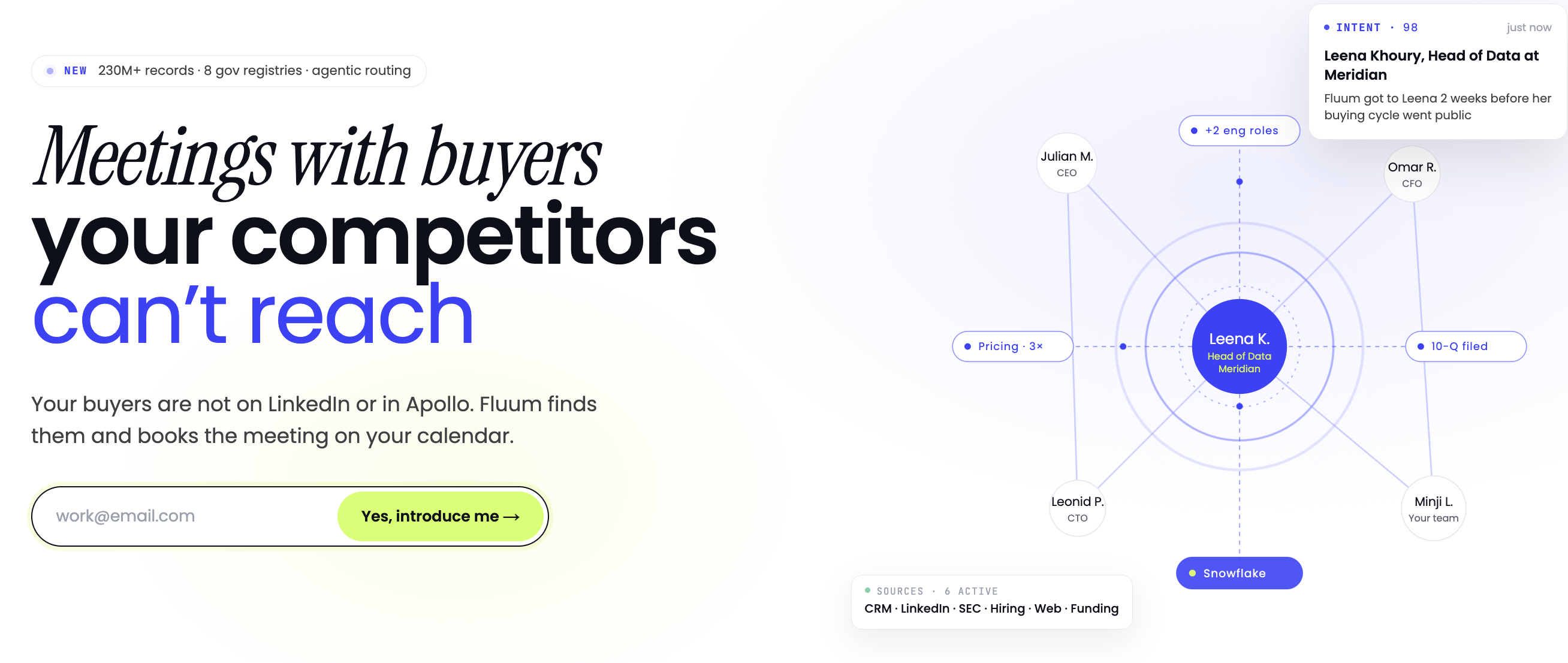
Fluum builds buyer graphs from 40+ private data vendors and 8 government registries, including Companies House, FCA Register, SEC EDGAR, and SIRENE. AI agents score intent signals and surface decision-maker paths. The platform then delivers double opt-in warm introductions — both parties confirm interest before any connection is made — across fintech, cybersecurity, manufacturing, and other regulated industries. The result is introduction platform verification at scale, with 40–50% average reply rates versus 2% for cold email.

Conclusion
Introduction platform verification isn’t a feature — it’s the foundation of a pipeline strategy that actually works in 2026. The teams hitting their numbers aren’t the ones sending more cold emails. They’re the ones who’ve replaced the cold-start problem with verified, consent-based connections where both sides already said yes before the first word is typed.
The mechanics matter. Identity checks, authority verification against government registries, real-time intent signals, and genuine double opt-in consent are what separate a verified introduction from a warm-ish cold list. Each layer adds trust. Together, they produce the 40–50% reply rates that make cold outreach’s 2% look like what it is: a broken channel propped up by volume.
If you’re building pipeline in fintech, cybersecurity, or manufacturing, the buyers you need are often invisible to conventional tools. They’re not on LinkedIn. They don’t reply to cold email. But they are in government registries, in opted-in networks, and in the buyer graphs that platforms like Fluum build from 40+ data sources. Fluum’s AI matches your ICP description against that data, confirms mutual interest through double opt-in, and delivers verified introductions that start conversations from a position of trust. If you’re a senior leader or C-suite executive, tell Aurora at Fluum who you’re looking to meet next — you’ll only receive what’s relevant to your specific pipeline needs.
Recommended Articles
Explore more from our content library: