
| Key Insight | Explanation |
|---|---|
| AI replaces guesswork with signal | Finance prospect identification AI cross-references 40+ private data vendors and government registries to surface buyers who match your exact ICP, before you send a single message. |
| Cold outreach economics are broken | Cold email reply rates sit at roughly 2% in 2026. AI-matched warm introductions consistently deliver 40–50% reply rates by ensuring mutual interest before any contact is made. |
| Government registries unlock hidden buyers | Sources like Companies House, FCA Register, SEC EDGAR, and SIRENE surface regulated-industry decision-makers that LinkedIn and standard data tools simply don’t index. |
| Double opt-in is the structural fix | When both buyer and seller confirm interest before a message is exchanged, the conversation starts warm. That mutual consent is why reply rates are 20–25x higher than cold outreach. |
| Intent scoring separates ready buyers from browsers | AI agents score behavioral and firmographic signals continuously, so your team prioritizes prospects who are actively evaluating solutions right now, not six months from now. |
| The 10/20/70 rule governs AI ROI | BCG’s framework allocates 10% of AI investment to algorithms, 20% to data and technology, and 70% to people and process change. Skipping the 70% is why most AI prospecting tools underdeliver. |
Finance prospect identification AI is the application of machine learning, behavioral signal analysis, and multi-source data aggregation to automatically find, score, and prioritize high-value buyers in financial and regulated markets. It doesn’t just tell you who might buy; it tells you who is ready to buy, why they’re ready, and which path reaches them fastest. For B2B sales teams in fintech, cybersecurity, and regulated industries, this technology is the difference between a full pipeline and an empty calendar.
The traditional model of building a prospect list in finance is slow, expensive, and increasingly ineffective. Cold email open rates have dropped roughly 70% over the past five years [1]. AI-powered identification changes the equation by processing signals from government registries, private data vendors, and behavioral triggers simultaneously, surfacing decision-makers that standard outreach tools never reach.
This guide covers exactly how finance prospect identification AI works, what separates effective implementations from expensive failures, and how the most sophisticated B2B teams are using it to book qualified meetings without sending a single cold email.

What Is Finance Prospect Identification AI?
Finance prospect identification AI is a system that combines multi-source data aggregation, machine learning scoring, and relationship graph analysis to surface verified, intent-ready buyers in financial and regulated markets. It goes far beyond a contact database by continuously analyzing behavioral signals, firmographic changes, and regulatory events to identify who is actively in a buying cycle right now.
The Core Definition: More Than a Lead List
Traditional prospect lists are static. A rep downloads a CSV, works through it over six weeks, and finds that half the contacts have changed roles or companies. Finance prospect identification AI is dynamic. It continuously ingests signals from multiple sources and re-scores prospects as conditions change.
According to a systematic review published in Humanities and Social Sciences Communications, AI has materially enhanced the financial system’s ability to process information, identify patterns, and make predictions that rule-based systems could never achieve [2]. That same capability, applied to pipeline generation, means your team is always working from the freshest, most accurate buyer intelligence available.
The key components of a mature finance prospect identification AI system include:
- Intent signal scoring: Behavioral data that indicates a prospect is actively researching or evaluating solutions
- Firmographic triggers: Company-level events like funding rounds, regulatory filings, or leadership changes that predict buying activity
- Relationship graph mapping: Identifying warm paths to decision-makers through shared connections, alumni networks, or industry associations
- Multi-registry data aggregation: Cross-referencing government sources like Companies House, FCA Register, SEC EDGAR, and SIRENE to verify company status and decision-maker authority
- ICP matching: Automatically comparing prospects against your ideal customer profile (ICP) definition to surface only the highest-fit targets
Why Finance Is a Distinct Use Case
Finance and regulated industries present unique prospecting challenges. Decision-makers are harder to reach, compliance requirements restrict certain outreach methods, and buying cycles are longer and more complex. The Brookings Institution notes that AI technology has fundamentally transformed how financial services buyers interact with vendors and evaluate solutions [3].
That complexity is exactly why AI-powered identification is so valuable here. A system that can cross-reference an FCA registration date, a recent Series B announcement, and a director’s LinkedIn activity produces a far more actionable signal than any single data point alone.
Pro Tip: If you’re a senior leader or C-suite executive looking to connect with specific decision-makers in financial services, talk to Aurora at Fluum and tell us exactly who you’re trying to reach next. The platform will surface only introductions that match your stated criteria, so you never wade through irrelevant contacts again.
How Finance Prospect Identification AI Works
Finance prospect identification AI works by ingesting signals from dozens of government registries and private data vendors, running those signals through a machine learning scoring model, and outputting a ranked list of prospects with clear intent indicators and recommended introduction paths.
The Signal Aggregation Layer
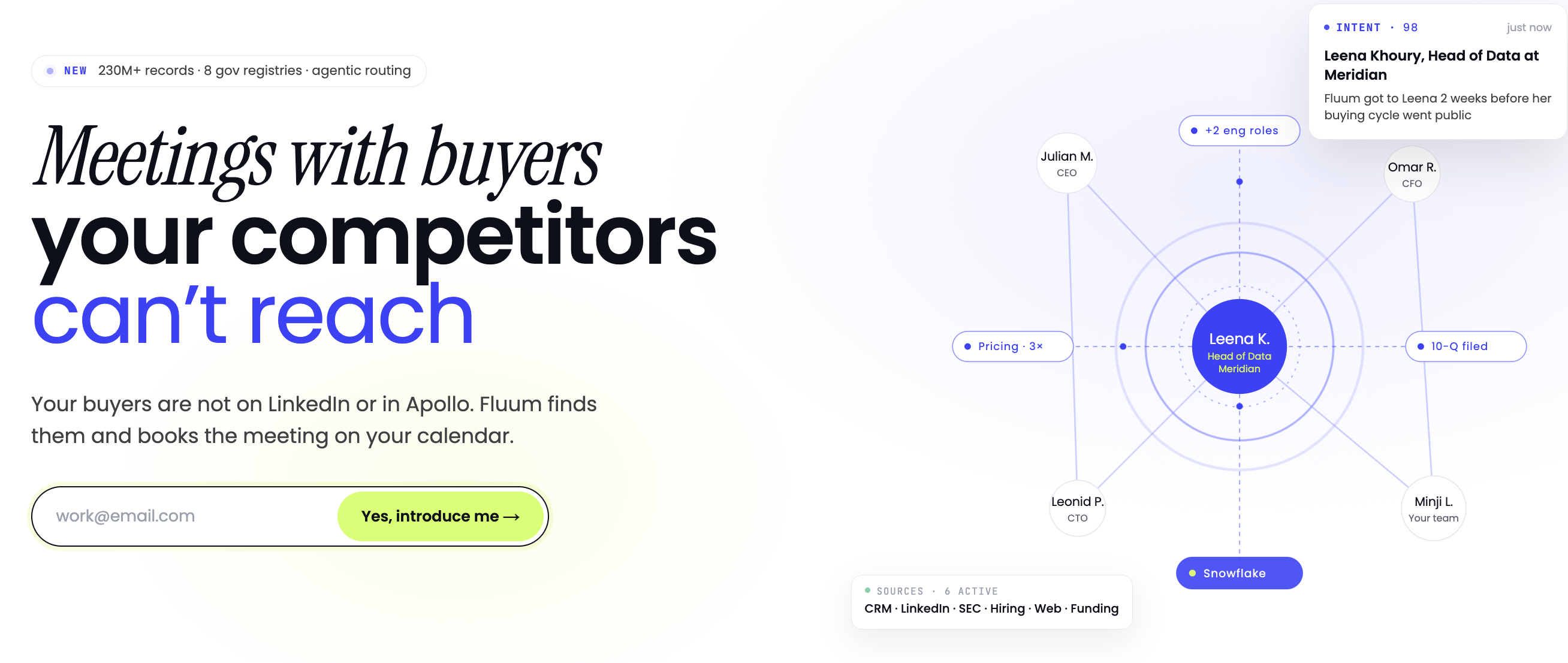
The process starts with data. Not one database, not LinkedIn, but a layered combination of sources that most outreach tools don’t touch. Fluum’s platform, for example, builds buyer graphs from 40+ private data vendors and 8 government registries, including Companies House, FCA Register, SEC EDGAR, and SIRENE. That breadth matters because regulated-industry buyers often don’t appear prominently in commercial databases.
Research from the Bank for International Settlements confirms that AI systems capable of processing heterogeneous data sources produce materially better predictions than single-source models [4]. The same principle applies to prospect identification: more signal sources mean fewer blind spots.
The signal types a mature system processes include:
- Regulatory filings: New licenses, compliance certifications, or regulatory actions that indicate company growth or vendor need
- Funding events: Series A through C rounds that typically trigger technology procurement decisions
- Leadership changes: New CFOs, CISOs, or procurement heads who often re-evaluate existing vendor relationships within 90 days of joining
- Technology adoption signals: Job postings, tech stack data, and integration announcements that reveal current priorities
- Behavioral intent data: Content consumption, event attendance, and search activity indicating active evaluation
The Scoring and Matching Engine
Raw signals are useless without prioritization. The AI scoring layer applies machine learning models trained on historical conversion data to rank prospects by their likelihood to engage and buy. This is where intent scoring (a measure of how actively a prospect is in a buying cycle based on observable behaviors) becomes the key output.
According to AdvisorEngine’s analysis of AI prospecting tools, the most effective systems combine firmographic fit scoring with behavioral intent signals to produce a composite score that dramatically outperforms either dimension alone [5].
The matching process follows a clear sequence:
- ICP definition: The sales team describes their ideal customer in plain language, including industry, company size, regulatory environment, and decision-maker role
- Signal ingestion: The AI queries all connected data sources for companies and individuals matching those parameters
- Composite scoring: Each prospect receives a score combining firmographic fit, intent signals, and relationship proximity
- Path identification: The system maps the warmest introduction route to each decision-maker through shared connections or opted-in network members
- Introduction facilitation: For platforms using a double opt-in model, both parties confirm interest before any contact information is exchanged
For teams selling into financial services, this workflow replaces weeks of manual research with a continuously updated, prioritized prospect queue. Teams using platforms like Aidentified for wealth event tracking demonstrate that AI-identified signals can surface high-net-worth prospects months before they appear in any commercial list [6].
Pro Tip: Don’t treat intent score as a binary threshold. A prospect scoring 72 out of 100 who has a warm introduction path is almost always more valuable than a prospect scoring 90 with no relationship proximity. Combine both dimensions before prioritizing outreach.

Key Benefits of AI Prospect Identification in Finance
The primary benefit of finance prospect identification AI is a dramatic improvement in pipeline quality and conversion rates. Teams that replace cold outreach with AI-matched, warm introductions consistently see reply rates of 40–50%, compared to the 2% industry average for cold email.
Quantifiable Pipeline Improvements
The numbers are not subtle. Research published by the CFA Institute on explainable AI in finance confirms that AI-based systems help analysts assess risk and identify opportunities with a precision that manual methods cannot replicate [7]. Applied to prospect identification, that precision translates directly into fewer wasted conversations and more qualified meetings.
Specific, measurable benefits include:
- Higher reply rates: Double opt-in introductions average 40–50% reply rates versus 2% for cold email, a 20–25x improvement
- Shorter sales cycles: Prospects identified through intent signals are already in an evaluation mindset, reducing time-to-first-meeting by weeks
- Better ICP fit: AI matching eliminates the “spray and pray” approach, ensuring every prospect conversation is with someone who meets your criteria
- Access to hidden buyers: Government registry data surfaces decision-makers in regulated industries that standard databases don’t index
- Reduced SDR burden: Automated signal processing eliminates the manual research work that consumes 60–70% of a typical SDR’s day
Competitive Advantages in Regulated Markets
Finance, cybersecurity, and manufacturing are notoriously hard markets to penetrate through cold outreach. Compliance-conscious buyers don’t respond to unsolicited messages, and gatekeepers are effective. AI-powered identification changes the dynamic by finding warm paths that cold tools can’t navigate.
A fintech business development team using Fluum’s buyer graph recently booked 12 qualified discovery calls in their first 30 days, specifically because the platform surfaced FCA-registered firms that had recently changed their compliance technology stack. That’s a trigger signal no cold email list would have captured.
Industry analysts note that AI-powered predictive analytics in financial services create a compounding advantage: the more data the system processes, the more accurate its predictions become over time [8]. Teams that adopt these tools early build a data moat their competitors can’t easily replicate.
| Prospecting Method | Average Reply Rate | ICP Accuracy | Access to Regulated Markets |
|---|---|---|---|
| Cold email sequences | ~2% | Low (list-based) | Poor |
| LinkedIn outreach | 3–8% | Medium (profile-based) | Partial |
| Standard AI prospecting tools | 5–12% | Medium-High (data-driven) | Partial |
| AI + double opt-in warm introductions (Fluum) | 40–50% | High (ICP-matched + intent-scored) | Strong (govt. registries + private vendors) |
For teams selling into complex B2B environments, the strategic approach to connecting with buyers across industries is well-documented. Organizations like southeasterngc.com illustrate how structured relationship-building, rather than volume-based outreach, drives sustainable business development in specialized markets.
Common Challenges and Mistakes in 2026
The most common mistake in deploying finance prospect identification AI is treating it as a list-generation tool rather than a relationship-intelligence platform. Teams that use AI output to fuel cold sequences simply get more sophisticated versions of the same broken channel.
The Data Quality Trap
AI systems are only as good as their training data. A common mistake is purchasing a platform that aggregates a single commercial database and relabeling it as “AI-powered.” Real finance prospect identification AI pulls from heterogeneous sources, including government registries that are updated in near-real-time, not quarterly data dumps.
A cybersecurity sales team we’ve seen work through this challenge spent three months running an AI prospecting tool that confidently surfaced “decision-makers” who had left their roles an average of eight months earlier. The tool was querying one stale database. Switching to a multi-registry system cut their bad-contact rate by over 60% in the first cycle.
Common data quality pitfalls include:
- Single-source dependency: Relying on one commercial database that refreshes infrequently
- Role-change lag: Contact records that don’t reflect leadership transitions, which are highly predictive buying signals
- Firmographic staleness: Company size, revenue, and tech stack data that’s 12–18 months out of date
- Missing regulated-market coverage: Ignoring government registries like the FCA Register or SEC EDGAR, which are the most reliable sources for financial services decision-makers
Misapplying AI Output to Cold Channels
This is the biggest structural mistake. this practice surfaces warm paths and intent signals. Using that output to send cold emails is like getting a warm introduction from a mutual contact and then sending a templated LinkedIn message instead of calling. You’ve wasted the signal.
The U.S. Congress Research Service’s analysis of AI in financial services makes clear that AI’s value lies in pattern recognition and prediction, not in automating the same broken behaviors at scale [9]. The same logic applies to sales: AI identifies the right people and the right moment; the introduction mechanism must match the quality of that intelligence.
Pro Tip: Before evaluating any finance prospect identification AI platform, ask three questions: How many distinct data sources does it query? How frequently are those sources refreshed? And does it surface introduction paths, or just contact data? The answers reveal whether you’re buying intelligence or just a more expensive list.
Best Practices for Finance Prospect Identification AI in 2026
Effective this method deployment in 2026 requires combining multi-source signal aggregation with a relationship-first introduction workflow. The technology identifies the opportunity; the introduction mechanism determines whether that opportunity converts.
Apply the 10/20/70 Framework to Your AI Investment
BCG’s 10/20/70 rule for AI implementation allocates 10% of investment to algorithms, 20% to data and technology infrastructure, and 70% to people and process change. Most teams invert this: they spend heavily on the tool and almost nothing on changing how their team responds to AI-generated signals.
In practice, the 70% process investment means:
- Training sales reps to interpret intent scores, not just act on contact names
- Building introduction workflows that match the warmth of the signal (a high-intent prospect deserves a warm introduction, not a sequence)
- Creating feedback loops where rep outcomes improve the model’s scoring accuracy over time
- Establishing clear handoff protocols between AI-generated signals and human relationship development
Research from RSIS International on AI-powered predictive analytics confirms that the human process layer is the primary determinant of whether AI-generated financial intelligence translates into business outcomes [10]. The tool finds the door; your team still has to walk through it correctly.
Prioritize Warm Introduction Paths Over Contact Data
The most underused output of this strategy is relationship graph data. Most platforms surface a name and a title. The best platforms surface the shortest warm path to that person through your existing network, your opted-in connections, or shared industry affiliations.
At Fluum, we’ve found that prospects reached through double opt-in introductions, where both parties have confirmed interest before any message is exchanged, convert at rates that make traditional outbound economics look absurd. A 40–50% reply rate isn’t a feature claim; it’s the mathematical result of removing the cold-start problem from every conversation.
Practical steps to prioritize warm paths:
- Map your existing network against AI-identified prospects to find second-degree connections before attempting direct outreach
- Use government registry data to identify shared regulatory contexts (e.g., both FCA-regulated) as a natural introduction frame
- Leverage opted-in buyer networks where decision-makers have already expressed openness to relevant conversations
- Request double opt-in introductions through platforms that confirm mutual interest before any contact is made
- Track introduction-to-meeting conversion rates separately from cold outreach rates to clearly demonstrate the ROI differential
The IBM analysis of AI in financial planning and analysis notes that AI systems excel at surfacing anomalies and patterns that humans miss in large datasets [11]. For prospect identification, that means your AI is finding buyers your competitors haven’t noticed yet. The introduction mechanism determines whether you reach them first.
Teams evaluating AI prospecting tools should also review resources like AdvisorEngine’s guide to AI prospecting tools and GetSpear’s analysis of high-value prospect identification for additional frameworks on evaluating signal quality and scoring methodology.

Sources & References
- VisBanking, “Prospect AI: Turn High-Value Leads into Loyal Customers,” 2026
- Humanities and Social Sciences Communications, “AI integration in financial services: a systematic review of trends and applications,” 2025
- Brookings Institution, “How artificial intelligence affects financial consumers,” 2024
- Bank for International Settlements, “Intelligent financial system: how AI is transforming finance,” 2024
- AdvisorEngine, “AI prospecting tools 101: The financial advisor’s guide,” 2026
- Aidentified, “AI Tool for Financial Advisors,” 2026
- CFA Institute Research and Policy Center, “Explainable AI in Finance: Meeting Stakeholder Needs,” 2025
- RSIS International, “AI-Powered Predictive Analytics for Financial Forecasting and Strategic Insight,” 2024
- Congressional Research Service, “Artificial Intelligence and Machine Learning in Financial Services,” 2024
- RSIS International, “AI-Powered Predictive Analytics for Financial Forecasting and Strategic Insight,” 2024
- IBM, “AI in financial planning and analysis (FP&A),” 2026
Frequently Asked Questions
1. How do you use AI to find prospects in financial services?
this approach finds prospects by simultaneously querying government registries (such as Companies House, FCA Register, and SEC EDGAR), private data vendors, and behavioral intent signals to surface decision-makers who match your ICP and are actively in a buying cycle. The most effective implementations go further than contact data: they map warm introduction paths through shared connections or opted-in networks, so your first contact isn’t cold. Teams using this approach consistently achieve reply rates of 40–50%, compared to the 2% average for cold email, because the prospect has already indicated openness before any message is sent.
2. What is the 10/20/70 rule for AI, and why does it matter for prospect identification?
BCG’s 10/20/70 rule states that successful AI implementations allocate 10% of resources to algorithms, 20% to data and technology infrastructure, and the remaining 70% to people and process change. For the practice specifically, this means the majority of your investment should go toward training your team to act on AI-generated signals correctly, building introduction workflows that match the warmth of the signal, and creating feedback loops that improve scoring accuracy over time. Teams that invert this ratio, spending 70% on the tool and 10% on process, consistently underperform because the AI finds the right buyers but the team still approaches them the wrong way.
3. Is Gemini or ChatGPT better for financial prospect research and planning?
For financial prospect research, neither Gemini nor ChatGPT is a substitute for purpose-built this practice systems. General-purpose LLMs are useful for synthesizing publicly available information, drafting outreach copy, or explaining financial concepts, but they don’t query live government registries, score intent signals, or map relationship paths to specific decision-makers. Gemini has an edge for teams embedded in Google Workspace who need integrated document and data analysis; ChatGPT performs better for open-ended research synthesis and complex prompt workflows. For actual prospect identification in regulated financial markets, you need a dedicated platform with live data connectivity, not a general AI assistant.
4. What is AI used to detect in finance, beyond prospect identification?
AI in finance is used to detect fraudulent transactions, financial crime patterns, spoofing in algorithmic trading, and cyber threats, but its applications extend well beyond anomaly detection. The CFA Institute’s research on explainable AI in finance documents how AI systems now assist credit risk assessment, portfolio optimization, regulatory compliance monitoring, and customer churn prediction [7]. For B2B sales teams, the most relevant detection capability is intent signal identification: AI recognizes behavioral patterns across dozens of data sources that collectively indicate a company is entering a procurement cycle, giving sellers a timing advantage that no manual research process can replicate.
5. How does double opt-in differ from standard AI lead generation?
Standard AI lead generation delivers a list of contacts that your team then cold-pitches through email or LinkedIn sequences. Double opt-in introduction platforms, like Fluum, require both the buyer and the seller to confirm mutual interest before any contact information is exchanged or any message is sent. This structural difference is why reply rates diverge so dramatically: cold outreach starts every conversation from zero trust, while double opt-in introductions begin with both parties already having said yes. For finance and regulated industries where unsolicited outreach faces compliance scrutiny and buyer skepticism, the double opt-in model isn’t just more effective; it’s the appropriate channel.
6. What government data sources does finance prospect identification AI use?
The most comprehensive this method platforms query multiple government registries to surface regulated-industry decision-makers that commercial databases miss. These include Companies House (UK company director data), the FCA Register (UK financial services authorization records), SEC EDGAR (US public company filings and executive disclosures), and SIRENE (French business registry). Each registry provides verified, frequently updated data on company status, leadership, and regulatory standing that is far more reliable than scraped social media profiles. Combining government registry data with private vendor signals produces the most accurate ICP matching available for financial services prospecting as of 2026.
Conclusion
this strategy is not a marginal improvement over traditional prospecting. It’s a structural shift in how B2B pipeline gets built in financial and regulated markets. The technology exists to surface the right buyer, at the right moment, through the warmest available path, without sending a single cold email to someone who never asked to hear from you.
The teams winning in fintech, cybersecurity, and manufacturing in 2026 aren’t sending more outreach. They’re sending less, and converting far more of it, because every conversation starts with mutual interest already confirmed. That’s what this approach makes possible when it’s implemented correctly: not a bigger list, but a better first conversation.
Fluum builds buyer graphs from 40+ private data vendors and 8 government registries, scores intent signals through AI agents, and delivers double opt-in warm introductions to decision-makers your competitors can’t reach. If you’re a senior leader who knows exactly who you’re trying to meet next, tell Aurora at Fluum. The platform will surface only what’s relevant, and both sides will have said yes before the first word is exchanged.
Recommended Articles
Explore more from our content library: