
| Key Insight | Explanation |
|---|---|
| SIRENE is France’s official business registry | Maintained by INSEE, it records every registered French company and establishment with legal, geographic, and sector data — free to access. |
| SIREN vs. SIRET identifiers | A SIREN number (9 digits) identifies a company; a SIRET number (14 digits) identifies a specific establishment. Both are essential for accurate prospecting. |
| Raw data is not a pipeline | SIRENE gives you company records, not decision-maker contacts or intent signals. Enrichment and qualification are required before any outreach. |
| GDPR compliance is non-negotiable | Using SIRENE data for outreach triggers GDPR obligations. B2B use of professional data is permissible under legitimate interest, but documentation is required. |
| Enrichment multiplies SIRENE’s value | Layering SIRENE records with contact data, technographic signals, and intent data from additional sources turns a registry into a real prospecting engine. |
| Warm introductions outperform cold outreach 20:1 | Even the best SIRENE-sourced list converts at under 2% via cold email. Platforms that deliver double opt-in introductions consistently hit 40-50% reply rates. |
SIRENE database prospecting is the practice of using France’s national business registry — maintained by INSEE (Institut National de la Statistique et des Études Économiques) — to identify, segment, and target French companies for B2B sales and business development. The registry contains over 30 million company and establishment records, each tagged with a unique SIREN or SIRET identifier, legal status, NAF activity code, and geographic data. It matters because it gives sales teams a structured, government-verified foundation for building prospect lists in one of Europe’s largest economies.
The catch? Raw SIRENE data is a starting point, not a finished pipeline. What you do with it — how you enrich, filter, and convert those records into actual conversations — determines whether you’re building real pipeline or just a very long spreadsheet that nobody reads.

What Is SIRENE Database Prospecting?
SIRENE database prospecting is the systematic use of France’s official company registry to build targeted B2B prospect lists, segment markets by industry or geography, and initiate outreach to French businesses. The database is free, government-maintained, and updated daily, making it one of the most reliable sources of company-level data in Europe.
The SIRENE Registry: What It Actually Contains
SIRENE stands for Système d’Identification du Répertoire des ENtreprises et de leurs Établissements. INSEE has maintained it since 1973, and as of 2026, it covers every legally registered French entity — from sole traders to listed corporations [1].
Each record in the database includes:
- SIREN number — a 9-digit identifier unique to each company (the legal entity)
- SIRET number — a 14-digit identifier for each physical establishment (SIREN + 5-digit location code)
- NAF code (Nomenclature des Activités Françaises) — the French equivalent of a SIC or NAICS code, used to classify business activity
- Legal form — SAS, SARL, SA, auto-entrepreneur, etc.
- Registered address and geographic coordinates
- Date of creation and current status (active, ceased, in liquidation)
- Employee headcount band — a categorical range, not an exact figure
What it does not contain: named decision-makers, email addresses, phone numbers, revenue figures, or any intent signals. That gap is where most prospecting strategies either succeed or fail [2].
Why SIRENE Matters for B2B Sales Teams
France is the world’s seventh-largest economy. Any B2B team selling into European markets — particularly in fintech, manufacturing, or regulated industries — needs accurate company-level data to build a credible Ideal Customer Profile (ICP) and segment their addressable market.
SIRENE is the authoritative source for that data. Unlike third-party databases that may carry stale or inaccurate records, SIRENE is updated daily by INSEE and cross-referenced with tax and social security registries [3]. Industry analysts consistently recommend it as the baseline layer for any France-focused market intelligence project.
According to research published on GZ Consulting, effective company prospecting depends on reliable firmographic filters including industry, location, company status, and employee counts — all fields that SIRENE provides at no cost [4].
How SIRENE Database Prospecting Works
SIRENE database prospecting works by downloading or querying the registry, applying filters to isolate target segments, then enriching the resulting records with contact data and intent signals before initiating outreach. The process has five distinct stages, and skipping any of them produces worse results.
Step-by-Step: From Registry to Pipeline
- Access the data. The full SIRENE dataset is available as a bulk download via data.gouv.fr and through INSEE’s API. Bulk files are large (several gigabytes), so most teams use filtered API queries or third-party tools that have pre-processed the data [5].
- Apply firmographic filters. Use NAF codes to target specific industries, INSEE geographic codes to target regions or departments, legal form filters to exclude sole traders if you’re targeting corporate entities, and employee band filters to match your ICP’s size criteria.
- Validate SIREN/SIRET numbers. Before enriching, verify that each record is active and correctly formatted. ERP platforms like Sage X3 include built-in SIREN/SIRET validation functions that cross-reference against the live Sirene database [6].
- Enrich with contact data. SIRENE records don’t include decision-maker names or contact details. Layer in data from LinkedIn, company websites, procurement portals, or specialized enrichment providers. As IBLead notes in their 2026 analysis, “neither source is complete on its own” — SIRENE provides the administrative skeleton; enrichment adds the human layer [7].
- Score and prioritize. Apply intent signals, technographic data, or trigger events (new funding, leadership changes, regulatory filings) to rank prospects by likelihood to buy before any outreach begins.
Tools and Methods for Accessing SIRENE Data
Sales teams have several practical options for working with SIRENE data, depending on their technical capacity and budget:
| Method | Best For | Limitation |
|---|---|---|
| Bulk CSV download (data.gouv.fr) | Data teams with SQL or Python skills | Files are 3-5 GB; requires preprocessing |
| INSEE API (api.insee.fr) | Real-time lookups by SIREN/SIRET | Rate-limited; requires API key registration |
| Pre-processed vendor files (IBLead, Salesdorado) | Sales teams without engineering support | Paid; data freshness varies by vendor |
| Google Dataset Search | Research and market sizing | Not designed for prospecting workflows |
| AI pipeline platforms (e.g., Fluum) | Teams wanting enriched, scored, opt-in-ready introductions | Requires ICP definition; not a raw data dump |
Pro Tip: Don’t download the full SIRENE bulk file unless your team has a data engineer. Instead, use the INSEE API with targeted SIREN queries filtered by NAF code and postal code. You’ll get cleaner data in a fraction of the time, and you can automate refresh cycles to keep your prospect list current.
Platforms like Enso are increasingly used to automate the enrichment and routing of SIRENE-sourced records into CRM workflows, reducing the manual effort required between data extraction and sales engagement.

Key Benefits of Prospecting the SIRENE Database
Prospecting the SIRENE database gives B2B sales teams government-verified company data at no cost, with daily updates and complete coverage of the French market — advantages that no private data vendor can fully replicate. For teams targeting France, it’s the most accurate firmographic foundation available.
Why Government Registry Data Beats Third-Party Lists
Private contact databases are built by scraping, inferring, and aggregating — which means they carry error rates that compound over time. SIRENE is the source of truth. INSEE updates it daily based on mandatory registration filings, which means a company’s legal status, address, and activity classification are as current as the law requires them to be [3].
The practical benefits for sales teams include:
- Zero cost for the underlying data — the full dataset is freely available under France’s open data framework
- Complete market coverage — every legally registered French entity is included, with no gaps based on company size or sector
- Reliable NAF code segmentation — allows precise targeting by industry without relying on self-reported LinkedIn categories
- Legal entity verification — SIREN numbers are used in contracts, invoices, and regulatory filings, so they’re the most reliable company identifier in France
- Geographic precision — department and commune codes enable hyper-local prospecting campaigns
- New company identification — filtering by creation date surfaces recently registered businesses that may not yet appear in private databases
SIRENE as a Market Intelligence Tool
Beyond prospecting, SIRENE is a legitimate market intelligence asset. Sales leaders use it to size total addressable markets (TAM) by counting active companies within specific NAF codes and geographies. Strategy teams use it to track sector growth by monitoring new registrations over time. As Mathew Davis notes in his LinkedIn analysis of the registry, “SIRENE becomes a prospecting engine” when you export company lists by segment and cross-reference them with procurement portals and public websites [8].
One practical example: a cybersecurity vendor targeting mid-market French manufacturers can pull all active SARL and SAS entities with NAF codes in the 24-33 range (manufacturing), filter for companies with 50-249 employees, then cross-reference with public tender databases to identify which firms have active IT procurement activity. That’s a qualified segment built from public data before a single euro is spent on enrichment.
Pro Tip: Use SIRENE’s creation date field to build a “new entrant” trigger list. Companies registered in the last 6-12 months are often actively buying software, services, and infrastructure they didn’t need before. This is one of the highest-intent segments you can build from public data alone.
Common Challenges in SIRENE Database Prospecting
The most common challenge in SIRENE database prospecting is the gap between company records and actionable sales intelligence. SIRENE tells you a company exists; it doesn’t tell you who makes decisions, what they’re buying, or whether they have any interest in talking to you. That gap is where most prospecting efforts stall.
The Data Gap: What SIRENE Doesn’t Give You
Teams that treat SIRENE as a finished prospect list make a predictable mistake. They export 50,000 records, push them into a sequencing tool, and wonder why reply rates are below 1%. The problem isn’t the data source. It’s the assumption that a company record is a sales conversation.
Specific gaps that require external enrichment include:
- Named decision-makers — SIRENE records the legal representative (dirigeant) for some entity types, but this is rarely the economic buyer for B2B purchases
- Contact details — no email addresses, phone numbers, or LinkedIn profiles
- Revenue data — employee bands are categorical ranges, not exact figures; revenue is not included at all
- Intent signals — no indication of whether a company is actively evaluating vendors in your category
- Technographic data — no information about what software or systems a company currently uses
GDPR Compliance and Legal Obligations
Using SIRENE data for outreach is not a GDPR-free zone. INSEE explicitly states that the database contains personal data (particularly for sole traders and micro-enterprises where the individual and the business are legally the same), and that processing this data triggers obligations under GDPR [1].
For B2B outreach to corporate entities, GDPR’s legitimate interest basis (Article 6(1)(f)) generally applies, but you must document your legitimate interest assessment, ensure the data is relevant and not excessive, and provide clear opt-out mechanisms in every communication.
A common mistake is assuming that because SIRENE is public data, outreach based on it is automatically compliant. It isn’t. The legal basis for processing depends on how you use the data, not where it came from.
Research from the J-PAL poverty action lab on French firm-level data programs highlights how administrative data from INSEE registries is subject to strict use-case governance — a principle that applies equally to commercial prospecting [9].
Best Practices for SIRENE Database Prospecting in 2026
Effective SIRENE database prospecting in 2026 combines precise firmographic filtering, multi-source enrichment, and a contact strategy that doesn’t rely on cold outreach volume. The teams generating real pipeline from SIRENE data are the ones treating it as a foundation, not a finished product.
Build Your ICP Filter Before You Touch the Data
The most effective SIRENE prospecting projects start with a written ICP definition that translates directly into database filters. Before downloading a single record, define:
- Which NAF codes map to your target industries
- Which legal forms are relevant (SAS, SARL, SA — or all corporate forms)
- Which employee bands match your ICP (and acknowledge that SIRENE bands are approximate)
- Which departments or regions are in scope
- Whether you want established companies only (filter by creation date) or include new entrants as a trigger segment
Getting this right before extraction means your output is a qualified segment, not a raw dump. Waalaxy’s prospecting database guide recommends this filtering-first approach specifically for SIRENE workflows, noting that the database’s value multiplies when you apply structured segmentation criteria before enrichment [2].
Layer Enrichment Strategically
Enrichment is not a one-step process. The most effective approach layers data sources in order of cost and reliability:
- Start with SIRENE for firmographic baseline (free)
- Add public web data — company websites, LinkedIn company pages, procurement portals (low cost)
- Layer contact data from enrichment providers for decision-maker names and verified emails (moderate cost)
- Add intent signals from technographic providers, job posting analysis, or government tender databases (higher cost, highest ROI)
- Validate before outreach — verify email deliverability and check for recent company status changes against the live SIRENE API
IBLead’s 2026 analysis of SIRET-enriched B2B prospecting files confirms that the combination of SIRENE administrative data with web-sourced enrichment produces significantly higher match rates and more accurate segmentation than either source alone [7].
Replace Cold Volume with Warm Introductions
Here’s the uncomfortable truth about SIRENE prospecting: even a perfectly filtered, fully enriched list still converts at under 2% via cold email. That’s not a SIRENE problem. That’s a cold outreach problem.
At Fluum, we’ve found that sales teams using SIRENE as a targeting layer — combined with a warm introduction mechanism rather than cold sequences — consistently achieve reply rates of 40-50%. The database tells you who to target. The introduction mechanism determines whether they actually respond.
Cold email open rates have dropped 70% over the past five years. Sending more emails to a better SIRENE-sourced list doesn’t fix that math. What fixes it is arriving in someone’s inbox through a mutual contact who has already confirmed that both sides want to talk.
Pro Tip: If you’re a senior leader or C-suite executive looking to reach specific buyers in France or other regulated markets, talk to Aurora at Fluum and tell us who you’re looking to meet next. We match based on your ICP description and only send you introductions that are relevant — double opt-in, both sides confirmed before a single message is exchanged.
The Salesdorado sales intelligence guide notes that aggregated and reformatted SIRENE data, organized by city or profession, is significantly more actionable for prospecting than the raw registry download [1]. That principle extends further: the most actionable version of any SIRENE-sourced list is one where the outreach mechanism is warm, not cold.

Sources & References
- Salesdorado, “Sales Intelligence,” 2026
- Waalaxy Blog, “Prospecting Database: Learn How to Develop it from Scratch,” 2026
- Chorus Pro (French Government), “Sirene Database of Companies and Their Branches,” 2026
- GZ Consulting, “Sales Triggers,” 2026
- Open Data Stack Exchange, “Database of French Companies,” 2026
- Sage X3 Online Help, “SIREN/SIRET Validation,” 2026
- IBLead, “SIRET-Enriched B2B Prospecting Files,” 2026
- Mathew Davis via LinkedIn, “Using the SIRENE Database to Understand a Market,” 2026
- J-PAL Poverty Action Lab, “Are Active Labor Market Policies Directed at Firms Effective?”, 2020
Frequently Asked Questions
1. What is a prospect database?
A prospect database is a structured collection of company and contact records used by sales teams to identify and prioritize potential customers. It typically includes firmographic data (industry, company size, location, legal form), contact details for decision-makers, and increasingly, intent signals that indicate purchase readiness. For B2B teams targeting France, SIRENE database prospecting provides the firmographic foundation, which is then enriched with contact and behavioral data to create a fully actionable prospect list.
2. Was SIREN a search engine?
No. SIREN (Système d’Identification du Répertoire des ENtreprises) is a 9-digit company identifier used in France’s national business registry, not a search engine. It’s the unique number assigned to every legally registered French company by INSEE. You may be thinking of Siren.io, which is an AI-powered investigation platform used for fraud detection and network analysis — a completely separate product that happens to share a similar name. SIREN numbers are the key lookup field in SIRENE database prospecting workflows.
3. How much is a database worth?
The value of a prospect database depends on three factors: data quality (accuracy and freshness), enrichment depth (whether it includes decision-maker contacts and intent signals), and relevance to your ICP. A raw SIRENE export costs nothing but requires significant enrichment investment before it generates pipeline. Fully enriched, intent-scored B2B databases from commercial vendors typically cost $0.10-$2.00 per verified record depending on the level of enrichment. The real measure of worth, though, is conversion rate — a smaller, highly qualified database that converts at 10% is worth far more than a million-record dump that converts at 0.1%.
4. How do you build a prospect database?
Building a prospect database for SIRENE database prospecting involves five steps: (1) Define your ICP with specific firmographic criteria including industry NAF codes, company size bands, legal form, and geography. (2) Extract matching records from SIRENE via bulk download or the INSEE API, filtered by your ICP parameters. (3) Validate SIREN/SIRET numbers against the live registry to confirm active status. (4) Enrich records with decision-maker contact data, technographic signals, and intent data from secondary sources. (5) Score and prioritize the enriched records by fit and buying intent before any outreach begins. The result is a qualified, segmented database rather than a raw data dump.
5. What are NAF codes and why do they matter for SIRENE prospecting?
NAF codes (Nomenclature des Activités Françaises) are France’s official business activity classification system, equivalent to SIC or NAICS codes used in the US. Every SIRENE record carries a NAF code that identifies the company’s primary business activity. For prospecting purposes, NAF codes are the most reliable way to segment the SIRENE registry by industry — more accurate than keyword searches or self-reported categories. A fintech vendor targeting payment processors would filter for NAF code 64.19Z; a cybersecurity firm targeting manufacturers would use codes in the 24-33 range. Mastering NAF code mapping is the single highest-leverage skill in SIRENE database prospecting.
6. Is SIRENE data GDPR compliant to use for outreach?
Using SIRENE data for B2B outreach is permissible under GDPR but not automatically compliant. For corporate entities (SAS, SARL, SA), legitimate interest under GDPR Article 6(1)(f) typically applies, provided the outreach is relevant to the recipient’s professional role. For sole traders and micro-enterprises, the individual and the business are legally the same person, which triggers stronger personal data protections. You must document your legitimate interest assessment, include clear opt-out mechanisms, and avoid processing data that is excessive relative to your stated purpose. INSEE itself draws attention to these legal obligations in its SIRENE documentation.
Conclusion
SIRENE database prospecting gives B2B sales teams something genuinely valuable: a government-verified, daily-updated foundation for building France-focused prospect lists that no private vendor can fully replicate. The registry’s 30+ million records, organized by NAF code, legal form, geography, and company status, make it the most reliable starting point for any French market intelligence project.
But starting points aren’t pipelines. The teams that actually generate revenue from SIRENE data are the ones who enrich it, score it, and then use a contact mechanism that doesn’t rely on cold outreach volume. Cold email converts at under 2%. That math doesn’t improve just because your list is better sourced.
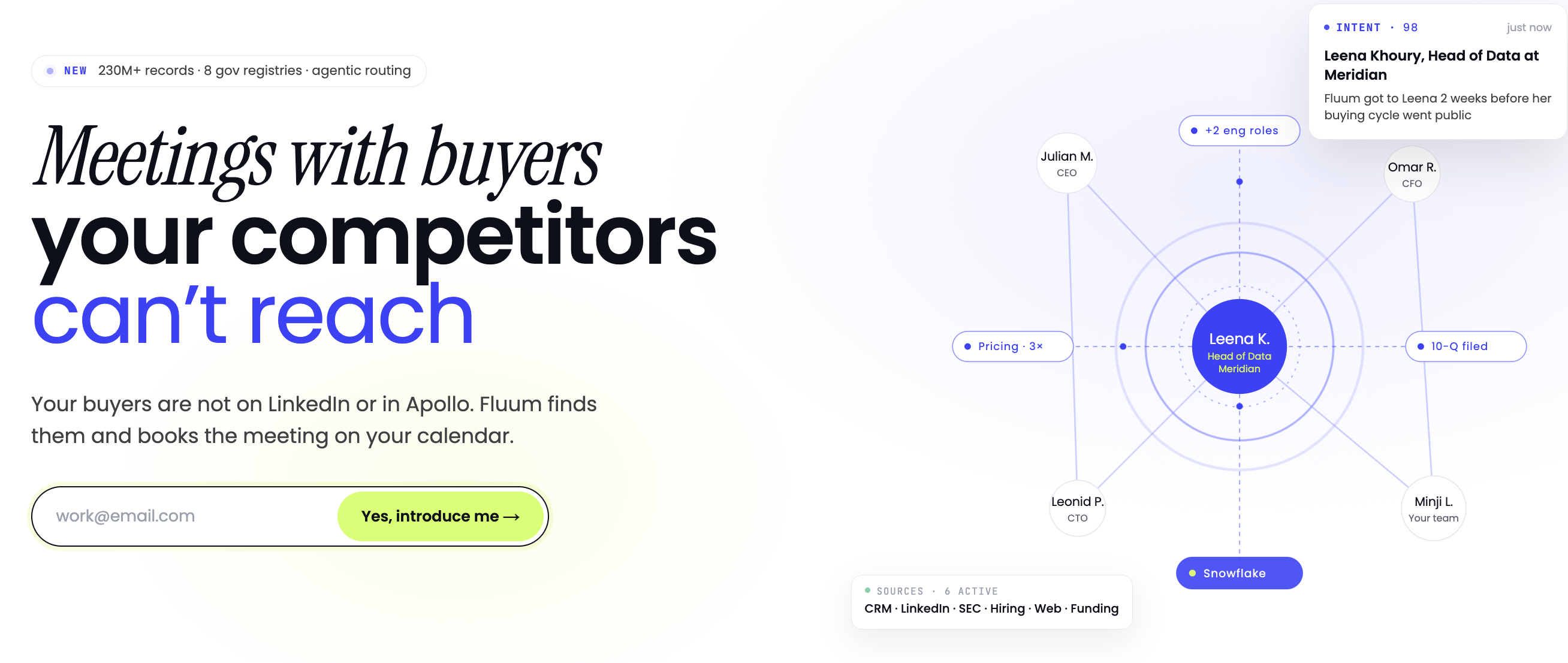
The structural fix is arriving in a prospect’s inbox as a warm, mutually confirmed introduction rather than one of the 300 cold emails they delete on a Tuesday morning. Fluum pulls signals from 40+ private data vendors and 8 government registries including SIRENE, scores intent, surfaces decision-maker paths, and delivers double opt-in introductions that convert at 40-50%. If you’re building pipeline in France or any regulated market, that’s the difference between a spreadsheet and a conversation.
Recommended Articles
Explore more from our content library: