
| Key Insight | Explanation |
|---|---|
| EDGAR is a live sales signal layer | 10-K, 8-K, and S-1 filings reveal budget cycles, expansion plans, and technology investments before any press release goes out. |
| Most sales teams ignore public filings | Cold outreach tools scrape contact data but miss the contextual intelligence buried in mandatory SEC disclosures. |
| AI changes what’s extractable | Natural language processing can now parse thousands of EDGAR filings in minutes, surfacing intent signals that would take analysts weeks to find manually. |
| Regulated industries are the richest seam | Fintech, cybersecurity, and manufacturing companies disclose vendor relationships, compliance gaps, and capital allocation in filings — all of which are buying signals. |
| Warm introductions outperform cold by 20–25x | Research from Bain & Company consistently shows B2B buyers are 5x more likely to engage via a trusted introduction. Fluum’s double opt-in model delivers 40–50% reply rates versus 2% for cold email. |
| EDGAR + warm intro = structural advantage | Combining filing intelligence with a double opt-in introduction network means you reach the right buyer at the right moment — without a single cold email. |
SEC EDGAR intelligence sales is the practice of mining public SEC filings — 10-Ks, 8-Ks, S-1s, and proxy statements — to extract buying signals, map decision-maker hierarchies, and time outreach to moments of genuine commercial urgency. It turns mandatory regulatory disclosure into a prospecting engine. Every public company in the U.S. is legally required to file with the SEC, which means EDGAR [1] is one of the most comprehensive, continuously updated, and completely free commercial intelligence databases on the planet — and most sales teams have never opened it.
The reason that matters is simple. Cold email reply rates sit at roughly 2% as of 2026. The average B2B buyer receives hundreds of unsolicited messages a week and has learned to ignore all of them. SEC EDGAR intelligence sales offers a structural alternative: instead of blasting a list and hoping for a response, you identify companies at a documented inflection point, understand their stated priorities from their own filings, and arrive with context that proves you’ve done the work. That’s a different conversation entirely.

<!– YOUTUBE_PLACEHOLDER: Overview video explaining how to use SEC EDGAR filings as B2B sales intelligence signals, including a walkthrough of the EDGAR full text search tool and how to extract buying triggers from 10-K and 8-K filings –>
What Is SEC EDGAR Intelligence Sales?
SEC EDGAR intelligence sales is the systematic use of public SEC filings to identify, qualify, and prioritize B2B sales targets based on documented commercial events rather than generic firmographic data.
EDGAR as a Data Source: The Basics
EDGAR, which stands for Electronic Data Gathering, Analysis, and Retrieval, is the SEC’s official filing system. As of 2026, it holds more than 20 million documents covering every public company operating in the U.S. market [2]. The database is free, searchable, and updated in near real-time as companies submit mandatory disclosures.
The filings that matter most for sales intelligence include:
- 10-K (annual report): Discloses full-year financials, risk factors, technology infrastructure, vendor relationships, and strategic priorities.
- 10-Q (quarterly report): Tracks mid-year shifts in capital allocation, operational changes, and emerging risk disclosures.
- 8-K (current report): Filed within four business days of a material event — leadership change, acquisition, new contract, or regulatory action.
- S-1 (IPO registration): Reveals a company’s full business model, competitive landscape, and technology stack for the first time.
- DEF 14A (proxy statement): Names board members, executive compensation, and voting matters — a decision-maker map handed to you on a plate.
- 13F (institutional holdings): Shows which institutional investors hold significant stakes, useful for partnership and channel intelligence.
Why “Intelligence Sales” Is a Distinct Discipline
Standard prospecting tools give you a name, a title, and an email address. SEC EDGAR intelligence sales gives you a reason to call. There’s a fundamental difference between reaching out to a CFO because their company fits your ICP and reaching out because their latest 10-K disclosed a $40 million technology modernization initiative and a specific compliance gap you can solve.
Industry analysts at GZ Consulting have noted that EDGAR filings are consistently underutilized by sales teams despite being one of the most reliable sources of forward-looking commercial intelligence available [3]. The companies that do use them systematically gain a material timing advantage over competitors who rely on intent data alone.
Pro Tip: Don’t start with the financials. Start with the “Risk Factors” and “Management Discussion & Analysis” sections of a 10-K. These sections contain the most candid language about what a company is worried about and where it’s planning to invest — which is exactly where your solution should fit.
How EDGAR Filings Work as Sales Signals
EDGAR filings function as sales signals by surfacing documented commercial events that indicate budget availability, strategic urgency, or organizational change — all of which create buying windows that cold outreach tools cannot detect.
The Filing-to-Signal Translation Process
The mechanics of converting a raw SEC filing into an actionable sales signal involve four distinct steps:
- Filing identification: Use the EDGAR full text search to find filings containing specific keywords relevant to your solution — “cybersecurity incident,” “ERP implementation,” “regulatory compliance,” or “vendor consolidation,” for example [4].
- Signal extraction: Identify the specific passages that indicate commercial urgency. A disclosed breach, a new regulatory requirement, or an announced acquisition all represent documented triggers.
- Decision-maker mapping: Cross-reference the filing with proxy statements and 8-K leadership announcements to identify who owns the budget and who signs off on vendor decisions.
- Timing calibration: File dates tell you when the event occurred. Quarterly filing cycles tell you when budget conversations are most active. An 8-K filed today means a buying conversation is possible now, not in six months.
AI-Powered Parsing: What Changed in 2024-2026
Manually reading EDGAR filings at scale was never realistic for a sales team. A single 10-K can run to 200 pages. That’s where AI changes the equation entirely.
Natural language processing models can now parse thousands of filings simultaneously, flagging relevant passages, scoring signal strength, and surfacing the highest-priority accounts in seconds. Platforms built on the SEC EDGAR Filings API can stream new filings in real-time and apply custom scoring logic to identify accounts matching your ICP [5]. The open-source SEC-EDGAR-MCP project demonstrates how AI assistants can now be directly connected to EDGAR filing data with exact numeric precision [6].
Research published on arXiv covering the Stanford EDGAR Filings Dataset confirms that modern NLP approaches can reconstruct and analyze SEC filings at a fidelity level that makes large-scale automated intelligence extraction genuinely viable for the first time [7].

| Filing Type | Signal Category | Sales Implication | Urgency Level |
|---|---|---|---|
| 8-K (leadership change) | Organizational trigger | New CTO/CFO typically reviews all vendor contracts within 90 days | High |
| 8-K (material contract) | Expansion signal | New contract win often precedes technology or compliance spending | High |
| 10-K (risk factors) | Pain signal | Disclosed compliance gaps or technology risks indicate active budget conversations | Medium-High |
| S-1 (IPO registration) | Growth signal | Pre-IPO companies are scaling infrastructure and vendor relationships rapidly | High |
| 10-Q (capital allocation shift) | Budget signal | Increased R&D or IT spend in a quarter signals active procurement activity | Medium |
| DEF 14A (proxy statement) | Decision-maker map | Names board members and executive compensation — identifies who controls vendor budgets | Strategic |
Key Benefits of SEC EDGAR Intelligence Sales in 2026
The primary benefit of SEC EDGAR intelligence sales is that it replaces assumption-based outreach with evidence-based timing, putting your team in front of buyers who are actively experiencing the problem your solution solves.
Competitive Advantages That Cold Outreach Can’t Replicate
Standard prospecting tools — even the most sophisticated ones — work from static databases. They tell you who a company is. EDGAR tells you what a company is doing right now. That’s a fundamentally different type of intelligence.
- Verified intent, not inferred intent: A company that discloses a cybersecurity incident in an 8-K isn’t a “possible” buyer for security solutions. They’re an active one. That’s the difference between a signal and a fact.
- Timing precision: Filing dates give you a timestamp on commercial urgency. An 8-K filed this week is a conversation you should be having this week — not in 90 days when a cold sequence finally generates a reply.
- Depth of context: EDGAR filings contain language that executives chose carefully under legal obligation. The risk disclosures, technology descriptions, and strategic priorities in a 10-K are more candid than anything on a company website.
- Competitive blind spots: Most sales teams aren’t reading EDGAR. The teams that do build a systematic advantage that compounds over time because they’re consistently earlier to the right conversations.
- Regulated industry access: Fintech, cybersecurity, manufacturing, and healthcare companies are among the heaviest filers. These are precisely the industries where cold outreach fails most dramatically and where relationship-led pipeline is most valuable.
The Compound Effect: Intelligence Plus Warm Introduction
The real power of SEC EDGAR intelligence sales isn’t just knowing who to call. It’s combining that knowledge with a warm introduction that gets you into the conversation with credibility already established.
At Fluum, we’ve found that pairing EDGAR-derived intent signals with double opt-in introductions produces a dramatically different outcome than either approach alone. A rep who arrives at a conversation already knowing that the prospect’s latest 10-K disclosed a specific compliance challenge — and who was introduced by a mutual contact rather than cold-emailing — is operating at a structural advantage that volume-based outreach cannot match.
Research consistently shows that B2B buyers are 5x more likely to engage when reached through a trusted introduction rather than cold outreach. Combine that with the timing precision of SEC EDGAR intelligence sales, and the 40–50% reply rates Fluum delivers become less surprising and more logical.
According to the SEC’s own documentation on EDGAR, the system provides free public access to corporate information that allows anyone to quickly research a company’s financial condition and operations [8]. Most investors use it. Most sales teams don’t. That gap is an opportunity.
Pro Tip: Set up real-time filing alerts for your top 50 target accounts using a tool like SEC Filing Data. The moment one of them files an 8-K disclosing a material event, you want to be the first person in the conversation — not the fiftieth cold email they receive that week.
Common Mistakes When Using EDGAR for Sales Intelligence
The most common mistake in SEC EDGAR intelligence sales is treating filings as a data source rather than a signal layer, which leads to information overload without actionable output.
Mistake 1: Reading Everything Instead of Filtering for Signals
A single 10-K can be 150 to 300 pages long. A sales team that tries to read every filing manually will burn out before it builds a repeatable process. The discipline is in defining which signals matter for your specific ICP before you open a single document.
In practice, this means building a keyword library tied to your solution’s value proposition. If you sell compliance software to financial institutions, your keyword list might include “regulatory action,” “material weakness,” “consent order,” and “remediation plan.” If you sell supply chain technology, you’re searching for “supplier concentration risk,” “inventory management,” and “logistics disruption.”
The SEC’s full-text search tool allows you to filter by filing type, date range, company, and keyword simultaneously [9]. That’s where the process starts — not with a spreadsheet of company names.
Mistake 2: Skipping the Decision-Maker Mapping Step
A common mistake is identifying the right company but targeting the wrong person. EDGAR intelligence tells you what a company needs. The proxy statement and 8-K leadership announcements tell you who controls the budget to address it. Skipping the second step means doing the hard work of signal extraction and then handing off to cold outreach anyway.
- New C-suite appointments (8-K Item 5.02) are the single highest-value signal for enterprise sales teams. A new CTO or CFO reviews vendor relationships within the first 90 days of tenure in most cases.
- Proxy statements (DEF 14A) name every board member and their committee assignments, which is critical for regulated industries where board-level oversight of technology and compliance is standard.
- Ownership filings (13D, 13G) reveal which institutional investors have significant influence — useful for partnership and channel intelligence in fintech and asset management.
Mistake 3: Using EDGAR Intelligence to Craft Better Cold Emails
This is the subtler mistake. Teams that discover EDGAR often use the intelligence to write more personalized cold emails. That’s marginally better than generic outreach, but it’s still cold outreach. The buyer didn’t ask to be contacted. The context is still unsolicited. The reply rate is still 2–3%, not 40–50%.
The structural fix is to combine EDGAR intelligence with a warm introduction channel. Know what the buyer needs from their filing. Arrive via a mutual introduction. That combination is what actually moves the needle on pipeline conversion.
Best Practices for SEC EDGAR Intelligence Sales in 2026
The most effective SEC EDGAR intelligence sales workflows in 2026 combine automated filing monitoring, AI-powered signal extraction, and warm introduction delivery to create a pipeline process that is both scalable and high-conversion.
Building a Repeatable EDGAR Intelligence Workflow
A workflow that actually produces pipeline follows this structure:
- Define your signal library: Map your ICP’s buying triggers to specific EDGAR keywords. This is a one-time investment that makes every subsequent search immediately actionable.
- Automate filing monitoring: Use the SEC EDGAR API or a monitoring tool to receive real-time alerts when target accounts file relevant documents [5]. Manual checks don’t scale.
- Apply AI extraction: Use NLP tools to parse flagged filings and extract the specific passages that contain your target signals. Tools built on platforms like Apify’s EDGAR intelligence scraper can process 18 million+ filings with AI-powered scoring [10].
- Score and prioritize: Not every signal is equally urgent. A disclosed material weakness in internal controls is more urgent than a general mention of technology investment. Build a scoring framework that reflects your solution’s fit.
- Map the decision-maker path: Before any outreach, identify the specific executive who owns the relevant budget using proxy statements and leadership filings.
- Deliver via warm introduction: Use the intelligence as context for a warm introduction, not as ammunition for a cold email. The buyer should feel that the introduction is relevant and timely — because it is.
Regulated Industries: Where EDGAR Intelligence Delivers the Most Value
EDGAR intelligence is most powerful in industries where regulatory disclosure requirements are most demanding. These are also the industries where cold outreach is least effective and where relationship-led pipeline is most valued.
- Fintech and financial services: Banks, broker-dealers, and investment advisers file extensively with the SEC. Risk factor disclosures, regulatory action notices, and technology investment language are all standard and highly actionable.
- Cybersecurity: Since the SEC’s 2023 cybersecurity disclosure rules took effect, public companies must disclose material cybersecurity incidents within four business days. That’s a real-time buying signal for security vendors.
- Manufacturing: Supply chain risk disclosures, capital expenditure plans, and ERP implementation mentions in 10-Ks identify manufacturers actively investing in operational technology.
- Healthcare and life sciences: FDA approval milestones, clinical trial updates, and compliance infrastructure investments are all disclosed in EDGAR and represent clear buying windows for relevant vendors.
The Finrep AI guide to SEC EDGAR research confirms that AI-assisted filing analysis is now standard practice for CFO teams and financial professionals — the same methodology applies directly to sales intelligence workflows [11].
Our team at Fluum recommends treating EDGAR intelligence as a trigger layer that sits above your CRM, not as a replacement for it. The filing identifies the moment. The warm introduction creates the conversation. The CRM tracks the outcome. Each layer does what it’s designed to do.
Pro Tip: If you’re a senior leader or C-suite executive reading this, Fluum’s Aurora matching engine can identify exactly who you should be meeting next based on your ICP and current pipeline gaps. Tell Aurora who you are and who you’re looking to meet — she’ll make sure you only see introductions that are genuinely relevant to your goals right now.

Sources & References
- SEC.gov, “EDGAR Full Text Search,” 2026
- EDGAR Online, “Trusted Source for SEC Filing & Financial Data,” 2026
- GZ Consulting, “Edgar Filings (SEC) Tag Archive,” 2026
- SEC.gov, “Search Filings — Full Text Search,” 2026
- SEC-API.io, “SEC EDGAR Filings API,” 2026
- Amorelli, S., “sec-edgar-mcp — GitHub,” 2026
- arXiv, “The Stanford EDGAR Filings Dataset,” 2026
- Investor.gov, “EDGAR Glossary Entry,” 2026
- SEC.gov, “Search Filings,” 2026
- Apify, “SEC EDGAR Filings — Insider Trading Financial Data,” 2026
- Finrep AI, “Comprehensive Guide to SEC EDGAR Research with AI,” 2026
- Visualping, “Turn SEC Filings Into Sales Signals,” 2026
- Stanford Law, “Transactional Law Research: SEC Filings,” 2026
Frequently Asked Questions
1. Is all information on EDGAR reliable?
EDGAR filings are legally binding disclosures submitted under penalty of SEC enforcement action, which makes them significantly more reliable than most commercial data sources. Companies can face substantial fines and legal consequences for material misstatements. That said, forward-looking statements carry inherent uncertainty and are clearly labeled as such. For SEC EDGAR intelligence sales purposes, the factual disclosures — financial figures, leadership changes, regulatory actions, and technology investments — are highly accurate. Interpretive analysis of intent or strategic direction requires judgment, but the underlying data is among the most verified public information available on U.S. companies.
2. What filing types are most useful for B2B sales intelligence?
For SEC EDGAR intelligence sales, the highest-value filing types are 8-Ks (material events including leadership changes, acquisitions, and incidents), 10-Ks (annual reports containing risk factors, technology descriptions, and strategic priorities), S-1s (IPO registrations revealing full business models), and DEF 14A proxy statements (which name executives and board members). 10-Qs are useful for tracking quarterly shifts in capital allocation that signal active procurement cycles. The specific combination depends on your ICP and the buying triggers most relevant to your solution.
3. Can I access EDGAR data for free?
Yes. The full EDGAR database is free to access at SEC.gov, including the full-text search tool that covers electronic filings since 2001. The SEC’s search interface allows filtering by company, filing type, date range, and keyword at no cost. For programmatic access at scale, the SEC EDGAR API and third-party platforms offer paid tiers with AI-powered scoring, real-time streaming, and structured data extraction that go significantly beyond what the free interface provides.
4. Does EDGAR only cover U.S. companies?
EDGAR covers all companies registered with the SEC, which includes foreign private issuers (FPIs) listed on U.S. exchanges. Many large international companies in fintech, technology, and manufacturing file with the SEC if they have U.S.-listed securities. For non-U.S. companies not listed in America, equivalent registries include Companies House (UK), SIRENE (France), and SEC EDGAR’s international equivalents. Fluum’s buyer graph aggregates signals from 40+ private data vendors and 8 government registries — including both EDGAR and these international sources — to cover regulated buyers that EDGAR alone doesn’t reach.
5. How do I turn an EDGAR signal into a sales conversation without cold emailing?
The answer is a warm introduction. Once you’ve identified a buying signal in an EDGAR filing and mapped the relevant decision-maker, the most effective next step is a double opt-in introduction through a shared connection or a platform that facilitates mutual-interest matching. Cold emailing a prospect with “I noticed your 10-K mentioned X” is still cold outreach — the buyer didn’t ask for the contact. A warm introduction where both parties have confirmed interest before the first message is exchanged converts at 40–50% versus 2% for cold email. That’s the structural difference between SEC EDGAR intelligence sales done well and done poorly.
6. How often should I monitor EDGAR for sales signals?
For active target accounts, real-time monitoring is the standard as of 2026. 8-Ks are time-sensitive — a material event disclosed today creates a buying window that closes as competitors learn about it. Set up automated alerts for your top 50 to 100 accounts using the SEC Filing Data alert system or an API-based monitoring tool. For broader market scanning, weekly reviews of new 10-K and 10-Q filings in your target sectors are sufficient to identify emerging opportunities before they become widely known.
Conclusion
this approach isn’t a new concept. It’s a discipline that most sales teams have consistently underinvested in because it requires more upfront thinking than buying a list and launching a sequence. That’s exactly why it works.
The teams that build systematic EDGAR monitoring workflows, pair filing signals with precise decision-maker mapping, and deliver those insights through warm introductions rather than cold outreach are operating in a fundamentally different tier of pipeline generation. They’re not competing with 300 other cold emails in an inbox. They’re arriving at the right conversation, with the right context, at the right moment.
The mechanics are accessible. The SEC’s full-text search is free. The API infrastructure for automated monitoring is mature. The missing piece, for most teams, is the introduction layer that converts intelligence into conversation without resorting to cold outreach.
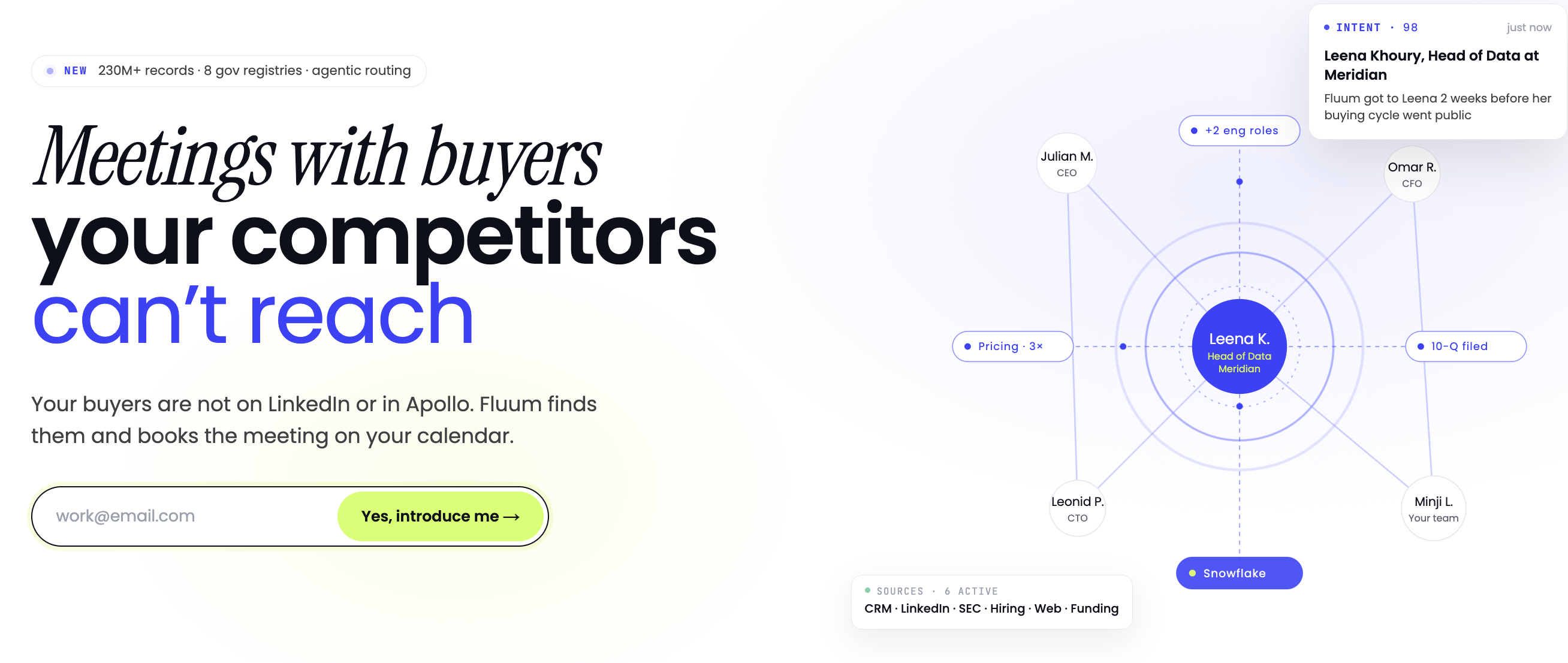
That’s what Fluum is built for. Our buyer graph pulls signals from 40+ private data vendors and 8 government registries, including SEC EDGAR, to identify decision-makers at the exact moment they’re most likely to be receptive. AI agents score intent signals and surface decision-maker paths. And every introduction is double opt-in, meaning both sides have said yes before a single word is exchanged.
If you’re a senior leader who’s done with cold outreach economics and ready to build pipeline from evidence rather than assumption, talk to Aurora. Tell her who you are and who you’re looking to meet next. She’ll make sure the introductions you receive are exactly the ones worth having.
Recommended Articles
Explore more from our content library: