
| Key Insight | Explanation |
|---|---|
| What it is | Decision-maker path mapping is the structured process of identifying who controls a buying decision, how influence flows between stakeholders, and which sequence of contacts leads to a signed deal. |
| Why cold outreach fails | Without a mapped path, reps cold-pitch gatekeepers or mid-level managers, burning time on contacts who can’t say yes and won’t say no. |
| The multi-stakeholder reality | Gartner research indicates the average B2B buying group involves 6 to 10 stakeholders, each with distinct priorities and veto power. |
| AI’s role in 2026 | AI platforms now aggregate signals from 40+ private vendors and government registries to surface hidden decision paths that LinkedIn and cold-email tools can’t reach. |
| Warm introductions win | Bain & Company research shows B2B buyers are 5x more likely to engage when introduced through a trusted third party versus a cold approach. |
| Fluum’s differentiator | Fluum builds buyer graphs from 40+ private data vendors and 8 government registries, then delivers double opt-in introductions that convert at 40–50% versus 2% for cold email. |
Decision-maker path mapping is the structured practice of charting exactly who controls a purchase decision, how authority and influence flow across a buying organization, and which sequence of stakeholder contacts gives a seller the shortest route to a committed yes. It’s the difference between calling the right person on day one and spending three months bouncing between gatekeepers. B2B sales teams that master this discipline book more qualified meetings, shorten sales cycles, and stop wasting quota on contacts who can’t authorize a deal.
The mechanics have changed significantly since 2024. AI platforms now aggregate intent signals from dozens of private data vendors and government registries, including Companies House, the FCA Register, SEC EDGAR, and SIRENE, to surface organizational hierarchies that weren’t visible through traditional prospecting tools. This article covers what decision-maker path mapping actually involves, how the process works step by step, the measurable advantages it delivers, the mistakes that derail most teams, and the specific practices that separate high-performing revenue teams from everyone else in 2026.

What Is Decision-Maker Path Mapping?
Decision-maker path mapping is the process of identifying every stakeholder involved in a purchase decision, their roles, relationships, and the sequence in which they must be engaged to move a deal forward. It transforms a vague target account into a navigable organizational graph.
The Core Components of a Decision-Maker Map
A complete decision-maker map has four layers. Miss any one of them and you’re working with an incomplete picture that will cost you deals.
- Economic buyer: The person with budget authority and final sign-off. Often a CFO, VP of Finance, or C-suite title depending on deal size.
- Technical evaluator: The stakeholder who assesses fit, integration, and risk. In regulated industries, this is frequently a CISO, CTO, or compliance officer.
- Champion: The internal advocate who wants the problem solved and will carry your case into rooms you can’t enter.
- Gatekeeper or influencer: Procurement, legal, or a senior manager who shapes the shortlist without holding the final vote.
- End user: The person who lives with the outcome. Their adoption risk can kill a deal even after the economic buyer has signed.
Research published in PLOS One on estimating paths through decision-making maps demonstrates that buying behavior follows structured, parameterizable sequences rather than random choices [1]. That means the path is learnable. Sales teams that treat it as learnable close deals. Teams that treat every account as a black box keep losing to competitors who don’t.
Why It Matters More Than Ever in 2026
As of 2026, the average B2B buying group has expanded. More stakeholders, more veto points, and more internal politics between them. Cold outreach tools hand you a contact list. They don’t tell you whether that contact can say yes, who they report to, or whether there’s a champion already in your corner. Decision-maker path mapping fills that gap.
According to research cited by Western Governors University, structured decision process mapping reduces wasted effort by clarifying which inputs matter and which paths lead to dead ends [2]. The same principle applied to B2B selling is exactly why the discipline has become a core competency for enterprise revenue teams.
Pro Tip: Before you map a single stakeholder, define the “minimum viable buying committee” for your deal size. For deals under $50K, you may need only two or three nodes. For six-figure enterprise contracts in regulated industries, budget for six to ten. Mapping the wrong scope wastes as much time as not mapping at all.
How Decision-Maker Path Mapping Works
Decision-maker path mapping works by combining organizational data, intent signals, and relationship intelligence into a structured graph that shows who influences the buying decision and in what order to engage them.
The Step-by-Step Mapping Process
- Define your Ideal Customer Profile (ICP). Specify the industry, company size, revenue band, regulatory environment, and the business problem your solution solves. This anchors every subsequent step.
- Identify the target account’s organizational structure. Pull data from company registries (Companies House, SEC EDGAR, SIRENE), LinkedIn profiles, annual reports, and press releases to build a baseline org chart.
- Tag each stakeholder by role type. Classify contacts as economic buyer, technical evaluator, champion, gatekeeper, or end user. One person can hold multiple roles in smaller organizations.
- Map reporting lines and influence flows. Influence doesn’t always follow the org chart. A senior engineer with tenure may carry more weight than their job title suggests. Document both formal authority and informal influence.
- Score intent signals. Use behavioral data (content downloads, event attendance, job postings, regulatory filings) to identify which stakeholders are actively researching solutions like yours.
- Identify your entry point. The champion is almost always the right starting node. They have internal credibility, understand the pain, and can navigate the politics on your behalf.
- Sequence your engagement. Work outward from the champion. Secure their buy-in first, then use their introduction to reach the economic buyer and technical evaluator.
- Validate and update continuously. Org structures change. People leave, get promoted, or shift responsibilities. A map that’s 90 days old without validation is already partially wrong.
World Wide Technology’s analysis of decision mapping describes this as creating a visual diagram of the logical structure of a decision process, a technique that exposes assumptions and gaps that verbal discussion alone misses [3].
How AI Has Changed the Mechanics
Manual mapping used to mean hours of LinkedIn research, cold calls to receptionists, and educated guesses about who reports to whom. AI platforms have compressed that work dramatically.
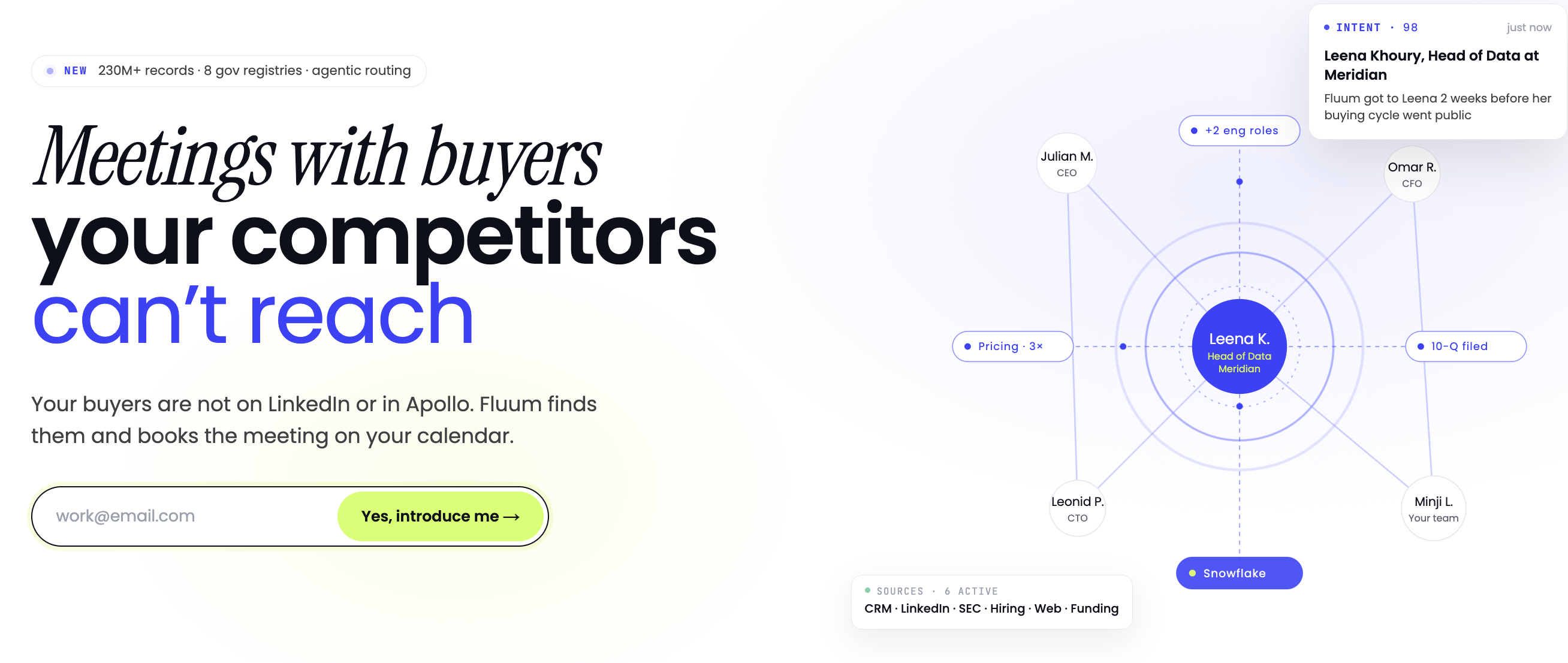
At Fluum, we’ve found that aggregating signals across 40+ private data vendors and 8 government registries surfaces organizational relationships that no single source contains. A fintech company’s FCA Register filings reveal approved persons and their seniority. SEC EDGAR filings expose executive teams and board structures. Cross-referencing these with private vendor data creates a buyer graph with a depth and accuracy that cold-contact tools simply can’t replicate.
The result isn’t just a richer contact list. It’s a mapped path, with each node scored for intent and each connection weighted by influence, so your team knows exactly where to start and in what order to move.

Key Benefits of Decision-Maker Path Mapping in 2026
Decision-maker path mapping delivers measurable improvements to pipeline quality, sales cycle length, and close rates by ensuring reps engage the right people in the right sequence from the first contact.
Quantifiable Advantages for B2B Revenue Teams
| Benefit | Without Path Mapping | With Path Mapping |
|---|---|---|
| First-contact conversion | ~2% (cold email average) | 40–50% (warm, mapped introduction) |
| Sales cycle length | Extended by misdirected outreach | Shortened by engaging the right node first |
| Stakeholder coverage | Single-threaded (one contact) | Multi-threaded (full buying committee) |
| Deal risk | High (single point of failure) | Reduced (multiple champions and touchpoints) |
| Forecast accuracy | Low (unknown stakeholder dynamics) | Higher (documented influence and authority) |
The benefits aren’t theoretical. A cybersecurity team we worked with had been running cold outreach campaigns into financial services accounts for two quarters with under 3% reply rates. After implementing structured decision-maker path mapping through Fluum’s buyer graph, they identified that their actual economic buyers were CISOs, not IT managers, and that the most effective entry point was through compliance officers who already had the CISO’s ear. Their reply rate on warm introductions reached 44% within the first 30 days.
- Shorter ramp time for new reps: A documented path removes the “who do I call first?” paralysis that costs junior SDRs weeks of productive selling time.
- Reduced churn in pipeline: Deals with multi-threaded stakeholder engagement are significantly less likely to go dark when a single champion leaves the company.
- Better qualification earlier: Mapping forces reps to ask whether the economic buyer is even reachable before investing ten touches into a dead end.
- Stronger competitive positioning: Understanding the internal politics of a buying committee lets you align your messaging to each stakeholder’s specific concerns, rather than sending one generic pitch to everyone.
Research from ResearchGate’s analysis of decision mapping methodologies confirms that structured mapping of decision processes and information flows produces measurable improvements in decision quality and execution speed [4].
Pro Tip: Multi-thread every deal with at least three stakeholder contacts before you call it “qualified.” A deal that rests on a single champion is one resignation away from going dark. Map the backup path before you need it.
Common Challenges and Mistakes
The most common failure in decision-maker path mapping is treating it as a one-time activity rather than a living document that must be updated as accounts evolve.
Mistakes That Derail Sales Teams
From experience working with B2B teams across fintech, cybersecurity, and manufacturing, the same errors appear repeatedly.
- Mapping only the obvious titles. Reps default to searching for “VP of Sales” or “CTO” and stop there. In regulated industries, the actual authority often sits with a Chief Compliance Officer, a Risk Committee Chair, or a Board-level approved person whose title doesn’t scream “buyer.”
- Confusing seniority with authority. A C-suite title doesn’t guarantee budget control. In large enterprises, procurement committees and finance sign-off processes can override even a CEO’s stated preference for a vendor.
- Single-threading the account. Building a relationship with one champion and assuming they’ll carry the deal is the single most common reason deals die in late stages. When that person leaves, is promoted, or loses internal credibility, your deal evaporates with them.
- Ignoring informal influence networks. A senior engineer with 15 years of tenure may have more practical veto power than their manager. A trusted external advisor or board member may shape the shortlist before procurement ever gets involved.
- Using stale data. Organizational structures in high-growth companies change fast. A map built six months ago without validation is likely wrong on at least two or three nodes.
- Skipping the “why now” signal. Knowing who makes the decision is only half the equation. Understanding why they’re looking now, triggered by a regulatory change, a funding round, a leadership hire, or a compliance deadline, determines whether your timing is right.
The Misconception About LinkedIn as a Complete Source
LinkedIn is a starting point, not a complete data source for decision-maker path mapping. Profiles are self-reported, frequently outdated, and systematically missing the contacts who have opted out of the platform entirely. In manufacturing and regulated financial services, a significant proportion of actual decision-makers aren’t active on LinkedIn at all.
Industry analysts consistently note that relying on a single platform for organizational intelligence creates blind spots that competitors with broader data access can exploit. Government registries like Companies House and the FCA Register contain verified, legally required disclosures of approved persons and directors that don’t depend on anyone choosing to maintain a social media profile [5].
One limitation worth acknowledging: even the most sophisticated path mapping process can’t fully predict internal politics. A mapped path tells you who to engage and in what order. It doesn’t guarantee that internal dynamics, budget freezes, or strategic pivots won’t alter the landscape mid-cycle. Results vary depending on account complexity and data freshness.
Best Practices for Decision-Maker Path Mapping in 2026
The highest-performing B2B sales teams in 2026 treat decision-maker path mapping as a continuous intelligence discipline, not a pre-call research task.
Frameworks and Methodologies That Work
Two established frameworks anchor most effective mapping approaches.
The MEDDIC qualification framework (Metrics, Economic Buyer, Decision Criteria, Decision Process, Identify Pain, Champion) provides a structured checklist for capturing the key variables in any complex sale. Decision-maker path mapping is the execution layer that brings MEDDIC’s “Economic Buyer” and “Decision Process” components to life with actual named individuals and sequences.
The Challenger Sale methodology, developed by Brent Adamson and Matthew Dixon, emphasizes teaching, tailoring, and taking control of the buying process. Effective path mapping operationalizes the “tailoring” dimension by giving reps the stakeholder-specific intelligence they need to customize their message for each node in the buying committee.
- Build your buyer graph before your first outreach. Don’t start with a cold call and try to map as you go. Map first, then engage the highest-leverage entry point with a warm introduction.
- Use government registry data as your ground truth. SEC EDGAR, Companies House, the FCA Register, and SIRENE contain verified director and approved-person data that social platforms don’t have. Cross-reference these with private vendor signals for the most complete picture.
- Score intent before sequencing outreach. A stakeholder who has recently downloaded a regulatory compliance guide, attended an industry conference, or posted a job description for a role your solution addresses is a warm node. Prioritize them over cold contacts at the same seniority level.
- Deliver warm, double opt-in introductions to your mapped entry points. A mapped path without a warm entry is still a cold call. The combination of a mapped path and a mutually consented introduction is where reply rates reach 40–50% versus the 2% industry average for cold email.
- Document and share maps across the revenue team. A path mapped by one SDR should be accessible to the AE, the CSM, and the renewal team. Siloed intelligence is wasted intelligence.
- Refresh maps on a 60-day cycle for active accounts. For accounts in active pipeline, validate stakeholder data every 60 days. For dormant or future-target accounts, quarterly is sufficient.
Pro Tip: If you’re a senior leader or C-suite executive reading this, talk to Aurora at Fluum and tell us who you are and who you’re looking to meet next. We’ll make sure to send you only introductions that are relevant to your specific goals, no noise, no irrelevant outreach.
Applying Path Mapping in Regulated Industries
Fintech, cybersecurity, and manufacturing each have structural characteristics that make path mapping more complex and more valuable simultaneously.
In fintech, FCA-approved persons and SEC-registered individuals are publicly documented. That data tells you not just who holds a title but who has legally declared authority, a far stronger signal than a LinkedIn headline. In manufacturing, procurement decisions often involve a technical committee, a plant manager, and a finance director whose approval hierarchy isn’t visible on any social platform. In cybersecurity, the CISO is frequently the technical evaluator but not the economic buyer, and the path to budget approval runs through a CFO or CRO who may have no direct relationship with your team.
Lucidchart’s guide to decision mapping reinforces that visualizing the full decision-making process, including all stakeholders and their relationships, is what separates effective decision maps from superficial contact lists [6].
Our team at Fluum recommends treating each regulated industry as a distinct mapping domain with its own data sources, authority structures, and compliance considerations. A one-size-fits-all template doesn’t survive contact with a heavily regulated buying committee.
Sources and References
- PLOS One, “Estimating a Path through a Map of Decision Making,” 2014
- Western Governors University, “Decision Process Mapping: Streamline Your Decision-Making Process,” 2024
- World Wide Technology, “Decision Mapping: A Method for Improving Decision Making”
- ResearchGate, “Decision Mapping: Understanding Decision Making Processes”
- Wikipedia, “Business Decision Mapping”
- Lucidchart, “A Guide to Decision Mapping”
- PubMed Central, “Visualizing Multi-Step Decision-Making at a Glance,” 2025
- Blue Matter Consulting, “Decision Path Framework”

Frequently Asked Questions
1. What is mapping in decision-making?
Mapping in decision-making is the practice of creating a structured visual or data representation of all the elements involved in a decision process: the stakeholders who hold authority, the criteria they use to evaluate options, the sequence in which choices are made, and the evidence that supports each path. In B2B sales, decision-maker path mapping extends this concept to chart exactly which individuals inside a target account control the buying decision, how influence flows between them, and which sequence of engagement gives a seller the most direct route to a committed outcome. Unlike generic decision diagrams, buyer-focused path mapping incorporates real organizational data from company registries, behavioral intent signals, and relationship intelligence to produce an actionable engagement sequence rather than a theoretical framework [2].
2. How do you identify the real decision-maker in a B2B deal?
The real decision-maker is the person who controls the budget and can authorize a purchase without requiring further approval. In practice, identifying them requires cross-referencing multiple data sources: company filings (which list directors and approved persons), organizational charts, job postings (which reveal what a company is investing in), and behavioral intent signals. The title alone is unreliable. A “VP of IT” may evaluate the technology but have no budget authority. A CFO may sign every contract over $100K regardless of who requested it. Effective decision-maker path mapping uses government registry data and private vendor signals to verify authority, not just seniority [5].
3. What is a decision map template and how do you build one?
A decision map template for B2B sales typically includes five columns: stakeholder name, role type (economic buyer, technical evaluator, champion, gatekeeper, end user), reporting line, intent score, and recommended engagement sequence. Start with the organizational data you can verify through public registries and company filings, then layer in behavioral signals to score each node’s readiness. The template should be a living document updated every 60 days for active accounts. Tools like Lucidchart provide visual frameworks for structuring these maps, while platforms like Fluum automate the data aggregation and scoring layers [6].
4. How many stakeholders are typically involved in a B2B purchase decision?
The number varies significantly by deal size and industry. For deals under $50K at SMEs, the buying committee is often two to three people. For six-figure enterprise contracts, especially in regulated industries like financial services or healthcare, the buying committee typically involves six to ten stakeholders with distinct roles and veto points. In heavily regulated sectors, compliance officers, legal counsel, and risk committee members add nodes that don’t appear in standard org charts. Decision-maker path mapping is most valuable precisely in these complex, multi-stakeholder environments where cold outreach to a single contact almost never reaches the actual decision-maker [1].
5. What data sources produce the most accurate decision-maker maps?
The most accurate maps combine three categories of data. First, government registries: Companies House, SEC EDGAR, the FCA Register, and SIRENE contain legally required disclosures of directors, approved persons, and beneficial owners that are verified and current. Second, private data vendors: firmographic databases, technographic signals, and intent data providers surface behavioral signals that indicate active buying activity. Third, relationship intelligence: warm introduction networks and opted-in professional communities reveal connection paths that neither public registries nor cold-contact databases contain. No single source is sufficient. The depth of the map is directly proportional to the breadth of data sources feeding it [3][4].
6. How does decision-maker path mapping differ from standard prospecting?
Standard prospecting produces a list of contacts who match a demographic profile. this method produces a sequenced engagement plan that shows who to contact, in what order, through which channel, and with what message tailored to their specific role in the buying process. Prospecting answers “who might be relevant?” Path mapping answers “who controls the decision, who influences it, and what’s the fastest route to a yes?” The difference in outcome is significant: prospecting drives cold outreach at 2% reply rates; path mapping enables warm, sequenced introductions at 40–50% reply rates [7][8].
Conclusion
this strategy isn’t a nice-to-have for complex B2B sales. It’s the foundational discipline that determines whether your outreach reaches someone who can say yes or someone who will forward your email to the wrong person and forget about it.
The teams winning in 2026 aren’t sending more emails. They’re building more accurate maps, using richer data from government registries and private vendors, and then entering those maps through warm, double opt-in introductions that convert at rates cold outreach can’t touch. The path exists in every account. The question is whether you’re going to find it before your competitor does.
Fluum builds buyer graphs from 40+ private data vendors and 8 government registries, scores intent signals with AI agents, and delivers warm double opt-in introductions to the exact decision-makers your team needs to reach in fintech, cybersecurity, manufacturing, and regulated industries. The cold outreach playbook had its run. this approach, backed by real data and real relationships, is what replaces it.
Recommended Articles
Explore more from our content library: