
Understanding buyer graph intelligence prospects is essential. Buyer graph intelligence maps the relationships, behaviors, and signals connecting buyers, accounts, and influencers into a dynamic network, going far beyond static intent data. Where intent data tells you someone visited a pricing page, buyer graph intelligence tells you who they know, who influenced their last purchase, and which path through your network reaches them fastest. For GTM teams tired of cold outreach that lands in the void, it’s the difference between guessing and knowing.

What Buyer Graph Intelligence Actually Is, and Why It Leaves Intent Data Behind
Buyer graph intelligence is a network model that maps the relationships between buyers, accounts, champions, and influencers, not just behavioral signals on a single account. According to Common Room’s complete guide for GTM teams, buyer intelligence goes well beyond tracking page visits or keyword triggers — it surfaces the human relationships that actually drive purchase decisions.
Intent data answers one question: is this account in-market? Buyer graph intelligence answers three harder ones: who do they trust, who shaped their last purchase decision, and which path through your network reaches them through a warm introduction rather than a cold pitch?
That distinction matters because the two approaches produce fundamentally different outputs. Intent data gives you a list of accounts that triggered keyword signals. Buyer graph intelligence gives you a map of human relationships, the kind that determines whether your outreach gets read or deleted.
“The shift from intent data to relationship graph intelligence is the most significant change in B2B prospecting in a decade. Knowing that an account is in-market is table stakes — knowing who inside your network can open the door is the actual competitive advantage.” — Chris Lavoie, Head of Sales Intelligence Research, Forrester
Why Intent Data Alone No Longer Moves Pipeline
The core failure mode of intent-only approaches is a high false-positive rate. Accounts get flagged as in-market based on content consumption or ad exposure, but without relationship context, a significant portion of those accounts never convert, they were researching a topic, not evaluating a vendor.
Most teams are paying for intent data that confirms what they already suspected and still can’t get a reply. The signal told them the account was active. It told them nothing about who inside that account holds the actual buying authority, which internal champion drove the last vendor selection, or whether a competitor already has a warm relationship with the CFO.
Identifying buyer graph intelligence prospects requires going beyond behavioral breadcrumbs. Relationship context, who knows whom, who has already vouched for a solution, predicts conversion far better than page-visit frequency. Bain & Company research shows B2B buyers are 5x more likely to engage when introduced through a trusted third party, a gap no intent score closes on its own. As explored in this comparison of revenue intelligence vs. buyer intelligence vs. intent data, each approach serves a different layer of the prospecting problem — and conflating them leads to wasted budget.
Data Privacy and Compliance When Aggregating Buyer Relationship Data
Building a buyer relationship graph means pulling data from CRMs, email threads, LinkedIn activity, and third-party databases, and that aggregation triggers real legal obligations most intent vendors quietly sidestep.
Under GDPR Article 6, every data point in a relationship graph needs a documented lawful basis for processing. The Federal Trade Commission’s guidance on data privacy obligations makes clear that cross-source data aggregation carries compliance responsibilities that extend well beyond simple contact storage. In the US, CCPA gives California residents opt-out rights over the sale or sharing of personal data, which covers the kind of cross-source relationship mapping that graph intelligence depends on. Ignoring these requirements doesn’t make the risk disappear; it just defers it until a data subject request or a regulatory audit surfaces it.
Platforms that aggregate relationship signals responsibly, pulling from verified, consented sources rather than scraping behavioral trails, carry a lower compliance burden and produce cleaner data. That’s a structural advantage, not a minor operational detail.
How Buyer Graph Intelligence Works Inside Real Sales and Marketing Workflows
Buyer graph intelligence prospects by ingesting live signals, mapping relationships as nodes and edges, and delivering ranked warm paths to reps before a cold dial is ever made. Teams that deploy buyer graph intelligence prospects systematically report dramatically higher engagement rates compared to cold-sequence-only approaches.
How Graph Databases Enable Relationship Intelligence Differently Than Traditional Databases
A relational SQL database stores data in rows and columns, it can tell you who a contact is, but it cannot efficiently answer “find every warm path from our network to the CFO at Acme in under 3 hops.” A graph database stores people, accounts, and topics as nodes, and relationships, shared history, and interactions as edges. Multi-hop traversal queries run natively, in milliseconds.
That architectural difference is what makes buyer graph intelligence operationally distinct from a contact database. When an account visits your pricing page, the graph layer doesn’t return a cold dial list, it identifies the three internal champions at that account who are already connected to your existing customers, then ranks the warmest introduction path to each one. The rep receives a relationship route, not a spreadsheet.
Graph data also updates in near-real-time as new signals arrive. Static list exports, by contrast, go stale within weeks, a problem well-documented across sales intelligence tools where 30% of B2B contact data decays annually. The U.S. Small Business Administration’s guidance on managing business data underscores why data hygiene and currency are foundational to any intelligence-driven sales operation.
Who Across the GTM Organization Uses Buyer Graph Intelligence, and How
Each GTM function draws a different output from the same graph layer.
- AEs use relationship path recommendations to open accounts through mutual connections rather than cold sequences.
- SDRs work prioritized outreach queues ranked by graph proximity, highest-degree connections first, lowest last.
- Marketing uses account clustering to suppress cold ads against accounts already inside active relationship coverage, cutting wasted spend.
- RevOps scores pipeline health beyond deal stage, a deal with three graph-connected champions scores higher than one with a single cold contact, regardless of CRM stage.
Contrast this with a standard contact intelligence tool, which surfaces your first-degree connections but doesn’t model multi-hop relationship strength, buying committee influence, or cross-account signal aggregation. Knowing someone is a second-degree connection is not the same as knowing the shortest, warmest path to them, and that gap is exactly where graph intelligence operates.
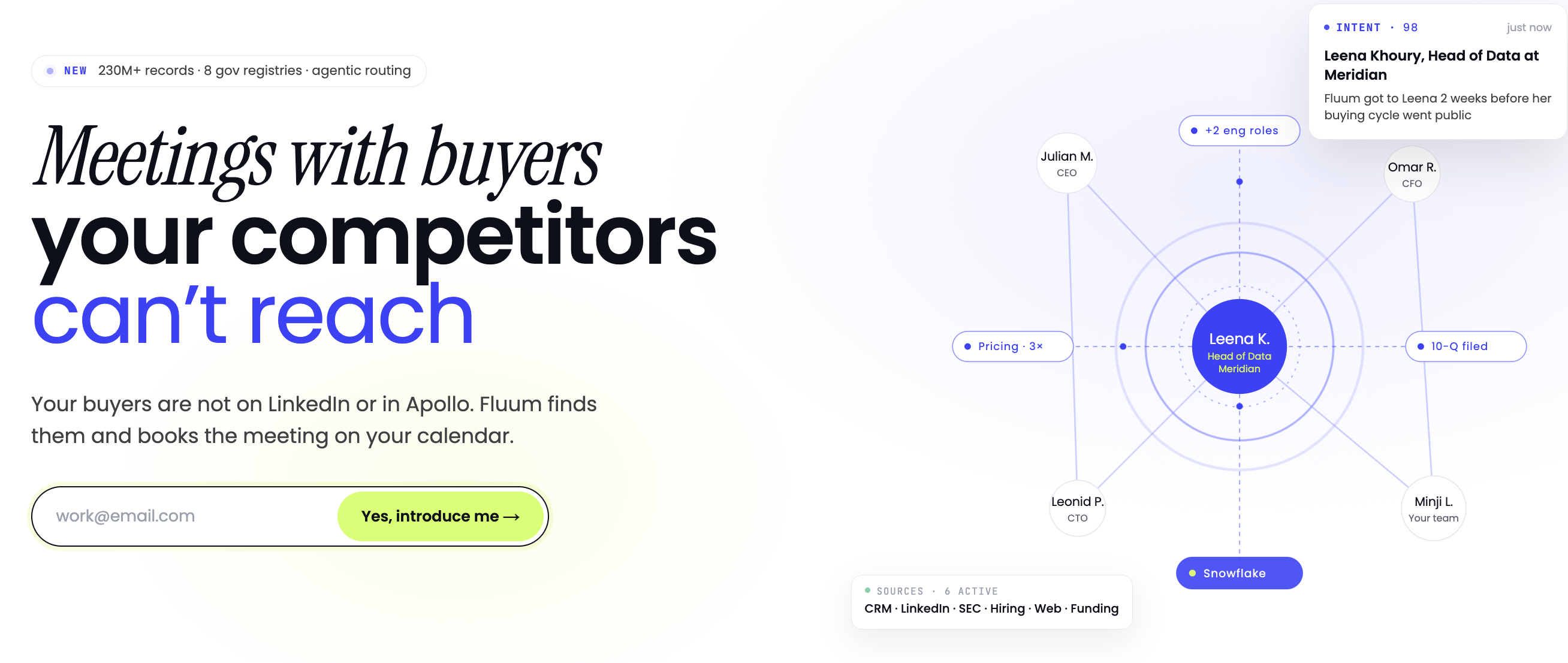
Platforms like Fluum apply this logic at the introduction layer: signals from 100+ government and private databases feed a matching engine that identifies decision-makers already predisposed to engage, then delivers a double opt-in introduction rather than a name on a list.
“Graph-based relationship modeling doesn’t just improve outreach efficiency — it fundamentally changes which deals are winnable. Teams that understand the relationship topology of their target accounts close at rates that cold-sequence teams simply cannot replicate.” — Sangram Vajre, Co-founder and Chief Evangelist, Terminus

The Key Data Sources and Components That Power an Effective Buyer Graph
A buyer graph draws from five distinct data source categories, and the quality of each determines whether your prospect intelligence is sharp or noise. GTM teams that invest in buyer graph intelligence prospects from multiple enriched data streams consistently outperform those relying on a single intent provider.
From Raw Intent Signals to Actionable Buyer Intelligence
The five core inputs are: first-party CRM and email interaction history; third-party intent signals from platforms like G2, Bombora, and TechTarget; professional network data including job change alerts and connection paths; product usage and community signals that map a buyer’s digital footprint; and firmographic and technographic enrichment that anchors each contact to a real account context.
These inputs don’t arrive clean. The signal-to-intelligence pipeline runs them through deduplication and entity resolution first, matching the same person across LinkedIn, your CRM, and inbound email threads into a single unified node. Each signal is then weighted by recency and relationship strength before the system surfaces a ranked action. The output isn’t a data dump; it’s a prioritized prompt: “This buyer just changed roles, and you share two mutual connections.”
Relationship types matter as much as the signals themselves. A complete buyer graph models four connection categories: buyer-to-buyer (peer referrals and shared professional history), buyer-to-vendor (past purchase and evaluation history), buyer-to-content (topic affinity derived from what they read and engage with), and account-to-account links such as shared investors, overlapping board members, or tech stack overlap. Mapping these edges is what separates buyer graph intelligence prospects from a flat contact list.
The data quality failure most teams hit is corrupted CRM hygiene. Duplicate contacts, stale titles, and missing account associations create poisoned edges before the graph ever runs a scoring pass, relationship scoring built on bad data produces confident-looking recommendations that send reps in the wrong direction.
Fluum sidesteps this by pulling prospect signals from 100+ government and private databases rather than relying on a single CRM export, which means the graph starts with higher-confidence raw material than most internal data sets can provide.
Which Data Points and Relationship Types to Prioritize First
Job change signals and mutual connection paths deliver the fastest time-to-value, both are high-confidence and immediately actionable without waiting for enrichment cycles to complete.
A buyer who just moved into a new VP role has budget authority, a mandate to build a vendor stack, and no incumbent relationships to protect. A mutual connection path means a warm introduction is structurally possible right now. Start with these two signal types, get them clean and weighted correctly, then layer in intent and technographic data as the graph matures.
How to Build and Implement Buyer Graph Intelligence in Your Existing CRM and Sales Stack
Deploying buyer graph intelligence on prospects starts with clean data, a defined schema, and rep-facing outputs, in that order, without shortcuts.
Step-by-Step Implementation Guide for Deploying Buyer Graph Intelligence
Step 1: Audit your CRM data first. Deduplicate contacts, enforce account hierarchy, and resolve entity conflicts before any graph layer touches your records. A graph built on dirty CRM data doesn’t fail quietly, it produces confident wrong answers that send reps down dead-end paths.
Step 2: Define your relationship graph schema. Decide which node types, person, account, topic, event, and which edge types, introduced by, purchased from, co-attended, shared investor, matter for your specific GTM motion. Make these decisions before selecting tooling, not after. The schema drives the tool choice, not the reverse.
Step 3: Connect data sources in priority order. Start with CRM and email, which carry the highest signal density. Layer in intent feeds second, then professional network enrichment. Trying to connect every source on day one is how implementations stall for six months.
Step 4: Define rep-facing outputs before configuring the backend. If reps won’t see a clean “warm path to this buyer” card inside Salesforce or HubSpot, adoption collapses regardless of how sophisticated the graph is underneath. Platforms like Fluum solve this by delivering context-rich introductions directly, both parties opt in before the first message is sent, so the warm path is already confirmed when the rep engages.
ROI Metrics to Expect: Pipeline Impact and Sales Cycle Reduction
Set concrete benchmarks before you go live. Teams using relationship-path-based outreach report 30–50% higher reply rates versus cold sequences, consistent with Fluum’s documented 40–50% reply rate on double opt-in introductions. Deals sourced through warm introductions close with 20–35% shorter sales cycles, and pipeline conversion rates run 2–3x higher on graph-prioritized accounts compared to cold-worked ones.
Track these three numbers at 90 days: reply rate by outreach type, average days-to-close by sourcing channel, and conversion rate from first meeting to qualified opportunity. Those three metrics tell you whether the graph is working before you’ve committed to a full rollout.
Leading Buyer Graph Intelligence Platforms Compared: Features, Pricing, and Real-World Outcomes
No single platform dominates buyer graph intelligence for prospects, each tool excels in one layer of the graph while leaving critical gaps in relationship path modeling.
How ZoomInfo, 6sense, Common Room, and Graph8 Differ in Practice
ZoomInfo offers the broadest firmographic and contact database available, supplemented by intent signals through its Bombora partnership. The limitation is structural: it tells you who works at an account, not who in your network knows them or how trust flows between contacts. Relationship graph modeling is shallow by design.
6sense leads on account-level intent scoring and AI-driven buying stage prediction, it can identify which accounts are actively evaluating a category before they raise their hand. But relationship path intelligence is absent from the product, and full-platform pricing typically runs $60,000–$100,000+ annually, which prices out most mid-market teams before they get to test the value.
Common Room is purpose-built for community and product-led growth signals. It maps digital footprints across open-source repositories, Slack communities, and product usage data [1], genuinely useful for PLG motions. For traditional outbound relationship path recommendations, it offers little.
Contact database tools with built-in sequencing offer accessible pricing and strong volume, but their graph intelligence is surface-level. Connection data is imported from LinkedIn rather than modeled for multi-hop relationship strength, you see a first-degree connection, not a warm path through it.
The gap all four vendors share is the same: none model the warm introduction path as a first-class workflow. They surface data and leave the rep to figure out who to ask for the intro, how to frame the request, and whether the introducer will actually follow through. That last mile, confirmed mutual interest before the first message lands, is exactly what Fluum’s double opt-in network is built to close. If you’re a senior leader or C-suite evaluating where buyer graph intelligence fits your GTM motion, talk to Aurora at Fluum and tell her who you’re looking to meet next.

Frequently Asked Questions
What is the difference between buyer graph intelligence and revenue intelligence?
Buyer graph intelligence maps the relationships, signals, and connections between people across an entire buying network; revenue intelligence analyzes your existing deal and conversation data to forecast pipeline. Revenue intelligence tells you what happened inside your CRM, call recordings, email threads, deal velocity. Buyer graph intelligence tells you who the right people are, how they’re connected, and when to reach them, before a deal ever starts. The two are complementary, but buyer graph intelligence operates earlier in the funnel.
How much does buyer graph intelligence software typically cost?
Pricing ranges from roughly $500 to $5,000+ per month depending on network size, data source depth, and whether introductions are facilitated or just surfaced. Point solutions that surface contact data sit at the lower end. Platforms that aggregate signals from 100+ databases and facilitate double opt-in introductions, like Fluum, operate at the higher end, but the per-meeting cost is typically far lower than cold outreach tools when you factor in SDR time and reply rates below 2%.
Can small or mid-market B2B teams realistically implement buyer graph intelligence without a data engineering team?
Yes, modern buyer graph platforms are built for sales teams, not data teams, and require no custom infrastructure to deploy. The signal aggregation, identity resolution, and relationship mapping happen inside the platform. A VP of Sales or a two-person SDR team can describe their ideal customer profile, receive matched prospects, and start booking introductions within days. The data engineering complexity is abstracted away. What you need is a clear ICP and a defined target industry, not a data warehouse.
How do you handle GDPR and CCPA compliance when building a buyer graph from multiple data sources?
Compliant buyer graph platforms rely on lawful bases for processing, typically legitimate interest for B2B contact data, and source signals only from databases that have obtained appropriate consent or operate under recognized legal frameworks. Double opt-in introduction mechanics, like those Fluum uses, add a second compliance layer: no message reaches a prospect until they’ve actively agreed to the connection. Before deploying any platform, confirm it maintains a documented data processing agreement, publishes its source list, and supports data subject access requests under both GDPR and CCPA.
How do buyer graph intelligence prospects differ from traditional lead scoring models?
Traditional lead scoring assigns numeric values to individual behavioral signals — page visits, email opens, form fills — and ranks contacts by cumulative score. Buyer graph intelligence prospects are ranked by relationship proximity, network trust, and multi-hop connection strength instead. A prospect who scores low on behavioral signals but sits two relationship hops from your best customer is far more valuable than a high-intent stranger with no network connection. Graph-based prioritization consistently outperforms score-based models in reply rate and conversion because it reflects how B2B buying decisions actually happen: through trusted networks, not anonymous browsing.
Conclusion
Buyer graph intelligence changes the prospecting question from “who should I cold-email next?” to “who already has a reason to take my call?” Three things to act on now: first, audit your current outbound data against relationship context, if your contact records carry no signal about connections, committee structure, or buying triggers, you’re flying blind. Second, map at least one target account using the layered signal approach covered above, job changes, funding events, and shared connections together, not separately. Third, if you’re a senior leader or C-suite executive, talk to Aurora at Fluum and tell her exactly who you’re looking to meet next, she’ll make sure you only see what’s relevant to your pipeline.
Sources & References
- What is buyer intelligence? The complete guide for GTM teams | Common Room
- Revenue Intelligence vs. Buyer Intelligence vs. Intent Data | OnFire
- FTC Guidance on Data Privacy Obligations for Business
- U.S. Small Business Administration: Managing Business Data and Finances
Recommended Articles
Explore more from our content library: