
Understanding SEC EDGAR sales signals is essential. SEC EDGAR filings reveal buying intent because events like new debt raises, executive appointments, M&A disclosures, and Form D funding rounds all signal that a company is about to spend money, often 30-90 days before that budget reaches a public RFP. A newly disclosed CFO or a fresh Series C in Form D means procurement conversations are starting internally right now. Sales teams who monitor these filings can identify the decision-maker and reach out with a warm, informed introduction before competitors relying on traditional prospecting even know the opportunity exists.
How Do SEC EDGAR Filings Reveal Buying Intent Before Your Competitors See It?
A filing is a company telling the market, in writing, that money is about to move, before that money turns into a press release or an RFP. That gap between disclosure and public announcement is where SEC EDGAR sales signals do their work.
Every 8-K, 10-K, and Form D exists because federal law requires companies to disclose material events: new debt, leadership changes, facility expansions, restructuring, mergers. These aren’t marketing statements. They’re forward-looking records of capital events that precede budget allocation, because a company doesn’t raise a credit facility or hire a CFO and then wait a year to act on it. The spend follows the disclosure, usually within a quarter.
What Specific Filing Events Signal That a Company Is Actively Buying or Expanding?
Certain filing types correlate directly with procurement activity. A new executive hire disclosed in an 8-K, a CFO, CTO, or VP of Operations, almost always triggers a review of existing vendor contracts and tooling within their first two quarters. A facility expansion or new lease disclosure signals headcount growth and the infrastructure spend that comes with it. A new or amended credit facility means the company has capital it didn’t have last quarter, and capital gets deployed. M&A announcements are the clearest signal of all, integration always creates budget for software, services, and compliance work the combined entity didn’t need separately [4].
Traditional prospecting waits for one of two things: the company issues a press release, or someone inside picks up the phone and calls a vendor. Both happen downstream of the filing, often by weeks or months, because press releases get drafted and approved long after the underlying financial event was legally disclosed [4]. By the time a competitor’s rep sees the funding announcement on a news site, the buyer has already had internal budget conversations for a month.
How Early Can You Identify Decision-Makers From Filings Compared to Traditional Prospecting?
Filings name officers and directors directly, often before those changes show up on LinkedIn or a company’s own website. An 8-K disclosing a new executive appointment is a matter of public record the day it’s filed [3], whilst the same person’s LinkedIn profile update, or an org chart refresh a research tool scrapes, typically lags by weeks. Board changes work the same way, new directors are named in filings well before press coverage catches up.
None of this depends on proprietary access. EDGAR is a free, public database [3], the reasoning is what separates teams that use it from teams that don’t.
Which SEC Filing Types Generate the Strongest Sales Signals?
Three filing types drive most usable SEC EDGAR sales signals: 8-K disclosures of material events, annual 10-K reports, and Form D notices of private capital raises.
Each answers a different question about a buyer. The 10-K is the slow, comprehensive one, filed annually, it lays out strategic direction, risk factors, and planned capital allocation across a full page range that few sales teams ever open [4]. That’s the mistake. The risk-factor section alone often names the exact operational fear your product solves, months before a budget line exists to fix it [4].
The 8-K is faster and narrower. Companies must file it within four business days of a material event, leadership departures, acquisitions, new executive hires, major contract wins [2]. That tight window makes it the highest-velocity signal of the three: by the time an 8-K becomes public, the triggering event already happened, which means budget conversations may already be underway internally.
Form D sits apart from the other two because it isn’t a disclosure about an existing public company, it’s a notice that a private company just closed a funding round. For growth-stage targets, that’s often the earliest available signal of any kind, arriving before hiring pages update or press releases go out.
How Do 10-K, 8-K, and Form D Filings Differ in Signal Strength Across Verticals?
Signal strength depends heavily on which vertical you’re selling into. Fintech and cybersecurity buyers surface most reliably in 8-K executive and compliance disclosures, a new Chief Information Security Officer, a disclosed breach, or a compliance-related leadership change all point directly at budget in motion. Manufacturing buyers behave differently: their strongest signals cluster in capital expenditure disclosures and facility-related filings, where a new plant, equipment investment, or supply chain restructuring shows up in the 10-K’s investment or subsequent-events sections rather than in a standalone 8-K.
For earlier-stage or private targets, Form D outranks both. A fresh private placement signals fresh growth spend before that company has any public disclosure obligations at all, which is precisely why it works so well as an early-warning layer for scaleup-focused sellers building SEC EDGAR sales signals into their pipeline process.
What False Positive Rates Should You Expect When Interpreting Filing Signals?
Not every filing event converts to a purchase, and treating a single filing as a buy signal produces noise, not pipeline. A leadership hire disclosed in an 8-K doesn’t guarantee released budget, new executives frequently spend two or three quarters auditing existing vendors before touching new spend. A 10-K risk factor about cybersecurity exposure might reflect a concern the board raised once, not an active procurement mandate.
The fix is cross-referencing. A single 8-K executive hire is weak evidence. That same hire paired with a Form D funding event from the prior quarter and a 10-K capital expenditure line pointing at the same function is a cluster, and clusters correlate far more reliably with near-term purchasing activity than any lone filing. Screen for combinations, not headlines, before a rep ever picks up the phone.
Why Do Most Sales Teams Fail to Extract Value From Raw SEC EDGAR Data?
Most sales teams fail because EDGAR gives them a document archive, not a lead list, nobody translates 200 pages of legal text into a call script before the moment has passed.
SEC EDGAR sales signals only exist once a human or a system reads a filing, understands what it means for a buying decision, and connects it to an account already in the CRM. The SEC’s own search tools return exactly what they promise: full-text results, form listings, company lookups [3]. They don’t rank a 10-K’s risk-factor section by sales relevance or flag which paragraph mentions a technology investment your product solves for. That interpretation step is where most teams stall.
What Technical and Operational Barriers Prevent Direct API Access From Becoming Actionable Intelligence?
Volume is the first wall. Thousands of filings post across EDGAR every trading day, spanning every sector from manufacturing to fintech, and a rep tasked with monitoring even fifty target accounts cannot realistically read each new 8-K, 10-Q, or proxy statement the day it lands [1]. Without a dedicated analyst or an automated parsing layer, filings pile up unread.
Timing compounds the problem. A rep who manually stumbles onto a relevant 10-K a month after it posts is reading old news, the budget cycle it hinted at may already be underway, and a competitor who monitored the filing on day one has likely already opened the conversation [4]. Autobound’s guide on filing-derived signals makes the point directly: the useful data point is usually one sentence buried on page 83 of a 247-page document, and nobody on a revenue team has time to find it manually [2].
Integration is the third barrier. Raw API output arrives as JSON or plain text with no field mapping to account owner, deal stage, or contact record, someone still has to build the bridge from “filing mentions capital investment” to “task assigned to the rep who owns that account” [1].
How Do Filing Signal Platforms Differ in Accuracy, Speed, and CRM Integration?
Not every filing-monitoring tool clears these barriers equally. A basic keyword alert flags that a word appeared somewhere in a filing; a stronger filing-intelligence layer extracts the specific clause, scores its relevance to your product category, and routes it to the right account owner within hours rather than days [1][5]. The gap between those two experiences is the gap between noise and a signal a seller can act on before the buying window closes.
How Do You Turn SEC EDGAR Sales Signals Into Warm Introductions and Qualified Conversations?
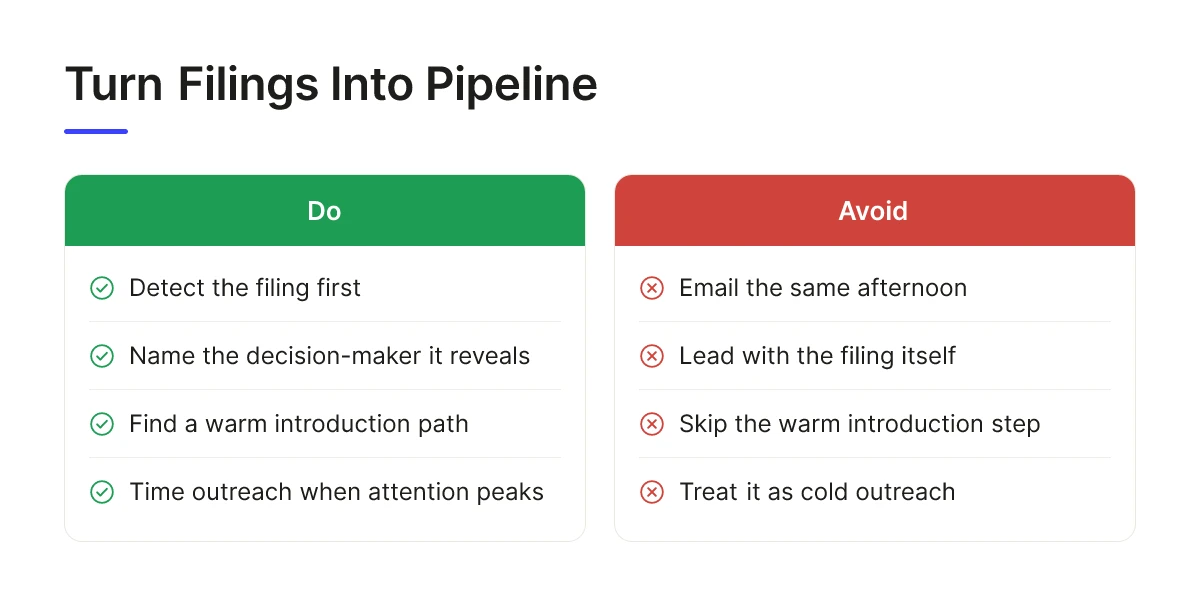
The path runs three steps: detect the filing, name the decision-maker it points to, then find someone who already knows them before you send a single message.
Most teams stop at step one. They see the 8-K, the Form D, the new executive named in a proxy statement, and they fire off an email that same afternoon. That’s not turning SEC EDGAR sales signals into pipeline, that’s just faster cold outreach with better trivia attached.
The filing tells you who just got budget authority or a new mandate, and when their attention is highest. It should never become the opening line of your pitch. “I saw your Form D” or “Congratulations on the funding round” reads as surveillance, not insight [4]. The buyer knows the filing is public. What they’re actually judging is whether you understood what it means for them, and whether you arrived through a channel that feels earned rather than automated.
What’s the Fastest Timeline From Filing Detection to a Qualified Conversation?
Teams running an automated monitoring workflow can move from filing detection to a routed outreach task inside 24 hours [1]. A trigger picks up the new 10-K or 8-K, extraction pulls the relevant paragraph, and a task lands on the right account owner’s desk the same day the filing hits EDGAR [1].
Manually, that same cycle stretches across days or weeks, someone has to remember to check, read a lengthy document, and decide it’s worth acting on [4]. By the time a manual reader reaches page 83, a competitor with a monitoring workflow has already identified the decision-maker and started building the introduction path.
How Do You Combine SEC Signals With Other Data Sources to Build Credible Warm Introductions?
A filing alone is a timing signal, not a reason to talk. Layer it against hiring pages showing a new team being built, funding databases confirming the capital is real, and your own network to check who’s already one step from the buyer [2].
This is where the double opt-in principle matters more than speed. A filing tells you who to approach and when, it doesn’t tell you whether the conversation will land. Fluum’s AI matches the decision-maker named in the filing against a curated network spanning finance, technology, and manufacturing, then confirms mutual interest before any introduction happens. The signal earns you the right timing; the warm path, a real connection, verified on both sides, earns you the reply.
What’s the Difference Between Manual SEC Monitoring and AI-Powered Filing Intelligence?
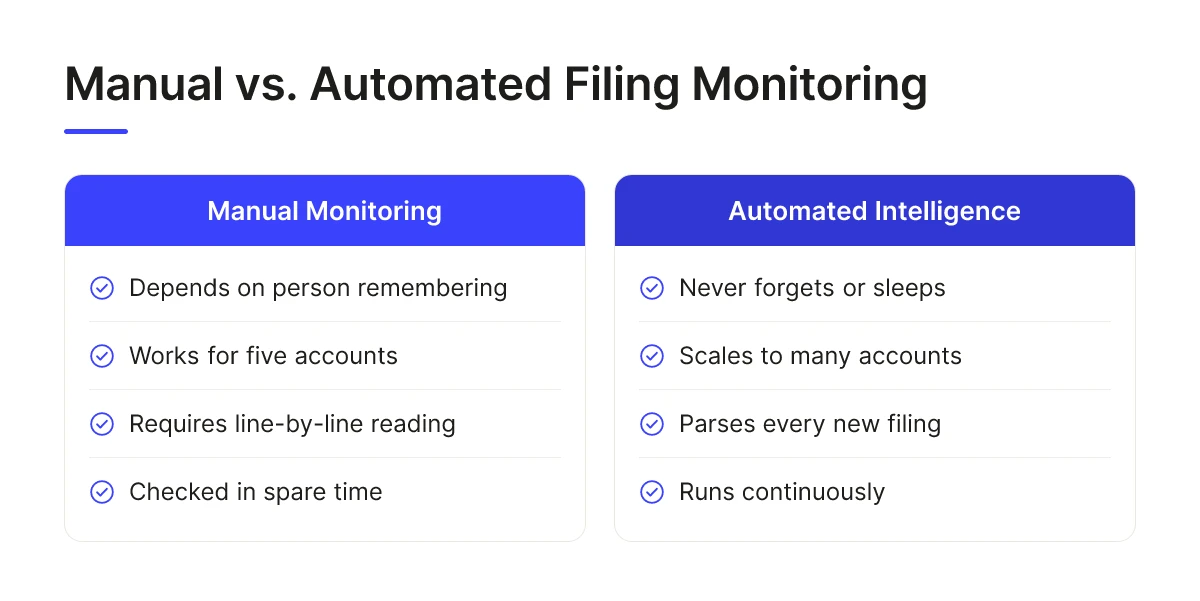
Manual monitoring depends on a person remembering to look; automated filing intelligence never forgets and never sleeps through a Friday-afternoon 8-K.
The manual version looks like this: a saved search on EDGAR’s full-text tool, maybe an RSS feed pointed at a handful of target tickers, and a rep or SDR who checks it when they have a spare ten minutes [3]. That works when you’re tracking five accounts. It falls apart at fifty, because nobody has time to read a 10-K line by line looking for the one paragraph that matters [4]. Automated systems solve the coverage problem differently, they parse every new 10-K, 10-Q, and 8-K the moment it hits EDGAR, extract the relevant passages with NLP, and flag only the filings tied to accounts on your list [1][2].
That’s the real shift: not more data, but less noise pointed at the right names.
What ROI and Win Rate Improvements Should You Expect From Automated Signal Detection?
Expect faster time-to-outreach, fewer missed signals, and more consistent follow-up, not a guaranteed lift in close rate.
Speed compounds. A rep who reads a risk-factor update the morning it’s filed and opens with that exact language starts the conversation already understood, whilst a competitor still sends a generic check-in [4]. Automation doesn’t replace that judgment, it makes sure the filing reaches someone before the moment has passed. The honest framing: automated SEC EDGAR sales signals reduce the odds you miss a trigger entirely, they don’t manufacture interest that wasn’t already latent in the filing.
How Does AI Scoring and Decision-Maker Mapping Change Your Sales Workflow?
AI scoring ranks filings by relevance to your ideal customer profile instead of dumping every keyword match into your inbox.
Rather than surfacing every filing containing “cybersecurity” or “restructuring,” a scoring layer weighs each hit against your target account list and ICP, so a manufacturing VP of Sales sees the filings that actually match their buyer, not a generic feed [2]. Decision-maker mapping goes a step further: instead of a rep spending an hour on LinkedIn after spotting a signal, the system surfaces the named executive and title tied to that filing directly. This is where Fluum fits into the picture, once a filing signal identifies buying intent, Fluum’s AI matches that account against its network of finance, technology, and manufacturing decision-makers and pursues a double opt-in introduction, so the rep starts from a warm, mutually confirmed conversation instead of a cold email to a guessed contact.
None of this erases the tradeoff. Manual monitoring still works at low account volume, with full control over what gets flagged and no risk of a scoring model misjudging relevance. Automated intelligence trades some of that manual precision for coverage and speed at scale, and tooling spans budget-friendly alert setups through to premium, enterprise-grade platforms with API access and CRM integration [1][5]. Choosing between them is a maturity question, how many accounts you’re tracking and how much missed timing costs you, not a question of one approach being universally correct.
Frequently Asked Questions
Can small sales teams use SEC EDGAR filings without a dedicated analyst?
Yes, a lean team can monitor a target account list on EDGAR without hiring an analyst, using free full-text search or a lightweight monitoring tool [1]. The barrier isn’t headcount, it’s routing: someone still needs to turn a filing alert into an outreach angle within hours, not weeks [4].
Do private companies file anything useful on SEC EDGAR?
Some do, private companies raising debt, registering securities, or involved in M&A with a public counterparty still leave a paper trail on EDGAR [3]. Coverage is patchier than for public issuers, so treat EDGAR as one signal source among several rather than a complete map of the private market.
How often should you check for new SEC filings on target accounts?
Check daily, since 8-Ks disclosing material events can appear at any time and lose value fast once competitors spot them [5]. Manual daily review doesn’t scale past a handful of accounts, which is why most revenue teams automate the check instead [1].
Is it legal and appropriate to use public SEC filings for sales prospecting?
Yes, EDGAR filings are public disclosures the SEC makes freely available specifically so investors and the market can read them [3]. Referencing a filing’s stated priorities in outreach isn’t insider information or a grey area; it’s citing what a company already told the public itself [4].
Conclusion
A 10-K risk factor or an 8-K disclosure tells you what a company is worried about before any intent-data vendor catches up. The teams winning deals aren’t reading more filings, they’re turning filings into a same-day conversation instead of a generic “checking in” email [4]. Two things matter most: build a repeatable monitoring routine for your named accounts, and pair that filing intelligence with a warm path into the buyer rather than another cold send.
That second part is where most pipelines still break. Start this week by pulling the 8-Ks filed by your top 20 target accounts over the last 90 days, and flag the three that mention a strategic priority Fluum could help you open a warm introduction around.
Sources & References
- Turn SEC Filings Into Sales Signals
- SEC Filings as Sales Signals: 10-K, 10-Q, 8-K via API | Autobound
- SEC.gov | Search Filings
- Turn SEC Filings Into Sales Signals: A Practical Playbook | PageCrawl.io
- How to Monitor SEC Filings: Get Real-Time EDGAR Alerts for Investors and Analysts
Recommended Articles
Explore more from our content library: