
A pipeline intelligence platform identifies buyers already showing intent, through funding events, hiring surges, technology switches, or shared connections, then routes warm introductions instead of cold outreach. It differs from traditional sales intelligence by pairing AI-scored buying signals with a network of opted-in contacts, so reps start conversations with people who’ve already agreed to talk rather than blasting lists that ignore them. The result is fewer, better-timed conversations instead of higher-volume cold outreach.
How Do Pipeline Intelligence Platforms Identify and Qualify Sales Prospects With Buying Intent?
A pipeline intelligence platform moves from raw signal to qualified prospect by scoring multiple buying triggers together, then confirming mutual interest before anyone sends a message. That two-step process, weighted scoring followed by opt-in confirmation, is what separates it from a spreadsheet of firmographic matches.
What Role Do AI Agents Play in Scoring Intent Signals and Qualifying Leads?
No single event tells you a company is ready to buy. A funding round might mean budget six months out. A hiring surge in procurement might mean nothing until it’s paired with a leadership change or a tech-stack swap that signals the incumbent vendor is on its way out.
AI agents inside this kind of system weigh these signals against each other rather than firing on any one trigger. Recency matters as much as the signal itself, a leadership move from three days ago outranks a funding announcement from eight months back, even if the funding round is larger. The scoring logic combines how fresh a signal is with how strong it is on its own, producing a ranked view of who’s likely buying now versus who’s simply a plausible fit for later.
This is a fundamentally different exercise from static list qualification. A traditional list checks title, industry, and company size, then stops, it confirms fit but never confirms timing or appetite. Two prospects can look identical on paper and be months apart in readiness; a list can’t tell you which is which, but signal-weighted scoring can.
How Do Pipeline Intelligence Platforms Enable Warm Introductions Instead of Cold Outreach?
Scoring alone doesn’t make an introduction warm, consent does. Fluum applies this logic by pulling prospect signals from over 100 government and private databases, then running a double opt-in step: both the buyer and the introducer have to agree before a conversation is scheduled.
That mutual agreement is the mechanic that separates a warm introduction from a cold one. Nobody on either side is surprised by the outreach, because both sides already said yes. It’s also why qualification here means something narrower and more useful than “matches an ideal customer profile”, it means ready to talk, confirmed by the prospect themselves, not just inferred by a data model.
What Data Sources and Signals Do Pipeline Intelligence Platforms Use to Surface Decision-Makers?
A platform like this is only as good as the breadth of its sourcing, it blends firmographic basics with alternative data and opted-in network signals to spot buyers before a cold list ever could.
Firmographic data, company size, industry code, headquarters location, is table stakes. Every data vendor has it, which is exactly the problem: if you and your three competitors are all buying the same firmographic list, you’re all calling the same 200 people in a sector. What separates genuine pipeline intelligence from a static database is alternative data, hiring velocity, funding rounds, patent filings, executive appointments, regulatory filings. These are the signals that tell you something is changing inside an organisation, not just that the organisation exists.
What Alternative Data Sources and Registries Do the Best Platforms Integrate?
The strongest platforms pull from government registries and private vendors simultaneously, rather than picking one. Government sources, companies house filings, patent office records, procurement databases, confirm that a business is real, solvent, and legally structured the way it claims to be. Private vendors add the texture registries can’t: job postings, tech stack changes, social signals, news mentions. Fluum’s approach reflects this directly, pulling prospect signals from 100+ government and private databases to surface decision-makers who never show up through cold outreach tools or LinkedIn searches alone.
How Do Private Data Vendors and Government Registries Improve Buyer Graph Accuracy?
Registries and private data solve different problems, and that’s precisely why combining them matters. A registry confirms legitimacy, a company is incorporated, its directors are named, its filings are current. A private vendor confirms behaviour, this company is hiring aggressively, that executive just moved roles. Neither alone builds an accurate buyer graph. A registry with no behavioural layer tells you who exists but not who’s buying; a private data feed with no registry backing risks surfacing shell entities or stale contacts. Fusing the two is what makes a match credible rather than speculative.
This is also where opted-in professional networks differ structurally from scraped or purchased contact lists. A scraped list is a snapshot of public profiles harvested without consent, accurate today, often stale by next quarter, and legally shaky in some jurisdictions. An opted-in network, by contrast, is made up of people who’ve actively confirmed they’re reachable and interested in relevant conversations. That consent layer is what makes double opt-in introductions possible in the first place.
A concrete signal chain shows why this matters. Consider a hypothetical example: a manufacturing firm closes a funding round, then hires a VP of Sales within eight weeks, then starts researching sales tooling. Each event alone is noise. Chained together, they’re a live buying signal. Freshness matters as much as volume here, a funding signal from fourteen months ago is far less useful than one from fourteen days ago, because the buying window has usually closed by then.
Recent coverage of sales intelligence software highlights the same pattern across categories of tools, breadth and freshness of data consistently outweigh raw contact-list size when it comes to producing usable buying signals [4].
How Does a Pipeline Intelligence Platform Differ From Traditional CRM and Cold Outreach Tools?
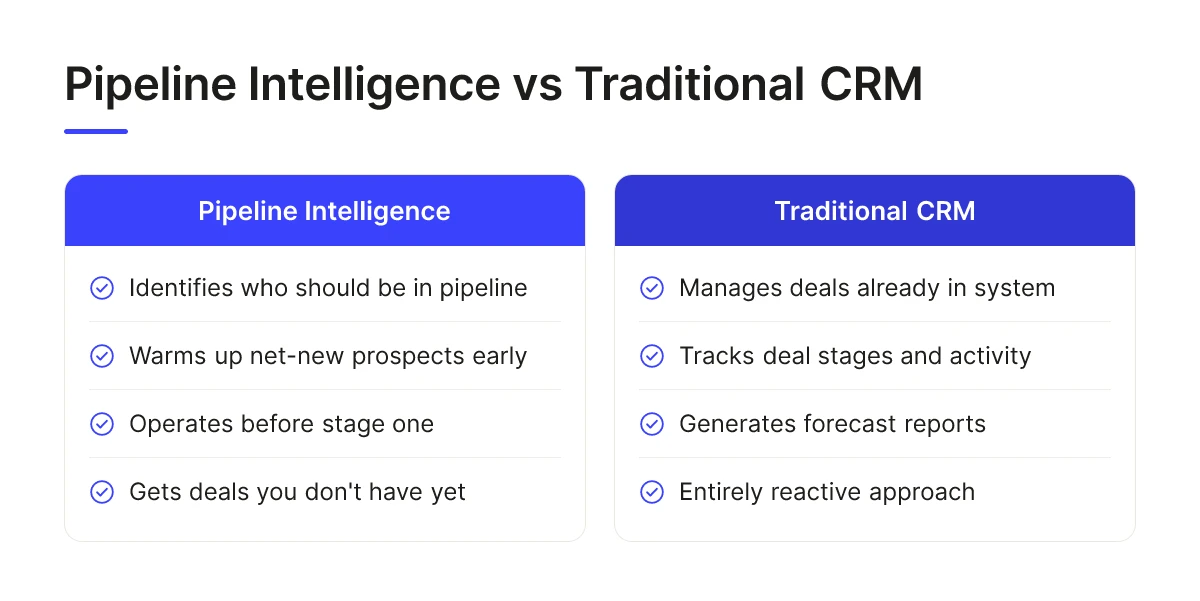
A CRM manages deals you already have; this type of system gets you deals you don’t have yet, by warming up net-new prospects before they hit stage one.
The name confusion is real and worth clearing up immediately. Plenty of software calls itself “pipeline” something whilst doing nothing more than tracking deal stages, logging activity, and generating forecast reports on contacts already in the system. That’s system-of-record work, valuable, but entirely reactive. A true intelligence layer operates one stage earlier: it identifies who should be in your pipeline at all, then does the work of getting them to say yes to a conversation before a rep ever opens a sequence tool.
That earlier stage exists because the old one stopped working. Inbox providers have tightened spam filtering year over year, and call-screening apps now flag unknown numbers by default, which is why cold email and cold call reply rates have fallen into single digits across most B2B sectors. Sales teams didn’t abandon cold outreach because they got lazy, they abandoned it because the maths stopped working. That collapse is precisely what pushed intent-based, warm-introduction approaches from nice-to-have into necessity.
What Buyers and Market Segments Do Pipeline Intelligence Platforms Reach That LinkedIn and Traditional Tools Miss?
Opted-in networks surface decision-makers who never respond to a LinkedIn connection request or a cold sequence, because those buyers have already agreed to be introduced rather than pitched. Fluum’s approach illustrates the mechanism: it queries signals from 100+ government and private databases to find matching contacts in finance, technology, and manufacturing, then requires double opt-in from both sides before any introduction happens. Nobody on that list is a stranger being interrupted, they’re a match who’s confirmed interest.
How Do Opted-In Networks and Unconventional Channels Change the Sales Prospecting Workflow?
The rep’s job changes shape entirely. Instead of writing sequence copy, testing subject lines, and managing domain deliverability, they receive a pre-qualified, mutually-interested introduction and simply act on it. That’s the difference between hunting and being handed a warm hand-off, Fluum reports 40–50% reply rates from this model, against the roughly 2% now typical for cold email.
None of this replaces the CRM. It remains the system of record for what happens once a qualified conversation starts, stage tracking, forecasting, activity history. This layer’s job is narrower and earlier: get that first qualified conversation started at all.
Which Industries and Use Cases Benefit Most From Pipeline Intelligence Platforms?
Regulated industries and long-cycle, relationship-driven sectors see the biggest gains from this approach, because both suffer worst under cold outreach economics.
How Do Fintech, Cybersecurity, Manufacturing, and Regulated Industries Use Pipeline Intelligence Differently?
Buyers in fintech, healthcare, and cybersecurity gatekeep harder than almost anyone else in B2B. They’ve been trained by compliance teams and years of vendor spam to treat unsolicited contact as a red flag rather than an opportunity, a cold email from an unknown security vendor often gets forwarded to IT security before it gets a reply. Regulatory exposure raises the stakes on every vendor relationship, so a warm, double opt-in introduction clears a trust barrier that no amount of clever subject-line testing will touch.
Manufacturing and other long-cycle sectors face a different but related problem. Procurement committees, multi-stakeholder sign-off, and capital-intensive purchasing decisions mean the early sales cycle is almost entirely trust-building before any commercial conversation starts. Cold outreach forces a vendor to earn that trust from zero, one unanswered email at a time. A platform that surfaces buying-authority contacts who’ve already agreed to talk skips straight past that early phase [3].
What ROI and Deployment Timelines Should You Expect by Industry Vertical?
Deployment speed tracks directly with how well-defined the target market is. A company with a narrow, specific ideal customer profile, say, mid-market fintechs that recently raised a Series B and hired their first compliance officer, sees usable, relevant introductions faster than a company chasing a vague “enterprise tech” segment with no clear buying trigger. Specificity is what lets the AI matching layer do its job well.
The payback mechanism is straightforward even without invented figures attached to it: fewer wasted discovery calls, because both sides confirmed interest before the meeting existed, and shorter cycles, because the trust-building phase that normally eats weeks has already happened. Consider a hypothetical cybersecurity vendor tracking funding rounds and compliance-hire signals: a newly funded company hiring its first head of compliance is a strong buying-intent signal, and reaching that buyer before competitors even notice the hiring post gives that vendor a real first-mover window [1].
How Do You Evaluate and Implement a Pipeline Intelligence Platform for Your Sales Team?
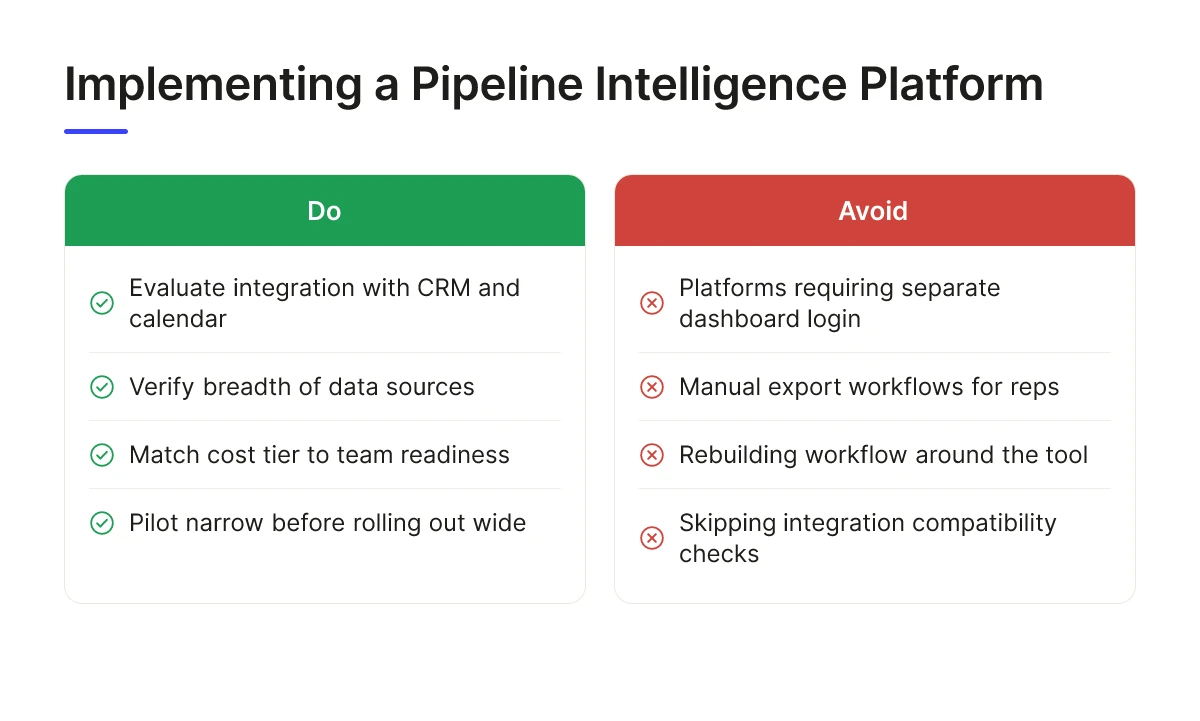
Evaluate a pipeline intelligence platform on three axes: how deeply it integrates with your existing stack, how broad and verified its data sources actually are, and which cost tier matches your team’s readiness, then pilot narrow before rolling out wide.
What Integration Ecosystem Depth and Third-Party Tool Compatibility Should You Prioritize?
Ask a blunt question before any demo ends: does this connect cleanly with your CRM, calendar, and outreach sequencer, or does it demand you rebuild your workflow around it? A platform that requires your reps to log into a separate dashboard, manually export contacts, and re-enter data into Salesforce or HubSpot has already failed the integration test, it’s adding a step, not removing one.
Check calendar sync specifically. Warm introductions only convert to pipeline if a meeting gets booked without five email round-trips, so native calendar scheduling matters more than most vendors admit upfront. Also check whether the platform pushes introduction context, the reason two parties matched, directly into your CRM’s activity log, or whether that context dies in a separate tool your reps forget to check.
Test data portability too. Ask what happens to your matched contacts and introduction history if you switch providers in eighteen months. A platform confident in its own value won’t lock your data behind an export wall.
What Implementation Timeline and Cost-Benefit Metrics Matter Most When Comparing Platforms?
Judge data source breadth by specifics, not marketing copy: ask which government registries and private data categories are actually integrated today, not which ones appear on a roadmap slide. A vendor claiming access to “100+ databases” should be able to name several and explain what signal each contributes, company filings, procurement records, hiring data, rather than gesturing at a big number.
Pricing generally splits into three practical tiers:
- Budget-friendly: typically caps seat count and data depth, giving smaller teams enough signal to test the model without enterprise commitment.
- Mid-range: usually adds broader database access and more matched introductions per month.
- Premium/enterprise: adds dedicated support, custom ICP configuration, and deeper data categories, the layer that matters most for regulated industries like fintech or manufacturing, where buyer verification carries more weight [3].
Implementation typically runs in phases rather than a single switch-flip:
- Connecting your CRM and calendar and configuring your ideal customer profile.
- A calibration period where the platform’s matching improves as it learns which introductions your team actually books.
- A stretch where the first double opt-in introductions start landing.
- Scaling once conversion patterns hold steady.
Pilot with one narrow ICP segment, a single vertical, region, or deal size, before expanding company-wide. Validating signal quality against a small, well-defined segment tells you fast whether the match quality holds, without betting your whole quarter’s pipeline on an unproven channel.
Frequently Asked Questions
Is a pipeline intelligence platform the same as a CRM?
No, a CRM stores and manages contact records you already have, whilst a pipeline intelligence platform finds and qualifies new prospects before they ever enter your CRM. Think of the CRM as the filing cabinet and the intelligence layer as the scout that decides what’s worth filing. Most teams run both, feeding matched, warm contacts from the intelligence layer into Salesforce or HubSpot for tracking.
Can a pipeline intelligence platform replace cold outreach entirely?
For most B2B teams, yes, that’s the point, not just an efficiency upgrade. Fluum, for instance, is built to replace cold email and LinkedIn sequencing with double opt-in introductions targeting 40–50% reply rates, versus the roughly 2% cold outreach delivers today. Some founder-led networking may still happen in parallel, but it no longer needs to carry the pipeline.
How is buying intent actually detected before a prospect fills out a form?
Intent is inferred from signals scattered across public and private data sources, not from a form fill at all. That includes hiring patterns, funding events, regulatory filings, procurement activity, and technology adoption signals pulled from government and private databases [1]. Fluum, for example, queries over 100 such databases to surface decision-makers showing these signals before any outreach begins.
Do smaller sales teams benefit from this approach, or only enterprise teams?
Smaller teams often see the biggest relative gain, because they can’t absorb wasted SDR hours the way enterprise teams can. A Series A to C scaleup with a defined ICP but no inbound engine gets more qualified conversations per rep-hour than from manual list-building or cold sequencing [2], without adding headcount.
What happens after a warm introduction is made, does the platform manage the rest of the deal?
No, the platform’s job ends once both parties have said yes and the introduction is delivered. From there, the conversation, qualification, and deal progression sit with your sales team and your existing CRM, exactly where relationship-building and negotiation belong.
Conclusion
Cold outreach economics won’t recover, reply rates have collapsed, and no amount of better copywriting fixes a channel prospects have learnt to ignore. The fix isn’t more volume; it’s better matching before the first message ever goes out, built on signals from finance, technology, and manufacturing databases rather than a purchased list. Pipeline intelligence, applied through mutual opt-in rather than cold pitching, turns pipeline generation into something repeatable instead of a numbers game.
If your team is missing pipeline targets despite a full sequencing stack, the next step is simple: pick one ICP segment, describe it precisely, and test a warm-introduction approach against your current cold outreach for one quarter.
Sources & References
- Top AI Tools for B2B Buyer Intent Data Enrichment
- 11 Best Sales Prospecting Tools with Records of Success | AiSDR
- PipelineIQ: Forward‑Looking Sales Intelligence That Drives Action | Databricks Blog
- Sales Intelligence Software: Complete Guide
Recommended Articles
Explore more from our content library: