
Understanding Companies House prospecting is essential. Companies House filings work as B2B prospecting signals because every UK limited company must disclose events, new director appointments, confirmed addresses, filed accounts, that often precede a buying decision. A newly appointed finance director, a fresh round of accounts showing headcount growth, or a change of registered office can all indicate a company is expanding, restructuring, or about to invest in new suppliers. Sales teams who monitor these filings can time outreach to moments of real organisational change instead of cold-calling static lists, though the registry gives you the trigger and the entity, not verified emails or phone numbers.
How Can B2B Sales Teams Use Companies House Data for Prospecting?
Companies House gives you entity-level and officer-level facts, company status, SIC code, incorporation date, director names, registered address, never an email address or a phone number. That distinction defines everything about how Companies House prospecting actually works in practice: it tells you who and what, not how to reach them.
The register is a compliance record, not a contact database. Every UK limited company must file it, which is exactly why it’s a strong source of raw entities and account-level change, and exactly why it can’t replace a verified contact list [4]. Treat it as the layer that tells you where to look, then bring in other tools to tell you how to get in touch.
What types of decision-maker information can you extract from Companies House filings?
You get a person’s full legal name, their appointment date, a nationality field, and an occupation field, enough to build a real picture of who sits on the board, not enough to email them directly. Cross-referencing officer records also shows you every other company that same director runs or has run, which is useful for spotting serial founders, group structures, or portfolio patterns worth mapping across a target account [1].
What you don’t get is a verified work email, a direct dial, or a LinkedIn profile URL. Director appointment filings are a strong leadership-change signal, new finance director, new commercial lead, but they stop at identity, not access [1].
How do you build a prospecting strategy around Companies House registry signals?
Start by filtering the register: SIC code narrows the universe to your target sector, incorporation date isolates newer entities that haven’t locked in vendor relationships yet, and company status filters out dormant or dissolved records before they waste a rep’s time [2]. That filtered list becomes your raw target account list, then you layer director names on top for account mapping, matching named officers to the roles your ICP cares about.
Filing data works best as a trigger, not a data point sitting in a spreadsheet. A new director appointment or a fresh set of accounts is a reason to request an introduction, timed, specific, and grounded in something that actually happened at the company, rather than another cold email dropped into an inbox that’s already ignoring two dozen others. Pairing that trigger with a double opt-in motion, where both sides confirm interest before contact, turns a registry filing into a warm conversation instead of one more unsolicited pitch.
None of this replaces verified contact data. Companies House prospecting is one input in a broader stack, it earns you the trigger and the entity, other systems still need to confirm reachability and consent.
A practical Companies House prospecting workflow usually follows this sequence:
- Filter the register by SIC code, incorporation date, and company status to build a raw target list
- Layer director and PSC names onto that list for account mapping
- Flag recent filings (director changes, office moves, size-band shifts) as outreach triggers
- Cross-reference triggers against a verified contact source before sending anything
- Time the message to land within days of the filing, not weeks or months later
What Filing Events Signal Buyer Intent?
Four filing types carry real buyer-intent weight: director and PSC appointments, confirmation statement changes, accounts showing a shifted company size band, and registered office moves. Companies House prospecting works because these events are public, timestamped, and, unlike most intent data, free.
Which specific filing events—director changes, accounts filed, or other triggers—correlate with sales readiness?
A new director or Person with Significant Control (PSC) appointment is the strongest of the four [1]. New leadership almost always means new budget authority, a fresh strategic mandate, or both. It’s not speculation, it’s how organisations actually work: someone hired to change outcomes starts by questioning what’s already in place.
Confirmation statement changes deserve equal attention, particularly a shift in registered SIC code. That’s a company telling the register, formally, that its core business activity has changed, evidence of a pivot that predates any press release or LinkedIn update [1]. Accounts filings that show a jump in the size band (micro to small, small to medium) point to growth that likely means new headcount, new tooling, and new vendor budget. A drop in size band matters too, it flags contraction, consolidation, or a restructuring effort that could mean vendor cuts as easily as new spend. Registered office changes round out the list: a relocation often accompanies expansion, a new lease, or a merger integration, all of which disturb existing supplier relationships [5].
How do you qualify leads based on the timing and type of Companies House filing activity?
Timing turns a filing from trivia into a trigger. A director appointment filed in the last 30 to 90 days is a live signal, that person is still in the phase where they’re auditing vendors and forming opinions. The same appointment from 14 months ago tells you nothing; whatever review happened has already concluded, one way or another.
This is why accounts filings, on their own, are the weakest trigger in the set. UK law allows filing windows stretching several months after the company’s year end, so by the time accounts hit the public register, the size-band change they reveal may be a year old or more [4]. Treat accounts as confirmation of a trend, not as the trigger itself, pair them with a more recent appointment or office-change filing to build a real case for outreach.
Watch for false positives, too. A director resignation isn’t automatically a bad sign, it’s frequently succession planning, and the incoming appointee is the actual signal worth acting on. Read filings as a sequence, not in isolation, and prioritise by recency first, event type second.
How Does Companies House Data Compare to Commercial B2B Databases?
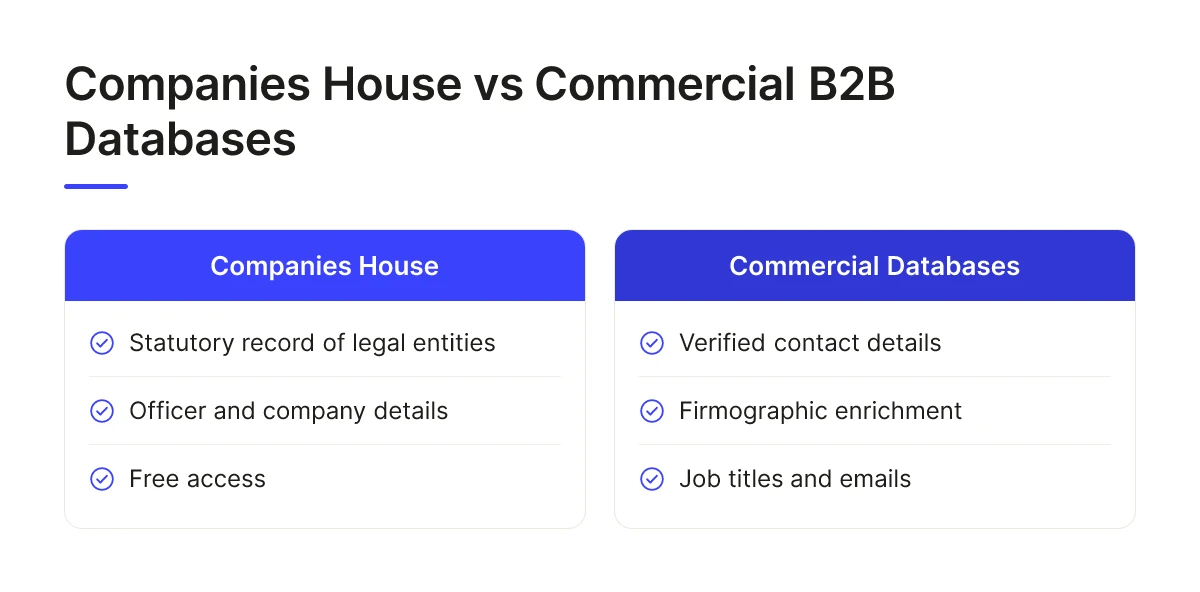
Companies House is a statutory record of legal entities and their officers; commercial B2B databases are built to surface verified contact details and firmographic enrichment on top of that base layer. They answer different questions, one confirms who a company legally is, the other tells you how to reach the person inside it.
That structural difference is the whole story. Companies House exists because UK law requires every limited company to file accounts, confirmation statements, and officer details [4]. Commercial databases exist because sales teams need a working email and a job title, and no government register was ever designed to provide that.
Why would a sales team choose Companies House data over commercial contact databases for certain industries?
Companies House wins on coverage and cost: it holds every UK limited company on record, free of charge, with no licensing restrictions on how you use it [4].
Commercial vendors prioritise companies large enough to justify the enrichment spend, mid-market and enterprise accounts with LinkedIn presence and marketing budgets. Small private companies, newly incorporated entities, and firms in less glamorous sectors like manufacturing or specialist engineering often sit thin or absent in paid databases. Companies House prospecting closes that gap because the register doesn’t discriminate by company size or sector visibility. If your ICP includes SMEs, family-owned manufacturers, or recently incorporated fintechs that haven’t yet built a digital footprint, the register may be the only reliable source that has them at all. It’s also the only place where filing events, a new charge, a director appointment, a change of SIC code, surface as they happen, ahead of any commercial enrichment cycle picking them up [1].
What are the accuracy and coverage gaps when relying solely on Companies House for decision-maker identification?
Officer records lag real organisational authority, and the register has no visibility below director level, which is exactly where most buying decisions get made.
A person listed as director may have stepped back from day-to-day operations years ago, or the actual budget holder for your deal, a Head of Procurement, an IT Director, a VP of Operations, may never appear on the register at all, because only statutory officers are required to file. Companies House also carries no phone numbers, no verified emails, and no job-title search. Commercial databases fill precisely that hole: verified contact data, seniority-level filtering, and intent signals layered from web and technology behaviour that the register was never built to capture.
The realistic pattern is sequencing, not substitution. Use the register to identify trigger events and qualify entities, then move to a commercial data source or direct verification to find and reach the actual buyer, rather than expecting one source to do both jobs.
Which Company Characteristics and SIC Codes Convert Best?
The highest-converting segment combines a relevant SIC code, a mid-range accounts band, and a stable filing history, not the entire register scanned indiscriminately. Effective Companies House prospecting means narrowing 5+ million registered companies down to the few thousand that actually match your offer and your buying window.
Are there industry-specific prospecting strategies that work better with Companies House signals?
SIC codes group companies by declared business activity, and they’re the fastest way to cut an unmanageable register down to a working list. A cybersecurity vendor filtering for codes tied to IT consultancy or software publishing will surface a fraction of the total register, the fraction actually likely to buy.
Sector shapes what a useful signal even looks like. Professional services and technology SIC codes tend to show more frequent director appointment and resignation filings, reflecting faster hiring cycles and leadership churn typical of growth-stage firms. Asset-heavy sectors, manufacturing, logistics, construction, show far more stable officer records over multi-year periods, so a single director change there carries more weight and deserves a closer look before you draft outreach.
How do you filter by company size, sector, or filing patterns to focus on high-intent targets?
Accounts band is a reliable proxy for budget and buying complexity. Micro and small companies file abbreviated accounts and typically make purchasing decisions with one or two people in the room, which means shorter sales cycles. Medium and large companies file fuller statutory accounts and involve procurement, finance, and often a board, more stakeholders, longer cycles, bigger contract values once you’re in.
Filing pattern itself is a signal, separate from what’s actually being filed. A company that submits its confirmation statement and accounts on time, year after year, signals operational stability, a low-drama account that’s easy to sell into on a predictable timeline. A company with a late filing, followed by two officer changes in a short window, is showing disruption worth understanding before you reach out, it might mean a restructuring, a departure, or a new decision-maker actively reassessing vendors.
When prioritising a Companies House prospecting shortlist, the strongest combination of signals typically includes:
- A SIC code that matches your ICP’s sector
- A recent size-band change in the accounts (growth or contraction)
- A director or PSC appointment filed within the last 90 days
- A consistent, on-time filing history with no unexplained gaps
- A registered office move that coincides with other change signals
One caveat worth stating plainly: SIC codes are self-declared at incorporation and rarely updated as a business evolves [1]. A company might file under a legacy code years after pivoting its actual activity. Treat SIC filtering as a coarse first pass that narrows the field, then verify sector fit through other signals before you invest outreach effort.
How Fresh Is Companies House Data for Outreach Timing?
Filing lag ranges from near-instant to several months, and the whole discipline of Companies House prospecting depends on knowing which is which before you act on a signal.
Every filing starts as a document submitted by the company, its accountant, or a formation agent. It only becomes visible to you once Companies House processes and publishes it on the register. That processing step is where the delay lives, and it isn’t uniform, a director appointment and a set of annual accounts move through completely different timelines even though they sit on the same register.
What is the typical lag between a company filing and when that signal becomes reliable for prospecting?
Director appointments and confirmation statements tend to appear quickly, often within days of submission, because they’re short, structured forms with little for the registrar to query. Annual accounts are a different story: a company prepares them after its financial year ends, then has months to actually file them, so the numbers you’re reading can describe a period that closed six to nine months earlier. Companies House has spent the last decade pushing toward faster, more digital-first processing of the register [4], and reforms tied to its expanded role are tightening filing standards further [5]. Neither change erases the structural gap between fast operational filings and slow financial ones.
How should sales teams account for data freshness when timing outreach around Companies House events?
Split your triggers by type rather than treating the register as one uniform feed. A new director or a share issuance is a live event, the kind of regulatory filing signal worth acting on within days, because it points to a leadership change or financing activity happening right now [1]. Annual accounts, by contrast, belong in account scoring and background research, not as the reason you send an email this week, the underlying reality they describe is already old news.
Speed matters because fresh signals are, briefly, uncontested. Businesses at their most receptive moment attract the least competitive noise precisely because most sellers haven’t spotted the trigger yet [2]. Move too fast, though, and a message that lands hours after a director appointment reads as surveillance rather than relevance, give it a day or two so the context feels observed, not scraped.
None of this works from occasional manual lookups. Set a recurring monitoring cadence, daily or weekly register checks or filing alerts against your target accounts, so freshness gets captured systematically instead of whenever someone remembers to look. Consistent monitoring is what separates a one-off Companies House prospecting experiment from a repeatable pipeline source.
Frequently Asked Questions
Can you automate monitoring of Companies House filings for sales alerts?
Yes, through the Companies House API or third-party monitoring tools that poll the register and push notifications when target accounts file documents. Most sales teams set alerts for director appointments, confirmation statements, and charges against companies on their target account list. The API is free [4], but you’ll need engineering time or a paid monitoring layer to turn raw filings into a usable alert feed rather than a data dump.
Is Companies House data free to use for prospecting?
Yes, all core company data has been free to access since Companies House launched its open data service a decade ago [4]. That covers filing history, director details, and registered addresses. Turning that raw register data into prioritised, decision-maker-ready prospecting signals still takes tooling or manual effort.
Do sole traders and partnerships appear on Companies House?
No, Companies House only holds records for incorporated entities such as limited companies and LLPs. Sole traders and ordinary partnerships never file with the registrar, so they’re invisible to any filing-based prospecting approach. If your ICP includes unincorporated businesses, you’ll need a different signal source alongside the register.
How do you find a company’s registered contact address on Companies House?
Search the company name on the Find and Update Company Information service and open its overview page for the registered office address. That address is a legal filing address, not necessarily where the business operates or where its sales team sits, treat it as a starting point for verification, not a direct mail target.
What tools help teams scale Companies House prospecting beyond manual searches?
Teams outgrow manual lookups once they’re tracking more than a handful of target accounts. The Companies House API, third-party filing-alert platforms, and CRM integrations that ingest register data all reduce the manual burden. The right choice depends on engineering capacity: API access needs development resources, while packaged monitoring tools trade some flexibility for a faster setup and require less ongoing maintenance to keep Companies House prospecting running as a repeatable process.
Conclusion
Companies House data rewards sales teams willing to treat filings as timing signals, not just compliance records. A director appointment, a fresh charge, or a confirmation statement flags a company in motion, and motion is what makes an introduction land instead of getting ignored. The register is free and public [4], but raw filings only become pipeline once someone matches them to the right decision-maker and the right moment.
That matching work is where most teams stall. Pick one filing type, director appointments are the easiest starting point, and track it against your target account list for the next 30 days before deciding whether to build or buy the monitoring layer.
Sources & References
- Regulatory Filing, B2B Buying Signal Guide | Axidex
- Business Filing Data for B2B Lead Generation: Build a System That Finds Buyers First | NewFilingAlerts
- Companies House celebrates 10 years of open data – GOV.UK
- Recent changes to the role of Companies House – what’s new?
Recommended Articles
Explore more from our content library: