
| Key Insight | Explanation |
|---|---|
| What it is | Private data vendor aggregation combines signals from multiple proprietary and government data sources into a single, enriched intelligence layer — going far beyond what any single database can deliver. |
| Why it beats cold outreach | Aggregated signals surface buyers who are invisible to standard prospecting tools, enabling warm introductions that convert at 40–50% versus the 2% industry average for cold email. |
| Data depth matters | Platforms pulling from 40+ private vendors and 8+ government registries (Companies House, FCA, SEC EDGAR, SIRENE) uncover decision-makers that LinkedIn and Apollo simply don’t index. |
| Compliance is non-negotiable | GDPR, CCPA, and sector-specific regulations govern how aggregated private data may be processed and shared — particularly in fintech, cybersecurity, and regulated manufacturing. |
| AI unlocks the value | Raw aggregated data is noise without AI scoring. Intent signal analysis, buyer graph construction, and decision-maker path mapping transform vendor data into actionable pipeline intelligence. |
| The double opt-in advantage | Warm introductions built on aggregated intelligence — where both parties confirm mutual interest — produce dramatically higher conversion than any cold outreach sequence. |
Private data vendor aggregation is the process of combining proprietary datasets from multiple third-party commercial providers — alongside government registries and alternative data sources — into a unified intelligence layer that reveals buyer intent, organizational structure, and decision-maker identity at a depth no single source can match. It’s the foundational architecture behind the most effective B2B pipeline tools operating in 2026. Sales and revenue operations teams that understand how aggregation works — and which vendors actually deliver signal versus noise — consistently outperform those relying on a single database or cold outreach alone. This guide covers what private data vendor aggregation is, how it works mechanically, its real-world benefits, the pitfalls that trip up most teams, and the best practices that separate high-performing pipeline programs from expensive experiments.

What Is Private Data Vendor Aggregation?
Private data vendor aggregation is the systematic collection, normalization, and unification of datasets purchased or licensed from multiple proprietary commercial vendors, combined with structured government registry data, to produce enriched intelligence that no single source can provide alone. It differs from simple list purchasing because the value comes from the synthesis — cross-referencing signals across sources to surface patterns, relationships, and intent that are invisible in any individual dataset [1].
Defining the Core Components
Three distinct data layers make up a well-built aggregation stack:
- Private commercial vendor data: Datasets licensed from specialized providers covering firmographics (company size, revenue, industry classification), technographics (software and infrastructure signals), intent data (content consumption patterns), and contact-level information for decision-makers.
- Government registry data: Structured records from official sources such as Companies House (UK), the FCA Register, SEC EDGAR (US), and France’s SIRENE directory. These registries provide verified corporate identity, directorship records, regulatory filings, and financial disclosures that commercial vendors often miss or misattribute [2].
- Alternative and opted-in network data: Signals from opted-in professional networks, industry associations, and proprietary relationship graphs that index buyers unreachable through standard prospecting channels.
According to LexisNexis, data aggregators collect information from public records, commercial databases, web sources, and surveys, then consolidate it into structured formats that power downstream analytics [3]. In B2B sales intelligence, this consolidation is what separates a warm, context-rich buyer profile from a cold name-and-email entry on a scraped list.
Why It Matters in Regulated and Complex Markets
Standard prospecting tools index the visible internet and a handful of professional networks. That’s fine for reaching generalist buyers. It’s inadequate for regulated industries like fintech, cybersecurity, and advanced manufacturing, where decision-makers often don’t maintain public LinkedIn profiles, where procurement authority is distributed across multiple roles, and where regulatory status (FCA authorization, SEC registration) is a meaningful buying signal.
Private data vendor aggregation fills that gap. Platforms built on 40+ private vendors and 8 government registries can surface the CFO of a Series B payments firm who hasn’t updated their LinkedIn in two years but whose company just filed a new FCA license amendment — a clear intent signal that cold outreach tools will never see.
Pro Tip: When evaluating a data aggregation vendor, ask specifically which government registries they ingest — not just which commercial providers. Government registry coverage (Companies House, SEC EDGAR, SIRENE) is a reliable indicator of data depth in regulated markets where your highest-value buyers actually operate.
How Private Data Vendor Aggregation Works
Private data vendor aggregation works by ingesting raw datasets from multiple sources, normalizing them to a common schema, resolving entity conflicts across sources, and applying AI scoring to surface the signals most relevant to a specific buyer profile or sales motion.
The Aggregation Pipeline: Step by Step
- Data ingestion: Raw feeds arrive from commercial vendors (firmographic, technographic, intent), government registries (corporate filings, regulatory records), and opted-in network sources. Ingestion frequency varies — some signals update in near-real-time, others refresh quarterly [4].
- Normalization and schema mapping: Each vendor uses different field names, taxonomies, and identifier formats. Normalization maps all inputs to a consistent internal schema so that “company size” from Vendor A and “employee count” from Vendor B refer to the same entity attribute.
- Entity resolution: The same company may appear as “Acme Corp,” “Acme Corporation Ltd,” and “ACME CORP” across different sources. Entity resolution (also called record linkage or deduplication) uses probabilistic matching algorithms to merge these into a single canonical record. This is technically the hardest step and where most DIY aggregation projects fail.
- Signal enrichment and cross-referencing: Once entities are resolved, signals from different sources are layered onto each record. A company’s SEC filing activity, its technographic stack, and its employees’ recent content consumption patterns are all attributed to the same canonical entity.
- AI scoring and intent modeling: Machine learning models score each enriched record against a defined ideal customer profile (ICP). Intent signals — regulatory filings, hiring patterns, technology adoption events — are weighted to produce a ranked list of accounts most likely to be in an active buying motion [5].
- Decision-maker path mapping: The system identifies not just target companies but the specific individuals with buying authority, maps their reporting relationships, and surfaces the warmest introduction path based on network proximity and mutual connections.
- Output delivery: Enriched, scored, and ranked buyer profiles are surfaced to sales teams or fed directly into a warm introduction workflow where both parties confirm mutual interest before any connection is made.
According to Splunk’s data aggregation reference, the core value of aggregation lies in combining large volumes of granular data from multiple sources into a unified body that enables pattern recognition impossible at the individual source level [6].
How This Differs from ETL and Simple Data Pipelines
A common misconception is that private data vendor aggregation is just ETL (Extract, Transform, Load) with more sources. ETL is a component of aggregation, but aggregation goes further. ETL moves data from point A to point B with transformation applied. Aggregation adds entity resolution, cross-source signal fusion, and AI-driven scoring on top of the ETL layer — producing intelligence rather than just consolidated data.
The IETF’s Distributed Aggregation Protocol (DAP) for privacy-preserving measurement illustrates how even at the protocol level, aggregation architectures require multi-party coordination and sophisticated handling that simple ETL pipelines don’t address [7].

Key Benefits of Private Data Vendor Aggregation for B2B Pipeline
Private data vendor aggregation delivers measurably deeper buyer intelligence, surfaces decision-makers invisible to standard tools, and enables warm introductions that convert at 20–25x the rate of cold outreach.
Pipeline Intelligence Advantages
- Access to buyers that standard tools don’t index: LinkedIn and conventional prospecting databases cover the visible, self-reported professional internet. Private data aggregation — particularly when it includes government registries — surfaces buyers in regulated industries who maintain minimal public profiles but leave rich data trails in official filings and commercial records.
- Intent signal accuracy: Cross-referencing intent signals across multiple vendors dramatically reduces false positives. A single vendor showing “high intent” based on content consumption is weak signal. The same company showing hiring patterns for a specific role, a recent regulatory filing, and technographic adoption of a complementary tool — all triangulated from independent sources — is strong signal [8].
- Decision-maker identification at depth: Aggregated data maps organizational hierarchies, identifies actual budget holders (not just job-title proxies), and surfaces secondary decision-makers and influencers that single-source databases miss entirely.
- Warm introduction conversion rates: When aggregated intelligence is used to power double opt-in introductions — where both buyer and seller confirm mutual interest before any message is exchanged — reply rates reach 40–50%. Cold email averages 2%. That’s not a marginal improvement. It’s a structural difference in how pipeline is built.
- Reduced prospecting waste: SDRs at companies using aggregated intelligence spend significantly less time on contacts who were never real prospects. The enriched, scored output means reps engage with accounts that match the ICP and show active buying signals — not just accounts that match a demographic filter.
Competitive and Strategic Advantages
| Capability | Single-Source Database | Private Data Vendor Aggregation |
|---|---|---|
| Buyer coverage in regulated industries | Limited — misses government registry data | Comprehensive — includes Companies House, FCA, SEC EDGAR, SIRENE |
| Intent signal confidence | Single-source, high false-positive rate | Multi-source triangulation, significantly higher accuracy |
| Decision-maker depth | Job title and email only | Organizational hierarchy, buying authority, introduction path |
| Outreach conversion rate | ~2% (cold email industry average) | 40–50% (warm double opt-in introductions) |
| Data freshness | Static snapshots, often 6–18 months stale | Multi-vendor refresh cycles, near-real-time for key signals |
| Compliance posture | Variable — depends on single vendor’s practices | Requires formal vendor governance framework; more defensible when done correctly |
Research from SentinelOne’s data aggregation analysis confirms that aggregated datasets consistently outperform single-source data for pattern recognition and anomaly detection — a principle that applies equally to cybersecurity threat intelligence and B2B buyer intent modeling [8].
At Fluum, we’ve found that the teams generating the most qualified pipeline aren’t those with the biggest prospecting budgets — they’re the ones whose data layer surfaces the right buyers at the right moment, with enough context to make the introduction genuinely relevant to both sides.
For enterprise teams in sectors like bamboo-based materials and sustainable manufacturing, platforms that aggregate across niche industry registries alongside mainstream commercial vendors — similar to how France Bamboo connects specialized industry stakeholders — illustrate why sector-specific data coverage matters as much as raw database size.
Common Challenges and Mistakes to Avoid
The most common failure in private data vendor aggregation is treating it as a one-time data purchase rather than an ongoing intelligence infrastructure — leading to stale signals, compliance exposure, and pipeline built on faulty buyer profiles.
Technical and Operational Pitfalls
- Entity resolution failures: Without robust deduplication, the same company appears as multiple records with conflicting attributes. Sales reps end up with contradictory information about the same prospect, and intent scores become meaningless. This is the most technically demanding step and the most frequently underinvested.
- Vendor overlap without differentiation: Buying data from five vendors that all pull from the same underlying sources (often a small set of upstream data brokers) doesn’t multiply signal quality — it multiplies cost while adding noise. Genuine aggregation value requires vendors with meaningfully different data collection methodologies and source networks.
- Ignoring data decay rates: Contact-level data decays at approximately 25–30% annually as people change roles, companies restructure, and email addresses change. Teams that don’t build refresh cycles into their aggregation architecture are working from increasingly inaccurate intelligence within six months of their last data purchase [9].
- Confusing volume with coverage: A vendor claiming “275 million contacts” isn’t necessarily covering your ICP. Depth in a specific vertical, geography, or regulatory category matters more than headline record counts for most B2B sales motions.
Compliance and Legal Risks
The regulatory environment around private data aggregation tightened significantly between 2024 and 2026. GDPR Article 5’s data minimization principle, CCPA’s opt-out requirements, and sector-specific rules from the FCA and SEC all constrain how aggregated personal data can be processed and used for commercial outreach.
FINRA’s guidance on data aggregation risks explicitly warns that sharing financial information with data aggregators creates downstream liability if those aggregators share data with service providers beyond the original disclosed purpose [2]. The same principle applies to B2B data: if your aggregation vendor’s terms allow onward sharing or resale, your compliance posture inherits their risk.
The OCC’s guidance on account aggregation services — while originally written for banks — established a risk framework that remains instructive: any aggregation arrangement requires clear data ownership terms, security controls, and defined limits on data use [10].
A common mistake we see in practice: teams sign broad data aggregation terms with vendors without reading the sub-processor clauses. Those clauses often permit the vendor to aggregate your usage data and your customers’ data for their own model training — which creates GDPR exposure that the procurement team never intended to accept.
Pro Tip: Before signing any private data vendor agreement, require a full sub-processor list and confirm that the vendor’s data collection methodology for each source is documented and legally defensible in every jurisdiction where your buyers are located. GDPR Article 28 makes this a legal requirement for EU-based processing, but it’s good practice everywhere.
Best Practices for 2026: Getting the Most from Aggregated Data
The highest-performing B2B pipeline programs in 2026 treat private data vendor aggregation as a strategic infrastructure investment — not a commodity data purchase — and govern it with the same rigor they apply to their CRM or security stack.
Building a Defensible Aggregation Stack
- Define your ICP before selecting vendors: Vendor selection should be driven by ICP coverage, not database size. If your buyers are FCA-regulated fintech CFOs in the UK, you need vendors with strong Companies House and FCA Register integration. If they’re manufacturing procurement heads in France, SIRENE coverage is non-negotiable.
- Audit vendor source diversity: Map each vendor’s upstream data sources. Eliminate redundancy. You want vendors that genuinely access different signal pools — not five resellers of the same underlying broker data.
- Implement continuous refresh cycles: Set automated refresh triggers for contact-level data (quarterly minimum), firmographic data (semi-annual), and intent signals (weekly or real-time where available). Static aggregation is a liability, not an asset.
- Build entity resolution into the architecture from day one: Don’t treat deduplication as a cleanup task. Invest in a canonical entity layer — a master record for each company and contact — that all vendor data maps to. Tools like the data aggregation frameworks described by Xurrent emphasize that normalization and entity resolution are prerequisites for reliable analytics, not optional enhancements [9].
- Score signals, don’t just collect them: Raw aggregated data without an AI scoring layer produces lists, not intelligence. Apply ICP-fit scoring and intent weighting before any data reaches your sales team. The goal is a ranked, prioritized output — not a bigger spreadsheet.
- Govern with a vendor risk framework: Treat each data vendor as a third-party risk. Review their security certifications (SOC 2 Type II minimum), data provenance documentation, and GDPR/CCPA compliance posture annually. Require contractual data deletion on termination.
Connecting Aggregation to Warm Introductions
Aggregated intelligence is most powerful when it feeds a warm introduction workflow rather than a cold outreach sequence. The reason is structural: cold outreach starts from zero credibility every time. Warm introductions built on aggregated buyer intelligence start with context — the right person, the right moment, mutual confirmed interest.
The double opt-in introduction model — where both buyer and seller independently confirm interest before any connection is made — is the mechanism that converts aggregated intelligence into actual pipeline. According to Duality Technologies’ analysis of financial data aggregation, privacy-preserving approaches that maintain data utility while respecting individual consent are increasingly the standard that enterprise buyers expect from their technology partners [5].
Our team at Fluum recommends that sales leaders evaluate their aggregation stack not by the number of records it delivers, but by the conversion rate of the introductions it enables. If your data is rich enough to support a genuinely contextual, mutually relevant introduction, the conversion math changes completely.
Pro Tip: If you’re a senior leader or C-suite executive reading this, tell Aurora at Fluum who you are and who you’re looking to meet next. The platform will send you only what’s relevant — no noise, no cold sequences, just warm introductions matched to your actual priorities.

Sources & References
- PrivacyEngine, “What is Data Aggregation?”, 2024
- FINRA, “Know Before You Share: Be Mindful of Data Aggregation Risks”, 2023
- LexisNexis, “Data Aggregator: What You Need to Know”, 2024
- FactSet, “Private Capital Data Aggregation Service”, 2024
- Duality Technologies, “Future of Financial Data Aggregation: Innovation Meets Privacy”, 2024
- Splunk, “Data Aggregation: How It Works”, 2024
- IETF, “Distributed Aggregation Protocol for Privacy Preserving Measurement”, 2023
- SentinelOne, “What is Data Aggregation? Types, Benefits, & Challenges”, 2024
- Xurrent, “Data Aggregation: The Complete Guide”, 2024
- OCC, “Bank-Provided Account Aggregation Services: Guidance to Banks”, 2001
Frequently Asked Questions
1. What is a personal data aggregator?
A personal data aggregator is a company or platform that collects individual-level data from multiple independent sources — including public records, commercial databases, government registries, and web-sourced information — and consolidates it into unified profiles. Unlike simple list brokers, aggregators perform entity resolution and cross-source enrichment, producing records that are significantly more detailed than any single source could provide. In B2B contexts, the practice applies this same principle to organizational and decision-maker profiles for sales intelligence purposes.
2. Should you enable data aggregation for your sales program?
Yes — with the right governance in place. Data aggregation dramatically improves pipeline quality by surfacing buyers with verified intent signals across multiple independent data sources, reducing the false-positive rate that plagues single-source prospecting. The performance case is clear: aggregated intelligence enables warm introductions that convert at 40–50% versus the 2% industry average for cold outreach. The caveat is compliance: you need a formal vendor risk framework, documented data provenance, and GDPR/CCPA-aligned processing agreements before you aggregate at scale. The performance benefits are real, but so is the regulatory exposure if aggregation is done carelessly.
3. Is data aggregation the same as ETL?
No — ETL (Extract, Transform, Load) is a component of data aggregation, but the two aren’t equivalent. ETL describes the mechanical process of moving and transforming data between systems. this practice encompasses ETL plus entity resolution (deduplication and record linkage across sources), cross-source signal fusion, and AI-driven scoring to produce intelligence rather than just consolidated records. You can run ETL without aggregating meaningfully; you can’t aggregate effectively without ETL as a foundation. The distinction matters because teams that treat aggregation as “just ETL with more sources” consistently underinvest in entity resolution and end up with conflicting, unreliable buyer data.
4. What are some examples of data aggregation in B2B sales?
Concrete examples of this method in B2B sales intelligence include: combining FCA Register filings with firmographic data to identify fintech companies that recently received new regulatory authorizations (a strong buying signal for compliance technology vendors); cross-referencing SEC EDGAR filings with technographic data to surface public companies adopting new financial infrastructure (a signal for fintech solution providers); and triangulating hiring patterns, intent data from content consumption, and Companies House director records to identify the specific individual with budget authority at a target account. Each of these examples combines at least two independent data sources to produce a signal that neither source could generate alone.
5. How many private data vendors do you actually need?
The right number depends on your ICP, not on a universal benchmark. A focused aggregation stack of four to six vendors with genuinely differentiated source networks will outperform a bloated stack of fifteen vendors that largely overlap. The key evaluation criterion is source diversity: each vendor should access meaningfully different data collection channels. For regulated industry buyers, government registry integration (Companies House, FCA, SEC EDGAR, SIRENE) is non-negotiable and should be treated as a separate layer from commercial vendor data, given its verification quality and legal standing.
6. What’s the difference between private data vendor aggregation and a data broker?
A data broker sells access to a pre-built database — typically a static snapshot of records collected and packaged for resale. this strategy is an active, ongoing process of combining signals from multiple vendors (which may include data brokers as upstream sources) to produce enriched, scored intelligence that no single broker delivers. The aggregation layer adds entity resolution, cross-source signal fusion, AI scoring, and continuous refresh — transforming raw broker data into actionable pipeline intelligence. Buying from a data broker gives you a list. Building an aggregation stack gives you a buyer graph.
Conclusion
this approach is the infrastructure that separates modern B2B pipeline programs from teams still buying static lists and hoping cold outreach math eventually works out. The core principle is simple: no single data source sees the full picture of a buyer’s intent, authority, and timing. Combining signals from 40+ private vendors and 8 government registries — with proper entity resolution, AI scoring, and continuous refresh — produces buyer intelligence that cold outreach tools simply can’t replicate.
The practical payoff is measurable. Aggregated intelligence feeds warm introductions that convert at 40–50%. Cold email converts at 2%. That gap isn’t a feature difference. It’s a structural argument for rebuilding how pipeline gets created.
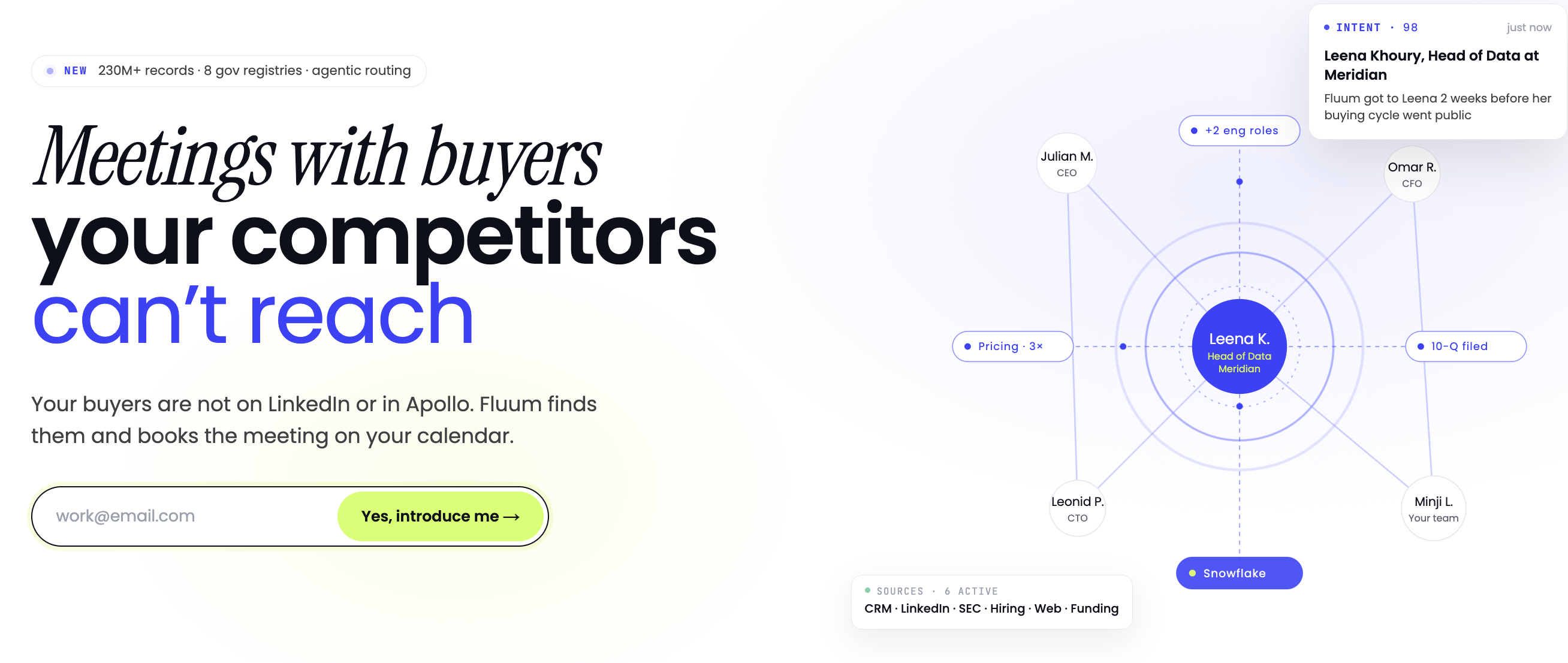
Fluum is built on exactly this architecture — pulling from 40+ private data vendors and 8 government registries, including Companies House, the FCA Register, SEC EDGAR, and SIRENE, to surface buyers that standard prospecting tools don’t index. The platform then uses AI agents to score intent signals and facilitate double opt-in introductions where both sides confirm mutual interest before any connection is made. If you’re a senior leader or C-suite executive, tell Aurora at Fluum who you are and who you’re looking to meet next — and we’ll make sure you only receive what’s actually relevant to your pipeline.
Recommended Articles
Explore more from our content library: