

Let’s learn the role of ai in business networking. Most American freelance marketers spend over half their time chasing leads that go nowhere. Knowing how to build genuine business relationships is more important than ever, especially as competition heats up around the world. Artificial Intelligence is changing the game by making strategic introductions to high-intent clients possible without cold outreach. This guide shows how to use AI tools for smarter networking, opening new doors to meaningful connections and real opportunities—all while saving valuable time.
Table of Contents
- Understanding AI’s Role in Modern Networking
- Types of AI Tools for Warm Introductions
- How AI Surfaces High-Intent Business Leads
- Real-World Use Cases for Freelancers
- Risks, Ethics, and Trust in AI Networking
Key Takeaways
| Point | Details |
|---|---|
| AI Transforms Networking | Artificial Intelligence enhances networking by automating connection management and analyzing relationship data for smarter engagement. |
| Tool Categories Matter | Various AI tools, like Recommendation Engines and Social Intelligence Platforms, can significantly amplify networking efficiency and uncover hidden opportunities. |
| High-Intent Leads Identification | AI empowers businesses to surface high-quality leads by analyzing behavioral intent, focusing on meaningful engagement rather than quantity. |
| Ethical Considerations are Crucial | Professionals should prioritize ethical AI use by regularly auditing tools for bias and ensuring alignment with values of transparency and fairness. |
Understanding AI’s Role in Modern Networking
Artificial Intelligence is fundamentally transforming how professionals build and leverage business networks. By integrating advanced machine learning techniques, AI enables smarter, more strategic connection management that goes far beyond traditional networking approaches. Automated networking technologies are revolutionizing how businesses identify, engage, and nurture professional relationships.
The core power of AI in networking lies in its ability to process massive amounts of relationship data rapidly and intelligently. Unlike manual networking strategies, AI can analyze behavioral signals, professional backgrounds, interaction histories, and contextual cues to recommend high-probability connection opportunities. These intelligent systems use sophisticated algorithms to understand complex social graphs, identifying potential collaboration pathways that human professionals might easily overlook.
Specifically for independent professionals and solopreneurs, AI networking tools provide unprecedented advantages. They can autonomously map professional networks, detect hidden connection opportunities, and even predict potential business interactions based on intricate relationship dynamics. Machine learning advances have transformed networking by enabling nuanced solutions to complex professional engagement challenges, particularly in areas like strategic introductions and opportunity discovery.
Pro tip: Configure your AI networking tools to prioritize warm introductions and shared professional context over pure quantity of connections.
Types of AI Tools for Warm Introductions
Business networking has evolved dramatically with the emergence of sophisticated AI tools designed to transform professional connections. Specialized AI technologies now enable professionals to navigate complex relationship networks with unprecedented precision and strategic insight.
The primary categories of AI networking tools can be classified into several key types. Recommendation Engines analyze professional profiles, interaction histories, and shared connections to suggest potential high-value networking opportunities. Social Intelligence Platforms dive deeper by examining behavioral signals, professional contexts, and latent relationship pathways. Limited memory AI systems underpin these tools, enabling dynamic learning and adaptation based on ongoing interaction data.
For independent professionals, these AI tools offer critical capabilities beyond traditional networking approaches. They can autonomously map professional networks, predict potential collaboration opportunities, and even draft personalized introduction messages that increase the likelihood of meaningful engagement. Advanced tools now integrate natural language processing to understand nuanced professional contexts, making introductions feel more authentic and purposeful.
Pro tip: Select AI networking tools that offer granular customization and prioritize context-aware introductions over volume-based connection strategies.
Here’s a summary comparing key AI networking tool categories and their business impacts:
| Tool Type | Main Function | Business Impact |
|---|---|---|
| Recommendation Engines | Suggest potential connections | Expands high-value network efficiently |
| Social Intelligence | Analyze behaviors and relationship paths | Uncovers hidden opportunities |
| Limited Memory Systems | Learn from ongoing interactions | Adapt connections to changing needs |
| NLP-Enabled Platforms | Draft personalized introductions | Improves engagement quality |
How AI Surfaces High-Intent Business Leads
In the rapidly evolving landscape of professional networking, AI has revolutionized how businesses identify and engage potential high-value clients. Voice analytics technologies now enable unprecedented insights into client intentions by decoding subtle behavioral signals that traditional methods often miss.
AI-powered lead generation goes far beyond simple demographic tracking. Behavioral Intent Mapping uses sophisticated algorithms to analyze complex data points such as online interactions, communication patterns, and contextual engagement signals. Advanced AI marketing techniques enable businesses to segment audiences with remarkable precision, identifying prospects most likely to convert through personalized, context-aware strategies.
For independent professionals, these AI capabilities represent a transformative approach to client acquisition. Intelligent systems can now triangulate multiple data sources – including social media interactions, professional network activities, and historical engagement metrics – to surface leads with genuine interest and alignment. This approach moves beyond volume-based prospecting, focusing instead on identifying high-quality, contextually relevant opportunities that match a professional’s specific expertise and business objectives.
Pro tip: Configure your AI lead generation tools to prioritize qualitative engagement signals over quantitative metrics, focusing on depth of potential client interaction rather than raw contact numbers.
Real-World Use Cases for Freelancers
Freelancer AI adoption reveals a nuanced landscape of technological transformation across professional domains. Independent professionals are rapidly integrating AI tools to enhance productivity, creativity, and service delivery, fundamentally reshaping traditional freelance work models.
The impact of AI varies dramatically across different professional sectors. Research indicates heterogeneous effects where some fields experience significant productivity gains while others face potential disruption. Sector-Specific AI Integration has emerged as a critical strategy for freelancers seeking to maintain competitive advantage. Web developers, for instance, can leverage AI for rapid prototyping and code generation, while translators might use advanced language models to streamline complex translation projects.
Beyond technical applications, AI empowers freelancers to elevate their strategic capabilities. Intelligent tools now assist in critical workflows such as proposal writing, client research, project scoping, and personalized communication. These technologies enable independent professionals to present more sophisticated, data-driven solutions, effectively competing with larger organizations by amplifying individual expertise and efficiency.
Pro tip: Develop a balanced AI integration approach that enhances your unique skills without becoming overly dependent on automated solutions.
This table highlights sector-specific AI adoption examples for freelancers:
| Sector | Typical AI Use Case | Resulting Benefit |
|---|---|---|
| Web Development | AI-assisted prototyping and coding | Faster project turnaround |
| Translation | Advanced language models | Accurate, rapid translations |
| Research | Automated data analysis | Deeper market insights |
| Consulting | Personalized client proposals | Stronger client acquisition |
Risks, Ethics, and Trust in AI Networking
Trustworthy AI principles have become critical in modern professional networking, establishing fundamental guidelines for ethical technology implementation. Independent professionals must navigate a complex landscape where technological innovation intersects with critical human values and professional integrity.
The potential risks in AI networking are multifaceted and require sophisticated understanding. AI network vulnerabilities encompass challenges ranging from privacy breaches to algorithmic bias, necessitating rigorous evaluation of technological tools. Ethical AI Frameworks demand proactive strategies that prioritize transparency, fairness, and individual user protection. Professionals must critically assess AI networking tools, understanding their underlying algorithms and potential unintended consequences.
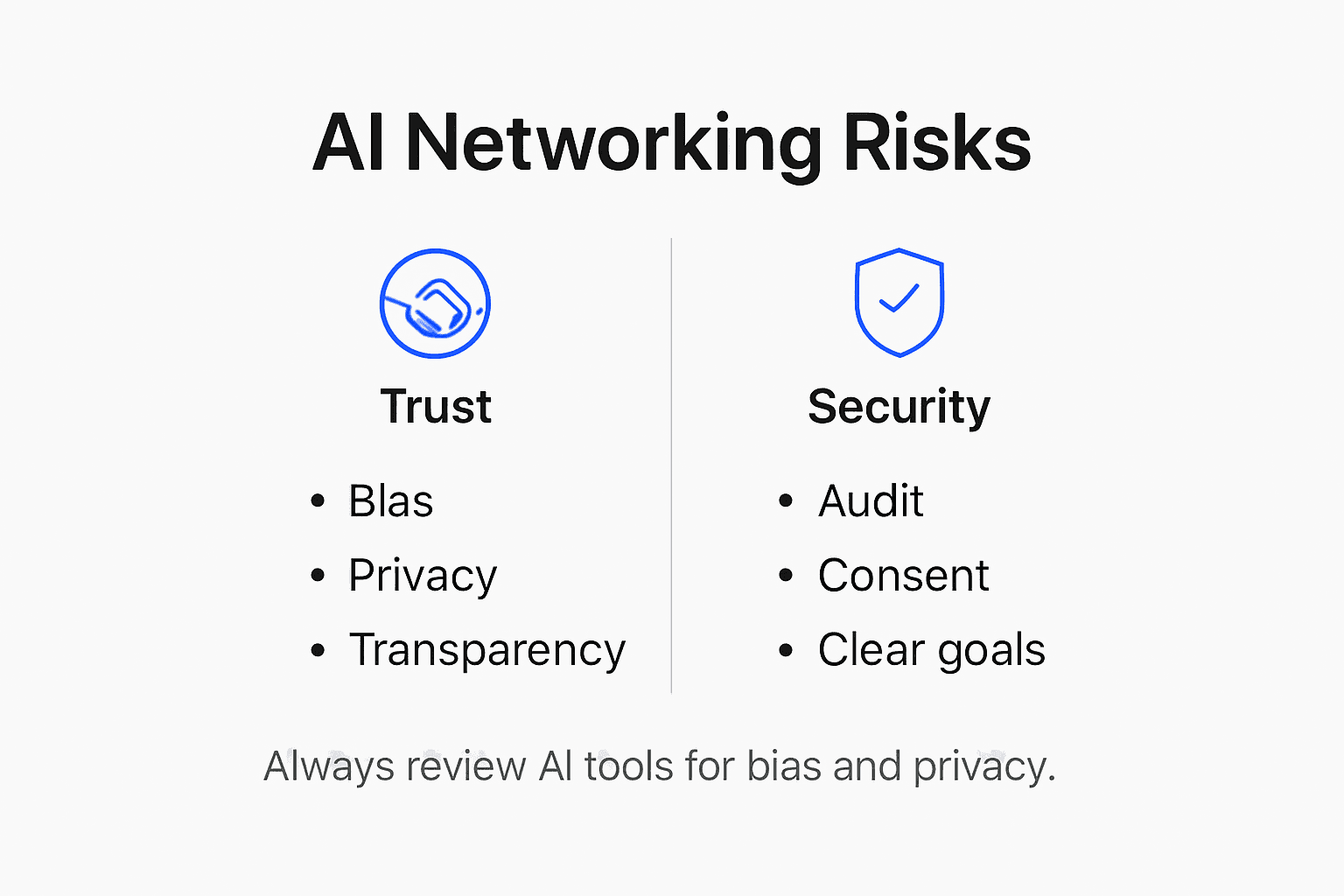
Navigating these ethical considerations requires a nuanced approach. Successful AI networking depends on maintaining a balance between technological efficiency and human judgment. Independent professionals should implement robust verification processes, maintain critical distance from automated recommendations, and continuously educate themselves about emerging ethical standards in AI technology.
Pro tip: Regularly audit your AI networking tools for potential bias, transparency, and alignment with your professional ethical standards.
Transform Your Network Into High-Value Clients with AI
The article highlights the challenge of identifying genuine business opportunities within vast professional networks by leveraging AI tools that analyze social intelligence and behavioral signals. For solopreneurs, freelancers, and independents, manually navigating complex relationship paths to surface warm introductions and high-intent leads can be overwhelming and inefficient.
Fluum directly addresses these pain points by acting as your AI-powered business development engine. It goes beyond simple automation by using advanced AI to detect buying intent and uncover referral paths, delivering personalized warm introductions that feel authentic. Instead of spending countless hours on cold outreach, Fluum empowers you to engage with prospects who are actively seeking your services, increasing your chances of meaningful collaboration and paid gigs.
- Experience intelligent prioritization of connection opportunities based on real client intent
- Automate outreach and follow-ups with seamless group chats after introductions
- Focus more on your craft while Fluum handles business development for you
Ready to convert your network connections into revenue? Take control of your client pipeline today by exploring Fluum’s AI-powered platform.
Don’t wait to unlock hidden opportunities in your network with smarter introductions. Visit Fluum Pricing now to get started and transform your business growth using AI-driven warm introductions and social intelligence.
Frequently Asked Questions
What is the role of AI in business networking?
AI enhances business networking by automating connection management, analyzing relationship data, and identifying high-value connections, making networking more strategic and efficient.
How can AI tools help independent professionals in networking?
AI tools can autonomously map professional networks, predict collaboration opportunities, and draft personalized introductions, enabling independent professionals to engage meaningfully with potential clients.
What types of AI tools are most effective for business networking?
Effective AI tools include recommendation engines that suggest connections, social intelligence platforms that analyze behaviors, and limited memory systems that adapt based on ongoing interactions, enhancing networking efforts.
How do AI capabilities improve client acquisition?
AI improves client acquisition by utilizing behavioral intent mapping to analyze interactions and context, helping businesses identify leads with genuine interest and potential alignment, leading to higher conversion rates.
Recommended
- Role Of AI In Business Coaching: Unlocking Client Growth
- Why Use AI For Client Prospecting Success
- Business Development For Solopreneurs: Turning Connections Into Revenue
- 7 Networking Tips For Solopreneurs To Build Real Connections
- Unlocking Growth: The Strategic Edge of Offering Branded Email Services – Atriomail
- Fluum | Effective Stress Management Techniques for Busy Professionals
- Fluum | How to Onboard Clients Effectively for Lasting Success
- Fluum | Master Managing Multiple Projects for Success
- Fluum | Build Your Brand with a Branding Builder in 2025
- Fluum | 7 Customer Retention Examples to Boost Your Business