

Let’s understand the role of AI co-founder. Most American solopreneur business coaches feel like client prospecting takes up more time than actual coaching. With over 60 percent of solopreneurs prioritizing technology that saves time and finds high-intent leads, staying ahead is no longer optional. Discover how AI is quietly becoming the ultimate partner for coaches who want smart client identification while keeping their main focus where it belongs: helping people grow.
Table of Contents
- Defining The Role Of An AI Co-Founder
- Types And Capabilities Of AI Co-Founders
- How AI Detects And Prioritizes Warm Leads
- Practical Use Cases For Solopreneurs
- Responsibilities, Legal Considerations, And Risks
Key Takeaways
| Point | Details |
|---|---|
| AI Co-Founders Enhance Human Capabilities | AI co-founders serve as cognitive collaborators, amplifying human creativity and providing data-driven insights to support strategic decision-making. |
| Types of AI Co-Founders Offer Diverse Support | Various AI co-founders specialize in areas such as ideation, customer insights, and market optimization, enabling tailored technological support for entrepreneurs. |
| Warm Lead Detection Improves Client Engagement | Advanced AI systems analyze complex datasets to identify and prioritize warm leads, enhancing client acquisition efficiency. |
| Legal and Ethical Responsibilities are Crucial | Entrepreneurs must navigate legal implications and ethical considerations when integrating AI, ensuring transparency and human oversight. |
Defining the Role of an AI Co-Founder
An AI co-founder represents a groundbreaking paradigm in entrepreneurial strategy, transforming how business leaders approach innovation and strategic planning. Unlike traditional software tools, this advanced technological partner acts as a cognitive collaborator that amplifies human capabilities while providing data-driven insights. The role extends far beyond simple automation, positioning itself as a strategic partner capable of generating ideas, analyzing market dynamics, and supporting critical decision-making processes.
At its core, an AI co-founder functions as a tireless virtual team member designed to complement human expertise. The system can rapidly process complex information, conduct comprehensive market research, and generate strategic recommendations that might take human professionals significantly longer to develop. Key capabilities include identifying emerging business opportunities, predicting potential market trends, and providing nuanced insights into customer behavior patterns. Startups can leverage this technology to accelerate innovation and manage growth more efficiently.
However, it is crucial to understand that an AI co-founder is not intended to replace human creativity or emotional intelligence. Instead, the most effective implementations create a symbiotic relationship where artificial intelligence enhances human judgment, providing data-driven support while allowing entrepreneurs to maintain strategic control. The AI serves as an analytical powerhouse, processing vast amounts of information and generating actionable insights, but ultimate decision-making remains a distinctly human domain.
Pro tip: When integrating an AI co-founder, establish clear boundaries and protocols to ensure the technology remains a supportive tool rather than an autonomous decision-maker.
Types and Capabilities of AI Co-Founders
AI co-founders represent a sophisticated spectrum of technological capabilities designed to support entrepreneurial endeavors across multiple dimensions. These systems exhibit diverse functionalities ranging from basic automation to advanced cognitive collaboration, each tailored to address specific business challenges. Understanding the nuanced types of AI co-founders becomes crucial for entrepreneurs seeking targeted technological support.
The primary categories of AI co-founders can be distinguished by their core operational strengths. Some specialize in product ideation, rapidly generating innovative concepts and market-responsive designs. Others focus on customer insights, analyzing behavioral patterns and predicting consumer trends with remarkable precision. Marketing optimization AI co-founders excel at developing targeted strategies, segmenting audiences, and recommending communication approaches that maximize engagement. Entrepreneurs can leverage specialized AI business assistants to accelerate growth and strategic planning.
Despite their impressive capabilities, AI co-founders are not autonomous decision-makers but strategic partners. Their primary value lies in processing vast amounts of data, identifying patterns humans might overlook, and presenting actionable recommendations. Critically, these systems complement human intuition rather than replace it. They provide analytical depth, speed, and scalability while relying on human judgment for ethical considerations, emotional intelligence, and nuanced strategic thinking. The most effective implementations view AI as an extension of human capability, creating a symbiotic relationship that amplifies entrepreneurial potential.
Pro tip: When selecting an AI co-founder, prioritize systems that offer transparent decision-making processes and seamlessly integrate with your existing workflow.
Here’s a comparison of key types of AI co-founders and their primary business impacts:
| Type of AI Co-Founder | Main Capability | Example Use Case | Business Impact |
|---|---|---|---|
| Ideation Partner | Rapid concept generation | Designing new product features | Speeds innovation cycles |
| Customer Insights Expert | Predicting consumer behaviors | Segmenting target audiences | Increases marketing precision |
| Market Optimizer | Strategy and trend analysis | Identifying emerging market gaps | Enhances competitive response |
| Content Strategist | Generating creative materials | Automating social media posts | Boosts engagement efficiency |
How AI Detects and Prioritizes Warm Leads
Warm lead detection represents a sophisticated technological breakthrough in business development, transforming how entrepreneurs identify and engage potential clients. Machine learning models analyze intricate datasets to systematically identify leads with the highest conversion potential, creating a precision-driven approach to client acquisition. These advanced systems go beyond traditional prospecting methods by continuously learning and adapting in real-time, offering unprecedented insights into potential business opportunities.
The AI-powered lead detection process involves multiple sophisticated layers of analysis. Initial screening examines firmographic data, including company size, industry, revenue, and growth trajectory. Subsequent layers incorporate behavioral signals such as online interactions, engagement patterns, and digital footprints. Entrepreneurs can leverage specialized AI tools to streamline their client prospecting strategies, transforming what was once a time-consuming manual process into an intelligent, automated workflow. The system prioritizes leads by calculating a comprehensive conversion probability score that considers multiple contextual factors beyond simple demographic information.
Critical to understanding AI-driven lead prioritization is recognizing its dynamic nature. Unlike static lead generation methods, these intelligent systems continuously refine their assessment models. They incorporate feedback loops that analyze actual conversion outcomes, progressively improving their predictive accuracy. This means the AI becomes more sophisticated over time, learning from each interaction and developing increasingly nuanced understanding of what constitutes a genuinely promising business opportunity. The result is a data-driven approach that dramatically reduces wasted effort and increases the likelihood of meaningful client connections.
Pro tip: Integrate your existing network data and past successful client interactions to help your AI lead detection system develop more accurate and personalized prioritization strategies.
Practical Use Cases for Solopreneurs
AI co-founders are revolutionizing the solopreneur landscape by providing comprehensive support across multiple business functions. Digital agents are transforming solo entrepreneurship by enabling sophisticated operational capabilities that were previously accessible only to larger organizations, effectively acting as a virtual team member that scales capabilities exponentially. These intelligent systems bridge the resource gap that typically constrains individual entrepreneurs, offering strategic support without the overhead of traditional hiring.
The practical applications of AI for solopreneurs span several critical business domains. Entrepreneurs can leverage AI tools to automate complex operational tasks, including personalized email marketing, customer interaction management, and targeted content creation. Market research becomes dramatically more efficient, with AI systems capable of analyzing vast datasets to uncover niche opportunities, competitive insights, and emerging trends. These tools help solo business owners make data-driven decisions quickly, transforming what would typically require significant time and expertise into streamlined, actionable intelligence.
Beyond operational efficiency, AI co-founders serve as strategic partners in business development and growth. They assist in prototyping business ideas, generating creative content, and even supporting scaling strategies. By handling repetitive tasks and providing sophisticated analytical insights, these systems free solopreneurs to focus on high-value creative and strategic work. The result is a more agile, responsive business model where individual entrepreneurs can compete effectively with larger, more resourced organizations through intelligent technological augmentation.
Pro tip: Select AI tools that offer seamless integration with your existing workflows and provide clear, transparent decision-making processes to maximize your technological partnership.
Responsibilities, Legal Considerations, and Risks
Navigating the complex landscape of AI co-founder technologies requires a comprehensive understanding of legal and ethical responsibilities. Organizations must develop robust frameworks addressing critical legal challenges surrounding artificial intelligence deployment, including intellectual property rights, data privacy, and potential algorithmic biases. These emerging technologies demand proactive governance strategies that balance innovation with responsible implementation.
Regulatory compliance becomes paramount when integrating AI systems into business operations. Solopreneurs must carefully evaluate the legal implications of AI-generated content and decision-making processes, ensuring transparency and accountability. Critical considerations include defining clear ownership of AI-generated intellectual property, establishing mechanisms for tracking and validating AI recommendations, and implementing robust data protection protocols. The legal landscape requires entrepreneurs to maintain active human oversight, treating AI as a collaborative tool rather than an autonomous decision-maker.
Potential risks extend beyond immediate legal concerns, encompassing broader ethical and operational challenges. AI systems can inadvertently perpetuate biases, generate inaccurate insights, or compromise sensitive information if not carefully managed. Solopreneurs must develop comprehensive risk mitigation strategies that include regular audits of AI performance, establishing clear boundaries for AI involvement, and maintaining the flexibility to override technological recommendations. The goal is to create a symbiotic relationship where AI enhances human capabilities without introducing unmanaged operational vulnerabilities.
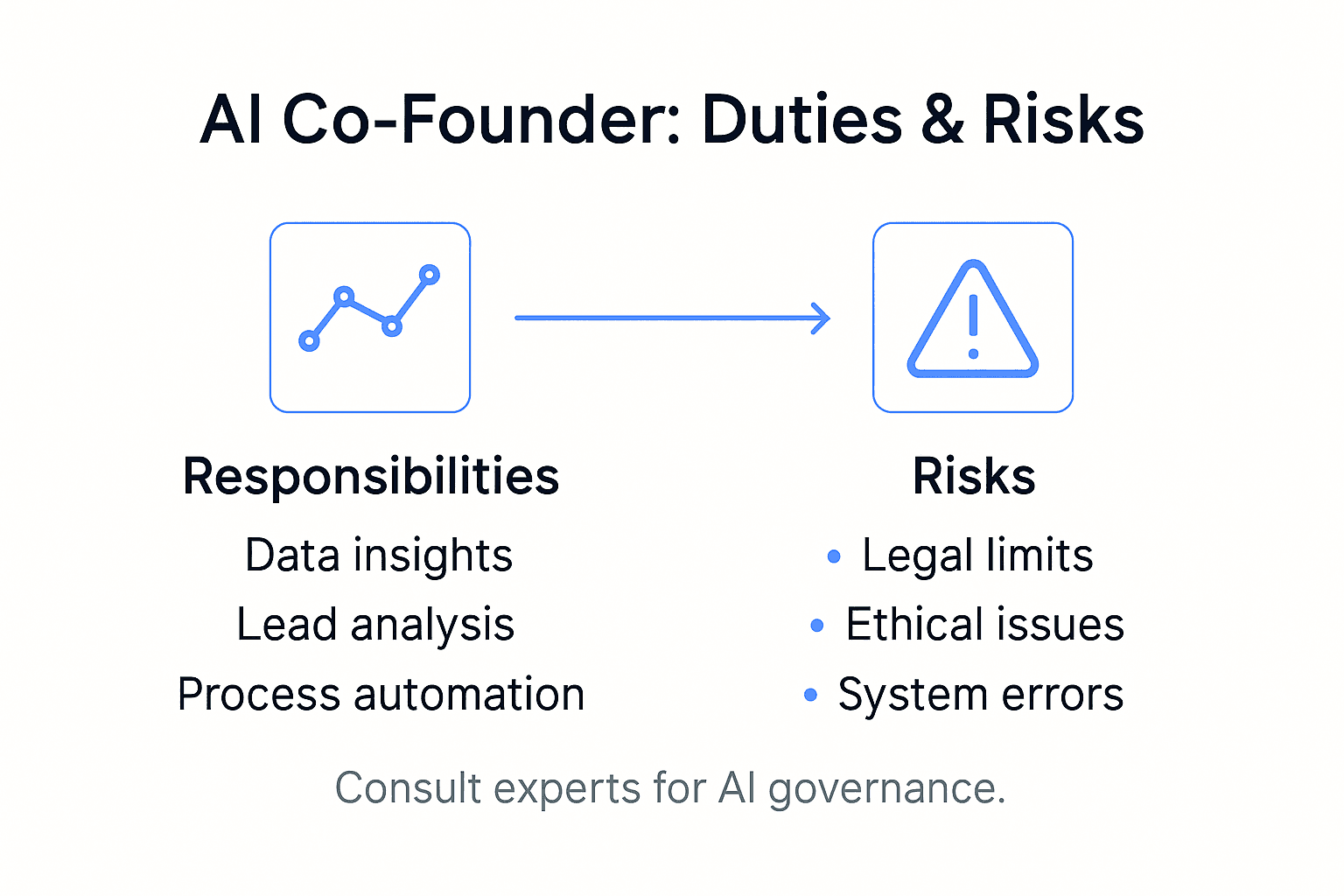
Pro tip: Consult with legal and technology experts to develop a comprehensive AI governance framework that addresses potential risks and establishes clear guidelines for responsible AI integration.
Below is a summary of major legal and ethical considerations when adopting AI co-founders:
| Area of Concern | Key Challenge | Mitigation Strategy |
|---|---|---|
| Intellectual Property | Defining ownership rights | Clear contracts and documentation |
| Data Privacy | Ensuring information security | Robust data protection protocols |
| Algorithmic Bias | Preventing unfair recommendations | Routine audits and monitoring |
| Human Oversight | Maintaining control | Transparent decision-making rules |
Unlock Warm Lead Success with Your AI Co-Founder
The article highlights how AI co-founders detect and prioritize warm leads by analyzing firmographic and behavioral data to uncover high-intent opportunities. If you are a solopreneur struggling to identify those hidden clients in your network or want to move beyond cold outreach, Fluum offers the perfect solution. By combining social intelligence with AI-powered warm introductions, Fluum surfaces potential collaborators and clients actively seeking your services, transforming your network into a business development engine.
With Fluum you get:
- AI-driven lead detection that understands buying signals
- Automated warm introductions without the hassle of cold calls
- Seamless management of follow-ups through group chats

Stop wasting time chasing cold leads and start building genuine relationships that convert. Experience the power of an AI co-founder tailored for solopreneurs and freelancers by exploring Fluum’s pricing plans. Act now to gain a strategic edge and turn your connections into revenue with Fluum that goes beyond automation by delivering personalized, high-intent introductions.
Frequently Asked Questions
What is the role of an AI co-founder in business?
An AI co-founder acts as a cognitive collaborator that enhances human capabilities by providing data-driven insights, generating ideas, and supporting decision-making processes. It functions as a virtual team member designed to complement human expertise rather than replace it.
How does AI detect and prioritize warm leads?
AI detects and prioritizes warm leads by analyzing intricate datasets, including firmographic data and behavioral signals, to identify prospects with the highest conversion potential. It continuously learns from interactions to refine its predictive accuracy, creating a more efficient client acquisition process.
What types of tasks can AI co-founders automate for solopreneurs?
AI co-founders can automate various operational tasks such as personalized email marketing, customer interaction management, and targeted content creation. They can also assist in market research, swiftly analyzing large datasets to uncover opportunities and trends.
What legal considerations should be taken into account when using AI co-founders?
When using AI co-founders, it’s crucial to consider legal aspects such as intellectual property rights, data privacy, and potential algorithmic biases. Entrepreneurs should establish clear ownership agreements, implement data protection protocols, and maintain human oversight to ensure responsible AI integration.
Recommended
- Role Of AI In Business Coaching: Unlocking Client Growth
- Finding Clients Without Sales Team: Warm Intro Strategies
- Why Use AI For Client Prospecting Success
- Client Outreach Workflow Guide | Solopreneurs Guide
- AIGP IAPP Artificial Intelligence Gov… Free Sample Questions
- Fluum | Effective Stress Management Techniques for Busy Professionals
- Fluum | How to Onboard Clients Effectively for Lasting Success
- Fluum | Master Managing Multiple Projects for Success
- Fluum | Build Your Brand with a Branding Builder in 2025
- Fluum | 7 Customer Retention Examples to Boost Your Business
