


What is business scaling? Most american solopreneurs aim to grow their businesses, yet research shows that only about 30 percent manage to scale successfully without burning out. Scaling is more than just making money faster. It involves creating systems that let you serve more clients while keeping your workload steady. This guide reveals how smart strategies and the right mindset can transform a solo venture into a thriving, flexible business engine.
Table of Contents
- Defining Business Scaling And Core Concepts
- Types Of Scaling: Horizontal Vs. Vertical Growth
- How Scaling Works For Solopreneurs
- Requirements And Key Success Factors
- Risks, Costs, And Common Scaling Mistakes
Key Takeaways
| Point | Details |
|---|---|
| Business Scaling Definition | Business scaling involves strategically growing revenue and operations without proportionately increasing workload, focusing on systems and efficiency. |
| Scaling Strategies | Solopreneurs can choose between horizontal scaling (expanding offerings) and vertical scaling (enhancing existing capabilities) for growth. |
| Key Success Factors | Critical to successful scaling are maintaining cost-effectiveness, operational flexibility, and developing adaptable infrastructure. |
| Common Mistakes to Avoid | Avoid premature scaling, underestimating resource needs, and neglecting continuous skill upgrades to ensure sustainable growth. |
Defining Business Scaling and Core Concepts
Learning what is business scaling represents a strategic approach where solopreneurs systematically grow their businesses by increasing revenue, expanding service offerings, and optimizing operational efficiency without proportionally increasing their workload or operational costs.
At its core, business scaling goes beyond simple growth. According to research exploring multinational enterprises, scaling involves horizontalization – a process of strategically standardizing and synergizing business operations to achieve greater economies of scale Scholar Publishing. For solopreneurs, this means developing systems and workflows that can accommodate increased demand without requiring constant manual intervention.
Key characteristics of effective business scaling for independent professionals include:

- Developing repeatable service delivery processes
- Creating scalable pricing models
- Implementing automation technologies
- Building strategic partnerships
- Designing flexible business models that adapt quickly
Successful scaling isn’t about working harder. It’s about working smarter. By developing scalable systems for online businesses, solopreneurs can transform their individual practices into strategic, growth-oriented enterprises that generate more revenue with less direct effort.
Types of Scaling: Horizontal vs. Vertical Growth
Scaling strategies for solopreneurs fundamentally break down into two primary approaches: horizontal and vertical growth. Understanding the nuanced differences between these methods is crucial for making strategic business expansion decisions.
According to GeeksforGeeks, vertical scaling involves increasing the capacity of a single system or resource, essentially upgrading the existing infrastructure. For solopreneurs, this might mean enhancing personal skills, investing in more advanced tools, or expanding service capabilities within their current operational framework.
Horizontal scaling, by contrast, focuses on distributed expansion. As University of Washington faculty explains, this approach involves adding more resources or systems to distribute workload and increase overall capacity. For independent professionals, horizontal scaling could translate to strategies like:
- Creating complementary service offerings
- Developing digital products
- Building strategic referral networks
- Leveraging automation technologies
- Outsourcing specialized tasks
The key difference lies in approach. Vertical growth intensifies existing capabilities, while horizontal growth expands through diversification and systematic resource distribution.
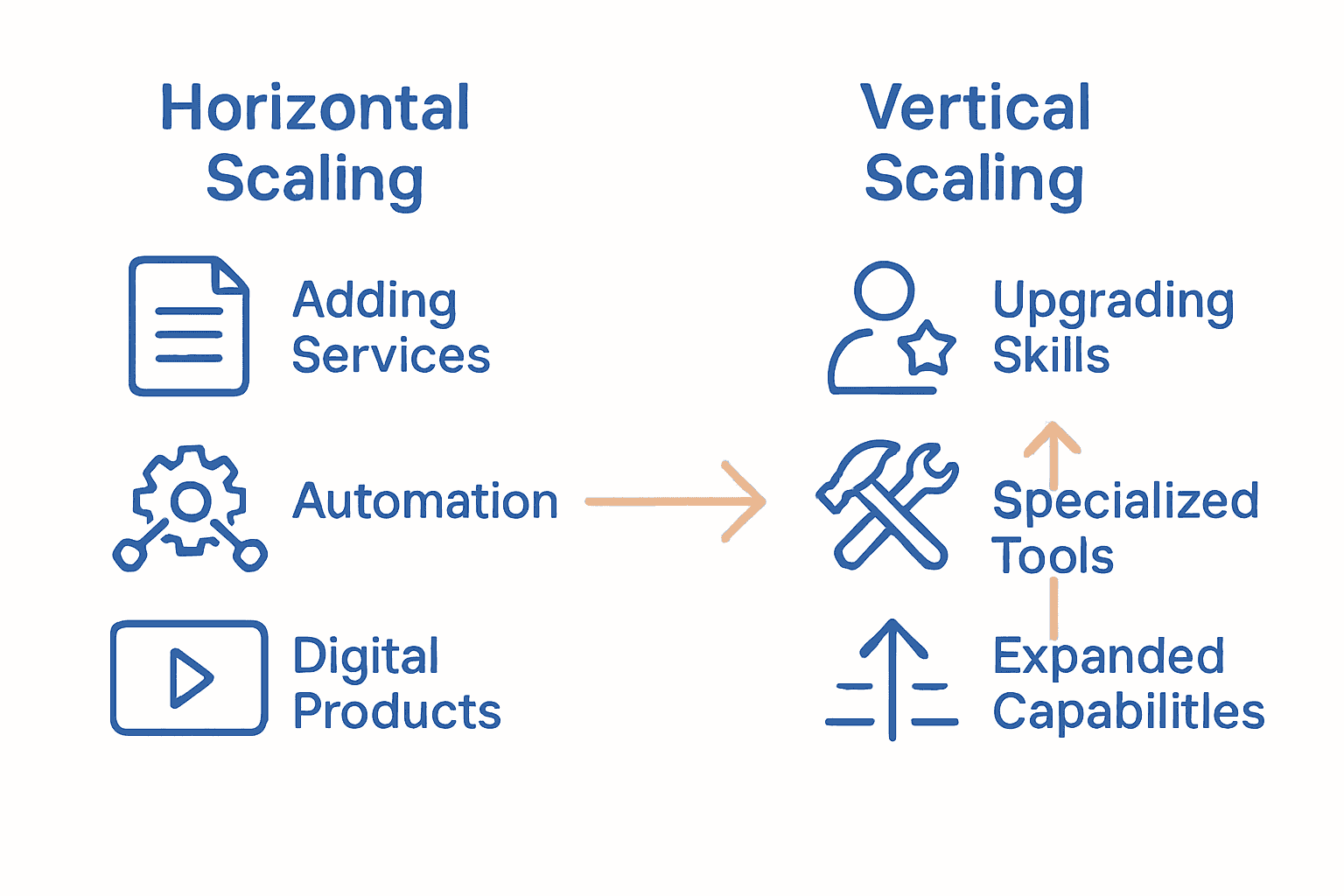 Smart solopreneurs often blend both strategies, creating a dynamic and adaptable business model that can efficiently respond to market demands.
How Scaling Works for Solopreneurs
Business scaling for solopreneurs is a nuanced process of strategic growth that goes beyond simply increasing revenue. It requires a systematic approach to expanding capabilities while maintaining operational efficiency and personal bandwidth.
According to Grasshopper Ventures, successful scaling involves mobilizing entrepreneurial leadership and technical expertise to commercialize innovative approaches. This means solopreneurs must develop systems that allow them to deliver more value without proportionally increasing their direct working hours.
Market segmentation plays a critical role in scaling effectively. AI University highlights the importance of understanding different market approaches, which for solopreneurs translates into strategic targeting and service differentiation. Key scaling strategies include:
- Creating productized service packages
- Developing digital assets and passive income streams
- Implementing robust client onboarding systems
- Utilizing automation and AI technologies
- Building strategic referral networks
For independent professionals, mastering the growth of a solo business means transforming individual expertise into a scalable, systematized enterprise. The goal is not just to work more, but to create intelligent business models that generate increasing returns with minimal additional effort.
Requirements and Key Success Factors
Business scaling demands a strategic and holistic approach that goes far beyond simple revenue growth. Solopreneurs must develop a comprehensive framework that balances operational efficiency, personal capacity, and strategic vision.
According to GeeksforGeeks, successful scaling requires carefully identifying business goals and potentially adopting a hybrid approach that combines different growth strategies. This means understanding that scaling is not a one-size-fits-all process, but a customized journey tailored to individual business needs.
Work Habit emphasizes several critical success factors for solopreneurs looking to scale effectively:
- Maintaining cost-effectiveness throughout growth
- Preserving operational flexibility
- Minimizing inherent business risks
- Developing adaptable infrastructure
- Creating systems that support consistent value delivery
The most successful solopreneurs understand that scaling a solo business requires continuous learning, strategic adaptation, and a willingness to invest in systems that can grow and evolve with their professional ambitions. Scaling is ultimately about creating a sustainable, intelligent business model that amplifies your unique expertise while minimizing direct time investment.
Risks, Costs, and Common Scaling Mistakes
Business scaling represents a complex journey filled with potential pitfalls that can derail even the most promising solopreneur ventures. Understanding these risks is crucial for developing a resilient and adaptive growth strategy.
GeeksforGeeks highlights that scaling strategies inherently involve nuanced trade-offs between performance, cost, and operational complexity. For solopreneurs, this means carefully evaluating potential investments and their long-term implications.
Common scaling mistakes that can significantly undermine business growth include:
- Premature scaling before establishing a stable service model
- Underestimating resource requirements
- Failing to develop robust operational systems
- Neglecting continuous skills development
- Overextending financial and personal capacity
As Scholarly Kitchen notes, successful scaling is about understanding the changing nature of business operations. Developing a scalable solo business requires a strategic approach that balances ambition with practical, sustainable growth mechanisms. Smart solopreneurs recognize that scaling is not about doing more, but about creating intelligent systems that multiply their professional impact.
Scale Your Solo Business with Intelligent Automation and Strategy
Scaling your solopreneur business requires more than just hard work. As highlighted in the article, the challenge lies in developing scalable systems that amplify your expertise without increasing your workload or costs. You need smart solutions for creating repeatable processes, automating client management, and building flexible business models that grow with your goals.
Fluum offers exactly that kind of AI-powered support. Our AI co-founder learns from your unique business operations and automates daily tasks such as sales outreach, client communication, and scheduling. This means you can focus on delivering exceptional service while your business scales efficiently and sustainably. Embrace both horizontal and vertical growth strategies with a platform designed to evolve alongside you.

Ready to transform your solo business into a scalable, high-impact enterprise? Explore how Fluum can become your strategic growth partner. Discover our plans and start scaling smarter today by visiting Fluum Pricing. Take the next step toward effortless business growth and unlock your true potential.
Frequently Asked Questions
What does it mean to scale a business as a solopreneur?
Business scaling refers to the strategic process of growing a business by enhancing revenue and operational efficiency without a proportional increase in workload or costs. It involves developing systems and workflows that allow you to accommodate increased demand effectively.
What are the key characteristics of effective business scaling?
Key characteristics include developing repeatable service delivery processes, creating scalable pricing models, implementing automation technologies, building strategic partnerships, and designing flexible business models that can quickly adapt to market demands.
What is the difference between horizontal and vertical scaling?
Vertical scaling involves increasing the capacity of existing resources or skills, while horizontal scaling focuses on distributed expansion by adding more resources or systems. Solopreneurs often combine both strategies to create a more adaptable business model.
What are common mistakes to avoid when scaling a business as a solopreneur?
Common mistakes include premature scaling without a stable service model, underestimating resource needs, failing to establish robust operational systems, neglecting continuous skills development, and overextending financial or personal capacities.
Recommended
- Master Scaling A Service Business For Growth And Profit
- Complete Guide To Business Decision-Making Success
- Business And Decisions: Complete Guide For Solopreneurs
- What Is A Solopreneur? Understanding The Solo Business Model
- Fluum | Effective Stress Management Techniques for Busy Professionals
- Fluum | How to Onboard Clients Effectively for Lasting Success
- Fluum | Master Managing Multiple Projects for Success
- Fluum | Build Your Brand with a Branding Builder in 2025
- Fluum | 7 Customer Retention Examples to Boost Your Business