


Over 60 percent of small business owners struggle to set the right prices for their services, often leaving money on the table or driving clients away. Choosing a pricing strategy shapes not only your income but also how clients perceive your value and expertise. Understanding the core principles behind service pricing helps you build a stronger brand, stand out from competitors, and attract the clients you want most.
Table of Contents
- Defining Pricing Strategy For Services
- Popular Service Pricing Models Compared
- Key Influences On Service Pricing Decisions
- Building Value-Based Pricing Approaches
- Avoiding Common Pricing Strategy Pitfalls
Key Takeaways
| Point | Details |
|---|---|
| Importance of Pricing Strategy | A well-defined pricing strategy conveys value to clients and influences profitability. It involves understanding costs, market positioning, and client perception. |
| Variety of Pricing Models | Service providers can choose from several pricing strategies, including cost-plus, competitive, and value-based models to match their business objectives. |
| Critical Influences on Pricing | Key factors such as market demand, operational costs, and perceived value influence pricing decisions and should be continuously assessed. |
| Avoiding Pricing Mistakes | Common pitfalls include ignoring market research and undervaluing expertise; regular evaluation of pricing strategy is essential for sustainability and competitiveness. |
Defining Pricing Strategy for Services
Pricing strategy is the critical roadmap that determines how service providers value their work and communicate that value to potential clients. According to Coursera, a pricing strategy represents the process and methodology for establishing prices that can “convey value to customers, attract customers, inspire trust, boost sales, increase revenue, and improve profit margins”.
At its core, pricing strategy goes beyond simple number calculation. It involves a nuanced understanding of several interconnected factors:
- Cost Coverage: Ensuring all direct and indirect business expenses are accounted for
- Customer Perception: Understanding what clients believe your services are worth
- Market Positioning: Aligning prices with your professional brand and expertise
- Competitive Landscape: Knowing how your rates compare to similar service providers
As Jove explains, successful pricing helps businesses “balance costs, customer perception, and competition” while maintaining sustainable profitability. For solopreneurs and freelancers, this means developing a strategic approach that reflects both professional value and market realities.
The right pricing strategy transforms your services from a commoditized offering into a unique value proposition. It signals expertise, builds client confidence, and creates a framework for sustainable business growth. By thoughtfully designing your pricing model, you position yourself not just as a service provider, but as a strategic partner who delivers measurable results.
Popular Service Pricing Models Compared
Navigating service pricing requires understanding multiple strategic approaches. According to BDC, there are five primary pricing strategies that service providers can leverage to optimize their business model.
Key Pricing Models for Service Providers
- Cost-Plus Pricing
- Calculate total business expenses
- Add predetermined profit margin
- Simple and straightforward approach
- Ensures direct cost recovery
- Competitive Pricing
- Set rates based on market competitors
- Requires ongoing market research
- Helps maintain industry standard pricing
- Prevents under or overpricing services
- Value-Based Pricing
- Price determined by client perceived value
- Focuses on outcomes and results
- Allows premium pricing for exceptional services
- Requires strong value communication
- Penetration Pricing
- Start with lower initial rates
- Attract new clients quickly
- Gradually increase prices as reputation grows
- Effective for new service providers
- Price Skimming
- Begin with high pricing
- Target premium market segments
- Gradually reduce prices
- Works well for innovative or unique services
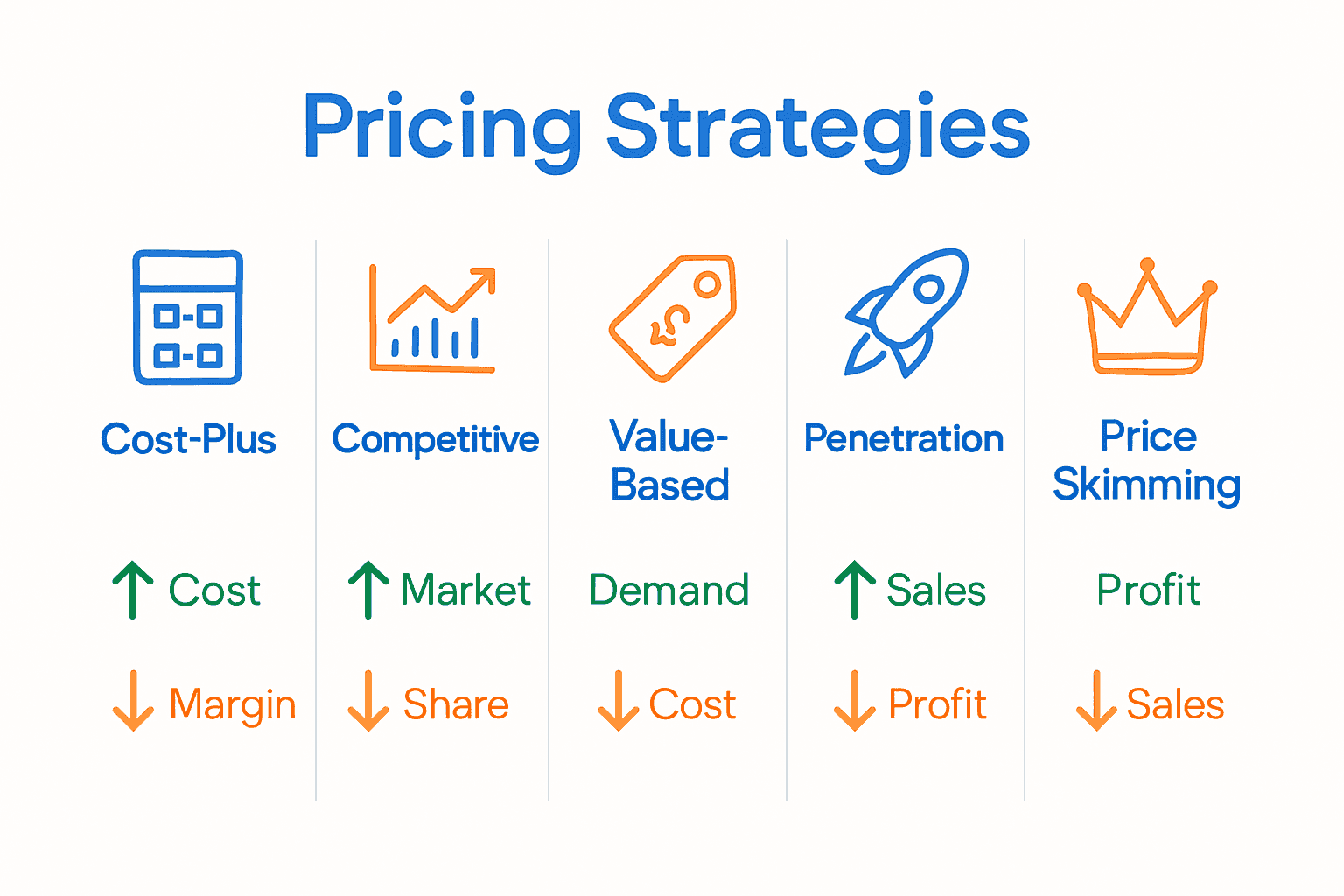
As ResearchGate highlights, these strategies can be broadly categorized into cost-based, competition-based, and demand-based approaches. The key is selecting a model that aligns with your specific business goals, target market, and service offerings.

Choosing the right pricing strategy is not just about numbers. It’s about positioning your services, communicating value, and creating a sustainable business model that attracts and retains clients while ensuring your continued professional growth.
Key Influences on Service Pricing Decisions
Pricing your services isn’t a random process but a strategic calculation influenced by multiple interconnected factors. According to IOSR Journals, key influences range from market accessibility and cost implications to legal considerations and professional image.
Critical Pricing Decision Factors
External Market Influences
- Customer Demand: Understanding client willingness to pay
- Competitive Landscape: Rates charged by similar service providers
- Market Positioning: Your unique value proposition
- Economic Conditions: Current market stability and spending trends
Internal Business Considerations
- Operational Costs: Direct and indirect expenses
- Skill Level and Expertise: Your professional credentials
- Service Complexity: Time and resources required
- Desired Profit Margin: Financial sustainability goals
Strategic Psychological Factors
- Perceived Value: How clients view your service quality
- Brand Reputation: Your professional credibility
- Client Expectations: Alignment between price and anticipated outcomes
- Target Market Segment: Specific client demographics
As IRE Journals emphasizes, pricing strategy is a crucial component of your marketing mix that directly impacts profitability and competitive positioning. The goal is not just setting a price, but creating a nuanced approach that reflects your professional worth while remaining attractive to potential clients.
Successful pricing requires continuous adaptation.
Regular market research, client feedback, and willingness to adjust your strategy ensure that your pricing remains competitive, fair, and aligned with your evolving professional expertise.
Building Value-Based Pricing Approaches
Value-based pricing represents a sophisticated strategy that transcends traditional cost calculations. According to Wikipedia, this approach focuses on pricing services “according to its perceived or estimated value” by considering complex factors beyond mere production costs.
Core Principles of Value-Based Pricing
Calculating Customer Value
Value-based pricing requires a deep understanding of the tangible and intangible benefits your services provide:
- Outcome Measurement: Quantify specific results clients achieve
- Transformation Impact: Assess long-term changes your service enables
- Unique Differentiation: Highlight what makes your service distinctive
- Problem-Solving Capacity: Demonstrate direct solutions to client challenges
Strategic Value Estimation
- Analyze client’s potential financial gains
- Consider time saved or efficiency improved
- Evaluate emotional and professional transformation
- Understand client’s alternative investment options
Implementation Framework
- Conduct thorough client needs assessment
- Map potential service outcomes
- Quantify monetary and non-monetary benefits
- Develop pricing that reflects comprehensive value
As Wikipedia explains through the Economic Value to the Customer (EVC) methodology, successful value-based pricing allows businesses to “capture more value than traditional cost-plus pricing” by precisely estimating the comprehensive value delivered.
Effective value-based pricing is an ongoing dialogue. It requires continuous learning, transparent communication, and a genuine commitment to delivering exceptional, transformative results that justify your chosen pricing structure.
Avoiding Common Pricing Strategy Pitfalls
Pricing strategy is a delicate balance that can make or break your service business. According to BDC, setting prices incorrectly can lead to significant consequences – pricing too low risks financial loss, while pricing too high can result in lost sales opportunities.
Critical Pricing Mistakes to Dodge
Pricing Myopia Traps
- Ignoring Market Research: Pricing without understanding client perception
- Undervaluing Expertise: Failing to account for your unique skills
- Fixed Mindset Pricing: Not adapting rates as your experience grows
- Comparison Paralysis: Solely mimicking competitor rates
Financial Risk Indicators
- Consistently losing potential clients
- Experiencing high client turnover
- Struggling to cover operational expenses
- Feeling constantly undervalued
Strategic Self-Assessment Questions
- Does my pricing reflect my actual value?
- Am I attracting my ideal client profile?
- Can I sustain my business at current rates?
- What unique transformation do I provide?
As Academic Research emphasizes, transforming pricing from a “one-off project” to a consistent business capability requires strategic management and continuous refinement.
Successful pricing is an ongoing journey of understanding your worth, market dynamics, and client value. Regular evaluation, transparent communication, and willingness to adjust ensure your pricing strategy remains both competitive and sustainable.
Unlock Smarter Pricing Strategies with Fluum AI
Mastering your pricing strategy means balancing costs, customer perception, and competition while ensuring your business stays profitable and scalable. If you find yourself struggling with complex pricing models like value-based or competitive pricing or worried about attracting the right clients without undervaluing your expertise, you are not alone. The challenges of setting prices that truly reflect your unique value and adapting as your business grows can be overwhelming.
Fluum is built to solve exactly these pain points by acting as your AI co-founder that learns from your behavior and business goals to provide personalized pricing insights. From managing client engagement to automating communication and payment tracking, Fluum helps you focus on what matters most — delivering exceptional services while your AI teammate handles daily operations and strategic growth.
Take the first step toward precision pricing and effortless business scaling today by exploring the full capabilities at Fluum Pricing.
Ready to transform how you price and grow your freelance or solopreneur services? Visit Fluum Pricing now to unlock AI-powered strategies that adapt with you every step of the way. Don’t let pricing uncertainties hold back your growth — act now and make smarter decisions that build lasting client trust and sustainable profits.
Frequently Asked Questions
What is a pricing strategy for services?
A pricing strategy for services is a methodology that outlines how service providers determine and communicate their prices, reflecting the value of their work to attract clients and maintain profitability.
What are the common pricing models used by service providers?
Common pricing models include Cost-Plus Pricing, Competitive Pricing, Value-Based Pricing, Penetration Pricing, and Price Skimming. Each model has unique attributes that fit different business needs and market conditions.
How does customer perception influence pricing strategies?
Customer perception influences pricing strategies by determining how clients value services. If clients perceive a high value, service providers can justify higher prices, making value communication crucial in pricing decisions.
What factors should I consider when setting my service prices?
When setting service prices, consider external market influences like customer demand and competition, internal business factors such as operational costs and skill level, and psychological elements like perceived value and client expectations.
Recommended
- How To Increase Bookings: A Complete Step-by-Step Guide
- Understanding Client Management Strategies For Success
- Fluum | Effective Stress Management Techniques for Busy Professionals
- Fluum | How to Onboard Clients Effectively for Lasting Success
- Fluum | Master Managing Multiple Projects for Success
- Fluum | Build Your Brand with a Branding Builder in 2025
- Fluum | 7 Customer Retention Examples to Boost Your Business