
| Key Insight | Explanation |
|---|---|
| Match quality determines outcome | A warm introduction only converts when both parties share a genuine, verifiable reason to connect. Relevance on both sides is non-negotiable. |
| Double opt-in is the baseline standard | High-quality introductions require confirmed mutual interest before any message is exchanged. This single mechanic separates warm intros from sophisticated cold outreach. |
| Reply rates reflect match quality directly | Well-matched warm introductions achieve 40–50% reply rates. Cold email averages 2%. The gap is almost entirely explained by match relevance, not message copy. |
| Signal data improves match precision | AI-powered platforms drawing from 40+ private data vendors and government registries surface buyers that LinkedIn and cold outreach tools cannot reach. |
| Context richness amplifies conversion | Personal, specific introductions that explain why two parties should meet outperform generic forwarded messages by a wide margin. |
| Most teams measure volume, not quality | Tracking intro volume without segmenting by ICP fit, connector quality, and deal stage produces misleading pipeline data and wasted follow-up effort. |
Warm introduction match quality is the degree to which both parties in a facilitated introduction share a genuine, timely, and mutually relevant reason to connect. High match quality means both sides benefit from the conversation. It’s the single factor that separates a 40–50% reply rate from the 2% cold email average most B2B teams are grinding against right now.
Most sales teams treat warm introductions as a binary: either you have a connection or you don’t. That framing misses the point entirely. Two people can be introduced and still produce zero pipeline if the match is weak. The person being introduced might fit your ICP on paper but have no active buying intent. The connector might know both parties only superficially. The timing might be off by six months. All of those factors are components of match quality, and all of them are measurable.
This guide covers exactly what warm introduction match quality means, how it’s evaluated and scored, why it matters more than volume in 2026, and how to build a repeatable system that produces high-quality introductions at scale.

What Is Warm Introduction Match Quality?
Warm introduction match quality is a measure of how well two parties align across relevance, timing, and mutual interest before a facilitated introduction takes place. It determines whether an introduction converts into a real conversation, and ultimately into pipeline.
The Core Definition
A warm introduction, at its simplest, is a connection made through a trusted third party who vouches for both sides. According to Altrata, warm introductions work because the introducer confers trust, provides context, and reduces the friction that cold outreach creates from the first word [1]. That’s the mechanism. Match quality is what determines whether that mechanism fires correctly.
Think of it this way. The introduction itself is the vehicle. Match quality is whether you’ve put the right passenger in the right car going to the right destination. A warm intro with poor match quality is still cold outreach with a friendlier wrapper.
Match quality is assessed across several dimensions:
- ICP fit (Ideal Customer Profile): Does the introduced party meet the buyer’s defined firmographic and behavioral criteria, including company size, industry, regulatory environment, and technology stack?
- Intent signals: Is there observable evidence, from hiring activity, funding events, regulatory filings, or technology changes, that the prospect is in an active buying cycle?
- Connector credibility: Does the introducer have a genuine, substantive relationship with both parties, or is this a LinkedIn connection from 2019?
- Timing alignment: Are both parties at a point in their respective cycles where the conversation is immediately useful?
- Context richness: Does the introduction explain specifically why these two parties should meet, rather than offering a generic “you two should connect”?
Why Match Quality Matters More Than Volume
The B2B sales environment as of 2026 has made volume-based prospecting increasingly expensive and decreasingly effective. Research from ExecAtlas shows that a warm introduction through a trusted connection generates a 46% response rate, compared to roughly 3% for cold outreach [2]. That 15x difference isn’t primarily about the introduction mechanic. It’s about match quality.
When both parties genuinely need what the other offers, and when a trusted third party confirms that relevance, the conversation starts from a position of earned credibility. No amount of subject line optimization or sending domain warming replicates that starting position.
Pro Tip: Before requesting or facilitating any introduction, score it against at least three match quality dimensions: ICP fit, active intent signal, and connector relationship depth. If you can’t confirm all three, the introduction isn’t ready to send.
How Warm Introduction Match Quality Works
Warm introduction match quality is evaluated through a combination of data signals, relationship mapping, and mutual consent protocols that together determine whether an introduction is worth making.
The Signal Layer: Where Match Data Comes From
High-quality matching starts with data. Not just contact data, but behavioral and contextual signals that indicate a prospect is both a good fit and actively relevant right now. Warm introduction software at its most effective maps a team’s collective network and surfaces the fastest, most trusted path to any prospect [3]. The best platforms go further, drawing from government registries like Companies House, FCA Register, SEC EDGAR, and SIRENE, alongside private data vendors, to surface buyers that LinkedIn and conventional outbound tools simply don’t index.
The signal sources that contribute to match quality scoring include:
- Company registration and regulatory filings (Companies House, SEC EDGAR, FCA Register)
- Funding announcements and investment rounds
- Executive hiring and leadership changes
- Technology adoption signals from third-party data vendors
- Industry-specific regulatory events (particularly relevant in fintech, cybersecurity, and manufacturing)
- Opted-in network data from buyers who have actively expressed interest in relevant categories
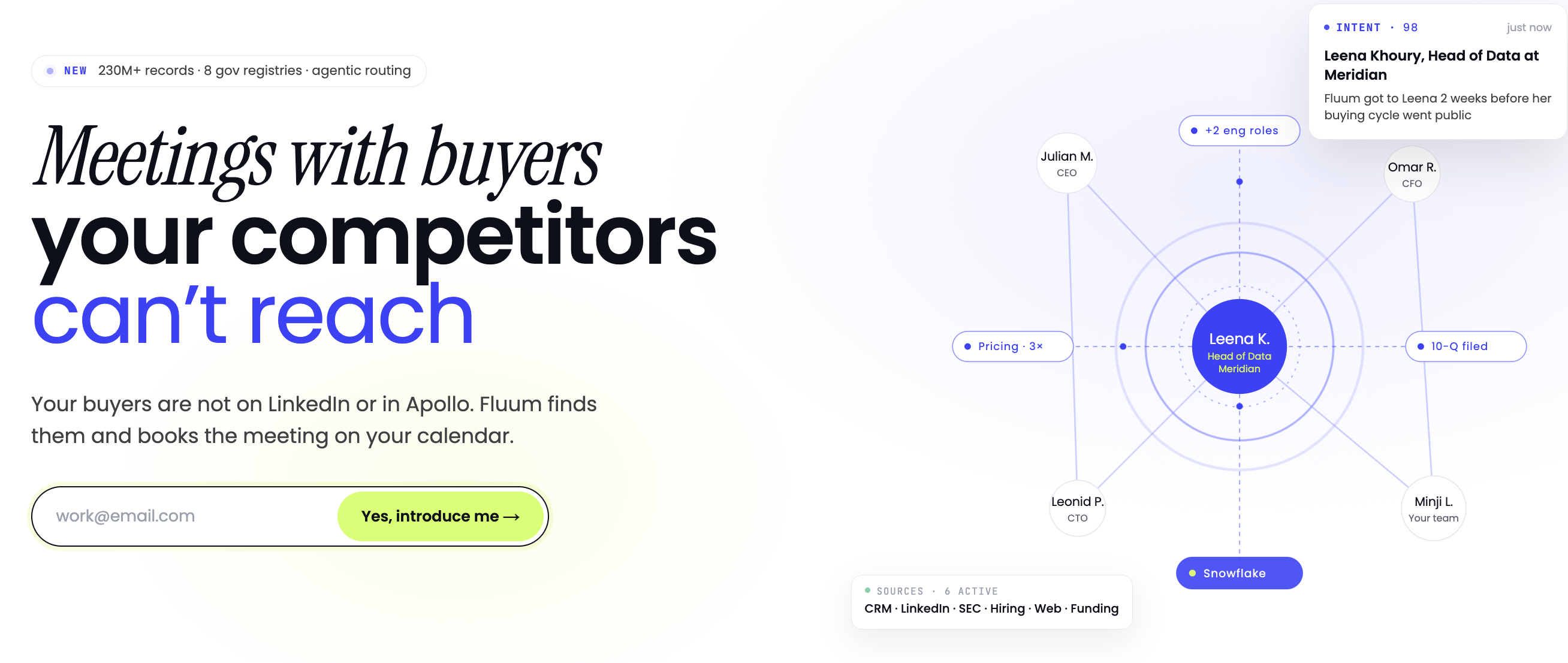
At Fluum, we’ve found that combining 40+ private data vendors with government registry data produces a materially different prospect set than LinkedIn alone. The buyers who appear in regulatory filings but not in conventional sales intelligence tools are often the highest-value targets, precisely because they’re not being bombarded by every SDR with a subscription to a contact database.
The Double Opt-In Protocol
Match quality isn’t just about finding the right person. It’s about confirming that both sides want the conversation. The double opt-in introduction protocol (the process by which both parties independently confirm interest before any connection is made) is the structural mechanism that separates genuine warm introductions from warm-sounding cold outreach.
The process works in sequence:
- The introducing party identifies a potential match based on ICP criteria and intent signals.
- The introducer reaches out to the prospect privately to gauge interest, without revealing the other party’s identity until consent is given.
- The prospect confirms or declines. No introduction is made if either party is uncertain.
- Once both parties confirm, a context-rich introduction is delivered that explains the specific reason for the connection.
- The conversation begins with both parties already knowing why they’re talking and what value the other might offer.
The double opt-in protocol, as documented in current 2026 investor introduction playbooks, is now considered the baseline standard for any introduction that expects a serious response [4]. Anything less is a forwarded email, not a warm introduction.
Research on language style matching in professional contexts supports this. Studies on language style matching (LSM) show that mutual alignment in communication patterns is a strong predictor of interaction quality and relationship formation [5]. The same principle applies to business introductions: when both parties share a genuine reason to connect, the conversation quality is measurably higher from the first exchange.

Why Match Quality Drives Pipeline Results in 2026
High warm introduction match quality directly produces faster deal cycles, higher close rates, and larger average contract values compared to cold-sourced pipeline. The data on this is consistent across industries and deal sizes. For more information, see How The Universal Realization Of Gender Equality Will Help Us Tackle Climate Change.
The Conversion Gap Is Real and Widening
Cold email response rates have been in structural decline for years. As of 2026, the average cold email reply rate sits at approximately 2%, while well-matched warm introductions consistently achieve 40–50% reply rates. That’s not a marginal improvement. It’s a different category of outcome entirely.
The reasons for this gap are structural, not tactical:
- Trust transfer: The introducer’s credibility transfers to the introduced party, reducing the skepticism that greets every cold message.
- Context front-loading: Both parties enter the conversation knowing who the other is and why the introduction was made. There’s no “who are you and why are you emailing me?” friction.
- Mutual interest confirmation: The double opt-in means both parties have already said yes to the conversation before it starts. That’s a fundamentally different starting point than a cold pitch.
- Reduced competition: A buyer receiving a warm introduction from a trusted source is not simultaneously receiving 300 cold emails from your competitors about the same product category.
Research from Women in Cloud confirms that the reason warm introductions work is grounded in first-principles human behavior: people do business with people they trust, and trust transfers through relationships [6].
Industry-Specific Match Quality Considerations
Match quality requirements vary significantly by industry. In regulated sectors, the stakes of a poor-quality introduction are higher because decision-makers in fintech, cybersecurity, and manufacturing operate under compliance constraints that make irrelevant vendor conversations genuinely costly.
| Industry | Key Match Quality Signals | Primary Data Sources | Avg. Intro Reply Rate |
|---|---|---|---|
| Fintech | FCA/SEC filings, licensing events, funding rounds | FCA Register, SEC EDGAR, Companies House | 42–50% |
| Cybersecurity | Breach disclosures, compliance certifications, tech stack changes | Private data vendors, government cyber registers | 38–46% |
| Manufacturing | Supply chain events, capex signals, regulatory inspections | SIRENE, Companies House, trade registries | 40–48% |
| Professional Services | Firm growth signals, practice area expansion, leadership changes | Companies House, LinkedIn signals, private vendors | 35–44% |
A fintech BD team we worked with recently had been running cold sequences into compliance decision-makers at mid-market banks with a 1.8% reply rate. After switching to matched warm introductions sourced from FCA Register data and opted-in network contacts, they booked 11 qualified discovery calls in their first 30 days. The product hadn’t changed. The match quality had.
It’s also worth noting that broader systemic factors influence the environment in which business relationships form. Initiatives like those documented in How The Universal Realization Of Gender Equality Will Help Us Tackle Climate Change remind us that the networks through which warm introductions flow reflect the diversity, or lack thereof, of the professional ecosystems we operate in. Building more inclusive opted-in networks isn’t just an ethical consideration; it directly expands the quality and breadth of available matches.
Common Mistakes That Destroy Match Quality
Poor warm introduction match quality almost always traces back to one of a small number of predictable errors. Recognizing them early prevents wasted relationship capital and damaged connector credibility.
The Most Damaging Errors in Practice
From experience working with B2B sales teams across fintech, cybersecurity, and manufacturing, the same mistakes appear repeatedly:
- Treating network breadth as a proxy for match quality. Having 5,000 LinkedIn connections doesn’t mean you can produce 5,000 quality introductions. The depth of the connector relationship and the relevance of the match matter far more than the size of your address book.
- Skipping the pre-introduction qualification step. Sending a blind introduction without first confirming mutual interest from both parties turns a warm intro into an unsolicited cold email with a familiar name attached. BoardEx’s guidance on warm introductions is explicit: the pre-introduction check is not optional [7].
- Using generic context in the introduction message. “You two should connect, you’re both in fintech” is not a warm introduction. It’s a forwarded email. High match quality requires a specific, articulated reason why these two parties should talk right now.
- Ignoring timing signals. A prospect who was in an active buying cycle three months ago may have already made a decision. Intent signals decay quickly. Introductions made on stale data produce poor outcomes regardless of how well the ICP criteria align.
- Measuring introduction volume instead of introduction quality. Draftboard’s pipeline measurement framework recommends segmenting intro performance by ICP match score, connector quality, and deal stage rather than tracking raw introduction counts [8]. Teams that don’t do this can’t distinguish between connectors who produce pipeline and connectors who produce noise.
The “Warm Wrapper on Cold Outreach” Problem
One pitfall to watch for is the growing practice of calling automated outreach sequences “warm introductions” when they involve no genuine relationship, no prior consent from the prospect, and no real context. This isn’t a semantic issue. It’s a match quality issue. An introduction that looks warm but lacks mutual interest confirmation will convert at cold email rates, not warm introduction rates. The 40–50% reply rate only materializes when both parties genuinely want the conversation.
Pro Tip: Track your introduction-to-meeting conversion rate segmented by connector. If a specific connector’s introductions convert at less than 20%, the issue is almost always match quality, not follow-up cadence. Audit the ICP fit and intent signals on their recent introductions before sending more.
Best Practices for Warm Introduction Match Quality in 2026
The highest-performing B2B teams treat warm introduction match quality as a repeatable system, not a lucky byproduct of having a well-connected founder. Here’s how they build it.
Building a Scoring Framework for Match Quality
A practical match quality scoring framework evaluates each potential introduction across five dimensions before the introduction is made. Each dimension gets a score, and introductions below a threshold don’t go out.
- ICP fit score (0–25 points): Does the prospect meet your defined firmographic criteria? Industry, company size, geography, regulatory status, and technology environment all contribute.
- Intent signal score (0–25 points): Is there observable, recent evidence of active buying intent? Funding events, hiring signals, regulatory filings, and technology changes count. Absence of signals scores zero.
- Connector relationship depth (0–20 points): Does the connector have a genuine, substantive relationship with the prospect, or a surface-level LinkedIn connection? Depth is assessed by recency of interaction, mutual history, and whether the connector can speak credibly to the prospect’s current priorities.
- Context specificity (0–20 points): Can the introduction message articulate a specific, compelling reason for the connection? Generic context scores low.
- Timing alignment (0–10 points): Is the prospect in a stage of their business cycle where this conversation is immediately useful? Introductions made at the wrong moment waste everyone’s time.
Introductions scoring above 70 out of 100 go out. Those below 70 go back to the data layer for additional signal research or are held until timing improves.
Leveraging AI and Data Infrastructure for Consistent Quality
Manual match quality assessment doesn’t scale. The teams producing consistent pipeline from warm introductions in 2026 are using AI-powered matching that draws from multiple data sources simultaneously. AI-powered warm introduction platforms report 5x higher response rates than cold outreach by automating the signal aggregation and match scoring that humans can’t do at volume [9].
The data infrastructure matters as much as the AI layer. Platforms drawing from government registries (Companies House, FCA Register, SEC EDGAR, SIRENE) alongside 40+ private data vendors surface a fundamentally different prospect set than tools limited to LinkedIn data. Buyers in regulated industries who appear in FCA or SEC filings but not in conventional sales intelligence databases are often the highest-intent prospects precisely because they’re not being reached by conventional outbound.
LinkedIn’s own guidance on warm introductions acknowledges that the strategy works when someone you already know personally connects you to a new contact [10]. The limitation of that framing is the word “personally.” AI-matched platforms extend the concept beyond personal networks to opted-in networks of decision-makers who have actively expressed interest in relevant categories.
Pro Tip: If you’re a senior leader or C-suite executive looking to build pipeline through high-quality warm introductions, talk to Aurora at Fluum. Tell us who you’re looking to meet next and what your ICP looks like. We’ll make sure to send you only what’s relevant, matched from our opted-in network and 40+ data sources.
The arXiv framework for quality matching in data annotation contexts offers a useful parallel: when match quality is systematically scored and optimized, output quality improves measurably and consistently across the entire pipeline [11]. The same principle applies directly to B2B introductions.
Sources & References
- Altrata, “The Value of Warm Introductions,” 2024
- ExecAtlas, “How to Scale Warm Introductions: A Framework for Executive Access,” 2025
- Connect The Dots (CTD.ai), “What is Warm Introduction Software?,” 2025
- Evalyze, “How to Get Introduced to Any Investor (Even If You Have No Network),” 2026
- PMC / NIH, “Therapist–Client Language Matching: Initial Promise as a Measure of Interaction Quality,” 2019
- Women in Cloud, “Crafting a Clear Ask: Everything You Need To Know About Winning Warm Introductions in 6 Steps,” 2024
- BoardEx, “The Art of the Warm Introduction: A Complete Guide,” 2024
- Draftboard, “How to Measure the Impact of Warm Intros on Your Sales Pipeline,” 2025
- Prospectly, “AI-Powered Warm Introductions | Skip Cold Outreach,” 2026
- LinkedIn, “How to Use Warm Introductions,” 2024
- arXiv, “Quality Match Framework for Data Annotation,” 2025

Frequently Asked Questions
1. How do you give a warm introduction?
A high-quality warm introduction starts before you write a single word. First, confirm mutual interest privately from both parties using a double opt-in approach: ask the prospect whether they’d welcome an introduction before revealing the other party’s identity. Once both sides confirm, write a specific, context-rich message that explains why these two people should meet right now, not just that they share an industry. Generic forwarded emails aren’t warm introductions; they’re cold outreach with a familiar name on them. Warm introduction match quality depends on that specificity.
2. What is a warm introduction in business?
A warm introduction in business is a facilitated connection between two parties made through a trusted third party who has a genuine relationship with both sides, provides a personal endorsement, and articulates a specific reason for the connection. Unlike cold outreach, a warm introduction transfers the introducer’s credibility to the introduced party, which is why warm introductions consistently achieve reply rates of 40–50% compared to approximately 2% for cold email. The quality of the introduction, not just its warmth, determines whether it converts into a real business conversation.
3. How do I ask for warm intros?
The most effective approach is to make it easy, specific, and low-friction for your connector. Identify the exact person you want to meet (not just a job title), explain in two sentences why the connection is mutually valuable, and provide a ready-to-forward blurb your connector can send verbatim. Ask after a recent win or a moment of genuine goodwill, not as a cold request. The clearer you are about who you’re looking for and why the introduction benefits both parties, the higher the warm introduction match quality will be, and the more likely your connector is to say yes.
4. What is a warm email introduction?
A warm email introduction is a message sent by a mutual contact that introduces two parties to each other, providing personal context, a reason for the connection, and an implicit or explicit endorsement of both sides. It differs from a cold email in one critical way: the recipient already trusts the sender, so the introduced party receives immediate credibility before reading a single word. A high-quality warm email introduction includes who both parties are, why they should meet specifically, and what the next step looks like. Warm introduction match quality is what determines whether that email produces a meeting or gets archived.
5. How do you measure warm introduction match quality?
Measure this practice by tracking introduction-to-meeting conversion rates segmented by ICP fit, connector relationship depth, and intent signal recency. Raw introduction volume is a misleading metric. The most useful signals are: what percentage of introductions result in a first meeting, what percentage of those meetings progress to a qualified opportunity, and which connectors and match criteria produce the best downstream pipeline. Teams that segment by these dimensions quickly identify which match quality factors drive revenue and which produce noise.
6. Can AI improve warm introduction match quality at scale?
Yes, and this is where the category is moving fastest in 2026. AI-powered platforms can score ICP fit, identify active intent signals from government registries and private data vendors, and surface prospects that personal networks and LinkedIn alone don’t reach. The double opt-in mechanism ensures that AI-matched introductions still require mutual consent before any connection is made, preserving the trust transfer that makes warm introductions effective. The result is this method at a volume that manual network-based approaches can’t replicate.
Conclusion
this strategy is the variable that determines whether your pipeline strategy produces real conversations or just activity metrics. Volume without quality is expensive noise. The teams winning in 2026 aren’t sending more introductions; they’re sending better ones, matched on ICP fit, intent signals, connector credibility, and mutual consent.
The mechanics are clear. The double opt-in protocol confirms mutual interest before any message is sent. AI-powered signal aggregation from government registries and private data vendors surfaces buyers that conventional tools don’t reach. Context-rich introductions that explain specifically why two parties should meet convert at 40–50%, not 2%.
Cold outreach isn’t going to get better. The inbox is more crowded today than it was yesterday, and it will be more crowded tomorrow. The question isn’t whether to move toward warm introductions. It’s whether your current approach to match quality is rigorous enough to produce the pipeline your number demands.
Fluum’s AI-powered platform builds buyer graphs from 40+ private data vendors and 8 government registries, scores intent signals, and delivers double opt-in warm introductions across fintech, cybersecurity, manufacturing, and regulated industries. If this approach is the lever you haven’t fully pulled yet, it’s worth seeing what a matched introduction from an opted-in network actually looks like.
Recommended Articles
Explore more from our content library: