
| Key Insight | Explanation |
|---|---|
| Cold outreach is broken | Cold email reply rates average 2% as of 2026, while opted-in network selling consistently delivers 40–50% reply rates through mutual-consent introductions. |
| Double opt-in is the core mechanic | Both buyer and seller confirm interest before any message is exchanged, eliminating the attention-fighting that kills cold outreach before it starts. |
| Compliance is built in | Permission-based contact aligns with CAN-SPAM, GDPR, and CCPA requirements — reducing legal risk while improving deliverability. |
| AI matching expands reach | Modern platforms pull buyer signals from 40+ private vendors and 8 government registries, surfacing decision-makers that LinkedIn and cold tools simply don’t index. |
| Regulated industries benefit most | Fintech, cybersecurity, and manufacturing buyers are harder to reach cold. Opted-in network selling reaches them through channels that don’t rely on public data. |
| Network quality beats list size | A curated opted-in network of 10,000 verified decision-makers outperforms a scraped list of 500,000 uninterested contacts every time. |
Opted-in network selling is a B2B pipeline strategy where both the buyer and the seller explicitly consent to an introduction before any conversation takes place. It replaces the volume-based logic of cold outreach with mutual interest as the starting condition. The result is a fundamentally different conversion dynamic: instead of fighting for attention, you start from agreement.
Cold email reply rates have collapsed to around 2% as of 2026 [1]. That’s not a deliverability problem you can fix with a new sending domain. It’s a structural failure of a channel that was never built on consent. Opted-in network selling is the structural fix — not another tactic layered on top of a broken model.
This article covers what opted-in network selling actually means in a B2B context, how the mechanics work, why it outperforms cold outreach by a factor of 20 or more, and what the best-in-class implementation looks like for sales teams in fintech, cybersecurity, and manufacturing.

What Is Opted-In Network Selling?
Opted-in network selling is a B2B sales methodology built on permission: every introduction is preceded by explicit consent from both parties, making mutual interest the precondition for any commercial conversation.
Defining the Core Concept
The term combines three distinct ideas. “Opted-in” refers to the permission-marketing principle that contact only happens when someone actively signals willingness [2]. “Network” refers to a curated ecosystem of decision-makers who have registered their interest in specific categories of introductions. “Selling” anchors it firmly in pipeline generation, not just professional networking.
This is meaningfully different from opt-in email marketing, where someone subscribes to a newsletter and later receives a sales pitch. In opted-in network selling, the consent is specifically to a commercial introduction. The buyer isn’t agreeing to receive content. They’re agreeing to a conversation with a matched seller.
According to ActiveCampaign’s definition of opt-in marketing, permission-based approaches consistently outperform unsolicited contact across every measurable engagement metric [3]. Opted-in network selling takes that principle and applies it to the introduction layer of B2B sales, not just the nurture layer.
How It Differs from Traditional Network Marketing
The phrase “network selling” sometimes triggers associations with multi-level marketing models. That’s a different category entirely. MLM-style network marketing (Amway, Avon, Tupperware) is built on distributor recruitment and product resale chains. Opted-in network selling is a B2B pipeline methodology focused on connecting buyers and sellers with verified commercial intent.
- MLM network marketing: Distributor-to-consumer, recruitment-driven, product-focused
- B2B opted-in network selling: Buyer-to-seller, consent-driven, pipeline-focused
- Cold outreach: No consent, volume-driven, attention-fighting
- Warm referrals: Consent implicit, relationship-dependent, not scalable
The key differentiator is the double opt-in mechanic. Both sides confirm interest before the introduction is made. That’s what separates this practice from a warm referral (where consent is assumed) and from cold outreach (where consent is absent entirely).
Research from Bain & Company consistently shows that B2B buyers are significantly more likely to engage when introduced through a trusted channel. this method operationalizes that dynamic at scale.
How Opted-In Network Selling Works
this strategy works through a structured four-stage process: network enrollment, AI-powered matching, double opt-in confirmation, and context-rich introduction delivery.
The Double Opt-In Introduction Mechanic
The double opt-in (a term borrowed from email marketing best practices [4]) is the operational heart of the model. In email marketing, double opt-in means a subscriber confirms their signup via a follow-up email. In network selling, it means both the buyer and the seller independently confirm they want the introduction before it happens.
- Network enrollment: Decision-makers join an opted-in network and specify the categories of introductions they’re open to receiving.
- Seller input: The selling team describes their ideal customer profile, including industry, company size, role, and buying signals.
- AI matching: An AI engine cross-references the seller’s criteria against buyer signals drawn from private data vendors, government registries (Companies House, FCA Register, SEC EDGAR, SIRENE), and behavioral intent data.
- Buyer confirmation: The matched buyer is notified of the potential introduction and confirms or declines independently.
- Introduction delivery: Once both parties confirm, a context-rich, personalized introduction is delivered, not a templated pitch.
This process eliminates the attention problem that kills cold outreach. You’re not trying to interrupt someone into a conversation. You’re completing a mutual agreement that was already forming.
The Role of AI and Signal Data
The matching layer is where modern this approach diverges sharply from old-school referral networks. Manual referrals depend on who your contacts happen to know. AI-powered matching queries intent signals from dozens of data sources simultaneously.
At Fluum, we’ve found that pulling signals from 40+ private data vendors and 8 government registries surfaces buyers that cold outreach tools and public databases like LinkedIn simply don’t index. A cybersecurity vendor looking for regulated financial services buyers, for example, can surface FCA-registered firms with active procurement signals, not just companies that happen to have a LinkedIn presence.
The IAPP notes that B2B contexts often carry different privacy law exposure than B2C, but the principle of prior opt-in consent is increasingly expected across jurisdictions [5]. Building the consent layer into the matching mechanic isn’t just good ethics. It’s good compliance architecture.
| Channel | Consent Model | Avg. Reply Rate | Compliance Risk |
|---|---|---|---|
| Cold Email | No consent | ~2% | High (CAN-SPAM, GDPR) |
| LinkedIn Outreach | Implicit (platform membership) | 3–8% | Medium |
| Warm Referral | Assumed (relationship-based) | 20–35% | Low |
| Opted-In Network Selling | Explicit double opt-in | 40–50% | Very Low |
Key Benefits of Opted-In Network Selling in 2026
the practice delivers three compounding advantages over cold outreach: dramatically higher conversion rates, built-in regulatory compliance, and access to buyer segments that cold tools can’t reach.

Conversion Rate Advantages
The numbers aren’t close. Cold email averages around 2% reply rates as of 2026 [1]. this practice, when the double opt-in mechanic is properly implemented, consistently delivers 40–50%. That’s not a marginal improvement. It’s a different category of performance.
The reason is structural. When a buyer has explicitly confirmed interest in an introduction, the first message doesn’t need to fight for attention. It arrives in a context of mutual agreement. The psychological starting point is entirely different.
- Shorter sales cycles: Conversations start warmer, so qualification happens faster.
- Higher close rates: Buyers who opted in are self-selected for intent, not just demographic fit.
- Less SDR time wasted: Reps spend time on confirmed conversations, not prospecting sequences that go nowhere.
- Better CRM data quality: Every contact in the pipeline has a verified interest signal attached.
Industry analysts consistently note that B2B buyers are far more likely to engage when they’ve initiated or confirmed the contact. Green Leads reports that opt-in leads convert at significantly higher rates than cold-sourced contacts, with some verticals showing 10x conversion differences [6].
Compliance and Deliverability Benefits
The FTC’s CAN-SPAM Act compliance guide establishes clear requirements around commercial email consent [7]. GDPR Article 6 requires a lawful basis for processing personal data in commercial contexts. this method satisfies both by design: the consent is explicit, documented, and specific to the commercial introduction.
This matters beyond legal risk. Email deliverability is increasingly tied to sender reputation, and sender reputation is increasingly tied to engagement rates. A channel that generates 40–50% reply rates doesn’t just convert better. It protects your domain from the spam filters that are destroying cold email deliverability in 2026.
Pro Tip: If you’re running any cold email sequences alongside opted-in introductions, keep them on separate sending domains. Mixing high-engagement opted-in traffic with low-engagement cold traffic will drag your domain reputation down and reduce deliverability on your best channel.
Reaching Buyers Cold Tools Don’t Find
This is the benefit most sales teams underestimate. Cold outreach tools and LinkedIn index the buyers who are publicly visible and active on professional platforms. That’s a real but limited subset of the actual buyer population.
Regulated industries are the clearest example. An FCA-regulated asset manager or a CISA-compliant cybersecurity buyer may not be active on LinkedIn. They may not respond to cold email. But they’re registered in government databases with verifiable firmographic data, and they may be part of opted-in networks that specifically serve their sector.
Common Challenges and Mistakes
The most common mistake teams make with this strategy is treating it as a faster version of cold outreach, rather than a structurally different pipeline model that requires different inputs and different patience.
Confusing Opt-In Consent with Passive Permission
There’s a meaningful difference between single opt-in and double opt-in consent [8]. Single opt-in means someone checked a box, possibly without reading what they agreed to. Double opt-in means they took an active, confirmed step. In network selling, the quality of consent directly determines the quality of the conversation.
A common mistake is building a “network” of contacts who passively agreed to receive introductions as part of a broader terms-of-service acceptance. That’s not this approach. That’s a slightly better-dressed cold list. The consent has to be specific and active.
- Mistake 1: Treating any email list as an “opted-in network” because subscribers agreed to marketing communications.
- Mistake 2: Skipping the buyer confirmation step to speed up the process, which destroys the reply rate advantage.
- Mistake 3: Using generic introduction messages after the double opt-in, wasting the warm context the consent created.
- Mistake 4: Measuring success by introductions made rather than qualified conversations generated.
One real-world scenario we’ve seen repeatedly: a sales team implements a warm introduction workflow but removes the buyer confirmation step to reduce friction. Reply rates drop from 45% to 12% almost immediately. The friction they removed was the mechanism generating the conversion advantage.
Underestimating Network Quality Requirements
The value of the practice scales with the quality and specificity of the network, not its size. A curated network of 8,000 verified CFOs in regulated financial services is worth more than a generic opted-in database of 200,000 mixed-role contacts.
Network quality depends on three factors:
- Role verification: Are the decision-makers in the network actually in buying roles, or is the network diluted with junior staff?
- Intent recency: Did they opt in last month or three years ago? Intent signals decay quickly in B2B.
- Category specificity: Did they opt in to introductions in your specific category, or to a broad “business opportunities” bucket?
Pro Tip: Before evaluating any opted-in network platform, ask for the breakdown of network members by seniority level and the average time since opt-in. A network where 60% of members opted in more than 18 months ago has significantly degraded intent signal quality — regardless of how large it is.
Best Practices for Opted-In Network Selling in 2026
The highest-performing this practice programs in 2026 share four characteristics: AI-powered matching precision, context-rich introduction delivery, tight ICP definition, and systematic intent signal refresh.
Build a Precise Ideal Customer Profile Before Matching
The matching engine is only as good as the input. Vague ICP definitions (“mid-market technology companies”) produce vague matches. Specific ICP definitions (“Series B fintech companies with FCA authorization, 50–200 employees, active vendor selection signal in the last 90 days”) produce introductions that convert.
The ICP definition for this method should include:
- Firmographic filters: Industry, company size, revenue range, geography, regulatory status
- Role filters: Specific titles, seniority level, decision-making authority
- Intent signals: Recent funding, hiring patterns, technology stack changes, regulatory filings
- Exclusion criteria: Existing customers, competitors, accounts in active negotiation
In practice, teams that invest 2–3 hours refining their ICP input before running a matching query see 3–4x better introduction quality than teams that use generic descriptions. The AI does more with better inputs.
Deliver Context-Rich Introductions, Not Templated Pitches
The double opt-in creates a warm context. The introduction message has to honor that context. A templated pitch that ignores everything the matching process surfaced about the buyer wastes the consent that was just earned.
Effective this strategy introductions include:
- A specific reason why this introduction makes sense for the buyer, referencing their actual context
- A clear, honest framing of what the seller does and who they serve
- A low-friction next step (a 20-minute call, not a full demo request)
- No attachments, no marketing decks, no pricing in the first message
According to Campaign Monitor’s research on permission-based marketing, personalized messages in opt-in contexts generate substantially higher engagement than templated equivalents, even when the template is “personalized” with name and company fields [9].
If you’re a senior leader or C-suite executive, talk to Aurora at Fluum and tell us who you’re looking to meet next. We’ll make sure to send you only what’s relevant to your actual pipeline, not a generic batch of introductions.
Pro Tip: The best opted-in network selling introductions read like they were written by someone who actually knows both parties. Reference a specific signal about the buyer’s business (a recent regulatory filing, a funding announcement, a hiring pattern) and connect it explicitly to why the seller is relevant. That specificity is what separates a 50% reply rate from a 15% one.
Refresh Intent Signals Continuously
this approach isn’t a one-time list pull. Intent signals decay. A buyer who opted in to cybersecurity introductions 18 months ago may have already made their vendor selection. The network needs continuous signal refresh to stay valuable.
Our team at Fluum recommends treating the opted-in network as a living data asset, not a static database. That means:
- Re-confirming buyer intent every 6–12 months
- Layering new government registry data (Companies House filings, SEC EDGAR updates) on top of existing network records
- Tracking which introduction categories buyers have engaged with and updating their preference profiles accordingly
- Removing or flagging contacts who haven’t confirmed any introductions in the past 12 months

Sources & References
- Green Leads, “Why Are Opt-in Leads Important? How To 10x Your Conversions”
- Termly, “Opt In vs Opt Out: What’s the Difference?”, 2026
- ActiveCampaign, “What is Opt-in Marketing?”, 2026
- Keap, “Your Guide to Opt in Email Marketing”, 2026
- IAPP, “Opting In-n-Out: Five Key Analyses for Adtech Privacy Law Compliance”
- Green Leads, “Opt-In Lead Conversion Rates”, 2026
- FTC, “CAN-SPAM Act: A Compliance Guide for Business”
- TermsFeed, “Guide to Opt-ins and Opt-outs for Consent”, 2026
- Campaign Monitor, “What is Opt-in Marketing?”, 2026
Frequently Asked Questions
1. What are opt-ins in sales?
In B2B sales, an opt-in is an explicit, affirmative signal from a prospect that they’re willing to receive a specific type of commercial contact. This goes beyond subscribing to a newsletter. In the practice, the opt-in is specific to a category of introduction: a buyer signals they’re open to meeting vendors in cybersecurity, fintech, or manufacturing, for example. That specificity is what makes the consent commercially meaningful rather than just legally compliant. Per the FTC’s CAN-SPAM guidance, explicit opt-in consent is the gold standard for commercial contact.
2. What is an example of network selling in a B2B context?
A clear B2B example of this practice: a cybersecurity vendor describes their ideal customer as “FCA-regulated asset managers with 50–500 employees actively evaluating endpoint security vendors.” An AI matching engine queries government registries and private data sources, identifies three firms matching that profile whose procurement leads have opted in to cybersecurity vendor introductions, and facilitates a double opt-in introduction. Both sides confirmed interest before a single message was sent. That’s categorically different from MLM-style network marketing, which is a distributor recruitment model, and from cold outreach, which involves no consent at all.
3. How does opted-in network selling differ from LinkedIn outreach?
LinkedIn outreach is still cold contact. Sending a connection request or InMail to someone who didn’t ask for it is functionally identical to cold email, just on a different platform. this method requires the buyer to have explicitly confirmed interest in the introduction before any message is sent. The conversion difference reflects that structural gap: LinkedIn InMail averages 3–8% reply rates; opted-in network introductions average 40–50%. LinkedIn also only indexes buyers who are active on the platform. Opted-in networks built on government registries and private data vendors reach buyers who aren’t publicly visible.
4. Is opted-in network selling compliant with GDPR and CAN-SPAM?
Yes, when implemented correctly. GDPR Article 6 requires a lawful basis for processing personal data in commercial contexts; explicit consent is the strongest available basis. The FTC’s CAN-SPAM Act establishes requirements for commercial email, and opted-in contacts satisfy those requirements by design. The IAPP notes that B2B contexts carry different privacy law exposure than B2C, but explicit opt-in consent remains the safest and most defensible approach across all major jurisdictions as of 2026. The compliance benefit is a side effect of the consent mechanic, not a workaround.
5. What industries benefit most from opted-in network selling?
Regulated industries see the largest gains. Fintech, cybersecurity, and manufacturing buyers are notoriously hard to reach through cold channels. They’re often under communication policies that filter unsolicited outreach, they’re not reliably active on LinkedIn, and their procurement processes are formal enough that cold contact rarely gets through to decision-makers. this strategy reaches them through channels that don’t depend on public data or inbox deliverability. Government registries like the FCA Register, Companies House, and SEC EDGAR provide verified firmographic data on these buyers that cold tools simply don’t have access to.
6. How large does an opted-in network need to be to generate consistent pipeline?
Network size matters far less than network quality and category specificity. A curated opted-in network of 5,000 verified decision-makers in your exact ICP will consistently outperform a generic opted-in database of 500,000 mixed contacts. The variables that matter are: percentage of network members in actual buying roles, recency of opt-in (intent signals decay after 12–18 months), and specificity of the introduction categories they opted in to. Results vary based on ICP definition and network category overlap, but teams with tightly defined ICPs and well-matched networks typically generate 15–30 qualified introductions per month from relatively small opted-in networks.
Conclusion
this approach isn’t a new tactic. It’s a return to the fundamental logic of how B2B deals actually close: through conversations where both parties wanted to be there. The volume-based cold outreach model borrowed against that logic for years, and the debt is now due. Reply rates at 2%, deliverability collapsing, inboxes trained to ignore anything that looks like a pitch.
The structural fix is consent. Not compliance-checkbox consent, but the genuine double opt-in kind where a buyer confirms they want the introduction before your rep types a single word. That’s what changes the starting condition of every conversation in your pipeline.
For sales teams in fintech, cybersecurity, and manufacturing, the advantage is compounded by reach. The buyers you need are often invisible to cold tools and LinkedIn. They’re in government registries, private data networks, and opted-in ecosystems that standard prospecting doesn’t touch.
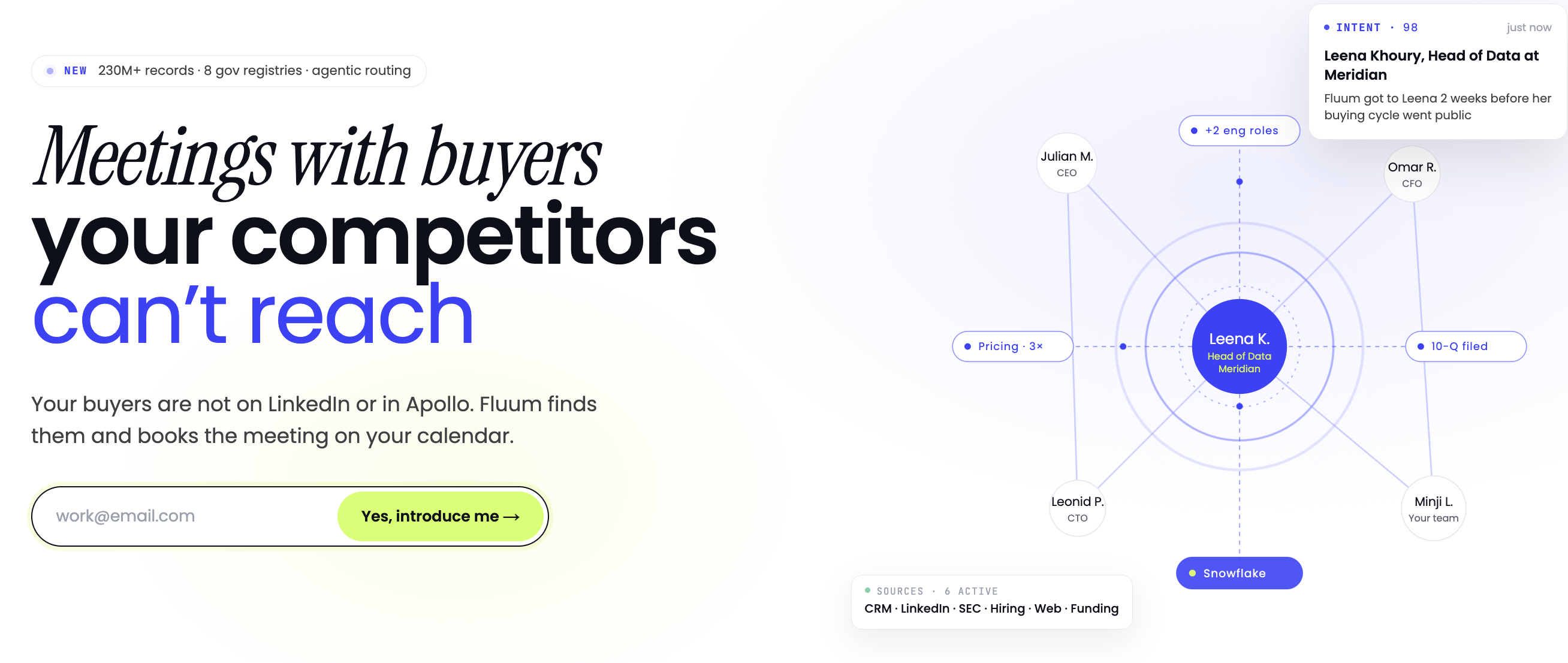
Fluum builds buyer graphs from 40+ private data vendors and 8 government registries, then uses AI agents to surface matched decision-makers and deliver warm, double opt-in introductions across the industries where cold outreach fails most visibly. If your pipeline depends on a channel people have learned to ignore, that’s worth examining before the next quarter’s target arrives.
Recommended Articles
Explore more from our content library: