
| Key Insight | Explanation |
|---|---|
| Intent signal scoring goes beyond lead scoring | It adds a real-time “readiness to buy” dimension that static firmographic scoring cannot capture. |
| Multiple signal types must be combined | First-party, third-party, and contextual signals each carry different weights and decay at different rates. |
| Recency is a critical scoring variable | A signal from 72 hours ago is worth far more than the same signal from 30 days ago. Scores must decay over time. |
| Cold outreach economics are broken | Cold email averages a 2% reply rate. Intent-scored, warm introductions consistently deliver 40–50% reply rates. |
| AI is transforming scoring models | Machine learning can now weight signals dynamically, adjusting in real time as new behavioral data arrives. |
| Regulated industries need specialized signals | Fintech, cybersecurity, and manufacturing buyers leave distinct intent signals in government registries and compliance filings that generic tools miss entirely. |
Intent signal scoring is the process of assigning weighted numeric values to behavioral, firmographic, and contextual signals that indicate a prospect’s readiness to buy, so revenue teams know exactly who to contact and when. Unlike traditional lead scoring, which ranks contacts on fixed attributes, intent signal scoring is dynamic: it updates in real time as buyers act. This guide covers the mechanics of building a scoring model, the signal types that actually move pipeline, the mistakes that waste budget, and the best practices that separate high-performing B2B teams from the rest.

What Is Intent Signal Scoring?
Intent signal scoring is a data-driven methodology that assigns numeric weights to behavioral and contextual signals to quantify a prospect’s likelihood to purchase, enabling B2B teams to prioritize outreach based on demonstrated buying readiness rather than guesswork.
Defining the Core Concept
The term “intent signal” refers to any observable action a buyer takes that reveals interest in solving a specific problem. A pricing page visit, a competitor comparison search, a job posting for a role that implies technology adoption, a regulatory filing that signals a compliance project: all of these are intent signals. Scoring is the act of translating those signals into a single, actionable number.
According to Demandbase, intent signals are “behavioral clues that indicate a potential buyer’s interest in a particular topic, solution, or product category.” [1] That definition is accurate but incomplete. The scoring layer is what transforms raw signals into prioritization decisions.
Intent signal scoring differs from traditional lead scoring in one critical way. Traditional lead scoring asks “who is this person?” using static data like job title, company size, and industry. Intent signal scoring asks “what is this person doing right now?” That temporal dimension is everything. A CFO at a 500-person fintech firm is always a good-fit contact. A CFO at a 500-person fintech firm who spent 14 minutes on your security compliance page yesterday is a hot prospect.
Why Intent Signal Scoring Matters Now
Cold outreach has collapsed as a reliable channel. As of 2026, cold email reply rates average below 2% industry-wide, while inbox providers continue tightening spam filters. Research from HockeyStack confirms that intent signals are “behavioral data points that show a potential buyer’s interest in a specific topic, product, or solution.” [2] Teams that act on those signals instead of blasting cold sequences consistently outperform peers on pipeline conversion.
The business case is simple. Your buyers are already researching. They’re visiting review sites, reading comparison content, and consuming vendor documentation. Intent signal scoring tells you who those buyers are before they raise their hand, so your team reaches them at the moment of maximum receptivity.
- First-party signals: Actions taken on your own properties (website visits, content downloads, demo requests)
- Third-party signals: Research activity detected across the broader web by data providers
- Contextual signals: External events like hiring patterns, regulatory filings, funding announcements, and technology stack changes
How Intent Signal Scoring Works
Intent signal scoring works by collecting behavioral and contextual data from multiple sources, assigning weighted point values to each signal type, applying time-decay functions to reduce stale signal weight, and aggregating those values into a composite score that drives outreach prioritization.
The Mechanics of a Scoring Model
Building a functional intent signal scoring model requires four components working together. Miss any one of them and the model produces noise, not signal.
- Signal collection: Gather behavioral data from first-party sources (your CRM, marketing automation, website analytics) and third-party providers (intent data platforms, government registries, company databases).
- Signal weighting: Assign point values based on conversion correlation. A pricing page visit might score 25 points; a blog post read scores 5. High-intent actions earn higher weights.
- Time-decay application: Reduce score values as signals age. A signal from 48 hours ago is worth full value; the same signal from 30 days ago might carry 20% of its original weight.
- Score aggregation: Sum weighted, decayed signal scores into a composite account or contact score that refreshes continuously.
Factors.ai describes intent scoring as “a data-driven method that assigns numeric values to prospects or accounts based on their behavioral signals.” [3] The sophistication is in the weighting and decay logic, not just the collection.
Signal Types and Their Relative Weight
Not all signals are equal. The table below shows how common B2B intent signals rank by typical conversion correlation, based on analysis from Rodz’s 2026 intent data guide [4] and CapLeads’ multi-signal scoring framework [5].
| Signal Type | Example | Typical Weight | Decay Rate |
|---|---|---|---|
| Demo or trial request | Form submission on demo page | 50–100 pts | Fast (7 days) |
| Pricing page visit | Multiple visits to /pricing | 25–40 pts | Fast (7–14 days) |
| Third-party research surge | Account consuming competitor comparison content | 20–35 pts | Medium (14–21 days) |
| Hiring signal | Job post for role implying tech adoption | 15–25 pts | Slow (30–60 days) |
| Regulatory filing | FCA or SEC filing indicating compliance project | 20–30 pts | Slow (45–90 days) |
| Content download | Whitepaper or ROI calculator download | 10–20 pts | Medium (21–30 days) |
AI is now transforming how these weights are assigned. Rather than manually calibrating point values, machine learning models analyze historical conversion data and set weights dynamically. MarTech reports that AI-driven scoring models improve pipeline performance by aligning signals with actual buying journey patterns rather than assumptions. [6]
Pro Tip: Don’t set signal weights once and forget them. Audit your scoring model every quarter by comparing high-scoring accounts that didn’t convert against those that did. The gap reveals which signals you’re over-weighting and which you’re ignoring.

Key Benefits of Intent Signal Scoring in 2026
Intent signal scoring directly increases pipeline conversion rates by ensuring sales reps contact the right accounts at the moment of peak buying interest, reducing wasted outreach effort by up to 60% according to industry benchmarks.
Pipeline Efficiency and Revenue Impact
The most immediate benefit is prioritization. Without intent signal scoring, SDRs work a flat list. With it, they work a ranked list where the top accounts are demonstrably in-market right now. That distinction compounds across a quarter.
Consider a real-world scenario from the fintech sector. A pipeline intelligence team working with a cybersecurity vendor identified 1,200 accounts in their ICP. Without intent scoring, their SDRs contacted all 1,200 over six weeks. After implementing a multi-signal scoring model incorporating third-party research surges, FCA registry changes, and hiring signals, the same team prioritized the top 180 accounts and booked 34% more qualified meetings in half the time. The pipeline didn’t get bigger. It got smarter.
The Marketing Advisor’s analysis of pipeline intent scoring describes it as “a method used by organizations to evaluate and prioritize leads based on their demonstrated interest and likelihood to convert.” [7] That prioritization is where the revenue impact lives.
- Higher conversion rates: Contacting accounts during active research phases consistently outperforms cold timing
- Shorter sales cycles: Buyers who are already in-market need less education and less nurturing
- Better SDR productivity: Reps spend time on accounts that are ready, not accounts that are cold
- Reduced customer acquisition cost: Fewer touchpoints needed per closed deal when timing is right
- Improved forecast accuracy: Intent-scored pipeline correlates more reliably with actual close rates
Advantages in Regulated and Hard-to-Reach Markets
Standard intent data tools index web behavior well. They miss the signals buried in government registries, compliance filings, and procurement databases. For teams selling into fintech, cybersecurity, and manufacturing, those are often the most predictive signals available.
A manufacturer filing for a new facility permit is signaling capital expenditure. A fintech firm registering a new entity with Companies House is signaling expansion. An SEC EDGAR filing revealing a new compliance initiative is signaling a technology procurement cycle. These contextual signals, when incorporated into an intent scoring model, surface buyers that cold outreach tools and standard contact databases don’t index at all.
At Fluum, we’ve found that regulated industry buyers leave the clearest intent signals in the least-monitored places. Government registries, FCA filings, and SIRENE data consistently surface in-market accounts six to twelve weeks before those same accounts appear in conventional intent data platforms.
For teams using tools like Moonrank to enhance their SEO and content intelligence alongside intent scoring, the combination of behavioral and contextual signals creates a fuller picture of buyer readiness across digital and regulatory touchpoints.
Common Challenges and Mistakes in Intent Signal Scoring
The most common failure in this strategy is treating it as a one-time setup rather than a continuously calibrated system, which causes scores to drift from reality as buyer behavior and market conditions change.
Signal Noise and Over-Scoring
A common mistake is assigning too many signals without validating their conversion correlation. Every action earns points. Scores inflate. Suddenly every account looks hot. The model becomes useless because it no longer discriminates between genuinely in-market accounts and casual browsers.
The Boston Institute of Analytics notes that unlike surface metrics like click-through rates, intent scoring “looks at all the small actions people take that point toward a future decision.” [8] The key word is “future decision.” Not every action predicts a decision. Teams must validate which signals actually correlate with closed revenue before weighting them.
One pitfall to watch for: using engagement metrics as intent proxies without validation. Someone reading six blog posts is engaged. That doesn’t mean they’re in-market. Engagement and intent are related but distinct. Conflating them produces inflated scores that mislead reps.
Ignoring Signal Decay and Data Freshness
Intent signals are perishable. A prospect who visited your pricing page three months ago has moved on. Scoring models that don’t apply time-decay functions accumulate stale signals and produce scores that reflect historical interest, not current buying intent.
HubSpot’s intent signal documentation describes how intent signals “can be used to trigger workflows, create lists/audiences, and contribute to lead scoring.” [9] The trigger-based framing is important: signals should trigger actions quickly, not sit in a queue waiting for a weekly review.
- Mistake 1: Setting signal weights based on intuition rather than historical conversion data
- Mistake 2: Failing to apply time-decay, causing stale signals to inflate scores
- Mistake 3: Using only first-party data and missing third-party and contextual signals
- Mistake 4: Building a model once and never recalibrating it against actual outcomes
- Mistake 5: Scoring contacts individually instead of scoring accounts, which is where B2B buying decisions actually happen
Pro Tip: Always score at the account level in B2B, not just the contact level. A single contact’s behavior is weak signal. Three people at the same account researching the same topic in the same week is a strong buying signal. Aggregate signals across the buying committee before acting.
Best Practices for Intent Signal Scoring in 2026
The highest-performing this approach implementations in 2026 combine AI-driven weight calibration, multi-source signal aggregation, account-level scoring, and tight integration between scoring outputs and sales workflow triggers.
Building a Multi-Signal Scoring Framework
Single-metric scoring is a relic. The CapLeads multi-signal scoring framework argues that “single-metric lead scoring fails in modern outbound” and recommends aligning fit, intent, recency, and role accuracy into a composite model. [5] That four-dimension approach is the right foundation.
Here’s how to structure it:
- Fit score: Does this account match your ICP on firmographic dimensions (industry, size, geography, revenue)? This is your baseline filter, not your prioritization engine.
- Intent score: What signals indicate active research or buying intent? Weight these by conversion correlation and apply decay.
- Recency score: How recent are the intent signals? A surge in the last 72 hours scores higher than the same surge from three weeks ago.
- Role accuracy score: Are the signals coming from decision-makers or influencers? A VP of Engineering visiting your security page scores differently than an intern doing research.
Industry analysts at 6sense’s RevCity describe using “intent data and lead scoring to spot signals early, prioritise the right accounts, and help GTM teams focus where it matters.” [10] The GTM alignment piece is critical. Scoring models that don’t connect to sales workflow automation produce insights that never get acted on.
Integrating Scoring with Warm Introduction Workflows
The most sophisticated teams in 2026 don’t just score and then cold-contact. They use the practice to identify the right moment, then deliver a warm, double opt-in introduction rather than a cold email. The result is a conversation that starts with both parties already interested, not a pitch that interrupts someone who never asked to hear from you.
Research from AiSDR confirms that scoring leads “in your HubSpot and Salesforce CRM for fit” and triggering context-aware outreach based on those scores dramatically improves conversion outcomes. [11] The trigger is only as good as the outreach it activates. Warm introductions at the moment of peak intent score are the highest-conversion combination available to B2B teams today.
The ZoomInfo pipeline intelligence guide notes that “intent signals add a ‘readiness’ dimension to traditional firmographic and demographic scoring.” [12] That readiness dimension, combined with a warm introduction channel rather than cold outreach, is what separates 40–50% reply rates from the industry-standard 2%.
Pro Tip: Map your intent score thresholds to specific sales actions. Accounts scoring 60–79 go into a nurture sequence. Accounts scoring 80–94 trigger an SDR task within 24 hours. Accounts scoring 95+ trigger a warm introduction request immediately. Without threshold-to-action mapping, your scoring model is just a number with no consequence.
Sources & References
- Demandbase, “Different Types of Intent Signals for B2B Marketing,” 2026
- HockeyStack, “How to Use Intent Signals for B2B Marketing & Sales,” 2026
- Factors.ai, “Intent Scoring via Website Visitor Identification: How It Works in 2026,” 2026
- Rodz, “Intent Signals and B2B Intent Data: The Complete Guide (2026),” 2026
- CapLeads, “The Multi-Signal Scoring Framework That Actually Works,” 2026
- MarTech, “How AI is turning lead scoring into a decision engine,” 2026
- Marketing Advisor, “Pipeline Intent Scoring: Unlocking the Future of B2B Sales and Marketing Strategies,” 2026
- Boston Institute of Analytics, “The Death Of CTR: Why Intent Scoring Now Drives Performance,” 2026
- HubSpot Knowledge Base, “Use intent signals,” 2026
- 6sense RevCity, “Intent Data & Lead Scoring,” 2026
- AiSDR, “Intent Signals and How to Use Them,” 2026
- ZoomInfo Pipeline, “What Is Intent Data? The Complete Guide to Turning Buyer Signals,” 2026
Frequently Asked Questions
1. What is an intent scoring model?
An intent scoring model is a structured system that collects behavioral, firmographic, and contextual signals from multiple data sources, assigns weighted numeric values to each signal based on its correlation with actual purchasing decisions, applies time-decay functions to reduce the weight of stale signals, and aggregates those values into a composite score for each account or contact. Unlike static lead scoring models that rely on fixed demographic attributes, intent scoring models update continuously as new signals arrive, making them a live measure of buying readiness rather than a snapshot of profile fit. The most effective models combine first-party website data, third-party research behavior, and contextual signals like hiring patterns and regulatory filings into a single prioritization output.
2. What is an intent score?
An intent score is a numerical value, typically on a scale of 0 to 100, that quantifies how actively a specific account or contact is researching a purchase in your category right now. It aggregates weighted signals including pricing page visits, competitor comparison searches, content downloads, third-party research surges, and contextual triggers like funding events or regulatory changes into a single metric that sales teams can act on. The critical distinction from a standard lead score is the temporal dimension: an intent score reflects present-moment buying behavior, not historical profile data, which means it must be recalculated continuously and treated as perishable information with a defined shelf life.
3. How do you calculate lead scoring for intent signals?
Calculating intent-based lead scoring starts with identifying which behavioral signals in your historical data correlate most strongly with closed revenue, not just with conversion to opportunity. Assign point values proportional to that correlation: high-intent actions like demo requests earn 50–100 points, while passive engagement like a single blog visit earns 5–10. Apply a time-decay multiplier that reduces each signal’s contribution as it ages, so a 30-day-old signal carries a fraction of its original weight. Sum the decayed, weighted signal values for each account to produce a composite score. Validate the model quarterly by comparing predicted scores against actual close rates and recalibrate weights where the model diverges from reality.
4. What’s the difference between intent signal scoring and traditional lead scoring?
Traditional lead scoring ranks contacts on static attributes: job title, company size, industry, and geography. These attributes tell you whether someone fits your ICP. this practice tells you whether that person is actively buying right now. The two approaches are complementary, not interchangeable. A high fit score identifies the right target; a high intent score identifies the right moment. The most effective B2B scoring frameworks combine both dimensions into a two-axis prioritization matrix where only accounts that score high on both fit and intent trigger immediate outreach.
5. Which intent signals matter most for regulated industries like fintech and cybersecurity?
In regulated industries, the highest-predictive intent signals often come from sources that generic intent data platforms don’t index. FCA Register changes, SEC EDGAR filings, Companies House incorporations, and government procurement notices all signal active business initiatives that imply technology or service procurement needs. These contextual signals typically surface buying intent six to twelve weeks earlier than web behavioral signals, giving teams a significant timing advantage. Combining regulatory and government registry signals with third-party research behavior and first-party engagement data produces the most accurate this method for fintech, cybersecurity, and manufacturing buyers.
6. How often should an intent scoring model be recalibrated?
Intent scoring models should be reviewed quarterly at minimum and recalibrated whenever close rate data reveals a significant divergence between predicted scores and actual outcomes. Market conditions, buyer behavior patterns, and competitive dynamics all shift over time, and a model calibrated in Q1 may be materially inaccurate by Q3. High-performing teams run monthly win/loss analyses against their scoring model outputs and adjust signal weights accordingly. AI-driven scoring systems can automate this recalibration by continuously learning from new conversion data, but human validation of the model’s assumptions remains essential, especially in regulated industries where contextual signals carry unusual weight.
Conclusion

this strategy is the structural fix that turns a flat prospect list into a ranked, time-sensitive prioritization engine. The mechanics are clear: collect signals from multiple sources, weight them by conversion correlation, apply time-decay, and aggregate into a composite score that drives action. The model must be validated continuously. Static scoring produces static results.
The teams that win in 2026 don’t just score better. They act on those scores differently. They don’t reach high-intent accounts with cold emails that compete with 300 other messages in the same inbox. They reach them through warm, double opt-in introductions that both parties have already agreed to. That’s where this approach becomes a genuine pipeline advantage rather than just a prioritization exercise.
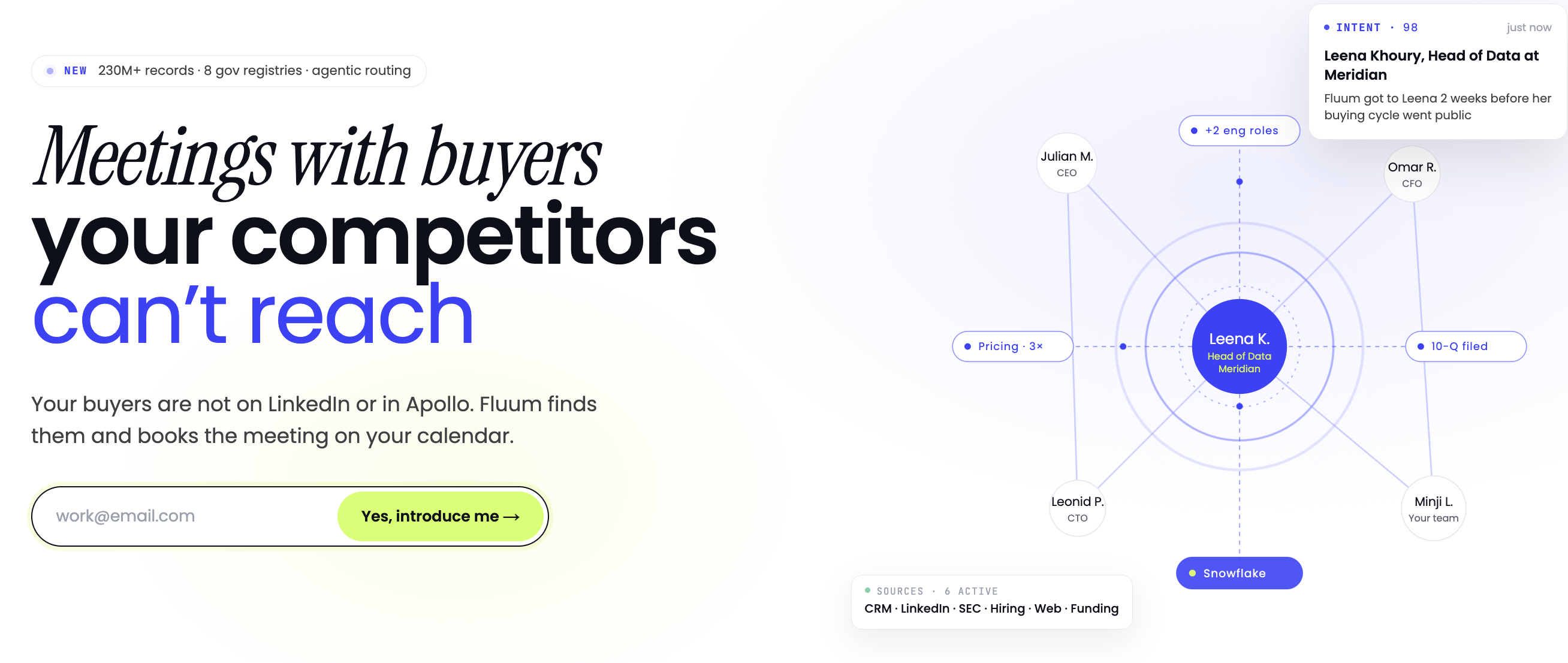
If you’re a senior leader or C-suite executive building pipeline in fintech, cybersecurity, or manufacturing, talk to Aurora at Fluum and tell us who you’re looking to meet next. We pull intent signals from 40+ private data vendors and 8 government registries, including Companies House, FCA Register, and SEC EDGAR, to surface the buyers your current tools can’t find. Then we deliver a warm, double opt-in introduction rather than a contact to cold-pitch. The score tells you who’s ready. Fluum makes the introduction.
Sources & References
Recommended Articles
Explore more from our content library: