

What is social intelligence?.Most American companies agree that strong social intelligence can mean the difference between failed projects and high-performing teams. In competitive business settings, professionals face subtle challenges every day that require far more than technical skill. Mastering social intelligence helps individuals read emotional cues, build trust, and navigate complex relationships at work. With research showing that up to 85 percent of workplace success depends on people skills, developing this ability shapes American business results in powerful ways.
Table of Contents
- Defining Social Intelligence In Business Contexts
- Core Types And Key Components Explained
- How Social Intelligence Drives Client Relationships
- Spotting Buying Signals And Social Cues
- Overcoming Common Mistakes In Social Interactions
Key Takeaways
| Point | Details |
|---|---|
| Importance of Social Intelligence | Social intelligence is essential for effective communication and relationship building in business environments. It enhances emotional awareness and the ability to navigate complex interpersonal dynamics. |
| Core Components of Social Intelligence | Developing self-awareness, self-management, social awareness, relationship management, and responsible decision-making is critical for professional success. Each component plays a unique role in interpersonal effectiveness. |
| Impact on Client Relationships | Leveraging social intelligence can transform client interactions from transactional exchanges to strategic partnerships, fostering deeper understanding and long-term collaboration. |
| Common Mistakes in Communication | Recognizing and addressing common social interaction pitfalls, such as interrupting and misreading cues, can significantly improve overall communication effectiveness in professional settings. |
Defining Social Intelligence In Business Contexts
Social intelligence represents a critical skill set for professionals navigating complex interpersonal dynamics in modern business environments. At its core, social intelligence involves the nuanced ability to read, understand, and effectively respond to social signals and emotional contexts within workplace interactions. Understanding the intricate web of interpersonal relationships allows individuals to create more meaningful and productive professional connections.
In practical business terms, social intelligence transcends basic communication skills. It encompasses emotional awareness, empathy, and strategic relationship management. Professionals with high social intelligence can decode subtle nonverbal cues, anticipate team dynamics, and navigate complex social landscapes with remarkable precision. Business interactions require sophisticated emotional comprehension that goes beyond surface-level communication, enabling leaders and team members to build trust and collaborate more effectively.
Successful social intelligence in business manifests through several key competencies:
- Emotional recognition and regulation
- Active listening skills
- Adaptability in diverse social contexts
- Empathetic communication
- Conflict resolution capabilities
Pro Business Insight: Practice active listening by focusing entirely on the speaker, maintaining eye contact, and reflecting back what you hear to demonstrate genuine understanding and build stronger professional relationships.
By developing social intelligence, professionals can transform their workplace interactions, creating more collaborative, supportive, and high-performing team environments.
Core Types And Key Components Explained
Social intelligence is not a monolithic concept, but rather a complex framework composed of interconnected skills and capabilities. Comprehensive models of social intelligence reveal five fundamental components that form the foundation of effective social interactions in professional environments.
These core components represent a holistic approach to interpersonal effectiveness. Each element contributes uniquely to an individual’s ability to navigate social landscapes:
- Self-Awareness
- Understanding personal emotions and triggers
- Recognizing how personal behavior impacts others
- Identifying personal strengths and limitations
- Self-Management
- Regulating emotional responses
- Maintaining composure under pressure
- Adapting behavior to different social contexts
- Social Awareness
- Reading nonverbal communication signals
- Empathizing with others’ perspectives
- Understanding group dynamics and unspoken social rules
- Relationship Management
- Building and maintaining professional connections
- Resolving conflicts constructively
- Inspiring and influencing team members
- Responsible Decision-Making
- Evaluating social-emotional consequences of decisions
- Considering ethical implications
- Balancing individual and collective needs
Pro Development Strategy: Conduct weekly self-reflection sessions where you analyze your social interactions, identifying areas for improvement and tracking your progress in developing these core social intelligence components.
By systematically developing these interconnected skills, professionals can dramatically enhance their ability to communicate, collaborate, and lead effectively across diverse business environments.
Here’s a summary of the five core components of social intelligence and their business value:
| Component | What It Involves | Business Benefit |
|---|---|---|
| Self-Awareness | Understanding emotion triggers | Guides personal growth and leadership |
| Self-Management | Regulating one’s emotional responses | Improves stress handling and focus |
| Social Awareness | Interpreting group and social cues | Enhances team collaboration |
| Relationship Management | Building networks and resolving issues | Strengthens professional partnerships |
| Responsible Decision-Making | Weighing ethical and social impact | Supports fair and sustainable choices |
How Social Intelligence Drives Client Relationships
Social intelligence fundamentally transforms how professionals approach client interactions, moving beyond transactional exchanges to create meaningful, strategic partnerships. Businesses that leverage social intelligence can proactively understand and anticipate client needs, developing deeper, more resilient professional relationships that transcend traditional communication methods.
The strategic advantage of social intelligence in client relationships emerges through several critical dimensions. Professionals with high social intelligence can:
- Decode subtle emotional signals
- Recognize unspoken client expectations
- Adapt communication styles dynamically
- Build genuine trust and rapport
- Predict potential collaboration opportunities
Recognizing and responding to nuanced social cues allows professionals to identify emerging client needs before they are explicitly articulated. This proactive approach transforms client interactions from reactive problem-solving to strategic partnership development. By understanding the emotional landscape of client relationships, professionals can create more personalized, responsive service experiences that differentiate them in competitive markets.

Effective social intelligence requires continuous learning and emotional attunement. Professionals must develop an acute awareness of communication subtleties, cultural contexts, and individual client preferences. This means going beyond surface-level interactions to truly understand the motivations, challenges, and aspirations driving each client relationship.
Pro Relationship Building Technique: Practice active empathy by dedicating 15 minutes after each client interaction to reflect on the emotional undertones of the conversation, identifying potential unspoken needs or concerns.
By integrating social intelligence into client relationship strategies, professionals can build more authentic, sustainable, and mutually beneficial partnerships that drive long-term business success.
Spotting Buying Signals And Social Cues
Buying signals represent the subtle communication markers that indicate a potential client’s readiness to engage or purchase. Sales professionals with advanced social intelligence can decode these nuanced communication patterns, transforming seemingly ordinary interactions into strategic opportunities for business growth.
Effective buying signal recognition involves understanding multiple communication dimensions:
- Verbal Buying Signals
- Asking specific pricing questions
- Inquiring about implementation details
- Discussing budget and resource allocation
- Expressing timeline preferences
- Nonverbal Buying Signals
- Increased eye contact
- Leaning forward during conversations
- Mirroring body language
- Reduced physical distance during interactions
- Digital Communication Signals
- Repeated website visits
- Downloading informational resources
- Engaging with multiple content pieces
- Requesting additional information
Advanced social intelligence enables businesses to interpret complex buying signals that extend beyond traditional sales approaches. This sophisticated understanding allows professionals to anticipate client needs, customize communication strategies, and create more meaningful engagement pathways.
The most successful professionals view buying signals as a holistic conversation, integrating verbal, nonverbal, and digital communication channels to build comprehensive client understanding. This approach transforms potential transactions into genuine, long-term partnerships.
Pro Signal Detection Strategy: Develop a personal tracking system where you log and analyze buying signals after each client interaction, creating a personalized database of communication insights that will refine your social intelligence over time.
By mastering the art of recognizing and responding to nuanced buying signals, professionals can significantly enhance their ability to connect with potential clients and drive meaningful business relationships.
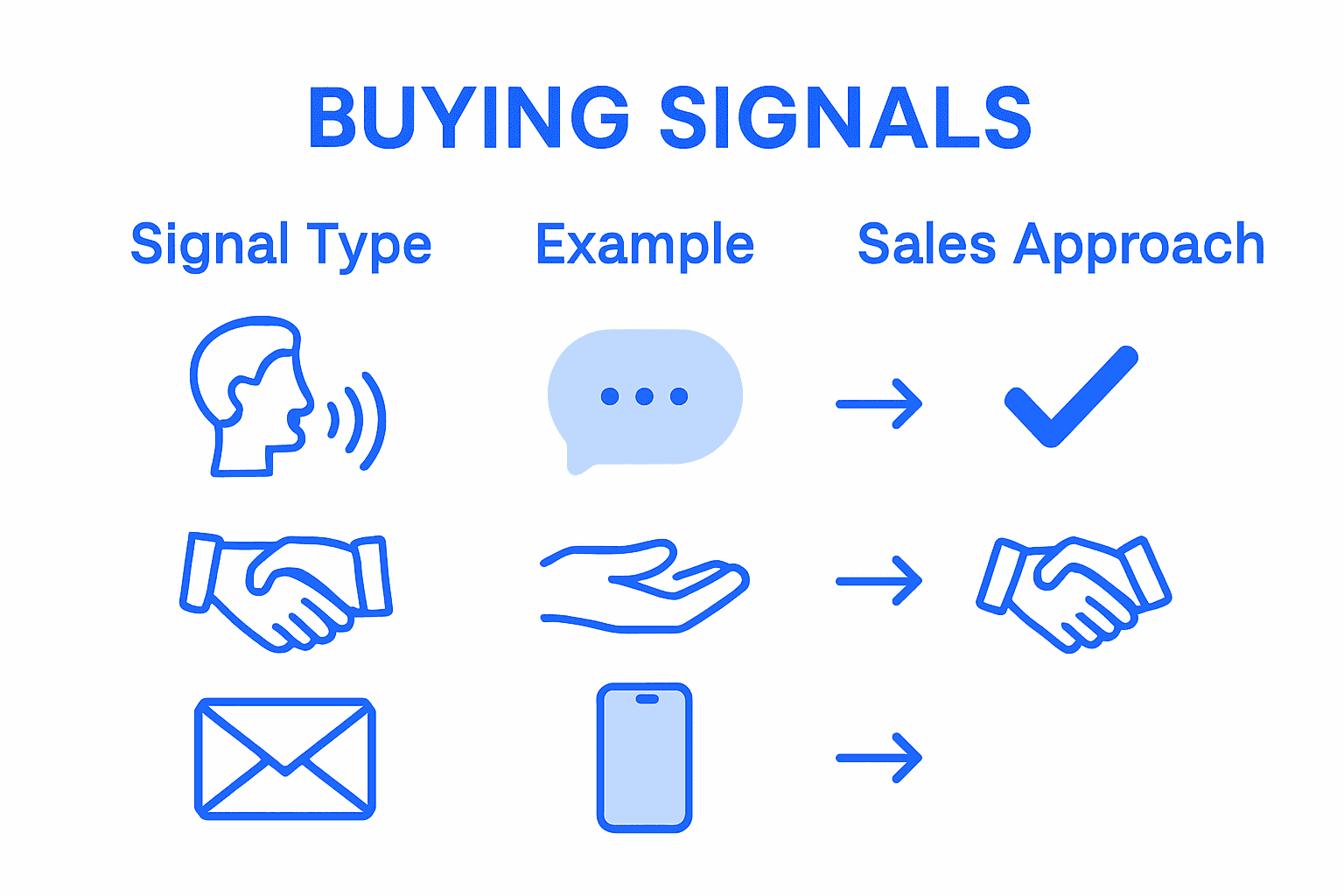
This table compares verbal, nonverbal, and digital buying signals in client communication:
| Signal Type | Typical Examples | How It Guides Sales Approach |
|---|---|---|
| Verbal | Budget questions, timeline details | Signals intent and readiness to proceed |
| Nonverbal | Eye contact, body language shifts | Shows engagement or concealed hesitation |
| Digital | Multiple resource downloads | Reveals interest and pre-purchase research |
Overcoming Common Mistakes In Social Interactions
Social interactions are complex landscapes where even experienced professionals can stumble. Developing emotional intelligence helps leaders proactively identify and prevent common communication pitfalls, transforming potential misunderstandings into opportunities for deeper connection.
Common social interaction mistakes typically fall into several critical categories:
- Communication Missteps
- Interrupting before others finish speaking
- Dominating conversations
- Failing to listen actively
- Misreading emotional context
- Oversharing personal information
- Nonverbal Communication Errors
- Inconsistent body language
- Avoiding eye contact
- Displaying defensive postures
- Mismatched facial expressions
- Inappropriate physical proximity
- Emotional Intelligence Gaps
- Reacting defensively
- Dismissing others’ perspectives
- Projecting personal assumptions
- Lacking empathy
- Struggling with emotional regulation
Cultural intelligence plays a crucial role in navigating diverse social environments, helping professionals understand and respect different communication styles and cultural nuances. This awareness prevents misunderstandings that can derail professional relationships and create unnecessary tension.
Successful social interaction requires continuous self-reflection and adaptive communication strategies. Professionals must develop a keen awareness of their own communication patterns, emotional triggers, and potential blind spots. This ongoing process of learning and improvement distinguishes exceptional communicators from average performers.
Pro Interaction Improvement Strategy: Record and review a sample of your professional conversations weekly, critically analyzing your communication patterns, identifying potential areas of improvement, and developing targeted strategies for more effective interactions.
By systematically addressing these common social interaction mistakes, professionals can build more authentic, responsive, and meaningful connections across diverse business environments.
Unlock Social Intelligence to Connect with High-Intent Clients Effortlessly
The article highlights how crucial social intelligence is for recognizing buying signals and building meaningful professional relationships. If you find it challenging to decode subtle client cues or want to avoid cold outreach, you are not alone. Many solopreneurs and freelancers struggle with turning social interactions into real opportunities because it requires a deep understanding of social signals and emotional context.
Fluum is designed with these exact challenges in mind. Our AI-powered platform acts like your personal business development engine, using social intelligence and behavioral signals to identify clients who are already interested in your services. It surfaces warm opportunities from your broader network and manages introductions for you, helping you avoid common pitfalls like confusing buying signals or missed connection chances.
Take your client relationships from guesswork to clear action with Fluum’s AI co-founder. Discover how to leverage the concepts of social awareness and relationship management discussed in the article by trying Fluum today.

Ready to stop chasing leads and start building authentic connections based on real buying intent Explore the Fluum pricing and plans to see how you can get started now and turn social intelligence into your competitive advantage.
Frequently Asked Questions
What is social intelligence in a business context?
Social intelligence in a business context refers to the ability to read, understand, and effectively respond to social signals and emotional contexts during workplace interactions, enhancing communication and relationships.
Why is social intelligence important for professionals?
Social intelligence is crucial for professionals because it enables them to navigate complex interpersonal dynamics, build trust, collaborate effectively, and create more meaningful working relationships, ultimately impacting team performance and business success.
What are the core components of social intelligence?
The core components of social intelligence include self-awareness, self-management, social awareness, relationship management, and responsible decision-making, each contributing to better interpersonal effectiveness.
How can one develop social intelligence skills?
One can develop social intelligence skills through active listening, self-reflection, adapting to various social contexts, practicing empathy, and consistently seeking feedback to improve communication and emotional understanding.
Recommended
- Emotional Intelligence At Work: Essential Guide
- Social Proof In Consulting: Unlocking Trust And Referrals
- What Is Personal Branding And Why It Matters
- 7 Networking Tips For Solopreneurs To Build Real Connections
- Fluum | Effective Stress Management Techniques for Busy Professionals
- Fluum | How to Onboard Clients Effectively for Lasting Success
- Fluum | Master Managing Multiple Projects for Success
- Fluum | Build Your Brand with a Branding Builder in 2025
- Fluum | 7 Customer Retention Examples to Boost Your Business