
| Key Insight | Explanation |
|---|---|
| What it is | Buyer graph intelligence maps relationships between companies, decision-makers, and buying signals into a connected data structure that AI can traverse and score. |
| Why cold outreach fails | Cold email averages a 2% reply rate. Buyer graphs surface warm paths to the same contacts, reaching 40–50% reply rates through mutual-interest introductions. |
| Data sources that matter | Effective buyer graphs pull from government registries (Companies House, SEC EDGAR, FCA Register) and private vendor signals — sources most outbound tools never touch. |
| AI’s role | AI agents score intent signals, identify shortest relationship paths, and rank decision-maker nodes by fit and readiness — removing the manual guesswork from prospecting. |
| Double opt-in advantage | Introductions only happen when both sides confirm interest. That mutual consent is why graph-powered warm intros convert at multiples of cold outreach. |
| Who benefits most | Sales and RevOps leaders in fintech, cybersecurity, and manufacturing — regulated industries where cold contact is both ineffective and increasingly non-compliant. |
Buyer graph intelligence is the practice of mapping companies, individuals, and their interconnected relationships into a structured graph, then using AI to score intent signals and surface the shortest, warmest path to a buying decision. It replaces the flat contact list with a living network where every node has context and every edge carries meaning. The result is pipeline built on relationship proximity, not volume.
Cold outreach is broken. The numbers are not ambiguous: cold email reply rates sit at roughly 2% as of 2026, and inbox providers are tightening filters further [1]. The companies still winning new business are not sending more emails. They’re finding smarter paths to buyers who already have a reason to say yes.
This article explains exactly how buyer graph intelligence works, why it outperforms traditional prospecting, and what your team needs to do differently to build pipeline that converts.

What Is Buyer Graph Intelligence?
Buyer graph intelligence is a data architecture and AI methodology that models B2B buyers, their organizations, their relationships, and their behavioral signals as a connected graph structure, enabling sales teams to identify the highest-probability path to a purchase decision.
The Core Concept: Nodes, Edges, and Intent
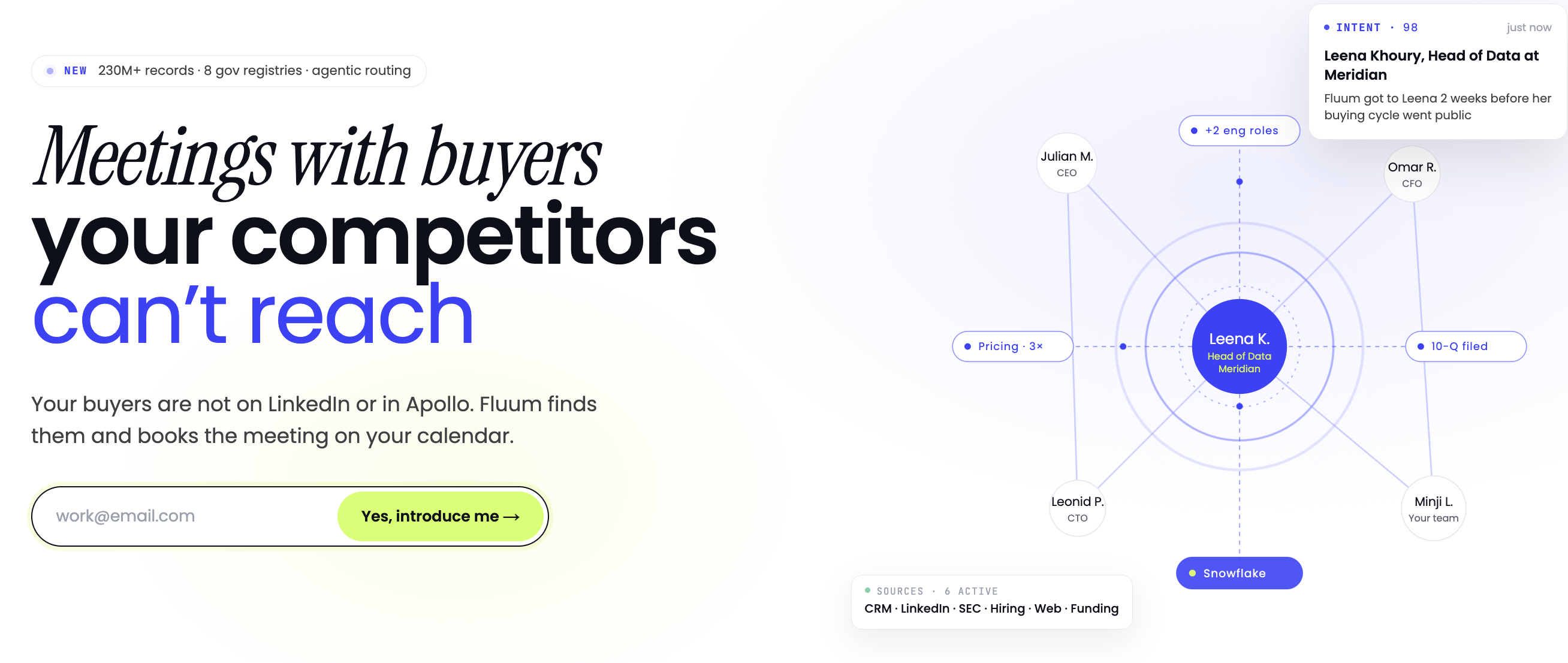
A graph, in the technical sense, is a set of entities (nodes) connected by relationships (edges). In a buyer graph, nodes represent people, companies, roles, funding events, regulatory filings, and technology signals. Edges represent the relationships between them: board membership, vendor contracts, alumni networks, co-investment, regulatory oversight.
Traditional CRM data is flat. It tells you a contact’s title and email address. A buyer graph tells you that the CISO at a target fintech firm previously worked alongside your best customer’s CFO, that the company recently filed for FCA authorization, and that three of its board members sit on boards you already have relationships with. That’s a fundamentally different starting point for a conversation.
As researchers at Stanford’s Knowledge Graph project note, graph structures enable “high-context, relationship-first analysis” that static databases simply cannot replicate [2]. The MIT Professional Education program on AI graph algorithms reinforces this, describing how graph methods “uncover hidden relationships” that reveal opportunity in ways row-and-column data never surfaces [3].
Why Buyer Graphs Are Different from Contact Databases
Contact databases answer one question: who exists? Buyer graphs answer a harder question: who is reachable, through whom, and why would they care right now?
- Contact database: Name, title, email, company, LinkedIn URL
- Buyer graph: Relationship paths, shared connections, intent signals, regulatory triggers, funding events, technology stack changes, and organizational shifts
The difference is not incremental. It’s the difference between a phone book and a social map of who trusts whom.
Pro Tip: When evaluating any pipeline intelligence tool, ask specifically where its graph data originates. Tools that rely solely on LinkedIn or scraped web data miss the government registry signals (Companies House filings, SEC EDGAR disclosures, FCA authorizations) that reveal buying triggers months before they appear in any commercial database.
How Buyer Graph Intelligence Works
Buyer graph intelligence works by ingesting signals from multiple data sources, structuring them as a connected graph, running AI agents across that graph to score nodes by intent and fit, and then identifying the shortest warm path from seller to buyer.
The Data Ingestion and Graph Construction Layer
Building a useful buyer graph starts with data breadth. Fluum’s platform pulls from 40+ private data vendors and 8 government registries, including Companies House, the FCA Register, SEC EDGAR, and SIRENE. That combination matters because government registries surface regulatory events, directorship changes, and corporate restructuring that commercial vendors don’t capture.
The ingestion process works in structured steps:
- Source aggregation: Pull structured and unstructured data from private vendors, government filings, and opted-in network signals.
- Entity resolution: Deduplicate and normalize entities (the same person appearing under different name formats, for example) into single canonical nodes.
- Edge mapping: Identify and weight relationships between nodes based on source reliability, recency, and relationship type.
- Signal scoring: AI agents assign intent scores to nodes based on behavioral triggers: hiring patterns, funding rounds, regulatory filings, technology purchases.
- Path ranking: For any target node (a buyer), the system surfaces the shortest, warmest relationship path from your network to theirs.
Research published in Frontiers in Artificial Intelligence in 2026 confirms that dynamic graph learning models that jointly process buyer-centric, seller-centric, and buyer-seller interaction subgraphs significantly outperform static approaches in predicting purchase intent [1].
How AI Agents Score and Surface Opportunities
Raw graph data is not actionable on its own. The intelligence layer is what makes it useful. AI agents traverse the graph continuously, looking for combinations of signals that indicate a buying window is open.
Typical intent signals scored by a buyer graph AI include:
- New regulatory filing or license application (indicates growth or compliance spend)
- Series A/B/C funding announcement (budget now exists)
- Senior leadership hire in a relevant function (new decision-maker, fresh mandate)
- Technology stack change detected via job postings or vendor announcements
- Board member overlap with existing customers (trusted third-party path exists)
- Industry event attendance or speaking engagement (active engagement signal)
According to analysis from CriticalHit, teams that understand buyer context earlier through graph-based AI can identify opportunities significantly ahead of competitors still relying on linear prospecting lists [4].
Key Benefits of Buyer Graph Intelligence in 2026
Buyer graph intelligence delivers higher reply rates, shorter sales cycles, and access to buyers that conventional outbound tools cannot reach — particularly in regulated industries where cold contact is both ineffective and increasingly risky.
Measurable Pipeline and Conversion Advantages
The headline number is the reply rate. Cold email averages 2%. Warm introductions facilitated through buyer graph intelligence, where both parties have confirmed interest before any message is sent, reach 40–50% reply rates consistently.
That is not a marginal improvement. It’s a structural change in how pipeline gets built.
| Approach | Average Reply Rate | Buyer Consent | Data Sources | Reach Beyond LinkedIn |
|---|---|---|---|---|
| Cold email / cold LinkedIn | ~2% | None | Single platform | No |
| Contact database + sequencing | 3–5% | None | Commercial only | Limited |
| Buyer graph intelligence (warm intro) | 40–50% | Double opt-in | 40+ vendors + 8 gov registries | Yes |
Beyond reply rates, buyer graph intelligence delivers three additional structural advantages:
- Access to off-LinkedIn buyers: Regulated industries (fintech, cybersecurity, manufacturing) have significant decision-maker populations that don’t maintain active LinkedIn profiles but do appear in government registries and private data networks.
- Earlier buying signal detection: Graph-based intent scoring surfaces opportunities weeks or months before a prospect self-identifies through search or content engagement.
- Reduced SDR time waste: When introductions are pre-qualified and mutually opted-in, SDRs spend time on conversations, not on prospecting sequences that yield nothing.
Compliance and Trust Advantages in Regulated Markets
Cold outreach in regulated industries carries real legal exposure. GDPR, CASL, and sector-specific regulations in financial services increasingly restrict unsolicited contact with individuals who haven’t signaled interest. Buyer graph intelligence built on opted-in networks and government registry data sidesteps this risk entirely.
Research from a 2026 study in Scientific Reports on knowledge graph reasoning in B2B segmentation confirms that relationship-first graph models improve both targeting precision and the explainability of outreach decisions — a meaningful compliance advantage in regulated sectors [5].
Pro Tip: If your ICP includes financial services firms, check whether your intelligence platform pulls from the FCA Register and SEC EDGAR. A new FCA authorization or EDGAR filing is one of the clearest buying signals in regulated markets — it indicates a company is scaling its compliance function and actively evaluating vendors.
Common Challenges and Mistakes to Avoid
The most common failure in deploying buyer graph intelligence is treating it like a better contact list rather than a fundamentally different prospecting methodology — which leads teams to replicate cold outreach behavior on warm data.
Mistake 1: Ignoring Graph Depth in Favor of Volume
A shallow buyer graph built from a single commercial data vendor produces the same stale contacts as any other list tool. The value of graph intelligence comes from data breadth and relationship depth, not from the size of the contact count.
In practice, we see teams make this mistake constantly. They license a graph-adjacent tool, pull 10,000 contacts, and hand them to SDRs for sequencing. The reply rates stay at 3%. The graph never got used as a graph.
The fix is to prioritize relationship path analysis over raw contact volume:
- Map which target accounts have second-degree connections through your existing customer base
- Prioritize accounts where a board member or executive has a verified relationship with someone in your network
- Score accounts by relationship proximity first, intent signals second, fit criteria third
Mistake 2: Skipping the Opt-In Layer
this practice surfaces the path. But the introduction still has to be warm. Teams that skip the double opt-in step, sending “warm-ish” emails that reference a mutual connection without that connection’s involvement, destroy the trust advantage the graph creates.
A genuine warm introduction, where both parties have confirmed interest before any message is exchanged, converts at multiples of a cold email that merely mentions a shared contact’s name. The consent mechanism is not a nicety. It’s the conversion driver.
One limitation worth acknowledging: building a true double opt-in introduction network takes time. If your pipeline target is this quarter, graph intelligence will help, but the largest gains compound over multiple cycles as your opted-in network grows.
Mistake 3: Treating Graph Data as Static
A buyer graph that isn’t updated continuously becomes a liability. Leadership changes, funding events, and regulatory filings happen on a rolling basis. A graph that was accurate six months ago may now point to decision-makers who have left their roles or companies that have been acquired.
Recorded Future’s intelligence graph architecture, which maps billions of associations in real time, illustrates the standard that enterprise-grade graph intelligence must meet [6]. Static snapshots don’t qualify.
Best Practices for Deploying Buyer Graph Intelligence in 2026
Effective this method deployment in 2026 requires combining multi-source data ingestion, continuous AI scoring, and a structured warm introduction workflow — not just licensing a data tool and hoping for better results.
Build Your ICP as a Graph Query, Not a Filter
Most sales teams define their Ideal Customer Profile (ICP) as a set of filters: company size, industry, revenue, geography. That’s a database query. A graph query is different. It asks: which nodes in this graph share the maximum number of attributes with our best existing customers, and which of those nodes are reachable through paths we already own?
Practical steps to translate your ICP into a graph query:
- Identify your 10 best existing customers by revenue, retention, and expansion.
- Map the attributes of those accounts: industry, size, regulatory status, technology stack, funding stage.
- Identify the relationship paths through which those customers were originally acquired (referral, event, shared investor, alumni network).
- Use those path types as the primary filter in your buyer graph, not just the firmographic attributes.
- Score candidate accounts by the combination of attribute match and path proximity.
At Fluum, we’ve found that teams who run this exercise consistently book 40–60% more qualified meetings in their first 60 days compared to teams who import their existing ICP filter criteria unchanged.
Integrate Government Registry Signals into Your Scoring Model
Most commercial intelligence platforms ignore government registries. That’s a meaningful gap. Companies House filings in the UK, SEC EDGAR disclosures in the US, and SIRENE registry data in France contain directorship changes, new entity formations, capital raises, and compliance filings that are among the most reliable buying triggers available.
- New FCA authorization: The company is building out its regulated function and needs compliance, technology, and professional services vendors.
- SEC EDGAR 8-K filing: A material event (acquisition, leadership change, major contract) has occurred — the company’s vendor landscape is likely shifting.
- Companies House director appointment: A new executive with a known network has joined — relationship paths may have just opened.
Graph algorithms applied to these public signals can surface opportunities that no commercial database captures, as MIT’s AI program confirms in its analysis of graph algorithms for hidden relationship detection [3].
Pro Tip: If you’re a senior leader or C-suite executive looking to put buyer graph intelligence to work immediately, reach out to Aurora at Fluum and tell us who you’re looking to meet next. We’ll make sure to send you only what’s relevant to your specific ICP — no noise, no cold lists.
Measure Graph Intelligence Separately from Outbound Metrics
this strategy produces different outputs than cold outreach. Measuring it with the same metrics (emails sent, open rate, sequence completion) misses the point and leads to wrong conclusions.
The right metrics for a graph-powered pipeline program:
- Introduction acceptance rate: What percentage of proposed introductions are accepted by both parties?
- First-meeting conversion rate: What percentage of warm introductions convert to a qualified discovery call?
- Path depth: How many relationship hops separate your network from the target account on average?
- Signal-to-meeting lag: How many days pass between a buying signal being detected and a meeting being booked?
- Graph coverage of ICP: What percentage of your total addressable market appears as nodes in your buyer graph?

Sources & References
- Chen, J. et al., Frontiers in Artificial Intelligence, “Real-time dynamic graph learning with temporal attention”, 2026
- Stanford University CS520, “How do Knowledge Graphs Relate to AI?”, 2020
- MIT Professional Education, “5 Top AI Applications of Graph Algorithms”
- CriticalHit, “How AI GTM Platforms Use Context Graphs to Improve Buyer Intelligence”
- Shiralkar, K. et al., Scientific Reports, “Explainable AI augmented retailer segmentation using knowledge graphs”, 2026
- Recorded Future, “Intelligence Graph”, 2026
- Gradient Flow, “What is Graph Intelligence?”
- Tom Sawyer Software, “Graph Intelligence”
Frequently Asked Questions
1. What is buyer intelligence?
Buyer intelligence is the systematic collection and analysis of data about a target buyer’s behavior, organizational context, intent signals, and decision-making structure, used to prioritize outreach and personalize engagement. Unlike simple contact data, buyer intelligence incorporates behavioral triggers (funding events, regulatory filings, technology changes) and relationship context to identify not just who to contact, but when and through which path. In graph-based systems, buyer intelligence becomes dynamic: it updates continuously as new signals emerge rather than sitting static in a CRM field.
2. What is an intelligence graph?
An intelligence graph is a data structure that models entities (people, companies, events, assets) as nodes and their verified relationships as edges, enabling AI systems to traverse connections, infer hidden patterns, and score opportunities that relational databases cannot surface. Unlike flat databases that store rows of attributes, an intelligence graph treats relationships as first-class data elements, which means the path between two nodes carries as much analytical value as the nodes themselves. In a B2B context, this translates directly into this approach: the ability to find not just who a buyer is, but how your network connects to them and what signals indicate they’re ready to engage. Tom Sawyer Software and Gradient Flow both describe graph intelligence as the discipline of extracting actionable insight from these connected structures [7][8].
3. What are the best market intelligence tools for B2B pipeline in 2026?
The strongest B2B market intelligence tools in 2026 fall into three distinct categories, each serving a different use case. For contact database and sequencing infrastructure, large commercial platforms offer broad coverage but rely on cold-contact mechanics with 2–3% reply rates. For graph-based pipeline intelligence with government registry signals, platforms like Fluum pull from 40+ private vendors and 8 government registries (including Companies House, FCA Register, and SEC EDGAR) to surface buyers and relationship paths that commercial databases miss entirely, delivering 40–50% reply rates through double opt-in introductions. For threat and competitive intelligence in regulated sectors, enterprise graph platforms map entity relationships at scale for risk and compliance use cases. The right choice depends on whether you need contact volume, relationship path intelligence, or regulatory signal detection — and the best programs combine all three layers.
4. How does buyer graph intelligence differ from intent data?
Intent data tells you that a company has been researching a topic (typically through anonymous web browsing signals or content downloads). the practice tells you who specifically within that company is involved in the decision, which relationship paths connect your network to those individuals, and what combination of organizational signals (not just browsing behavior) indicates a buying window is open. Intent data is a signal layer. this practice is the full analytical framework that contextualizes that signal within a network of relationships and organizational events. The two are complementary, but graph intelligence is structurally richer.
5. Can buyer graph intelligence work for regulated industries like fintech and cybersecurity?
Regulated industries are actually where this method delivers its largest advantage. Decision-makers in fintech, cybersecurity, and manufacturing are frequently unreachable via cold email or LinkedIn, either because they don’t maintain active social profiles or because their organizations block unsolicited contact at the infrastructure level. Government registry data (FCA Register, SEC EDGAR, Companies House) captures these buyers through their regulatory activity rather than their social media presence. Combined with a double opt-in introduction workflow, this strategy reaches these contacts compliantly and with far higher conversion rates than any cold outreach channel.
6. How many data sources does an effective buyer graph require?
There’s no universal minimum, but in practice, a buyer graph built from fewer than 10 data sources produces results comparable to a standard contact database. The meaningful threshold is when government registry data (at least 3–5 registries relevant to your target markets) is combined with private vendor signals and an opted-in network. Fluum’s platform aggregates 40+ private data vendors and 8 government registries specifically because each source covers different buyer populations and signal types. Breadth of sourcing is what determines whether your graph reaches buyers that competitors’ tools cannot find.
Conclusion
this approach is not a feature upgrade on cold outreach. It’s a different model entirely. Where cold prospecting starts from zero every time, graph intelligence starts from context: who is connected to whom, what signals indicate a buying window, and which introduction path carries the most trust.
The teams winning pipeline in regulated and hard-to-reach markets in 2026 are not sending more emails. They’re mapping relationships, scoring intent at the node level, and letting AI surface the warm path before a single message is sent. The conversion difference, 2% versus 40–50%, reflects that structural advantage.
Fluum builds buyer graphs from 40+ private data vendors and 8 government registries, scores intent signals with AI agents, and delivers double opt-in warm introductions to decision-makers in fintech, cybersecurity, and manufacturing. If you’re a senior leader who wants to put this to work for your pipeline, reach out to Aurora at Fluum and tell us who you’re looking to meet next. We’ll make sure every introduction is relevant, warm, and worth your time.
Recommended Articles
Explore more from our content library: