
| Key Insight | Explanation |
|---|---|
| The FCA Register is a verified prospect database | Over 50,000 FCA-authorized firms are listed with permissions, addresses, and principal contacts — making it one of the most reliable sources of qualified fintech buyers in the UK. |
| FCA registration signals buying authority | Firms on the FCA Register have passed regulatory scrutiny, hold real budgets for compliance and infrastructure, and employ decision-makers with genuine vendor selection authority. |
| Cold outreach to FCA firms converts poorly | Compliance-conscious fintech decision-makers are trained to reject unsolicited contact. Cold email reply rates average 2% industry-wide; warm introductions reach 40–50%. |
| Register data requires enrichment to be useful | Raw FCA data gives you firm names and permissions — not decision-maker contacts, intent signals, or relationship context. Enrichment layers are what turn it into actionable pipeline. |
| Warm introductions outperform cold lists | Research from Bain & Company shows B2B buyers are 5x more likely to engage when introduced through a trusted third party rather than receiving unsolicited outreach. |
| AI platforms now automate FCA-sourced prospecting | Platforms like Fluum combine FCA Register data with 40+ additional private and government data sources to surface verified fintech buyers and deliver double opt-in introductions at scale. |
FCA register fintech sales is the practice of using the UK Financial Conduct Authority’s public register of authorized firms to identify, qualify, and approach regulated fintech companies as prospective buyers. The FCA Register lists every firm authorized to carry out financial services activities in the UK, including permissions granted, principal addresses, and regulatory status. For B2B sales teams targeting fintech, payments, lending, and wealth management companies, it represents one of the most reliable sources of pre-qualified, compliance-verified prospect data available anywhere. [1]
The challenge isn’t finding the data. It’s knowing what to do with it once you have it.
Raw register entries don’t tell you who controls the technology budget at a Series B payments firm, which compliance officers are actively evaluating vendors, or which CEOs have just received FCA authorization and are building their supplier stack from scratch. Turning FCA data into closed revenue requires enrichment, intent signals, and the right introduction mechanics. This article covers all three.

What Is FCA Register Fintech Sales?
FCA register fintech sales refers to the strategy of mining the Financial Conduct Authority’s public register to build targeted prospect lists of regulated fintech firms, then converting those firms into qualified pipeline through structured outreach or introduction-based approaches.
The FCA Register: What It Actually Contains
The FCA Register is the UK’s definitive public record of every firm and individual authorized or registered to conduct regulated financial activities. [2] As of 2026, it includes more than 50,000 authorized firms spanning banking, payments, lending, insurance, investment management, and crypto asset registration. Each entry details the firm’s regulatory permissions (what activities the FCA has authorized it to carry out), its principal place of business, its FRN (Firm Reference Number), its current authorization status, and key individuals associated with the firm’s regulatory responsibilities.
For sales teams, that permission data is the critical layer. A firm authorized for “arranging and dealing in investments” has fundamentally different vendor needs than one authorized for “payment initiation services.” Permissions tell you what the firm does. That tells you what it buys.
Why Fintech Firms Are High-Value Targets
Fintech companies are among the most active buyers of B2B software, compliance infrastructure, data services, and professional services in the UK economy. The Bank for International Settlements documented the rapid global growth of fintech credit markets and the corresponding surge in regulatory and operational infrastructure spending that accompanies it. [3]
- Newly authorized firms are building their technology stack from zero — they’re actively buying
- FCA authorization requires ongoing compliance investment, creating recurring vendor relationships
- Regulated firms have defined budgets for RegTech (regulatory technology), AML (anti-money laundering) tools, and data infrastructure
- Decision-makers at FCA-authorized firms are identifiable through regulatory filings and public disclosures
- FCA registration confirms the firm is a real, operating business — not a prospect that will ghost you because it doesn’t exist yet
The FCA’s Innovation Hub supports fintech and RegTech firms with innovative business models, which means a steady pipeline of newly authorized companies entering the market every quarter and needing vendors immediately. [4] As detailed in The Financial Conduct Authority’s Innovation Journey, the FCA has deliberately built pathways to support new entrants — creating a continuous flow of newly authorized firms that represent active buying opportunities for fintech vendors.
How FCA Register Data Works for Sales Teams
FCA register data becomes a sales asset when you layer it with decision-maker intelligence, intent signals, and a structured approach to reaching buyers who didn’t ask to hear from you cold.
Accessing and Structuring the Raw Data
The FCA Register is publicly accessible at fca.org.uk and can be searched by firm name, FRN, or activity type. [5] The FCA also provides a bulk data extract through its Register Extract Service, which allows firms and data providers to access the full dataset programmatically. Third-party tools built on this extract, like the Hackford FCA Register search tool, make it possible to filter and segment authorized firms by classification and location for prospecting purposes. [6]
Structured access to FCA data typically follows this sequence:
- Define your ICP (Ideal Customer Profile) in regulatory terms. Identify which FCA permission categories correspond to your target buyer type. Payment institutions, e-money institutions, and investment firms each have distinct permission codes.
- Filter the register by those permission categories. This produces a universe of firms that definitionally match your ICP at the regulatory level.
- Enrich each firm record with decision-maker data. The register gives you the firm; enrichment tools and government data integrations give you the people inside it.
- Layer in intent signals. Recent FCA authorization, new branch registrations, or changes in permitted activities are all signals that a firm is in a growth phase and actively buying.
- Prioritize by signal strength. Not every FCA-registered firm is in-market. Rank your list by recency of authorization, firmographic fit, and any available behavioral signals.
Tools like the FCA Register Scraper on Apify can return structured data including CRD numbers, SEC registration status, addresses, branch counts, and active status — useful for fintech sales teams building enriched prospect lists programmatically. [7]
From Data to Decision-Maker: The Enrichment Layer
Raw FCA data identifies the firm. Getting to the right person inside it requires additional data layers. At Fluum, we’ve found that combining FCA Register data with signals from 40+ private data vendors and 8 government registries — including Companies House and the FCA Register itself — produces a buyer graph that surfaces not just firms, but the specific individuals who control purchasing decisions.
Pro Tip: Don’t stop at the FCA Register. Cross-reference each authorized firm against Companies House to identify directors, against LinkedIn for role verification, and against recent regulatory filings for intent signals like new product launches or geographic expansion. The intersection of these signals is where your best prospects live.
The FCA’s own guidance through its Innovation Hub signals which firms are in active development cycles — and those firms are almost always in buying mode for technology and compliance infrastructure. [4]

Key Benefits of Using the FCA Register for Fintech Sales
The FCA Register gives fintech sales teams a pre-qualified, compliance-verified universe of prospects that no scraped contact list or LinkedIn search can replicate.
Verified Prospect Quality at Scale
Every firm on the FCA Register has passed a rigorous authorization process. The FCA assesses fitness and propriety, financial soundness, and business model viability before granting authorization. That means every firm you find on the register is a real, operating business with regulatory accountability. Compare that to a typical cold outreach list, where a meaningful percentage of “companies” are dissolved entities, shell structures, or firms that simply don’t match your ICP on closer inspection.
The practical advantages for sales teams are significant:
- No wasted calls on dissolved or non-operating firms
- Permission data acts as a built-in ICP filter — you know exactly what each firm does
- FCA authorization confirms the firm has passed financial soundness checks, reducing credit risk concerns for SaaS contracts
- Regulatory filing dates reveal when firms were authorized, giving you a proxy for company age and growth stage
- The register is updated continuously, so data freshness is higher than most third-party contact databases
Research from the FCA’s own innovation programs indicates a consistent flow of new authorizations in payments, open banking, and crypto asset registration — creating a steady stream of newly authorized firms entering the market as active buyers. [4]
Compliance-Aware Prospecting in a Regulated Environment
Selling into regulated fintech firms requires understanding their regulatory context. A firm authorized for payment services under the Payment Services Regulations has specific compliance obligations around AML, transaction monitoring, and customer due diligence. A firm with FCA authorization for investment management has different obligations entirely.
Knowing a firm’s permissions before you reach out means you can lead with relevance. You’re not pitching a generic compliance tool — you’re pitching a solution that addresses the specific regulatory obligations that firm carries by virtue of its FCA authorization status.
| FCA Permission Category | Typical Vendor Needs | Sales Angle |
|---|---|---|
| Payment Institution | AML screening, transaction monitoring, fraud detection | Lead with PSR compliance requirements |
| E-Money Institution | Safeguarding audits, KYC tools, reporting infrastructure | Reference EMD2 obligations and FCA supervisory expectations |
| Investment Firm (MiFID) | Trade reporting, best execution monitoring, client suitability tools | Lead with MiFID II/UK MiFIR reporting obligations |
| Crypto Asset Firm | Travel Rule compliance, wallet screening, regulatory reporting | Reference FCA crypto registration requirements and FATF Travel Rule |
| Consumer Credit Firm | Affordability assessment tools, complaint management, FCA reporting | Lead with Consumer Duty obligations effective since 2023 |
Pro Tip: Filter your FCA Register prospect list by authorization date. Firms authorized within the last 12 months are almost always in active vendor evaluation mode — they’re building their stack, not locked into multi-year contracts. These are your highest-conversion targets.
The FCA’s collaboration with international regulators, including a formal arrangement with the US CFTC to support innovative fintech firms across jurisdictions, signals that the regulated fintech ecosystem is expanding internationally — creating cross-border sales opportunities for vendors who understand both regulatory environments. [8]
For sales teams working in adjacent markets, platforms like Katech offer complementary technology intelligence that can be layered with FCA Register data to build richer prospect profiles across the European tech and financial services landscape.
Common Challenges in FCA Register Fintech Sales
The FCA Register is a powerful starting point for fintech sales prospecting, but treating it as a ready-to-use lead list is the most common and costly mistake sales teams make.
The Data Gap Between Register and Decision-Maker
A fintech sales professional recently shared a common experience: they built a list of 400 FCA-authorized payment institutions, loaded them into their CRM, and started cold outreach. Three weeks later, they had two replies — both asking to be removed from the list. The problem wasn’t the data source. It was the approach.
The FCA Register identifies firms, not people. It doesn’t tell you:
- Who the Head of Technology or VP of Compliance actually is
- Whether the firm is currently in a vendor evaluation cycle
- Which decision-makers have authority over the specific budget you’re targeting
- What the firm’s current pain points are relative to its regulatory obligations
- Whether the firm already has a contracted solution for the problem you solve
Without this context, you’re cold-pitching a regulated firm with a generic message. Compliance-conscious fintech executives are specifically trained to be skeptical of unsolicited contact — and for good reason, given the volume of fraudulent approaches targeting FCA-registered firms. The FCA itself actively warns about unauthorized firms impersonating regulated businesses. [9]
GDPR, PECR, and the Legal Framework for Outreach
Selling into FCA-regulated firms doesn’t exempt you from data protection obligations. Under UK GDPR and the Privacy and Electronic Communications Regulations (PECR), direct marketing to individuals requires a lawful basis. For B2B email outreach, legitimate interests is the most commonly applied basis — but it requires a genuine assessment of proportionality and the reasonable expectations of the recipient.
A common mistake is assuming that because a firm’s contact details are listed on the FCA Register, those individuals have consented to marketing. They haven’t. The register is a regulatory disclosure mechanism, not a marketing opt-in list. Using it as one creates legal exposure and, more practically, damages your sender reputation with exactly the buyers you’re trying to reach.
The guide from TOVO Data on how to turn FCA Register data into sales leads makes this explicit: the FCA provides access to data, not a mechanism for sales and marketing. The enrichment, segmentation, and outreach approach you build around it determines whether it’s a legal and effective sales asset or a compliance liability. [10]
Pro Tip: Before launching any outreach campaign targeting FCA-registered firms, run a legitimate interests assessment (LIA) and document it. If your legal team can’t articulate why a compliance officer at a payment institution would reasonably expect to receive your message, don’t send it cold. Find a warmer path instead.
Best Practices for FCA Register Fintech Sales in 2026
The most effective FCA register fintech sales strategies in 2026 combine register-sourced firm intelligence with AI-powered enrichment, intent signal layering, and warm introduction mechanics that replace cold outreach entirely.
Build a Buyer Graph, Not a Contact List
A buyer graph (a structured map of firms, decision-makers, relationships, and intent signals) is what separates high-performing fintech sales teams from those still grinding cold outreach. The FCA Register is one node in that graph. The full picture requires:
- Companies House data: Directors, filing history, share capital, and recent changes in company structure
- FCA Register permissions: What the firm is authorized to do and when that authorization was granted
- Private data vendor signals: Technology stack data, job posting signals, funding rounds, and executive movement
- Intent data: Content consumption, event attendance, and search behavior signals that indicate active vendor evaluation
- Relationship mapping: Shared connections, mutual introductions, and trusted third-party paths to the decision-maker
The FCA has opened applications for AI live testing through its regulatory sandbox, signaling that AI-powered tools operating in the regulated financial services space are receiving increasing regulatory attention and legitimacy. [11] Sales intelligence platforms that use AI to process these multi-source data layers are now the standard for teams selling into regulated markets. The FCA’s second cohort for AI live testing underscores how rapidly AI-driven approaches are being validated within the regulated fintech environment — a signal that AI-powered sales intelligence tools targeting this market are operating in an increasingly legitimized space.
Replace Cold Outreach With Warm Introductions
Here’s the uncomfortable truth about FCA register fintech sales: the data is available to everyone. Your competitors have the same list. The differentiator isn’t who has the data — it’s who can reach the decision-maker in a way that actually gets a response.
Cold email reply rates across B2B sales have collapsed to approximately 2% industry-wide. The fintech sector is worse — compliance-conscious executives at regulated firms are specifically trained to ignore unsolicited contact from vendors they don’t recognize.
The structural fix isn’t better subject lines or more sending domains. It’s starting from a position of mutual interest rather than zero.
Our team at Fluum recommends a sequenced approach to FCA-sourced fintech prospecting:
- Segment your FCA Register universe by permission category, authorization date, and firmographic fit against your ICP
- Enrich the top-priority segment with decision-maker identification, technology stack signals, and intent data
- Map relationship paths from your existing network to the target decision-makers — shared connections, former colleagues, mutual advisors
- Request warm introductions through double opt-in mechanics where both parties confirm interest before any message is exchanged
- Enter the conversation with context — reference the firm’s specific regulatory obligations, recent authorization activity, or growth signals that make your solution directly relevant
Research from Bain & Company consistently shows that B2B buyers are 5x more likely to engage when introduced through a trusted third party. In a sector where cold contact is actively distrusted, warm introductions aren’t just a nice-to-have — they’re the only reliable path to a first conversation with the decision-makers who matter.
The FCA’s International FinTech Forum, which brings together regulated firms and innovation stakeholders, demonstrates that the fintech ecosystem actively values peer introductions and trusted network connections over cold vendor approaches. [12]
Sources & References
- Financial Conduct Authority, “FCA Firm Checker,” 2026
- Financial Conduct Authority, “FCA Register — CB Payments Ltd,” 2026
- Bank for International Settlements, “Fintech credit markets around the world: size, drivers and policy issues,” 2018
- Financial Conduct Authority, “FCA Innovation Hub,” 2026
- Financial Conduct Authority, “FCA Homepage,” 2026
- Hackford, “FCA Register Search Tool,” 2026
- Apify, “FCA Register Scraper — UK Financial Services Firm Data,” 2026
- Financial Conduct Authority, “FCA and US CFTC sign Arrangement to collaborate on FinTech,” 2019
- Financial Conduct Authority, “Fintech Market / fintechmarket.pro — Unauthorized Firm Warning,” 2026
- TOVO Data, “How to Buy FCA Register Data (and Turn It Into Sales Leads),” 2026
- techUK, “FCA opens second cohort applications for AI live testing,” 2026
- Financial Conduct Authority, “FCA International FinTech Forum: Pathways to Innovation & Growth,” LinkedIn, 2026
- Amy Friend, “The Financial Conduct Authority’s Innovation Journey,” Alliance for Innovative Regulation, 2021
Frequently Asked Questions
1. Are fintechs regulated by the FCA?
Yes. The FCA authorizes and regulates any firm carrying out regulated financial activities in the UK, and fintech companies are no exception. Whether a firm offers payment services, consumer credit, investment products, or crypto asset services, it must obtain the appropriate FCA authorization or registration before operating. The FCA focuses on conduct risk and consumer protection, while the Prudential Regulation Authority (PRA) oversees the financial soundness of systemically significant firms. Many fintech companies fall under FCA jurisdiction only, particularly those operating as payment institutions, e-money institutions, or investment firms below PRA thresholds.
2. Can you check if a company is FCA registered?
Yes, and you should always verify before engaging with any financial services firm. The FCA Firm Checker at fca.org.uk allows anyone to search by firm name, FRN (Firm Reference Number), or individual name to confirm whether a firm is authorized and what activities it has permission to carry out. For sales teams, this verification step is also a prospecting tool — you can confirm a firm’s regulatory status, check its permission scope, and identify when its authorization was granted, all of which inform your outreach strategy and ICP qualification.
3. How do I find the FCA register online?
The official FCA Register is accessible at register.fca.org.uk and through the main FCA website at fca.org.uk. The register supports searches by firm name, FRN, individual name, and activity type. For more advanced prospecting and segmentation, third-party tools built on the FCA’s Register Extract Service — such as the Hackford FCA Register search tool — allow you to filter authorized firms by classification, location, and permission category, making it significantly easier to build targeted prospect lists for FCA register fintech sales campaigns.
4. How do I verify a firm’s FCA registration?
Verification requires checking three things on the FCA Register: the firm’s authorization status (authorized, registered, or cancelled), its permission scope (what activities it’s allowed to conduct), and its FRN (Firm Reference Number), which is the unique identifier assigned at authorization. A firm claiming FCA authorization should be able to provide its FRN immediately — if it can’t, treat that as a red flag. The FCA actively publishes warnings about unauthorized firms impersonating regulated businesses, so verifying through the official register at fca.org.uk before any commercial engagement is essential.
5. What’s the best way to use FCA register data for fintech sales prospecting?
The most effective approach combines FCA Register data with enrichment layers and warm introduction mechanics. Start by filtering the register by the permission categories that correspond to your target buyer type. Enrich those firm records with decision-maker identification data from Companies House and private data vendors. Then prioritize firms by authorization recency and intent signals. Finally, reach those decision-makers through warm introductions rather than cold outreach — compliance-conscious fintech executives respond to trusted introductions at rates 20-25x higher than unsolicited cold email. Platforms that combine government registry data with double opt-in introduction mechanics produce the highest conversion rates in this market.
6. Is it legal to use FCA Register data for sales and marketing?
The FCA Register is public data, and using it to identify firms for prospecting is legal. However, using contact details derived from regulatory filings to send unsolicited direct marketing to individuals requires a lawful basis under UK GDPR and must comply with PECR. The register is a regulatory disclosure mechanism, not a marketing opt-in list. The safest and most effective approach is to use register data for firm identification and ICP qualification, then reach decision-makers through legitimate channels — including warm introductions where both parties have confirmed interest before any message is exchanged.
Conclusion

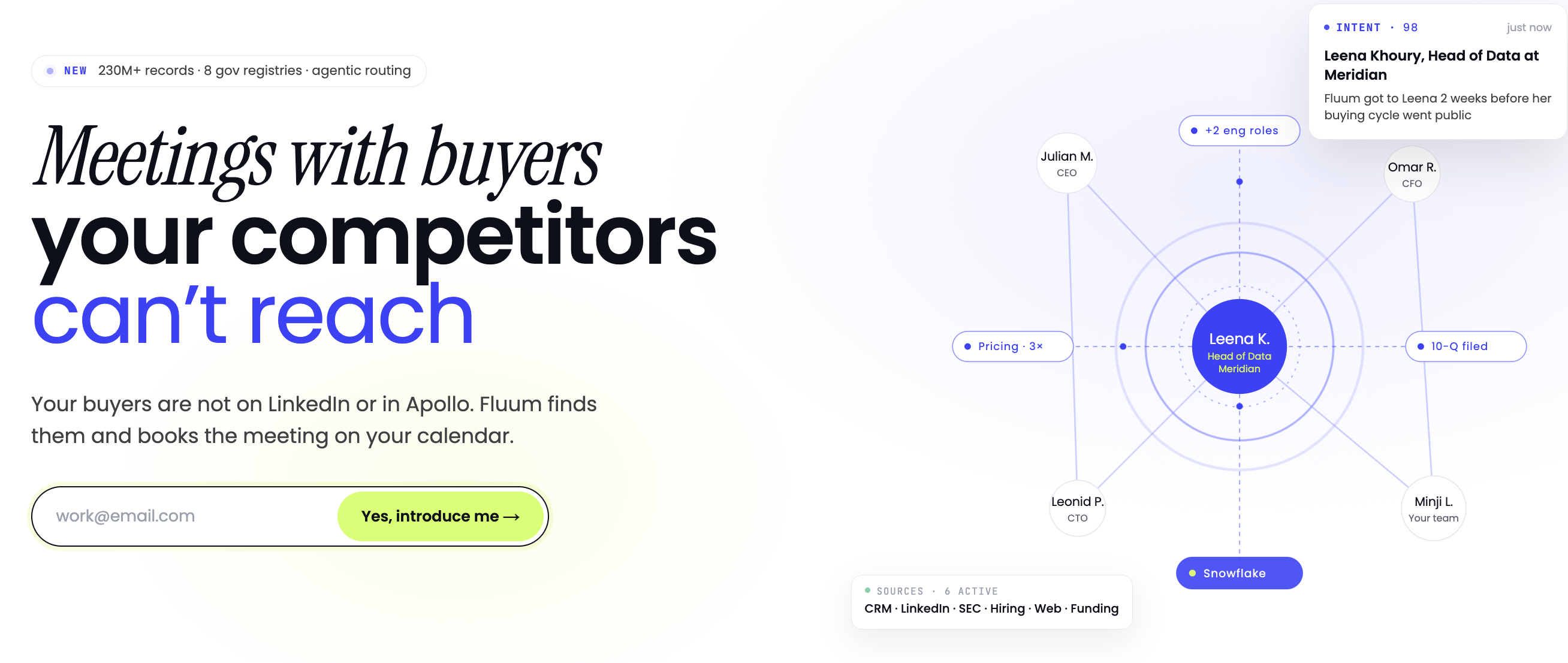
FCA register fintech sales is one of the highest-quality prospecting strategies available to B2B teams selling into the UK regulated financial services market. The register gives you a verified, permission-coded universe of real operating firms. The challenge is that everyone with a browser has the same access. The firms that win in this market aren’t the ones with the biggest lists. They’re the ones who reach the right decision-maker first, through a channel that actually gets a response.
Cold outreach to compliance-trained fintech executives converts at approximately 2%. Warm introductions, where both parties have confirmed mutual interest before the first message is exchanged, reach 40–50%. That’s not a marginal improvement. It’s a structural difference in how the conversation starts.
If you’re a senior leader or C-suite executive looking to build pipeline in the regulated fintech space, talk to Aurora at Fluum and tell us who you’re looking to meet next. We’ll make sure to send you only what’s relevant. Fluum combines FCA Register data with signals from 40+ private vendors and government registries to surface the exact decision-makers your team needs to reach, then facilitates double opt-in introductions that convert at rates cold outreach can’t touch. The FCA Register is the starting point. Fluum is what turns it into closed revenue.
Recommended Articles
Explore more from our content library: