
| Key Insight | Explanation |
|---|---|
| Government registries are public by design | Registries like Companies House, HM Land Registry, SEC EDGAR, and SIRENE were created to ensure transparency. Their data is legally accessible and increasingly available in bulk download formats. |
| Property sale prices are public in most jurisdictions | In England and Wales, the HM Land Registry Price Paid Dataset covers 20+ million transactions back to 1995. In the U.S., disclosure rules vary by state, with non-disclosure states being the exception. |
| Registry data powers B2B pipeline intelligence | Corporate registrations, director appointments, and regulatory filings signal buying intent far earlier than cold outreach tools can detect. B2B teams that tap these signals get to prospects before competitors do. |
| Aggregation is where the real value lives | A single registry is useful. Eight registries cross-referenced with 40+ private data vendors is a buyer graph. The difference in signal quality is not incremental — it’s structural. |
| Cold outreach tools don’t index government data | Most sales intelligence platforms rely on scraped LinkedIn profiles and third-party B2B databases. They miss the regulated, hard-to-reach buyers that government registries surface by default. |
| Warm introductions outperform cold outreach by 20-25x | Cold email averages a 2% reply rate. Warm, double opt-in introductions built on registry-sourced intelligence routinely achieve 40-50% reply rates, according to Fluum’s platform data. |
Government registry data sales refers to the commercial and open-access distribution of structured records held by public authorities — including property transactions, corporate filings, director appointments, and regulatory registrations. These datasets are authoritative, legally mandated, and updated continuously. For B2B sales teams, they represent one of the most underused sources of genuine buying intent available anywhere.
Most sales teams are still buying scraped contact lists and warming up sending domains. Meanwhile, the signals that actually predict a purchase — a new company incorporation, a director change, a fresh FCA authorization, a property acquisition — are sitting in public registries, updated monthly, and largely ignored by conventional outreach tools.
This article covers what government registry data sales actually are, how the data flows from public authority to commercial use, why it matters for regulated industries, and how forward-thinking B2B teams are using it to build pipeline that cold email simply can’t reach.

What Is Government Registry Data Sales?
Government registry data sales is the process by which structured public records — maintained by government authorities — are accessed, licensed, or distributed for commercial, analytical, or intelligence purposes. These records are authoritative by law, regularly updated, and increasingly available in machine-readable bulk formats.
The Core Registries That Matter
Not all government data is equal. The registries with the highest commercial signal value share three characteristics: they record legally significant events, they require accurate disclosure, and they’re updated frequently. The most widely used include:
- HM Land Registry (England and Wales): Maintains the Price Paid Dataset, covering over 20 million residential and commercial property transactions dating back to 1995 [1]. As of 2026, this data is available for bulk download and powers everything from mortgage underwriting to B2B prospecting in property-adjacent sectors.
- Companies House (UK): Records all UK company incorporations, director appointments, confirmation statements, and annual accounts. New incorporations are a direct signal of early-stage buying activity.
- FCA Register (UK): Tracks authorized financial services firms and individuals. A new FCA authorization signals a firm entering a regulated market — a high-value event for fintech vendors.
- SEC EDGAR (US): The Securities and Exchange Commission’s Electronic Data Gathering, Analysis, and Retrieval system. Covers public company filings, beneficial ownership disclosures, and material event reports [2].
- SIRENE (France): The national register of French enterprises, maintained by INSEE. Covers all business registrations and legal entity changes across France.
- County Recorder Offices (US): ICE Mortgage Technology aggregates property records from over 3,100 county recorder offices across the U.S., providing nationwide coverage of deeds, mortgages, and sale transactions [3].
What “Sales” Actually Means in This Context
The word “sales” in government registry data sales covers two distinct dynamics. First, it refers to the sale records themselves — property transactions, asset transfers, business sales — that registries capture and publish. Second, it refers to the commercial ecosystem around that data: data vendors, aggregators, and intelligence platforms that package raw registry records into actionable products.
Both meanings matter. Property sale prices recorded by HM Land Registry are public and freely downloadable [4]. But turning 20 million raw transaction records into a prospecting signal requires aggregation, normalization, and cross-referencing with corporate data — which is where commercial data providers add genuine value.
Pro Tip: Don’t treat government registries as a one-time data pull. The highest-value signals come from monitoring changes over time — new incorporations, director appointments, and property acquisitions all represent events that trigger buying cycles. Set up automated monitoring rather than static exports.
How Government Registry Data Sales Work
Government registry data flows from public authority to commercial use through a structured chain: legal mandate, public disclosure, bulk access, commercial aggregation, and finally, intelligence delivery to end users. Each stage adds structure, context, or analytical value to the raw records.
The Data Flow from Registry to Intelligence
Understanding the mechanics helps you evaluate data vendors honestly. Here’s how the chain typically works:
- Legal mandate: A law requires disclosure. Property sales must be registered with HM Land Registry. Companies must file annual accounts with Companies House. The legal obligation is what makes registry data reliable — it’s not optional.
- Public submission: Solicitors, company secretaries, or regulated entities submit records to the relevant authority. In England and Wales, solicitors typically submit conveyancing data within one to two months of completion [5].
- Registry publication: The authority publishes the data. HM Land Registry updates its Price Paid Dataset monthly [4]. Companies House updates director and filing data in near real-time. The Philadelphia city government, for example, released an open dataset covering millions of property records including deeds, mortgages, and sheriff deeds [6].
- Bulk access and licensing: Most major registries offer bulk download options, APIs, or licensed data products. HM Land Registry’s Price Paid Data is available as a free download under the Open Government Licence [4].
- Commercial aggregation: Data vendors — and platforms like Fluum — ingest multiple registries, normalize entity names, resolve duplicates, and cross-reference records across sources. This is where a raw transaction record becomes an actionable signal.
- Intelligence delivery: The aggregated, enriched data is delivered to end users via API, dashboard, or integrated platform, with scoring, filtering, and matching applied on top.
Disclosure Rules: What’s Public and What Isn’t
Disclosure rules vary significantly by jurisdiction. In England and Wales, all property sales registered for full market value are public [1]. In the U.S., disclosure is state-level: most states treat real estate transactions as public records, but a minority of “non-disclosure states” restrict public access to sale prices [7]. Missouri, for instance, uses Certificates of Value to ensure uniformity for property tax assessment purposes [7].
Georgia maintains an online property records portal through its Department of Revenue, giving public access to county-level records [8]. The National Association of REALTORS tracks existing-home sales data at the national level, providing monthly benchmarks for the broader market [2].
B2B sales intelligence” />
Key Benefits for B2B Pipeline Intelligence
Government registry data delivers something that scraped contact databases fundamentally cannot: legally mandated, event-driven signals that reflect real-world business activity rather than inferred intent. For B2B teams selling into regulated or hard-to-reach markets, this distinction is the difference between a list and a pipeline.
Why Registry Data Outperforms Conventional B2B Databases
Most sales intelligence platforms index what’s visible: LinkedIn profiles, company websites, press releases. Government registries index what’s legally required. That creates a structural information advantage for teams that know how to use it.
- Event-driven prospecting: A new company incorporation at Companies House signals a business in its first 90 days — when vendors, software, and services decisions are actively being made. That’s a buying trigger, not a contact record.
- Regulated industry access: FCA and SEC filings surface authorized firms in financial services that don’t maintain a public LinkedIn presence. For fintech and cybersecurity vendors, this is a significant gap in conventional tools.
- Property transaction intelligence: Commercial property acquisitions signal expansion, relocation, or new facility investment. For facilities management, commercial insurance, and professional services firms, a Land Registry acquisition record is a warm lead.
- Director-level contact paths: Corporate registries name directors and officers. Cross-referenced with private data vendors, those names become decision-maker paths — not cold contacts, but identified buyers with a documented connection to the triggering event.
- Geographic precision: Property and business registries are inherently location-specific. For sales teams with geographic territories, registry data provides coverage that national B2B databases often miss at the local level.
The Aggregation Multiplier
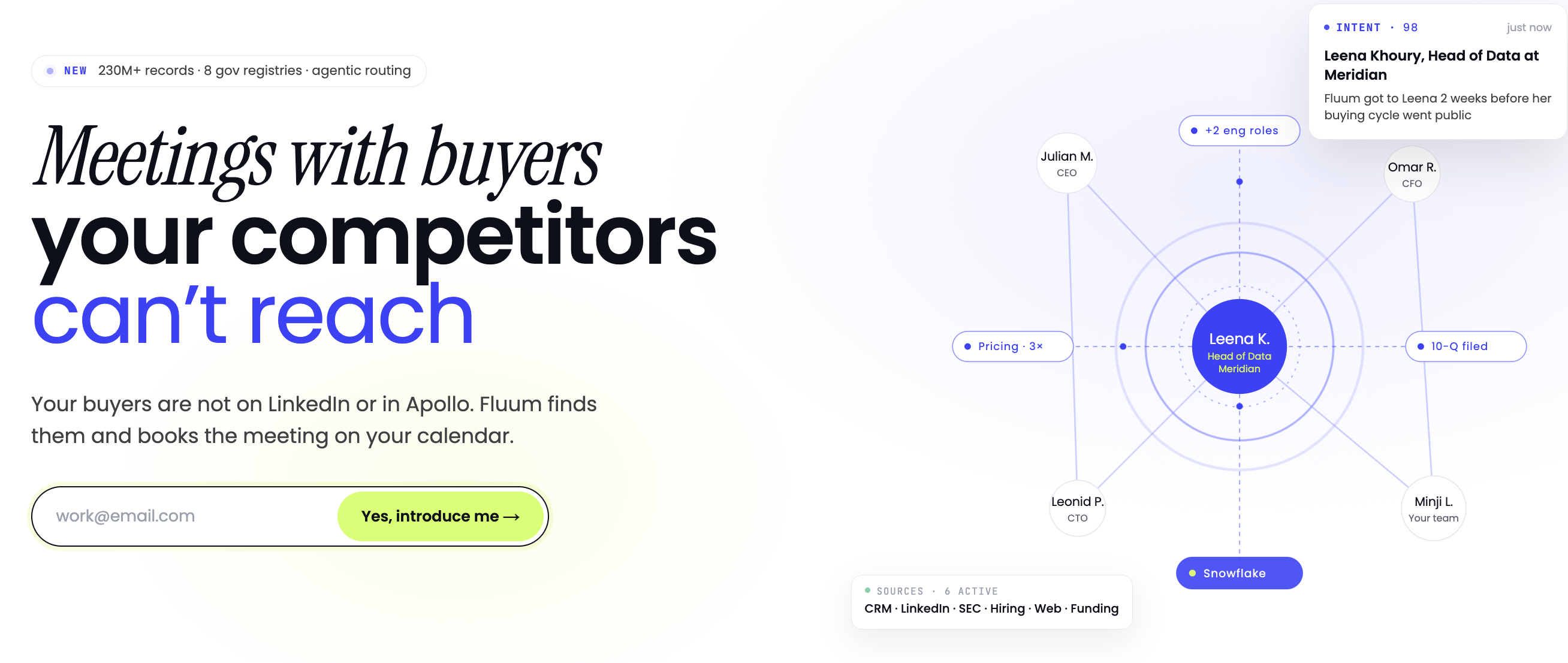
A single registry is useful. Eight registries cross-referenced with 40+ private data vendors produces something qualitatively different: a buyer graph. At Fluum, we’ve found that the signal quality from multi-registry aggregation isn’t incrementally better than a single source — it’s structurally superior, because cross-referencing resolves ambiguity and surfaces connections that no individual dataset contains.
| Data Source Type | Signal Type | Update Frequency | B2B Use Case |
|---|---|---|---|
| HM Land Registry | Property acquisition / sale | Monthly | Commercial real estate, facilities, insurance |
| Companies House | Incorporation, director change, filing | Near real-time | SaaS, professional services, early-stage targeting |
| FCA Register | Regulatory authorization | Continuous | Fintech, compliance, cybersecurity |
| SEC EDGAR | Public company filings, material events | Continuous | Enterprise sales, M&A intelligence |
| SIRENE | Business registration, legal entity change | Continuous | French market entry, cross-border B2B |
| US County Recorders | Deeds, mortgages, sheriff deeds | Varies by county | Mortgage, title, property services |
Research from Bain and Company consistently shows that B2B buyers are 5x more likely to engage when introduced through a trusted third party rather than receiving a cold approach. Registry-sourced signals, combined with warm introduction mechanics, close that gap structurally.
Pro Tip: If you’re selling into financial services or cybersecurity, monitor FCA Register and SEC EDGAR filings for new authorizations and material event disclosures. A firm that just received regulatory approval is in active vendor selection mode. That’s the moment to make contact — not six months later when they’ve already chosen a supplier.
Common Challenges and Mistakes in 2026
Government registry data is powerful, but most teams either underuse it or misuse it. The mistakes aren’t subtle — they’re structural, and they consistently produce the same outcome: a lot of raw data that never converts into pipeline.
The Raw Data Trap
The most common mistake is treating registry data as a contact list. It isn’t. A Companies House incorporation record gives you a company name, a registered address, and a director name. That’s a starting point, not a prospect. Teams that download bulk registry data and immediately push it into a cold email sequence are doing the B2B equivalent of cold-calling the phone book.
In practice, registry data requires enrichment before it becomes actionable:
- Entity resolution: matching the legal entity name to its trading name, website, and industry classification
- Contact path identification: connecting the director name to a verified email or professional profile
- Signal scoring: assessing whether the triggering event (incorporation, property acquisition, regulatory filing) actually aligns with your ICP (ideal customer profile)
- Timing calibration: understanding the typical buying cycle triggered by each event type so outreach lands at the right moment
Jurisdiction Blind Spots and Compliance Gaps
A second common pitfall is assuming that data that’s publicly available is automatically compliant to use for commercial outreach. It isn’t always. GDPR Article 6 requires a lawful basis for processing personal data, even if that data was sourced from a public registry. The fact that a director’s name appears in a Companies House filing doesn’t automatically grant permission to add them to an email sequence.
One limitation worth acknowledging: disclosure rules for property sale prices vary significantly by jurisdiction [7]. In the U.S., non-disclosure states don’t publish transaction values, which creates gaps in any national property intelligence product. Teams building cross-border registry intelligence need jurisdiction-specific legal review, not a blanket assumption that public means freely usable for any purpose.
From experience working with regulated industry clients, the teams that get into trouble are the ones who conflate “publicly available” with “consent given.” They’re not the same thing. A double opt-in introduction model — where both parties confirm interest before any connection is made — is the structural solution to this problem, not a legal workaround.
Best Practices for Using Registry Data in 2026
The teams getting the most value from government registry data sales in 2026 share a consistent approach: they treat registry signals as triggers, not targets. The data tells you when to engage. Your intelligence layer tells you who to engage. Your introduction mechanism determines whether they respond.
Build a Signal-to-Introduction Workflow
Effective use of registry data follows a clear sequence. Don’t skip steps:
- Define your trigger events: Which registry events correlate with buying activity for your specific ICP? New FCA authorizations for a fintech vendor. Commercial property acquisitions for a facilities management firm. New incorporations with specific SIC codes for a B2B SaaS product. Be specific.
- Set up automated monitoring: Most major registries offer APIs or bulk download feeds. Build or buy monitoring that alerts your team when a trigger event occurs in your target segment. Static exports go stale fast.
- Enrich before you act: Cross-reference the registry record with private data vendors to resolve the entity, identify decision-makers, and validate that the prospect matches your ICP. This is where aggregation platforms earn their cost.
- Score the signal: Not every trigger event represents equal opportunity. An AI scoring layer that weights signals by recency, ICP fit, and buying stage will dramatically improve conversion rates compared to treating all triggers equally.
- Introduce, don’t cold-pitch: The final step is the one most teams get wrong. A registry-sourced signal is an invitation to make a warm, context-rich introduction — not a license to send a cold sequence. Both sides confirming interest before the first message is exchanged is the mechanic that produces 40-50% reply rates instead of 2%.
The ICP Alignment Framework
Our team at Fluum recommends mapping your ICP against specific registry event types before building any monitoring infrastructure. The ICP Alignment Framework has three components:
- Entity type match: Does the registry record describe an organization that fits your buyer profile by size, sector, and legal structure?
- Event relevance score: Does the specific event (incorporation, acquisition, authorization) actually trigger a buying cycle for your product category?
- Decision-maker reachability: Can you identify and reach the right person within the organization through a warm path, not a cold sequence?
Teams that score all three before acting convert registry signals into qualified conversations at a significantly higher rate than those who act on raw data alone. Results will vary by industry and ICP specificity, but the directional principle holds across every regulated sector we’ve worked in.
Pro Tip: If you’re a senior leader or C-suite executive looking to use registry data to reach specific decision-makers, talk to Aurora at Fluum and tell us who you’re looking to meet next. We’ll make sure to send you only what’s relevant — no noise, no cold lists, just warm introductions to the exact buyers your registry signals identify.
Sources and References
- ODImpact.org, “United Kingdom’s HM Land Registry Price Paid Data,” 2023
- National Association of REALTORS, “Existing-Home Sales,” 2026
- ICE Mortgage Technology, “Public Property Records Data,” 2026
- HM Land Registry, “Price Paid Data,” GOV.UK, 2026
- HM Land Registry Open Data, “Search the Price Paid Dataset,” 2026
- City of Philadelphia, “City Releases Open Data Set of Millions of Property Records,” 2018
- MOST Policy Initiative, “Disclosure of Real Estate Sales Prices,” 2023
- Georgia Department of Revenue, “Property Records Online,” 2026
- Techsalerator, “Public Real Estate Data,” 2026
- Money Stack Exchange, “How Does Home Sale Transaction Value Get into the Public Domain?,” 2023

Frequently Asked Questions
1. Are property sale prices public?
In England and Wales, all residential and commercial property sales registered for full market value are publicly accessible through HM Land Registry’s Price Paid Dataset, which covers over 20 million transactions dating back to 1995 [1]. In the U.S., most states treat real estate transactions as public records accessible through county recorder offices, though a minority of non-disclosure states restrict public access to actual sale prices [7]. Even in disclosure states, access methods vary: some require in-person requests at county offices, while others, like Georgia, provide online portals through the Department of Revenue [8]. The practical implication for government registry data sales is that coverage is strong in the UK and in most U.S. states, but any cross-jurisdictional product requires careful mapping of disclosure rules by state or territory.
2. How often are sold prices updated?
HM Land Registry updates its Price Paid Dataset monthly, but there’s typically a one to two month lag between a property transaction completing and the record appearing in the published dataset — because solicitors must submit the conveyancing paperwork before the registry can publish it [4][5]. In practice, this means the dataset reflects transactions from approximately six to eight weeks prior. For commercial intelligence purposes, this lag matters: if you’re using property acquisition data as a buying signal, you’re working with events that happened roughly two months ago, not last week. U.S. county recorder offices vary significantly in their update frequency, with some providing near-real-time electronic filings and others updating records monthly or quarterly [3].
3. What is the difference between free and commercial government registry data?
The underlying registry records are often freely available — HM Land Registry’s Price Paid Data is downloadable at no cost under the Open Government Licence [4], and Companies House data is publicly accessible via its API. The commercial value in government registry data sales comes from aggregation, enrichment, normalization, and delivery infrastructure. A raw bulk download of 20 million Land Registry records is technically free but practically unusable without significant data engineering. Commercial vendors and platforms like Fluum add entity resolution, cross-referencing across multiple registries, AI-powered signal scoring, and decision-maker path identification — turning raw public records into actionable pipeline intelligence.
4. Which government registries are most useful for B2B sales intelligence?
The highest-value registries for B2B pipeline intelligence are those that record legally significant business events: Companies House (UK incorporations and director appointments), the FCA Register (financial services authorizations), SEC EDGAR (US public company filings and material events), HM Land Registry (property transactions), SIRENE (French business registrations), and US county recorder offices (property deeds and mortgages) [3][4]. The specific registry that matters most depends on your ICP. For fintech vendors, FCA and SEC filings are primary signals. For commercial real estate services, Land Registry and county recorder data are central. For broad B2B coverage across regulated industries, aggregating across all eight major registries produces a buyer graph that no single source can replicate.
5. Is it GDPR-compliant to use government registry data for sales outreach?
Publicly available registry data doesn’t automatically grant permission for commercial outreach under GDPR. Article 6 of the GDPR requires a lawful basis for processing personal data — even data sourced from public registries. Legitimate interest is the most commonly cited basis for B2B outreach using registry-derived contact information, but it requires a documented balancing test and must not override the individual’s reasonable privacy expectations. The safest approach, and the one that also produces the highest reply rates, is a double opt-in introduction model where both parties confirm mutual interest before any contact is made. This eliminates the compliance ambiguity entirely while simultaneously improving conversion rates from 2% (cold email) to 40-50% (warm introduction).
6. How does Fluum use government registry data differently from conventional sales tools?
Most conventional sales intelligence tools index publicly visible data — LinkedIn profiles, company websites, press releases. Fluum aggregates signals from 8 government registries and 40+ private data vendors, including Companies House, the FCA Register, SEC EDGAR, and SIRENE, to build buyer graphs that surface decision-makers in regulated and hard-to-reach markets that cold outreach tools simply don’t index. Crucially, Fluum doesn’t deliver a list — it facilitates a double opt-in warm introduction where both parties confirm interest before the first message is sent. That’s the structural difference between a 2% cold email reply rate and a 40-50% warm introduction reply rate.
Conclusion
Government registry data sales represents one of the most underused advantages in B2B pipeline intelligence. The data is authoritative, legally mandated, and event-driven — which means it reflects real business activity, not inferred intent. Property transactions, corporate filings, regulatory authorizations, and director appointments are all signals that precede buying decisions, often by weeks or months.
The teams winning in regulated industries in 2026 aren’t sending more cold emails. They’re monitoring the registries that tell them exactly when a prospect enters a buying cycle, enriching those signals with cross-referenced private data, and converting them into warm introductions where both sides have already said yes.
That’s the core premise behind Fluum. We aggregate government registry data sales intelligence across 8 registries and 40+ private vendors, score the signals with AI, and deliver double opt-in warm introductions that convert at 40-50% — not 2%. If your pipeline depends on channels that buyers have learned to ignore, the registry data that’s been sitting in public authorities all along might be exactly what changes that.
Recommended Articles
Explore more from our content library: