
| Key Insight | Explanation |
|---|---|
| Average committee size is 10-11 people | B2B purchase decisions now involve an average of 10-11 stakeholders, up from 5-6 a decade ago, making single-threaded outreach a structural failure. |
| Mapping is not the same as a contact list | A buying committee map documents roles, influence levels, relationships, and decision criteria — not just names and email addresses. |
| Most deals stall because of unmapped stakeholders | Deals frequently die in late stages when a previously unknown blocker or budget authority surfaces and derails consensus. |
| Warm introductions outperform cold outreach by a wide margin | Research from Bain & Company shows B2B buyers are 5x more likely to engage when introduced through a trusted third party versus cold contact. |
| Signal-based data accelerates mapping | AI-powered platforms that aggregate signals from government registries and private databases surface committee members that LinkedIn and cold outreach tools miss entirely. |
| Role matters more than job title | The economic buyer, technical evaluator, and internal champion may carry different job titles across organizations — mapping by function beats mapping by title every time. |
Buying committee mapping is the process of identifying every stakeholder involved in a B2B purchase decision, documenting their role, influence, and motivations, and building a strategy to engage each one. It’s the structural antidote to single-threaded selling. And in 2026, with B2B purchase decisions now involving an average of 10-11 decision-makers [1], getting this wrong doesn’t just slow deals down — it kills them entirely.
Most sales teams still run their enterprise deals through one contact. That contact gets promoted, goes quiet, or loses internal support, and suddenly a six-figure opportunity evaporates. Buying committee mapping exists to prevent exactly that.
This guide covers what buying committee mapping actually is, how to build one from scratch, which roles matter most, and how to use signal-based intelligence to reach stakeholders that cold outreach tools simply don’t surface.

What Is Buying Committee Mapping?
Buying committee mapping is the structured process of documenting every stakeholder in an account who influences, approves, or blocks a purchase decision — along with their role, priorities, and relationships to each other [2]. It transforms a vague “target account” into an actionable relationship graph.
The Core Definition
A buying committee (sometimes called a buying group or decision-making unit) is the collection of individuals inside a prospect organization who collectively determine whether a purchase happens, on what timeline, and at what price. Mapping that committee means going beyond a single champion contact to understand the full cast of characters involved.
According to research cited across Gartner and Forrester, the modern B2B buying committee includes people from multiple functions — finance, IT, operations, legal, and the end-user team — each with different success criteria and different levels of authority [1]. Reaching only one of them is like lobbying one vote on a ten-person jury.
Why It Matters Now More Than Ever
Buying committees have grown significantly larger over the past decade. Deals that once required sign-off from two or three people now routinely involve procurement, security review, legal, and executive sponsorship — all before a contract gets signed.
- Single-threaded deals (those managed through one contact) have a dramatically higher stall and loss rate
- Unmapped stakeholders are the most common reason late-stage deals collapse
- Marketing and sales alignment depends on knowing which message to send to which role at which stage
- Account-based marketing (ABM) — the practice of targeting specific high-value accounts with personalized campaigns — only works if you know who’s actually in the account [3]
Industry analysts consistently note that mapping the buying committee and marketing to the full group is always more effective than targeting individual leads [3]. That’s not a tactic. It’s a structural shift in how enterprise sales works.
How Buying Committee Mapping Works
Building a buying committee map follows a repeatable process: identify stakeholders by function (not just title), assign roles and influence levels, map relationships between them, and then design engagement strategies for each [4].
The Step-by-Step Process
- Confirm the buying scenario and ICP fit. Before mapping anyone, verify the account fits your Ideal Customer Profile (ICP). A detailed map of the wrong account is wasted effort [5].
- Identify roles, not just job titles. Look for the economic buyer (final budget authority), technical evaluator, end-user champion, procurement gatekeeper, and executive sponsor. The same role may carry different titles across organizations.
- Map relationships and influence paths. Who reports to whom? Who has informal influence over the economic buyer? Who can accelerate or block consensus? These relationship lines matter as much as the org chart.
- Score intent signals for each stakeholder. Signal-based prospecting — the practice of using behavioral and data signals to infer purchase readiness — helps prioritize which committee members to engage first.
- Design role-specific engagement. Each stakeholder needs messaging aligned to their specific concerns. The CFO cares about ROI and risk. The CISO cares about security posture. The end user cares about workflow impact.
- Update the map continuously. Buying committees change. People leave, get promoted, or bring in new stakeholders mid-process. A static map is a liability.
Pro Tip: Don’t start your committee map with LinkedIn searches. Start with what your existing champions tell you in discovery calls. Ask directly: “Who else in your organization will be involved in evaluating this?” Most reps never ask this question. The ones who do close faster.
Tools and Data Sources for Committee Mapping
Effective buying committee mapping requires data from multiple sources. Relying on a single database leaves significant gaps, especially in regulated industries where decision-makers don’t maintain public LinkedIn profiles.
| Data Source Type | What It Provides | Limitation |
|---|---|---|
| Professional social networks | Job titles, career history, connections | Incomplete in regulated industries; saturated with cold outreach |
| Government registries (Companies House, FCA, SEC EDGAR, SIRENE) | Verified officer names, directorships, regulatory filings | Requires aggregation and enrichment to be actionable |
| Private data vendors | Intent signals, technographic data, firmographic data | Quality varies significantly by vendor |
| CRM and engagement history | Prior interactions, relationship context, deal history | Only reflects past contacts — misses new stakeholders |
| Opted-in introduction networks | Warm, mutually interested contacts with verified buying intent | Network size matters — smaller networks limit coverage |
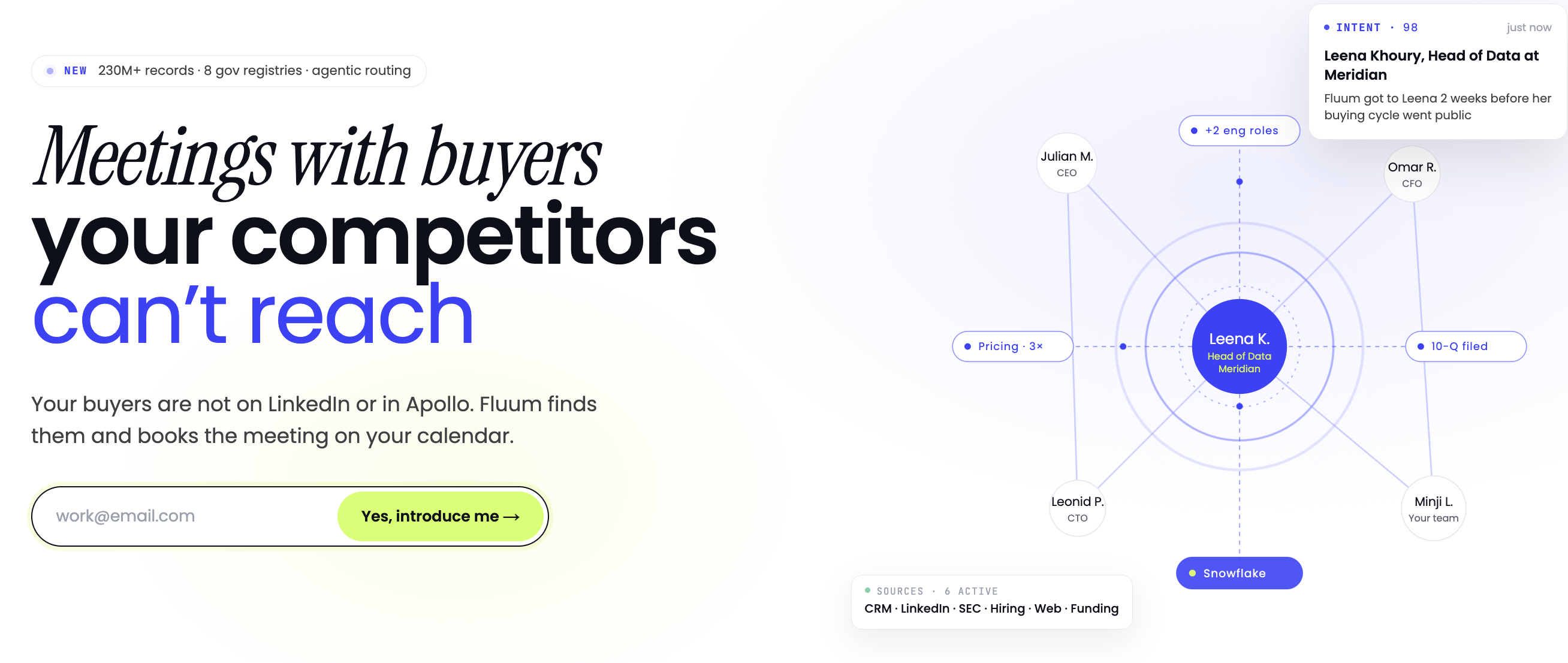
At Fluum, we’ve found that the most significant gaps in committee maps come from regulated industries — fintech, cybersecurity, and manufacturing — where decision-makers actively avoid public profiles. Pulling from 40+ private data vendors and 8 government registries surfaces stakeholders that standard outreach tools miss entirely.
Key Roles in a Buying Committee
Every buying committee contains a predictable set of functional roles, regardless of company size or industry — and each role requires a completely different engagement approach [6].

The Core Stakeholder Roles
- Economic Buyer: The person with final budget authority. They often don’t attend early meetings but have veto power over every deal. Your message to them is purely about business outcomes and risk reduction.
- Internal Champion: Your advocate inside the organization. They believe in your solution and will carry your message forward — but they need to be armed with the right materials to do it effectively.
- Technical Evaluator: Assesses whether your solution integrates with existing systems, meets security requirements, and can be implemented without disruption. In regulated industries, this role often has blocking power.
- End User: The person who will actually use the product day-to-day. Their adoption resistance can kill deals even after contracts are signed. Win them early.
- Procurement Gatekeeper: Controls the vendor selection process, negotiates terms, and ensures compliance with internal purchasing policy. They’re not evaluating your product — they’re evaluating your contract.
- Executive Sponsor: A senior leader who provides organizational air cover for the initiative. They may not be involved in evaluation but their endorsement signals priority.
- Legal and Compliance: Increasingly present in regulated industries. They review data processing agreements, liability terms, and regulatory compliance before any contract moves forward.
How Roles Shift by Industry
In fintech, the compliance officer and risk function carry significant weight — often more than the economic buyer in practical terms. In manufacturing, operations and plant managers frequently have informal veto power that doesn’t appear on any org chart. In cybersecurity, the CISO and their team can block a deal entirely regardless of executive sponsorship.
According to Heinz Marketing’s research on buying committees, marketing and sales teams use the committee map to tailor outreach, content, and messaging to each role’s specific concerns [7]. The map isn’t just a research artifact — it’s an active sales tool.
Pro Tip: If you’re selling into a regulated industry like financial services or healthcare, always check government registries (FCA Register, SEC EDGAR, Companies House) for named directors and officers. These individuals often hold buying authority that isn’t reflected in any commercial database. Fluum’s pipeline intelligence layer does this automatically across 8 government registries.
Why Buying Committee Mapping Drives Better Results
Buying committee mapping directly improves win rates, shortens sales cycles, and reduces late-stage deal collapse — because it replaces assumption-based selling with structured, evidence-backed account intelligence [4].
The Commercial Case for Mapping
The numbers on this are not ambiguous. Research from Bain & Company shows B2B buyers are 5x more likely to engage when introduced through a trusted third party. Gartner data consistently shows that deals with multi-threaded engagement — meaning active relationships with three or more stakeholders — have significantly higher close rates than single-threaded deals.
- Multi-threaded deals close at higher rates because consensus is built before the final decision point
- Mapped accounts generate better forecast accuracy — you know who can block, who can accelerate, and what each stakeholder needs to say yes
- Role-specific messaging increases engagement rates because each stakeholder receives content relevant to their actual concerns
- ABM campaigns built on accurate committee maps outperform generic account targeting by a wide margin [3]
- Sales cycles shorten when champions are properly armed — they can navigate internal politics faster when they have the right materials
What Happens Without a Map
In practice, deals without committee maps follow a predictable failure pattern. The rep builds a relationship with one contact. That contact gets promoted or leaves. Or they lose internal support. Or a previously unknown stakeholder surfaces in the final stage with objections nobody anticipated.
A fintech BD team we’ve worked with at Fluum described exactly this scenario: they had a 90-day enterprise deal collapse in the final week when a compliance officer — who had never appeared in any of their discovery calls — raised a data sovereignty concern that their champion couldn’t answer. A complete committee map, built earlier in the cycle, would have surfaced that stakeholder in week two.
The customer purchase journey mapping framework from Rutgers Business School [8] reinforces this: decision paths in complex B2B purchases are non-linear, multi-stakeholder, and require active management at every stage — not just at the point of proposal.
Common Mistakes in Buying Committee Mapping
Most buying committee maps fail not because the concept is flawed, but because teams execute them incorrectly — mapping too late, mapping too shallowly, or building a map and then never updating it [5].
The Most Damaging Errors
- Starting with job titles instead of roles. A “VP of Operations” at one company may be the economic buyer. At another, they’re purely an end user. Mapping by title instead of function produces a map that looks complete but isn’t.
- Treating the map as a one-time exercise. Buying committees change constantly. People leave, get promoted, or bring in new stakeholders mid-cycle. A map built in month one that isn’t updated by month three is actively misleading.
- Ignoring informal influence. The org chart doesn’t show who the economic buyer actually trusts. An executive assistant, a long-tenured manager, or a peer at another company can carry more real influence than a formal VP title.
- Only mapping the contacts you already have. This is the most common mistake. Teams document the stakeholders they’ve already met and assume the map is complete. The most dangerous committee members are the ones you haven’t met yet.
- Failing to assign engagement ownership. A map without clear ownership of each stakeholder relationship is just a document. Every person on the committee needs a named owner on your side who is actively building that relationship.
The Cold Outreach Trap
Here’s an uncomfortable truth: most teams try to fill committee map gaps by sending cold emails to the stakeholders they haven’t reached yet. Cold email open rates have collapsed — and the people most worth reaching in a buying committee are precisely the ones with the most filtered inboxes.
The economic buyer of a 500-person fintech firm isn’t reading cold emails from vendors they’ve never heard of. They’re responding to introductions from people they trust. That’s not a nice-to-have — it’s the only channel that actually works at that level [9].
Pro Tip: When you identify a stakeholder you can’t reach through existing relationships, don’t default to cold outreach. Map the path: who in your network knows this person? Who has a relationship with their function or industry? A warm introduction — where both sides have said yes before the first message is sent — converts at 40-50% versus 2% for cold email. The math is not close.
Best Practices for Buying Committee Mapping in 2026
As of 2026, the most effective buying committee mapping combines AI-powered signal aggregation, role-based engagement frameworks, and warm introduction mechanics to reach stakeholders that traditional outreach tools miss entirely [10].
Build the Map Before You Need It
The biggest structural shift in enterprise sales over the past two years is the move toward pre-opportunity committee mapping. Rather than building the map reactively once a deal is in motion, leading sales teams now map target accounts during the account planning phase — before outreach even begins.
- Use intent signals (behavioral data indicating purchase readiness) to prioritize which accounts to map first
- Pull data from government registries and private databases to surface decision-makers who don’t appear in commercial contact databases
- Cross-reference technographic data (information about a company’s current technology stack) to identify stakeholders likely to be involved in vendor evaluation
- Build relationship paths to every mapped stakeholder before the formal sales process begins
- Document the map in your CRM with role tags, not just contact records [11]
Use AI to Surface Hidden Stakeholders
Manual committee mapping has a ceiling. It surfaces the people you know about and the people they tell you about. AI-powered pipeline intelligence breaks through that ceiling by aggregating signals across dozens of data sources to identify stakeholders who are functionally involved in buying decisions but never appear in standard outreach databases.
This matters most in regulated industries. In fintech, cybersecurity, and manufacturing, the most consequential decision-makers — compliance officers, risk managers, plant directors — frequently have minimal public digital footprints. Government registries like Companies House, the FCA Register, SEC EDGAR, and SIRENE contain verified data on these individuals that commercial databases simply don’t carry.
Our team at Fluum recommends treating buying committee mapping as a continuous intelligence function, not a one-time sales activity. The accounts that close fastest are the ones where your team has already built relationship equity with three or more stakeholders before the formal RFP process begins.
| Approach | Stakeholder Coverage | Engagement Quality | Best For |
|---|---|---|---|
| Manual research + cold outreach | Low (misses hidden stakeholders) | ~2% reply rate | Small accounts with public profiles |
| CRM + single database mapping | Medium (known contacts only) | Varies by relationship depth | Existing accounts with established contacts |
| AI signal aggregation (40+ vendors + gov registries) | High (surfaces hidden decision-makers) | Depends on introduction method | Regulated industries, enterprise accounts |
| AI mapping + warm double opt-in introductions | High (full committee coverage) | 40-50% reply rate | Enterprise, regulated industries, hard-to-reach buyers |
The greater Toronto area’s B2B marketing community has noted that mapping the full buying committee — including CMOs, CIOs, CFOs, operations leaders, and end users — is now considered a baseline requirement for enterprise account-based marketing, not an advanced tactic [12].

Sources & References
- CodeDesign, “Why B2B Demand Gen Just Form Fills Are Dead,” 2026
- Influ2, “B2B Buying Committees: How to Target Decision Makers,” 2026
- MarTech, “Why Buying-Group Marketing Beats ABM Every Time,” 2026
- The Pedowitz Group, “How Do I Map Buying Committee Dynamics?”, 2026
- Colony Spark, “How to Map the B2B Buying Committee: Questions You Need to Ask,” 2026
- TractionComplete, “Mapping the B2B Buying Committee: 10 Roles, Strategies, and Best Practices,” 2026
- Heinz Marketing, “Frequently Asked Questions About ICPs, Buyer Personas & Buying Committees,” 2026
- Rutgers Business Review, “The Seven Steps of Customer Purchase Journey Mapping,” 2026
- LinkedIn / Luke Horsfall, “Buying Committee Mapping: A Simple Way to Boost B2B Sales,” 2026
- Nooks, “Buying Committee Prospecting: AI Account Mapping,” 2026
- Reddit / HubSpot Community, “HubSpot Still Has No Native Buying Committee Visualization,” 2026
- Greater Toronto, “Core Components of a Successful B2B Marketing Strategy,” 2026
Frequently Asked Questions
1. What is buying committee mapping?
Buying committee mapping is the process of identifying and documenting every stakeholder involved in a B2B purchase decision — including their role, level of influence, motivations, and relationships to each other. It goes beyond a simple contact list to create an actionable account intelligence framework that guides sales and marketing engagement across the full decision-making group.
2. How many people are typically in a B2B buying committee?
As of 2026, B2B purchase decisions involve an average of 10-11 stakeholders, according to data from Gartner and Forrester. This number has grown significantly from the 5-6 stakeholders typical a decade ago, driven by increased organizational complexity, security and compliance requirements, and distributed procurement authority across enterprise accounts.
3. What roles should I include in a buying committee map?
Every buying committee map should include the economic buyer (budget authority), internal champion (your advocate), technical evaluator, end user, procurement gatekeeper, and executive sponsor. In regulated industries, add compliance, legal, and risk functions. Map by role and function — not just job title — since the same function may carry different titles across organizations.
4. How does buying committee mapping differ from a standard contact list?
A contact list is a collection of names and email addresses. A buying committee map documents each stakeholder’s functional role in the decision, their level of influence, their specific success criteria, their relationships to other committee members, and the best engagement path to reach them. It’s an intelligence framework, not a prospecting database.
5. When should I build a buying committee map?
The best practice in 2026 is to build your committee map during account planning — before formal outreach begins. Reactive mapping (building the map after a deal is already in motion) means you’re always catching up to stakeholders who may already have formed opinions about your solution. Pre-opportunity mapping lets you build relationship equity before the formal evaluation starts.
6. How do I reach buying committee members I can’t find through standard tools?
Standard outreach tools and professional social networks miss significant portions of buying committees, especially in regulated industries. The most effective approaches combine government registry data (Companies House, FCA Register, SEC EDGAR) with private data signals and warm introduction networks. Cold outreach to unmapped stakeholders converts at around 2%. A warm, double opt-in introduction — where both parties have agreed to connect — converts at 40-50%.
7. Does buying committee mapping work for SMEs or only enterprise deals?
this practice applies to any deal where more than one person influences the purchase decision. Even at SMEs with 20-50 employees, the founder, finance lead, and technical owner may all need to say yes before a contract is signed. The committee is smaller, but the principle is identical: map every stakeholder, understand their concerns, and engage each one with relevant messaging.
8. How does AI improve buying committee mapping?
AI improves this method by aggregating signals from dozens of data sources simultaneously — government registries, private databases, technographic data, and intent signals — to surface stakeholders that manual research misses. AI agents can also score each stakeholder’s likely intent level, identify the shortest relationship path to reach them, and recommend engagement sequencing based on their functional role in the decision process.
Conclusion
this strategy is not a nice-to-have for complex B2B sales. It’s the structural difference between deals that close and deals that stall in the final stage because someone nobody mapped shows up with a blocking objection.
The core discipline is straightforward: identify every stakeholder by function, understand their motivations, map their relationships, and build engagement strategies tailored to each role. The execution is where most teams fall short — either mapping too late, mapping too shallowly, or defaulting to cold outreach to fill the gaps.
Cold outreach doesn’t reach the economic buyers and compliance officers who carry the most weight in regulated industries. The channel is too crowded, the reply rates are too low, and the people most worth reaching have the most filtered inboxes.
Fluum’s pipeline intelligence platform builds buyer graphs from 40+ private data vendors and 8 government registries — surfacing the full buying committee, including the stakeholders that standard tools miss. AI agents score intent signals, identify decision-maker paths, and deliver warm double opt-in introductions that convert at 40-50%. If you’re serious about this approach in fintech, cybersecurity, or manufacturing, that’s the infrastructure worth building on.
If you’re a senior leader or C-suite executive reading this, talk to Aurora at Fluum and tell us who you’re looking to meet next. We’ll make sure to send you only what’s relevant.
Recommended Articles
Explore more from our content library: