
| Key Insight | Explanation |
|---|---|
| Cold outreach is structurally broken | Cold email reply rates average 2% as of 2026. Inbox providers and buyers have both learned to ignore unsolicited outreach at scale. |
| Opt-in consent changes the math | When both parties agree before a conversation starts, reply rates jump to 40–50%. Consent isn’t just a compliance issue — it’s a conversion lever. |
| Double opt-in is the gold standard | Double opt-in means both the buyer and seller confirm mutual interest before any introduction is made — eliminating wasted outreach from the start. |
| Private data signals reach hidden buyers | Platforms pulling from 40+ private vendors and 8 government registries surface decision-makers that cold tools and standard databases simply don’t index. |
| Regulated industries require a different approach | Fintech, cybersecurity, and manufacturing buyers are harder to reach via standard outbound. Opted-in networks specifically built for these verticals outperform generic tools. |
| Pipeline quality beats pipeline volume | A smaller number of warm, consented introductions consistently outperforms a high-volume cold sequence in both close rate and sales cycle length. |
Opted-in network sales prospecting is the practice of building pipeline exclusively through contacts who have actively consented to receive introductions — replacing unsolicited cold outreach with warm, mutually agreed connections that convert at dramatically higher rates. Both parties signal interest before any conversation begins. That single structural difference is why this approach consistently outperforms cold email, cold calling, and scraped-list sequencing.
Cold email reply rates sit at roughly 2% as of 2026 [1]. That number hasn’t improved in years. What has changed is the volume of unsolicited messages hitting every inbox — which means opted-in network sales prospecting isn’t just a nicer way to sell. It’s the only approach that still reliably gets a response.
This article covers what opted-in network prospecting actually is, how it works mechanically, the specific advantages it delivers over conventional outbound, the mistakes teams make when implementing it, and the best practices that separate the teams closing pipeline from the ones still A/B testing subject lines.

What Is Opted-In Network Sales Prospecting?
Opted-in network sales prospecting is a pipeline-building method where every prospect has explicitly consented to be introduced — and the seller has been matched to them based on verified fit criteria, not just contact data availability.
The Core Definition
The term has two load-bearing parts. “Opted-in” refers to the consent layer: a prospect has actively agreed to receive relevant introductions, not simply appeared on a purchased list [2]. “Network prospecting” refers to the sourcing mechanism: leads come from a curated, relationship-mapped ecosystem rather than a scraped database.
Together, these elements produce something most outbound tools can’t replicate: a conversation that starts with mutual interest already established. According to research consistently cited by Bain & Company, B2B buyers are five times more likely to engage when introduced through a trusted third party than when contacted cold.
It’s worth distinguishing this from related but distinct concepts:
- Cold prospecting: Contacting individuals who have had no prior interaction with you and gave no consent to be reached
- Warm prospecting: Reaching out to people who have some awareness of you or your company, but haven’t necessarily agreed to an introduction
- Opted-in network prospecting: Connecting only through a double opt-in mechanism where both buyer and seller confirm interest before the first message is sent
Why This Matters in 2026
The FTC’s CAN-SPAM Act [3] and equivalent regulations in the UK and EU establish baseline rules for unsolicited commercial email. But legal compliance isn’t the same as effectiveness. Even a fully compliant cold email campaign still lands in a crowded inbox where the recipient never asked to hear from you.
Opted-in network prospecting sidesteps that problem entirely. The prospect isn’t just reachable — they’re receptive. That’s a different starting position, and it shows in the numbers. Industry analysts tracking B2B outbound consistently report that consent-based channels outperform cold outreach by a factor of 10 to 25 on reply rate alone [4].
If you’re a senior leader or C-suite executive reading this, talk to Aurora at Fluum and tell us who you’re looking to meet next. We’ll make sure to send you only what’s relevant.
How Opted-In Network Sales Prospecting Works
Opted-in network sales prospecting works through a structured matching and consent workflow: an AI engine identifies prospect fit, both parties confirm interest, and a context-rich introduction is delivered — no cold contact, no guesswork.
The Mechanics of Double Opt-In Matching
The double opt-in (DOI) model is the operational backbone of any serious opted-in network. Here’s how the process runs in practice:
- Profile input: The seller describes their ideal customer profile (ICP) — industry, company size, role, buying signals, and any regulatory or geographic constraints
- Signal aggregation: An AI engine queries multiple data sources — including private vendor databases and government registries like Companies House, FCA Register, SEC EDGAR, and SIRENE — to identify contacts that match the ICP
- Intent scoring: AI agents evaluate behavioral and firmographic signals to rank prospects by likelihood of genuine interest, not just demographic fit
- Buyer-side opt-in: The matched prospect is presented with the opportunity and confirms they’re open to the introduction
- Seller-side confirmation: The seller also confirms before the introduction is finalized
- Introduction delivery: A personal, context-specific introduction is made — not a templated blast, but a message that explains why this specific connection makes sense for both parties
This is fundamentally different from how most sales tools work. A standard contact database hands you a list and leaves the relationship-building entirely to your rep. An opted-in network delivers a conversation that’s already warm before your rep types a single word [5].
The Data Layer That Makes It Work
The quality of an opted-in network depends directly on the quality of its underlying data. Platforms pulling from 40+ private data vendors and 8 government registries surface buyers that cold outreach tools and standard professional networks simply don’t index. This matters most in regulated industries.
A fintech BD team looking for procurement leads at mid-market financial services firms, for example, won’t find many of those decision-makers on a generic contact database. They’re not posting on public professional networks. They’re not responding to cold email. But they are registered in regulatory databases, and they have opted into curated introduction networks because they want to hear about relevant solutions — on their own terms.
Pro Tip: When evaluating any opted-in network platform, ask specifically how many government registries it pulls from and whether its opt-in consent is single or double. Single opt-in means only one party confirmed interest. Double opt-in means both did. The difference in conversion rate is significant.

Key Benefits: Why Consent-Based Prospecting Wins
The primary benefit of opted-in network sales prospecting is a reply rate of 40–50%, compared to the 2% industry average for cold email — a difference that compounds across every stage of the sales funnel.
Quantifiable Pipeline Advantages
The numbers aren’t subtle. Consider what a 20x improvement in reply rate means for a team running 200 outreach attempts per month:
| Metric | Cold Email Outreach | Opted-In Network Prospecting |
|---|---|---|
| Monthly outreach attempts | 200 | 50 |
| Average reply rate | 2% | 40–50% |
| Replies per month | 4 | 20–25 |
| Rep time per attempt | High (research + personalization) | Low (matching is automated) |
| Deliverability risk | High (spam filters, domain reputation) | None (opt-in channel bypasses inbox) |
The math is stark. Fewer attempts, more conversations, and none of the deliverability risk that plagues cold email infrastructure [6].
Structural Advantages Beyond Reply Rate
Reply rate is the headline number. But opted-in network prospecting delivers several other structural advantages that compound over time:
- Higher close rates: Prospects who entered the conversation through mutual consent are already pre-qualified. They’re not just replying — they’re interested. Sales cycles shorten when the first meeting isn’t a cold education session.
- Brand protection: Cold outreach at scale damages sender reputation. Opted-in introductions carry no such risk — there’s no domain warming, no bounce rate management, no spam complaints.
- Access to hidden buyers: Regulated industry decision-makers in fintech, cybersecurity, and manufacturing often don’t appear in standard prospecting databases. Opted-in networks built on government registry data surface them where cold tools can’t.
- Regulatory alignment: As of 2026, GDPR enforcement and equivalent data privacy regulations have tightened across the UK, EU, and increasingly in US state-level legislation. An opted-in model is structurally compliant by design [3].
- Scalable relationship capital: Every warm introduction, whether it converts immediately or not, builds relationship equity. Cold email builds nothing except a list of people who’ve learned to ignore you.
Research from Demand Gen Report confirms that prospecting quality directly determines campaign outcomes — not just volume [7]. Opted-in network prospecting operationalizes that insight.
Common Mistakes in Opted-In Network Prospecting
The most common mistake in opted-in network sales prospecting is treating a warm introduction like a cold email — sending generic follow-ups that squander the goodwill the opt-in created.
Mistakes That Kill Conversion
From experience working with B2B sales teams across fintech and manufacturing, the same errors appear repeatedly:
- Vague ICP definition: Feeding an AI matching engine a broad, poorly defined ideal customer profile produces broad, poorly matched introductions. “Mid-market technology companies” isn’t an ICP. “Series B SaaS companies selling into regulated financial services, with a CISO or VP of Compliance as the buyer” is.
- Generic follow-up messaging: A warm introduction earns you a conversation. What you do with it is still on you. Sending a templated sequence after a double opt-in introduction signals that you didn’t read the context — and the prospect notices.
- Confusing single opt-in with double opt-in: Single opt-in means the prospect agreed to receive communications generally. Double opt-in means they specifically confirmed interest in this introduction. The conversion difference between the two is significant [2].
- Neglecting the network maintenance: An opted-in network degrades if it isn’t maintained. Contacts change roles, companies pivot, and consent preferences evolve. Teams that treat their opted-in network as a static asset see diminishing returns.
- Measuring the wrong metrics: Tracking volume (number of introductions sent) instead of quality (reply rate, meeting rate, pipeline generated) leads teams to scale the wrong behaviors.
The Misconception About Scale
A common misconception is that opted-in network prospecting doesn’t scale because it’s “too manual.” This was true before AI-powered matching. It isn’t true anymore.
Modern platforms automate the signal aggregation, ICP matching, and opt-in confirmation workflow entirely. The human element — the relationship judgment, the contextual introduction — is preserved where it matters. The administrative overhead is eliminated. At Fluum, we’ve found that teams switching from cold volume plays to opted-in network prospecting consistently book more qualified meetings with less total rep time, not more [8].
Pro Tip: Before launching any opted-in network prospecting program, audit your ICP definition with your last 10 closed-won deals. What did those buyers have in common that your current ICP description doesn’t capture? That gap is exactly what your AI matching engine needs to know.
Best Practices for Opted-In Network Prospecting in 2026
The best practice for opted-in network sales prospecting in 2026 is to combine precise ICP definition with AI-powered matching across multi-source data, and to treat every introduction as a relationship asset — not a transaction.
Building a High-Performance Opted-In Prospecting System
Sales teams that consistently generate pipeline through opted-in networks follow a recognizable set of practices. These aren’t theoretical — they’re drawn from real-world implementation across fintech, cybersecurity, and manufacturing sales teams:
- Define your ICP with buying-signal specificity. Include not just firmographic criteria (industry, size, revenue) but behavioral signals: regulatory events, funding rounds, leadership changes, and technology adoption patterns that indicate active buying intent.
- Use multi-source data, not a single database. Any platform pulling from only one or two data sources will miss significant portions of your addressable market. Government registries — Companies House, FCA Register, SEC EDGAR, SIRENE — surface buyers that private databases alone won’t find [9].
- Insist on double opt-in, not single. The consent quality difference between single and double opt-in is the difference between a contact who agreed to hear from someone someday and a contact who said yes to this specific introduction today.
- Personalize the introduction context. The introduction message should explain why this specific connection is relevant to both parties. Not a template. Not a feature list. A specific, honest reason why this conversation makes sense right now.
- Track pipeline quality metrics, not just activity volume. The right metrics for opted-in network prospecting are reply rate, meeting rate, opportunity creation rate, and sales cycle length — not number of introductions sent.
- Integrate with your existing CRM workflow. Warm introductions should flow into Salesforce or HubSpot as first-touch opportunities with full context attached, so your team has the relationship history from day one.
Frameworks Worth Applying
Two established frameworks map well to opted-in network prospecting. The MEDDIC qualification framework (Metrics, Economic Buyer, Decision Criteria, Decision Process, Identify Pain, Champion) helps teams define which prospects are worth pursuing through a warm introduction network — not everyone in your ICP is at the right stage. The SPICED framework (Situation, Pain, Impact, Critical Event, Decision) helps structure the first conversation after an introduction is made, ensuring the warm start translates into a qualified opportunity.
Industry analysts at Zendesk’s 2026 prospecting research note that the most effective sales teams combine intent data with relationship-first outreach — exactly the model that opted-in network prospecting is built on [1].
Pro Tip: If you’re a senior leader or C-suite executive evaluating opted-in network prospecting platforms, talk to Aurora at Fluum and tell us exactly who you’re looking to meet next. We’ll filter the network to your specific criteria and send you only what’s relevant — no noise, no volume plays.

Sources & References
- Zendesk, “7 Sales Prospecting Techniques You Need to Succeed in 2026,” 2026
- ActiveProspect, “What Does ‘Opt-In’ Mean in Digital Marketing?”, 2026
- FTC, “CAN-SPAM Act: A Compliance Guide for Business,” 2026
- Constant Contact, “Best Sales Prospecting Methods to Use,” 2026
- RingCentral, “11 Tactics for Sales Prospecting in a Digital World,” 2026
- Mike Kunkle, LinkedIn, “The Profound Puzzle of Sales Prospecting — Part 1,” 2026
- Demand Gen Report, “Why Sales Prospecting Remains the Unsung Hero of Sales Success,” 2026
- SalesTactics.org, “How Much Time Should You Spend Prospecting?”, 2026
- LibreTexts Business, “7.4: Go Fish — Resources to Help You Find Your Prospects,” 2026
- Shawn Casemore, “Methods of Prospecting: 10 Techniques to Ignite Sales,” 2026
Frequently Asked Questions
1. What are the 5 P’s of prospecting?
The 5 P’s of prospecting are: Preparation (researching your target before outreach), Personalization (tailoring your message to the specific prospect), Persistence (following up consistently without being intrusive), Prioritization (focusing effort on highest-fit prospects first), and Process (running a repeatable, measurable system). In opted-in network sales prospecting, these principles apply with one critical addition: consent. The best preparation in the world doesn’t overcome the friction of reaching someone who never agreed to hear from you.
2. What is the 70/30 rule in sales?
The 70/30 rule in sales states that an effective sales conversation should be 70% listening and 30% talking. The principle comes from consultative selling methodology and reflects the reality that buyers reveal their actual pain points, budget constraints, and decision timelines when they’re talking — not when they’re being pitched at. In the context of opted-in network prospecting, the 70/30 rule is easier to execute because the prospect already has context and interest when the conversation starts. You’re not spending the first 30% of the call establishing why you’re there.
3. What is prospecting in network marketing?
Prospecting in network marketing refers to the process of identifying and approaching potential customers or recruits for a network marketing business, typically through personal connections, referrals, and relationship-building rather than cold outreach [10]. While the term “network marketing” often refers to MLM-style businesses, the core prospecting principle — finding people through warm connections rather than cold contact — maps directly onto B2B opted-in network sales prospecting. The difference is that modern B2B platforms automate the matching and consent workflow at scale, rather than relying on manual personal network cultivation.
4. What are opt-ins in sales?
Opt-ins in sales are explicit consent signals from a prospect indicating they’re willing to receive communications or introductions from a specific party [2]. A single opt-in means a prospect has agreed to receive general outreach. A double opt-in means both the prospect and the seller have confirmed mutual interest in a specific introduction — the standard used in opted-in network sales prospecting. Opt-ins are significant both for conversion (consented contacts reply at dramatically higher rates) and for regulatory compliance under CAN-SPAM, GDPR, and equivalent frameworks [3].
5. How is opted-in network prospecting different from LinkedIn Sales Navigator?
LinkedIn Sales Navigator gives you a database of contacts and tools to filter and message them — but the outreach itself is still cold. The prospect didn’t agree to hear from you specifically; they just have a public LinkedIn profile. Opted-in network sales prospecting, by contrast, only surfaces contacts who have actively consented to relevant introductions. The platform does the matching and confirms mutual interest before any message is sent. The result is a fundamentally different starting position: warm rather than cold, consented rather than unsolicited, and significantly higher-converting as a result.
6. Which industries benefit most from opted-in network prospecting?
Fintech, cybersecurity, and manufacturing benefit most — precisely because their buyers are the hardest to reach via conventional cold outreach. Decision-makers in regulated financial services, enterprise security, and industrial manufacturing are often absent from standard prospecting databases, rarely respond to unsolicited outreach, and have procurement processes that require trust before any conversation can progress. Opted-in networks built on government registry data (FCA Register, Companies House, SEC EDGAR, SIRENE) surface these buyers where cold tools can’t, and the double opt-in model aligns with the trust-first buying culture of regulated industries.
Conclusion
Opted-in network sales prospecting isn’t a tactic layered on top of your existing outbound stack. It’s a structural replacement for a model that stopped working. Cold email at 2% reply rates isn’t a channel with room for optimization — it’s a channel that’s been systematically tuned out by the buyers you need to reach.
The alternative is straightforward: build pipeline through contacts who have said yes before the conversation starts, matched by AI against your specific ICP, sourced from data layers that cold tools don’t touch. That’s what this approach delivers — and the 40–50% reply rate difference isn’t a marketing claim. It’s the arithmetic of consent.
The teams winning pipeline in fintech, cybersecurity, and manufacturing in 2026 aren’t the ones with the biggest sending lists. They’re the ones who stopped starting from zero on every outreach attempt.
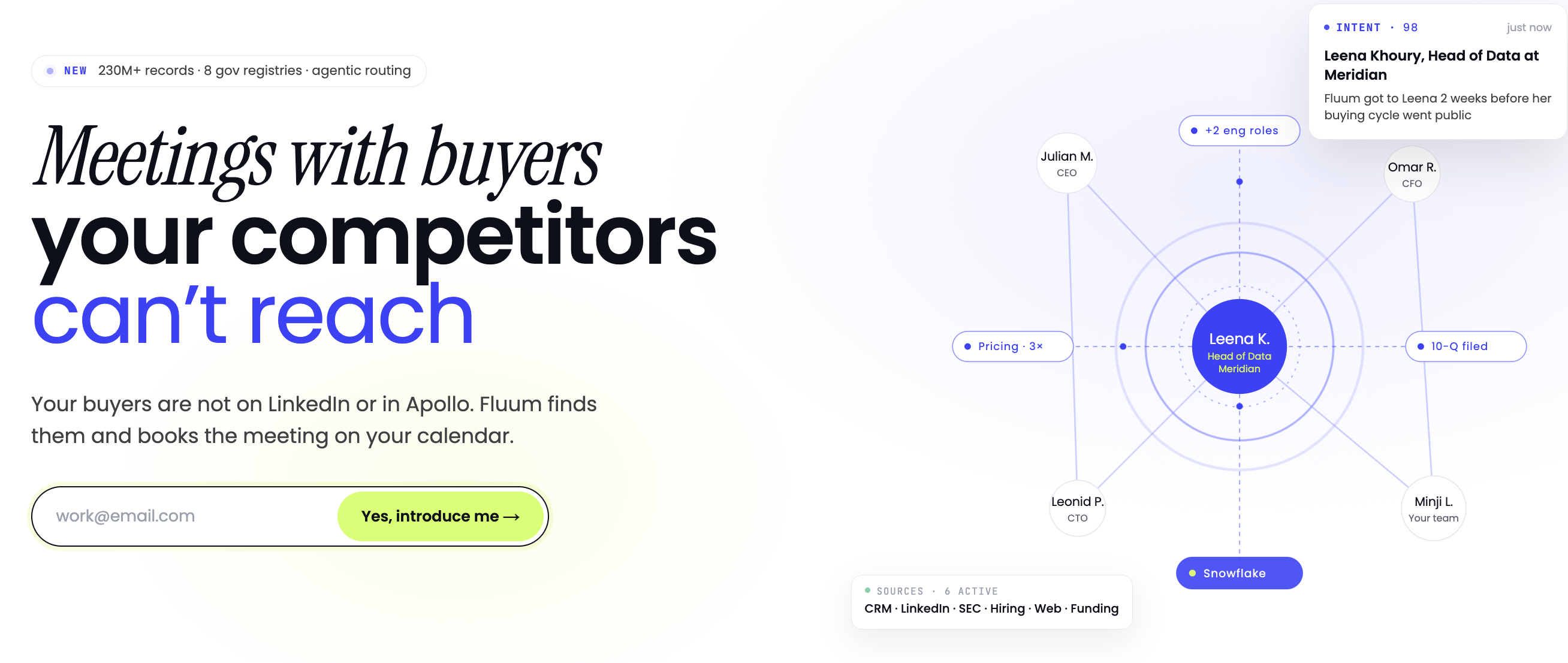
Fluum’s AI-powered introduction platform is built specifically for this model — pulling from 40+ private data vendors and 8 government registries, scoring intent signals, and delivering warm double opt-in introductions to buyers that cold outreach tools simply don’t reach. If you’re a senior leader evaluating what comes after cold email, talk to Aurora at Fluum and tell us exactly who you’re looking to meet next.
Recommended Articles
Explore more from our content library: