
A decision maker path is the sequence of stakeholders, from technical evaluators to budget holders to legal sign-off, a seller must reach, in order, to close a B2B deal. Mapping it matters because most deals don’t stall on finding one decision maker; they stall on missing the three or four people who influence that person’s yes. AI-powered platforms surface this sequence by combining buyer graphs, intent signals, and org data to predict who to reach next, and by delivering warm introductions instead of cold outreach at each step.
What Is a Decision Maker Path and Why Does It Matter in B2B Sales?
A decision maker path isn’t a framework you can buy a certification in, it’s simply the order in which the people around a deal have to say yes before money moves. There’s no fixed template, because that order changes with every org chart, every procurement policy, and every deal size.
Treat it as a relationship between stakeholders rather than a checklist, and the practical problem becomes obvious: your champion saying yes is the start of the sequence, not the end of it. A technical evaluator has to sign off on feasibility. A budget holder has to approve spend. Legal has to clear contract terms. Somewhere in the middle, an influencer nobody put on the call has to not object. Miss any one of them and the deal doesn’t close, it just goes quiet.
How Understanding Decision Maker Paths Improves Sales Velocity and Deal Closure Rates
Mapping the full stakeholder sequence before you’re deep in a deal cycle prevents the single most common cause of stalled B2B deals: getting blindsided by a stakeholder you didn’t know existed. Sales teams that only track one contact routinely discover, three months in, that procurement has its own vendor review process, or that legal flags a data residency clause nobody surfaced during discovery.
Each of those discoveries adds weeks. A deal that should close in a quarter drags into the next one, and RevOps ends up trying to explain a slipped forecast that had nothing to do with product fit and everything to do with sequencing. Knowing who has to approve what, and in what order, turns a reactive scramble into a plan you can build a mutual close plan around from week one.
Why Traditional Cold Outreach Tools Fail to Identify the Full Decision Maker Path
Most prospecting tools are built to find a title, not a path. Search “VP of Operations” in a database and you get a list of people with that title, not the finance partner who controls their budget, not the compliance lead who has veto power, not the influencer two reporting lines down who actually built the business case internally [1]. Sales intelligence platforms are explicit that their core function is surfacing firmographic and contact data, not stakeholder sequencing [4].
Consider a SaaS vendor selling into a manufacturing firm. The champion, a plant operations lead, loves the product and pushes it internally. Three weeks later, the deal stalls, because nobody engaged the procurement director who requires three competing quotes, or IT security, who needs a vendor risk assessment first. A path-aware approach would have identified those roles before the champion ever agreed to a demo. This is precisely the gap Fluum’s AI matching is built to close, pulling signals from 100+ government and private databases to surface the stakeholders around a title, not just the title itself.
How Do You Identify and Map the Decision Makers in a Complex Buying Cycle?
You map this stakeholder sequence by starting with your single known contact, then working outward through their reporting line, adjacent departments, and anyone who touched a similar deal before.
That last part matters more than most sales teams admit. Your known contact rarely sits alone, they report to someone with budget authority, sit next to a department that will use the product daily, and probably inherited relationships from whoever handled procurement last time. The mechanical version of this looks like three questions asked in sequence:
- Who does this person answer to?
- Who else uses what we sell?
- Who signed off on the last comparable purchase?
Answering all three, rather than stopping at the first name, is what separates a real decision maker path from a single contact’s LinkedIn profile.
What Does a Real Organizational Decision-Making Hierarchy Look Like Across Different Industries?
Hierarchies differ enough by industry that a single sales playbook will fail in at least one of them. A manufacturing plant typically routes a purchase through procurement first, who screens on price and supplier compliance, then hands it to engineering for a technical sign-off before anything reaches a plant manager’s desk. A software buyer usually runs the opposite sequence: a champion inside the using department pushes the deal internally first, and only once they’re sold does IT security review vendor risk, data handling, and integration requirements.
Fintech and cybersecurity accounts often add a third layer neither of those has, a compliance or risk function with informal veto power that sits outside both the budget-holder’s team and the technical review. Miss that layer and a deal that looked closed stalls for weeks with no clear explanation.
How Do You Uncover Hidden Influencers and Stakeholders Who Aren’t the Official Budget Holder?
Org charts show reporting lines, not influence, they miss the compliance reviewer nobody names until stage three, the technical gatekeeper who can kill a deal with one objection, or the replacement hire who quietly inherited a departing employee’s veto power. None of that shows up in a directory search.
Real signals surface these people before they surface themselves. Meeting attendee lists that keep including one name without an obvious title match are a tell. So are document co-editors on a shared proposal or requirements sheet, and repeated mentions of the same executive across public filings or press releases tied to vendor decisions. Sales intelligence platforms built for account mapping, the category covered in broader sales intelligence comparisons [3], increasingly try to surface exactly these patterns rather than relying on static contact records [4]. AI agents built for this kind of stakeholder discovery, a category explained in more depth in this breakdown of agent types [5], work by cross-referencing signals rather than searching a single database. Fluum’s approach pulls signals from over 100 government and private databases specifically to catch the contacts who never appear in a standard org chart search, then confirms mutual interest through a double opt-in introduction before either side spends time on a meeting that was never going to close.
What’s the Difference Between Decision Maker Identification and Decision Maker Path Mapping?
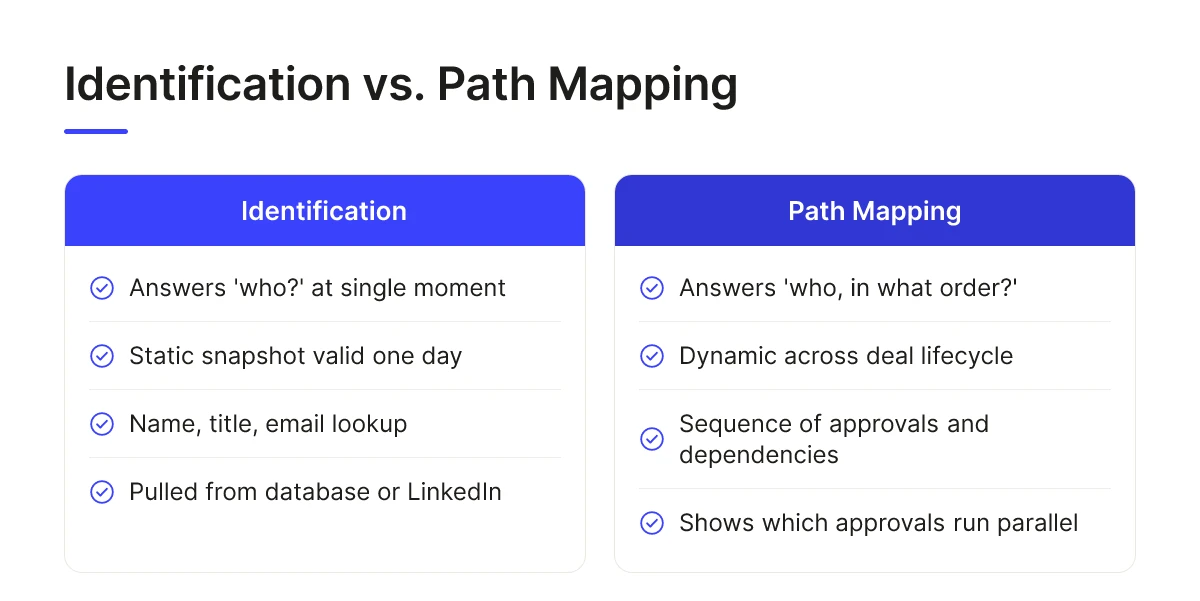
Identification answers “who?” at a single moment. Path mapping answers “who, in what order, with what dependencies?” across the whole life of a deal.
Identification is a lookup: a name, a title, an email address, pulled from a database or a LinkedIn search. It’s static, a snapshot valid the day you took it. A decision maker path is dynamic. It’s the sequence of approvals a deal must clear, who owns each one, and which approvals can run at the same time versus which must happen in order. Sales intelligence platforms are built to do the first job well [4]; almost none are built to do the second.
Why Is Finding One Decision Maker Not Enough in Enterprise and Regulated Sector Deals?
Because enterprise deals rarely have one approver, they have several, working in parallel, each with veto power over a different piece of the decision. Budget sign-off, security review, and legal clearance typically sit with three different people who don’t report to each other and don’t coordinate unless someone forces them to. Find the VP of Sales but miss the CISO who has to sign off on data handling, and the deal stalls at exactly the point you thought it was closing. Sales intelligence tools built for contact discovery and enrichment don’t model this, they hand you a list of names, not a map of dependencies [1].
How Do Approval Chains and Stakeholder Sequences Differ Across Fintech, Cybersecurity, and Manufacturing?
The order of approvals changes by industry, and getting the order wrong costs you as much time as missing a stakeholder entirely.
- Fintech: compliance goes first, nothing moves until legal and risk have cleared the vendor, regardless of how enthusiastic the business sponsor is.
- Cybersecurity: it’s inverted, technical proof comes before procurement even opens a file, because a security team won’t let commercial conversations start until the product has passed internal testing.
- Manufacturing: the sequence runs bottom-up, plant-level operations sign off on fit and function first, and only then does the request move to corporate procurement for contract terms.
Treating these three sequences as interchangeable is how deals stall. A rep who pushes commercial terms to a cybersecurity buyer before technical validation is finished will get ignored, not rejected, worse, because there’s no signal to correct course.
Skip the mapping step and the cost shows up late, not early. A deal that looked closed reopens discovery when a legal reviewer or a plant manager nobody accounted for resurfaces objections a sales cycle deep, forcing the whole approval sequence to restart from a weaker position.
How Do AI-Powered Platforms Surface Decision Maker Paths at Scale?
AI agents map this stakeholder sequence by combining buyer graphs, live intent signals, and cross-referenced records, then refresh that map continuously across an entire account list, not one prospect at a time.
A rep doing this manually opens a CRM, a LinkedIn tab, and a company org chart, and tries to guess who signs off after the first champion says yes. That guesswork is what AI agents replace, not with a better guess, but with structured data that shows how buying committees have actually behaved before.
How Do Buyer Graphs and Intent Signals Help AI Agents Predict the Sequence of Stakeholders You Need to Reach?
A buyer graph links people across companies, prior employers, and shared deal history, so the system can see that a VP who approved a similar purchase at their last company tends to loop in procurement at the same stage every time. That pattern, champion, then finance, then legal, repeats across accounts with enough consistency that an AI agent can predict the next name in the chain before a rep has made a single call.
Intent signals sharpen the timing. Hiring surges in a specific department, new tech adoption flagged in job postings, or a public announcement about a compliance deadline all indicate which stakeholder is becoming active before that person ever replies to an email. A cybersecurity vendor watching a target account hire three GRC analysts in a quarter is watching a buying committee assemble in real time, the pattern shows up in the data well before it shows up in a reply.
What Private Data Sources and Government Registries Reveal Decision Maker Paths That Public Tools Miss?
Job titles lie. A “Director of Procurement” at one manufacturing firm signs six-figure contracts alone; at another, they need three sign-offs above them. Cross-referencing private data sources against public registries, company filings, regulatory disclosures, procurement records, validates actual signing authority rather than assumed authority from a title on a profile.
This is where Fluum’s approach diverges from directory-style tools: it pulls signals from 100+ government and private databases to surface contacts whose real buying authority wouldn’t show up on LinkedIn or in a standard contact database at all. For fintech and manufacturing buyers in particular, where compliance sign-off often sits outside the obvious chain of command, that cross-referencing is what separates a real decision maker path from a title-based guess.
The scale advantage is the part most sales leaders underrate. Mapping one account manually takes a rep hours, chasing org charts, checking recent job changes, guessing at approval chains. AI agents do this continuously across a full target list, refreshing every path as people change roles or new signals appear, without adding a single hour of headcount.
What Tools and Data Sources Help You Navigate Decision Maker Paths in Regulated Industries?
Regulated sectors need licensing registries and compliance databases layered on top of standard firmographic data, because the approval sequence itself is dictated by law, not org chart preference.
In fintech, a vendor decision might legally require sign-off from a compliance officer before it ever reaches procurement, no amount of firmographic data from a standard contact database tells you that officer exists or who holds the title this quarter. In healthcare, state licensing boards and credentialing registries reveal which stakeholder has regulatory authority to approve a clinical tool, information that never appears on LinkedIn. Manufacturing adds its own layer: safety certifications and supplier accreditation bodies often gate who can even evaluate a new vendor. Standard sales intelligence platforms built for general B2B, pulling firmographics, technographics, and intent signals [4], miss this regulatory layer entirely because it was never designed to track licensing status or compliance mandates.
Tooling for this problem splits into three qualitative tiers:
- Budget-friendly: manual research, a rep cross-referencing public registries, state licensing databases, and regulatory filings by hand, which works but doesn’t scale past a handful of accounts a month.
- Mid-range: enrichment platforms that automate contact discovery and layer in some compliance data, closing gaps that generic sales intelligence tools [3] leave open.
- Premium: AI-driven path mapping that pulls from many databases simultaneously; Fluum’s approach queries signals from 100+ government and private databases to surface decision-makers in finance, technology, and manufacturing that cold outreach tools and LinkedIn alone can’t reach.
How Do You Deliver Warm Introductions Across a Decision Maker Path Without Cold Outreach?
A warm introduction confirms mutual interest at every stakeholder step through double opt-in, whilst cold outreach asks a total stranger to vouch for your urgency with no context at all.
This distinction matters most at stakeholder three or four. Reaching the first person on a mapped sequence cold is hard enough; reaching the fourth cold, after burning goodwill with the first three, often undoes whatever trust you built earlier in the sequence. Each unreturned cold email or ignored LinkedIn message is a small withdrawal from an account that never had much balance to begin with.
A double opt-in mechanic changes the economics. Fluum confirms that both the introducing contact and the next stakeholder actually want the conversation before any message goes out, then delivers a context-rich introduction rather than a generic template. That warm handoff carries the credibility of the first relationship into the second, and the second into the third, preserving trust across the full path instead of resetting it at every stage.
Frequently Asked Questions
How long does it typically take to map a decision maker path for a new target account?
Manual mapping through research and discovery calls usually takes one to three weeks per account; AI-matched platforms compress this to days. The gap comes from data access, pulling org signals from 100+ databases beats waiting for a champion to draw you an org chart on a call.
Can a decision maker path change mid-deal, and how do you adjust if it does?
Yes, reorganisations, budget freezes, and new hires reshuffle buying committees constantly, especially in regulated sectors like finance and manufacturing. Treat the path as a live model, not a one-time diagram: re-verify stakeholder roles at each stage gate rather than assuming your original map still holds.
Do smaller B2B deals still have a decision maker path, or is this only relevant for enterprise sales?
Smaller deals still have one, it’s just shorter, often two or three people instead of seven. A Series A to C scaleup selling into a 50-person company might only navigate a founder and a finance lead, but skipping either still kills the deal.
What role does a champion play in navigating the rest of the decision maker path?
A champion translates your pitch into internal language and vouches for you when you’re not in the room. Without one, you’re relying on your own credibility with people who’ve never heard of you; with one, budget holders and technical evaluators hear your case from a colleague they already trust, which is exactly the dynamic a double opt-in introduction replicates from the first contact.
How does account-based marketing relate to mapping this kind of stakeholder sequence?
Account-based marketing and stakeholder mapping solve overlapping problems: ABM targets a defined buying committee with coordinated messaging, while mapping identifies who belongs on that committee in the first place. Modern ABM approaches increasingly rely on AI to identify and sequence the right stakeholders before campaigns launch [2], which is why the two disciplines are converging rather than staying separate.
Conclusion
Mapping this stakeholder sequence is only half the job, reaching each one without triggering the spam filters and scepticism that cold outreach now provokes is the harder half. The teams winning in finance, cybersecurity, and manufacturing right now treat every stage of that path as a relationship to earn, not a contact to email.
Start with your next stalled account: identify who else on the buying committee you haven’t reached, and pursue a warm introduction to that person instead of another cold email. Fluum’s double opt-in matching exists for exactly that gap.
Sources & References
- Best Enterprise Lead Generation Tools | Knock AI
- ABM with AI: Complete Guide to Account-Based Marketing Strategy | Autobound
- Sales Intelligence Tools Ranked: 20 Top Selling Platforms In 2026
- What is Sales Intelligence? | DealHub AI
- 6 Types of AI Agents and What Each One Does Best | Sigma
Recommended Articles
Explore more from our content library: