
Understanding outbound reply rates falling is essential. Cold outbound reply rates are falling because buyers now filter unsolicited email by default, spam protections, inbox fatigue, and years of list-buying have taught people to ignore messages from strangers. The fix isn’t a better subject line; it’s changing how the first conversation starts. Warm introductions (where both sides have opted in) and intent-based targeting (reaching people already showing buying signals) consistently produce more replies and meetings than cold email, because the recipient already has a reason to respond. Sales leaders who want pipeline back should shift budget and process toward warm paths, not spend more time optimizing a channel people have learned to tune out.
Why Are Cold Outbound Reply Rates Falling, and What Does It Mean for Sales Pipeline Strategy?
Outbound reply rates falling is not a copywriting problem, it’s a structural one, built into how inboxes now defend themselves against volume. Spam filters, inbox providers, and corporate security tools have got much better at spotting bulk-looking, unsolicited email, and they down-rank it before a human ever sees the subject line. That means deliverability and attention both decay over time, no matter how sharp the messaging gets.
The mechanism is simple: send patterns, not sentences, get flagged. Domain-warming schedules, purchased lists, and templated personalisation, swap in first name, company name, done, have trained buyers to spot a cold pitch in under two seconds and delete it on sight. SaleShive notes that average cold reply rates now sit around 5-8% even with a disciplined framework [1], and Leadscampaign’s research puts many campaigns stuck below 3% once targeting and data quality break down [3]. Fintech, cybersecurity, and manufacturing sales leaders feel this hardest, because their buyers are exactly the ones who’ve seen every version of the script.
What Industry-Specific Factors Are Driving Reply Rate Decline in SaaS, Fintech, and Regulated Sectors?
Regulated industries add compliance friction that generic cold email frameworks never account for. Fintech and healthcare buyers operate inside procurement and data-governance rules that make an unsolicited pitch from an unknown domain a liability, not just an annoyance, legal and security teams often intercept messages before a decision-maker ever reads them. SaaS is a different problem: buyers there are oversaturated, not cautious, fielding dozens of near-identical vendor pitches a week until every one of them reads as noise.
How Has Buyer Behaviour Shifted Away From Cold Email Channels?
Decision-makers increasingly build their vendor shortlist from referrals, peer conversations, and their own inbound research, not from whoever emails first. SalesHive points out that most B2B buyers still say they prefer email as a channel [1], but preference and response are not the same thing; the shift is towards trusted introductions and self-directed research, with cold pitches acting as noise to filter out rather than a starting point to consider.
For a VP of Sales, this isn’t an inbox metric, it’s the loss of a predictable top-of-funnel. When outbound reply rates falling becomes the norm across a team’s whole pipeline, quota risk follows directly, because a channel that used to generate a known number of qualified conversations each month stops being reliable at any volume. That’s a structural failure, and it demands a structural fix rather than another round of subject-line testing.
How Do Warm Introductions and Intent-Based Targeting Compare to Cold Email for Pipeline Generation?
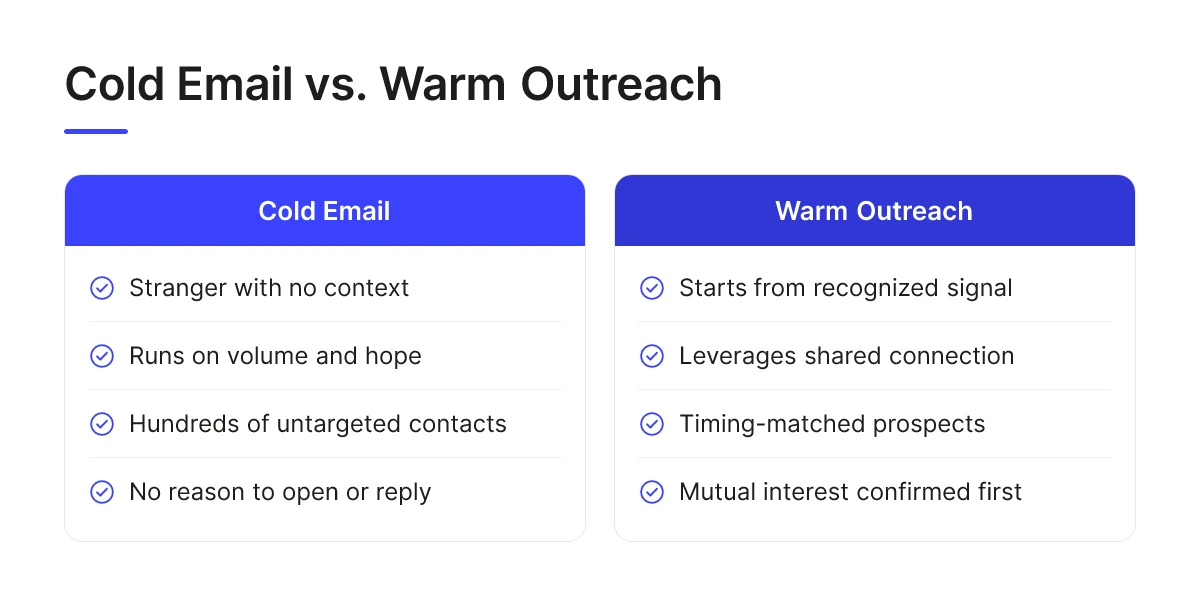
Cold email asks a stranger to give up their time with nothing to go on but a subject line; warm introductions and intent-based targeting start from something the stranger already recognises, a signal, a shared connection, a timing match. That single difference explains most of the gap between a channel that’s dying and one that isn’t.
Cold outbound still runs on volume and hope. You build a list, guess at relevance, and fire a sequence at hundreds of contacts who’ve never heard of you and have no reason to open the email, let alone reply. Warm introductions and intent-based targeting flip the order of operations: relevance gets established before the first message is ever sent, not after.
What Conversion and Engagement Metrics Do Warm Introductions Achieve Versus Cold Outbound Campaigns?
A recipient responds faster and more often when they already recognise the sender, or when the outreach lands at a moment that matches something real happening inside their business. That’s the entire mechanic behind why outbound reply rates falling has become the default trajectory for cold email, whilst introduction-based and intent-triggered outreach hold up. Cold email today converts in the low single digits for most B2B senders, with typical benchmarks sitting around 5-8% on a good list [1] and plenty of campaigns landing well under 3% once targeting or copy is off [3]. Warm introductions change the starting condition entirely, the conversation isn’t a cold ask, it’s a follow-up to interest that’s already been confirmed.
How Do Opted-In Networks and Private Data Vendors Enable Introductions Cold Email Tools Cannot Reach?
Public cold-email lists are scraped contact records, a name, a title, an email guessed and verified by a syntax checker. Opted-in networks and private data vendors work from a different substance altogether: real relationships, verified activity, and signals pulled from sources a scraper never touches. Fluum, for example, queries over 100 government and private databases to surface decision-makers in finance, technology, and manufacturing who simply don’t show up on a purchased list, then uses a double opt-in mechanic, both sides confirm interest before any conversation is proposed. That removes the guesswork cold email has always depended on: no more sending blind and hoping the timing happens to land.
None of this is free. Warm and intent-based approaches take more setup than loading a list into a sequencer and pressing send, someone has to define the ideal customer profile, verify the signal, and manage the matching. But that setup is precisely what turns a suppressed, ignored channel into pipeline you can actually forecast against.
What Buyer Signals and Decision-Maker Data Actually Predict Sales Conversations?
Five signal categories predict buying windows reliably: hiring activity, funding events, leadership changes, government registry filings, and regulatory disclosures.
Most sales teams still buy lists sorted by industry, headcount, and revenue band. That’s fit data, not timing data. It tells you a company could plausibly need what you sell, it says nothing about whether they’re actually deciding right now, which is the gap that explains outbound reply rates falling across nearly every B2B sector.
Which Intent Signals From Government Registries, SEC Filings, and Corporate Data Correlate With Sales-Ready Buyers?
A company posting five new roles in compliance or risk usually has a budget event behind it, not a wish list. A funding round closing means new headcount and new tooling decisions inside a defined window. A new CFO or Chief Revenue Officer typically re-evaluates vendor relationships within their first two quarters. Government registry filings and public regulatory disclosures, new licences, permit applications, statutory filings, often precede a procurement cycle by weeks, not months.
None of these signals is decisive alone. A hiring post could mean backfill. A filing could be routine. Fit data (industry, size, revenue) tells you who’s plausible; these signals tell you who’s moving. Firmographic data alone can’t distinguish a company that’s been the same shape for three years from one mid-transition, and mid-transition is when buying decisions actually get made.
How Do AI Agents Score and Prioritize Decision-Maker Paths to Improve Outreach Relevance?
A single weak signal is noise. Several weak signals stacked on the same account in the same window is a pattern worth acting on. This is where AI earns its place in the stack, it can hold hundreds of thousands of accounts against dozens of signal types simultaneously and rank them by momentum, something no rep can do manually across a territory of any real size.
Ranking accounts isn’t enough on its own. Fluum’s approach scores the decision-maker path too, not just which company looks ready, but which named person holds buying authority and what the most credible route to that person actually is, drawn from signals across 100+ government and private databases rather than a single scraped LinkedIn list.
Timing is what restores reply behaviour. A message that lands while a signal is fresh reads as relevant, informed, well-timed. The same message sent cold, six months later, reads as noise, which is the entire story behind reply rates collapsing industry-wide.
How Can Sales Leaders Implement Warm Outreach at Scale Without Relying on Cold Email?
Building a warm outreach motion means restructuring how reps find, qualify, and approach prospects around real signals instead of list volume, segment by trigger and industry, personalise around the specific connection, and confirm mutual interest before anyone sends a message.
What Segmentation and Personalization Strategies Work Best for Warm Outreach in Manufacturing, Cybersecurity, and Fintech?
A manufacturing procurement director doesn’t respond to the same trigger as a fintech compliance lead, so treating both with one template is why outbound reply rates falling has become the default outcome for so many teams. Manufacturing buyers move on supply chain disruption, new plant capacity, or capital expenditure cycles. Cybersecurity buyers move on breach disclosures, audit deadlines, or a new CISO hire. Fintech buyers move on regulatory change, funding rounds, or a compliance officer’s mandate to replace legacy vendors.
Segment your target list by signal type first, industry second. A rep chasing manufacturing accounts should be watching for plant expansions and supplier changes; a rep working cybersecurity should track leadership turnover and incident disclosures. Personalisation then means naming the specific signal that prompted contact, not a mail-merge field pulling in company size or job title. “I saw you just onboarded a new head of procurement” does more work than “I noticed you work in manufacturing.” Generic messaging is precisely what pushed reply rates below the 2% mark that most cold campaigns now see [3].
How Do Double Opt-In Introductions and Unconventional Channels Reduce Friction Compared to Traditional Cold Campaigns?
A double opt-in introduction works in three steps: first, identify mutual relevance between buyer and seller using signal data rather than guesswork; second, confirm genuine interest from both sides independently, before either party knows the other has said yes; third, facilitate the actual conversation with context already established. This is the mechanic Fluum runs, matching described ICPs against 100+ government and private databases, then only connecting parties once both have opted in, which is why introductions land at 40–50% reply rates instead of the 2% cold email now delivers.
Channels matter too. A warm phone call referencing a mutual contact, a LinkedIn message sent through a shared connection, or a conversation started at an industry event all carry inherited trust that a cold email can’t fake. These channels work because the friction of “who is this and why are they contacting me” is already resolved before the first message arrives.
Organisationally, this requires quota structures that reward qualified conversations over send volume, tooling that surfaces signals instead of just contact data, and reps trained to research triggers rather than write sequences.
What Metrics Should Replace Cold Email Reply Rates When Measuring Outbound Pipeline Success?
Conversation rate, meeting booking rate, and pipeline velocity tell you whether outbound is building revenue, reply rate only tells you whether an inbox noticed you.
A reply is not a conversation. It’s not a meeting. It’s barely a signal. Yet most sales teams still report reply rate as if it were the finish line, when it’s just the starting gun. Once outbound reply rates falling becomes the pattern on your dashboard, the fix isn’t a better subject line, it’s a different scorecard entirely.
How Do Conversation Rate, Meeting Booking Rate, and Pipeline Velocity Differ From Reply Rate as KPIs?
Each of these three metrics measures a step closer to revenue than reply rate ever does. Conversation rate tracks how many replies turn into a genuine back-and-forth, not an auto-reply, not a “not interested,” not a one-line brush-off. Meeting booking rate tracks how many of those conversations convert into a calendar invite with a decision-maker who can actually buy. Pipeline velocity tracks how fast a contact moves from first touch to a qualified opportunity, which is the number your CRO actually cares about.
A high reply rate with a weak meeting conversion still fails the pipeline, you’ve generated inbox noise, not revenue. Sales leaders who cling to reply rate as their headline KPI are optimising for the easiest number to move, not the one that pays quota.
What Before/After Results Show the Impact of Shifting From Cold Email to Intent-Driven Warm Outreach?
Before you shift spend, baseline your current cold performance qualitatively: how many touches does it take to book one meeting, how long does that take, and how many of those meetings actually progress. You don’t need a fabricated industry benchmark to see the direction of travel once you compare your own numbers before and after.
Teams that make this shift typically report fewer total outreach touches, noticeably higher conversation quality, and a shorter gap between first contact and booked meeting, because the contact already has context and motivation, rather than a cold subject line to decode. This is the mechanic behind Fluum’s double opt-in introductions: both sides confirm interest before the first message lands, which is why the conversation starts warm instead of defensive.
On cost, run it in stages. Test budget-friendly pilots into warm and intent-based channels first, then scale investment only as conversation and booking rates prove out, don’t rip out your entire outbound budget on day one.
Frequently Asked Questions
Is cold email dead, or does it still have a role in outbound strategy?
Cold email isn’t dead, but it’s a shrinking, high-maintenance channel that needs constant infrastructure work to stay usable. Roughly 73-77% of B2B buyers still say they prefer email as an outreach method [1], so it retains a role in a mixed strategy. The problem is that average reply rates have sunk to 5-8% at best [1], often lower without a “why now” trigger [2], meaning it can no longer carry pipeline alone.
How long does it take to shift a sales team from cold email to warm outreach?
Most teams can pilot warm-introduction channels alongside existing outbound within a single quarter without abandoning cold email overnight. The shift is gradual: RevOps typically layers intent-based targeting and double opt-in introductions in as a parallel motion, measures reply and meeting-booked rates against the cold sequence, then reallocates SDR time once the warm channel proves out.
Do warm introductions work for outbound-heavy industries like manufacturing or cybersecurity?
Yes, regulated and hard-to-reach sectors like manufacturing, cybersecurity, and finance often benefit most, since cold outreach struggles to reach gatekept decision-makers. Fluum’s matching draws on signals from 100+ government and private databases spanning finance, technology, and manufacturing, surfacing contacts that generic list-buying and cold sequencing rarely reach.
What’s the difference between intent data and firmographic data in outbound targeting?
Firmographic data describes a company, size, industry, revenue, whilst intent data signals that a specific buyer is actively researching a problem right now. Targeting on firmographics alone gets you a plausible list; intent data gets you timing, which is usually the missing “why now” behind a low reply rate [2].
Conclusion
Falling outbound reply rates aren’t a copywriting problem, they’re a channel problem. Tightening subject lines and adding another follow-up step won’t fix reply rates stuck below 3% [3] when the real issue is contacting the wrong person with no trigger event [2] and no relationship context [4]. The fix is structural: pair intent signals with a channel built on mutual interest rather than volume.
Start by auditing your last 100 outbound sends against two questions, did this contact have a live reason to care, and did anyone vouch for the conversation before it started? If the answer is no both times, pilot a double opt-in introduction alongside your next campaign and compare reply rates directly.
Sources & References
- The Art of Cold Emailing: Building the Framework | SalesHive
- The Practical Guide to Cold Email Outreach That Actually Converts | Salesmotion
- 18 B2B Cold Email Engagement Strategies (2026 Guide)
- Outbound Sales Strategy: Fix Broken Outbound Fast
Recommended Articles
Explore more from our content library: