
Understanding decision makers not on LinkedIn is essential. Many senior decision makers in regulated industries like fintech, cybersecurity, defense, and manufacturing simply aren’t on LinkedIn, or they keep profiles deliberately sparse, because compliance policies, privacy risk, and executive protection concerns discourage public visibility. That means LinkedIn job titles and search filters miss a real slice of the buying committee. Reaching these people requires other sources: government and regulatory registries, private data vendors, industry events, warm introductions, and verified contact data that don’t depend on someone maintaining an active LinkedIn presence.
Why Are Decision Makers Not on LinkedIn in Regulated Industries?
Compliance obligations, personal safety concerns, and sector culture combine to keep senior buyers invisible on a platform built for public self-promotion. This isn’t an accident or an oversight on their part, it’s often policy.
What Compliance or Privacy Concerns Make Decision Makers in Fintech, Cybersecurity, and Manufacturing Skip LinkedIn?
Regulated firms restrict what executives can say publicly, full stop. A CISO at a bank or a VP of Engineering at a defence contractor typically operates under communications policies that require legal or compliance sign-off before anything goes public, a LinkedIn post included.
Financial services firms worry about inadvertent disclosure of material information. Cybersecurity vendors worry about revealing product roadmaps or client relationships that competitors or attackers could use. Defence and manufacturing firms often work under contractual or regulatory confidentiality terms that make an active, opinion-sharing LinkedIn presence a liability rather than an asset.
Then there’s personal exposure. Being publicly identifiable as the person who signs off multi-million-pound vendor contracts, or who controls access to sensitive infrastructure, can attract unwanted attention, from recruiters, from social engineering attempts, from activists. Many of these executives deliberately minimise their digital footprint as a form of executive protection, not because they’re camera-shy but because visibility carries real risk.
How Does Ghost Mode or Limited LinkedIn Presence Affect B2B Prospecting in Regulated Sectors?
Plenty of these executives have a profile, it’s just abandoned. A “ghost” account gets created once, maybe during a job search years ago, and never touched again.
The job title is stale. The company listed might be an employer from three roles ago. Seniority signals that prospecting tools rely on, current title, tenure, reporting line, are simply wrong, which means search filters built around them silently exclude the very buyer a sales team needs to find.
Compare this to SaaS or media, where personal branding on LinkedIn is professionally rewarded and often expected, founders, marketers, and product leaders build audiences there because it drives their business [1]. That contrast is the point: this isn’t a universal shift away from the platform, it’s sector-specific caution.
The practical consequence for anyone prospecting is direct. Any tool or process built purely on LinkedIn scraping will systematically undercount real buying committees in fintech, cybersecurity, defence, and manufacturing, and 90% of certain business categories already carry zero LinkedIn footprint by one industry estimate, a gap that widens further once you’re targeting regulated enterprise buyers rather than small local firms [2].
How Can Sales Teams Identify Decision Makers Who Don’t Use LinkedIn?
You find decision makers not on LinkedIn by pulling from government registries, private data vendors, and behavioural intent signals instead of social profiles.
None of this is exotic. It’s the same due-diligence infrastructure that compliance teams, auditors, and M&A analysts have used for years, just pointed at pipeline generation instead of risk checks. The reason it works where LinkedIn search doesn’t is simple: officers, directors, and licensed professionals in finance, manufacturing, and regulated tech are legally required to appear somewhere. That somewhere is rarely a social network.
What Private Data Vendors and Government Registries Reveal Decision Makers That LinkedIn Misses?
Company registration filings, financial regulator registers, and market authority disclosures list the named individuals behind a business whether or not those people ever open a LinkedIn app. A company incorporation record names directors. A financial conduct register names licensed advisors and compliance officers. A manufacturing permit filing names the plant manager who signed off on it. None of this depends on the person maintaining a profile anywhere, the obligation to disclose sits with the regulator, not the individual.
Private data vendors take this a step further by aggregating those scattered filings, licensing records, and public disclosures into a single searchable layer. Instead of manually pulling records from a dozen regulatory bodies, a sales team queries one aggregated source and gets a structured profile: name, title, company, filing history. This is precisely why prospecting tools built around scraping social profiles struggle with entire categories of business, independently owned firms and tightly regulated entities alike tend to have a thin or nonexistent social footprint even when they’re fully documented elsewhere [2].
How Do AI-Powered Intent Signals and Buyer Graphs Surface Decision-Maker Paths Outside LinkedIn’s Network?
Buyer graphs map the relationships between people and companies using signals that have nothing to do with social connections: a job change recorded in a filing, a funding round, a new procurement contract, a licence transfer. AI models trained on this kind of signal can infer who now holds budget authority at a target account faster than a manual search through mutual connections ever could.
Intent signals close the loop. When someone requests a demo, downloads regulatory guidance, or engages repeatedly with industry-specific content, that’s a stronger buying indicator than a completed LinkedIn profile ever was, because it reflects an active decision, not a passive presence. Fluum’s matching layer works this territory directly, drawing signals from 100+ government and private databases to surface contacts across finance, technology, and manufacturing that cold-outreach tools and LinkedIn-only prospecting simply never see.
The practical step: cross-reference any target list against registries and private data sources before trusting a single tool’s output. Overlapping two or three sources catches the gaps each one leaves on its own.
What Alternative Channels Work Better Than LinkedIn for Reaching Off-Platform Decision Makers?
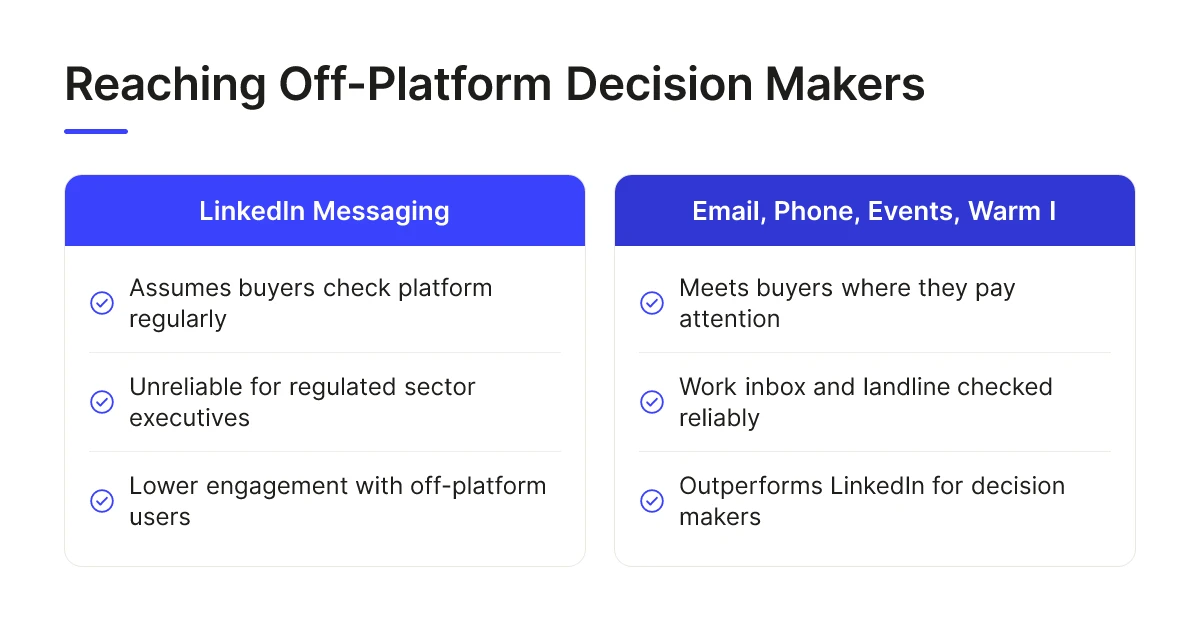
Email, phone, trade events, and warm introductions all outperform LinkedIn messaging for decision makers not on LinkedIn, because each one meets buyers where they actually pay attention, rather than where sales tools assume they are.
How Do Email, Phone, Industry Events, and Warm Introductions Compare to LinkedIn for SMB and Enterprise Decision Makers?
A compliance officer at a regional bank or a plant manager at a manufacturing firm often checks a work inbox and a landline more reliably than a LinkedIn account they set up once and never opened again. Email and phone still work here, not because they’re glamorous, but because they route through channels these buyers actually monitor. Cold versions of both still suffer the same collapse in response rates that’s hit every high-volume channel [1].
Industry events, conferences, and trade association gatherings do something no digital channel does: they put a low-profile buyer in a room voluntarily. Someone who avoids public social platforms for compliance or personal reasons will still show up to a sector conference, because that’s where deals, referrals, and regulatory updates actually happen. This makes events a primary touchpoint precisely for the buyers cold prospecting tools can’t see.
Warm introductions outperform both when they’re structured properly. When both sides confirm mutual interest before a conversation starts, reply rates and trust run structurally higher than any cold-volume tactic, recognition and context replace guesswork from a purchased list. This is the double opt-in mechanic Fluum runs on: an introduction only happens once both parties have said yes, so the first message a buyer receives already carries relevance instead of a generic pitch.
What Contact Database Tools and Unconventional Channels Actually Reach Buyers That Cold Outreach Platforms Don’t Index?
Contact database tools built on public records, licensing filings, corporate registries, procurement documents, reach people that scraped-social-data platforms simply never see [2]. A useful database in this category surfaces verified direct lines and licensing records, not just a job title copied from a public profile. That distinction matters: scraped data goes stale fast and misses anyone who never populated a profile in the first place [3].
SMB and enterprise buyers split here in a practical way. A small business owner is often reachable by a phone call or a local trade event, because the sales cycle is short and the owner is the whole decision unit. Enterprise buyers in regulated sectors more often surface through licensing registries, conference attendee lists, or a warm introduction, because the buying committee is layered, and cold contact rarely reaches the actual signer.
How Do You Verify Someone Is a Real Decision Maker Without a Reliable LinkedIn Title?
Verify buying authority by cross-checking regulatory filings, procurement records, and org-chart inference against whatever title a profile shows, never the title alone.
A job title on a profile is a claim, not evidence. It’s written by the person it describes, updated whenever they feel like it, and often stale by months or years. That’s the core problem when you’re trying to reach decision makers not on LinkedIn, or worse, decision makers whose LinkedIn presence exists but tells you nothing reliable about what they actually control.
What Signals Beyond Job Title Confirm Buying Authority in Regulated Industries Where LinkedIn Data Is Sparse or Outdated?
Regulatory and corporate filings beat self-reported titles because they carry legal weight. Companies House filings in the UK, FCA registers for financial services, or FDA and state licensing boards for healthcare and manufacturing all record who holds officer, director, or licensed-practitioner status, and these records get updated because failing to do so has consequences a stale profile never does. If someone appears as a registered director or a named compliance officer, that’s a far stronger signal of authority than any headline claiming “VP of Something.”
Procurement signals tell you who actually spends money, which matters more than who holds a senior title. Public tender documents, RFP responses, and purchase order sign-offs, especially in manufacturing and public-sector-adjacent finance, name the individuals who approve budget, not just the ones who present in board meetings. Origami’s research on small business prospecting notes that traditional databases index what’s easy to find, not where the real activity happens [2], and the same gap shows up at the enterprise level: procurement paper trails often reveal buying power that a title search misses entirely.
The fastest verification, though, comes from people, not databases. A warm introduction through a mutual connection lets you confirm someone’s actual remit in a single conversation, before you’ve spent any outreach effort on a title that might be three reorganisations out of date. This is precisely why double opt-in introduction models exist, Fluum’s matching process surfaces contacts from over 100 government and private databases and confirms mutual relevance before either side is asked to engage, which sidesteps the title-guessing problem completely.
A working checklist: cross-check the title against a registry filing, infer the org chart from adjacent hires and reporting lines, and get direct confirmation from a shared contact wherever possible. Three signals beat one every time.
Cold Outreach Tools vs. Buyer Intelligence Platforms for Finding Decision Makers Not on LinkedIn
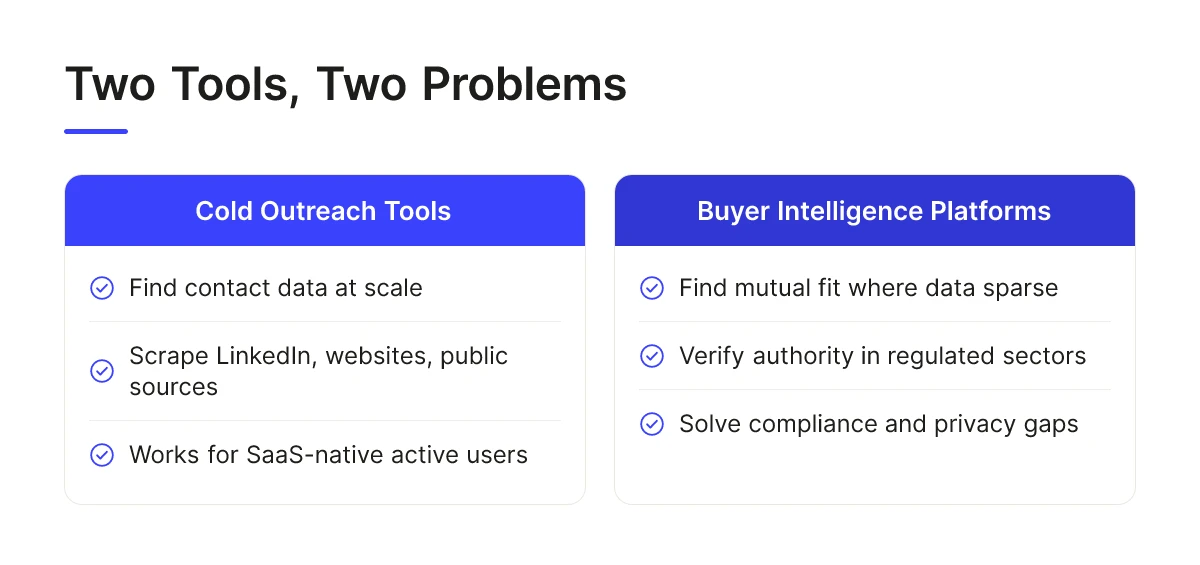
Cold outreach tools and buyer intelligence platforms solve different problems: one finds contact data at scale, the other finds mutual fit where contact data barely exists.
Most sales stacks are built around the first category. Contact enrichment tools scrape LinkedIn profiles, company websites, and public web sources, then package the results into lists with a job title, an email guess, and a company domain. That works fine for SaaS-native buyers who maintain active LinkedIn profiles. It breaks down fast once your ICP sits in finance, manufacturing, or any regulated sector where the compliance officer or plant procurement lead has never posted, connected, or updated a headline in five years.
How Do Contact Enrichment Tools Compare to AI-Powered Buyer Graph Platforms for Identifying Off-LinkedIn Decision Makers?
Enrichment tools answer “who holds this title at this company”, buyer graph platforms answer “who is actually in-market and reachable right now.”
Buyer intelligence platforms add a layer enrichment tools don’t have: relationship graphs, intent signals, and non-social data sources, filings, procurement records, licensing databases, trade registries, that keep producing results when LinkedIn data thins out. This is the structural gap behind decision makers not on LinkedIn: the buyer exists in public and private records long before they exist in a social graph. A platform pulling signals from 100+ government and private databases, which is how Fluum sources its matches, surfaces contacts a scraper never touches because it isn’t looking at LinkedIn at all.
What Real-World Sales Outcomes Result From Targeting Decision Makers Through Opted-In Networks Instead of Cold Outreach?
Opted-in introduction networks trade some volume for confidence, and the reply-rate gap between the two approaches is the clearest evidence of that trade-off.
A double opt-in introduction model is a distinct third category, separate from both scraping tools and buyer-graph platforms. It doesn’t depend on finding a contact’s data at all, it depends on confirming mutual interest before either side sends a message. Fluum’s approach sits here: match, confirm interest on both sides, then introduce with context, targeting 40–50% reply rates against the roughly 2% typical of cold email. Cold tools still win on raw volume for common, well-documented roles. For regulated-industry targets who avoid LinkedIn entirely, opted-in and registry-based approaches convert far better, even at lower reach.
Frequently Asked Questions
Is it illegal to contact a decision maker who isn’t on LinkedIn?
No, contacting a decision maker outside LinkedIn is legal, provided you follow standard data protection rules like GDPR or CCPA. What matters is how you sourced the contact and whether you honour opt-out requests, not which platform they use. Government registries and public filings are lawful data sources by design.
Do regulated industries have fewer decision makers on LinkedIn than other sectors?
Yes, broadly, compliance, procurement, and manufacturing leaders tend to keep a lower public profile than marketing or tech roles. Many operate under employer social media policies or simply don’t see networking value in a public feed. This mirrors the wider pattern where independently run and specialist businesses skip LinkedIn entirely [2].
Can government registries replace LinkedIn for finding decision makers?
They can’t replace LinkedIn outright, but they cover ground LinkedIn misses, ownership records, licensing boards, and regulatory filings often name the actual signatory or accountable executive. Traditional databases index what’s easy to scrape, not what’s actually true of who holds authority [2]. Combining registry data with other public signals gives a fuller, more accurate picture than any single source.
What’s the fastest way to confirm someone’s authority before reaching out?
Cross-check their name against a public filing, licence, or regulatory record tied to the decision, that’s faster and more reliable than a job title alone. Titles get inflated; signatures on filings, permits, or compliance documents don’t. This is also why account-based, verified searches consistently outperform keyword guesswork [3].
Are warm introductions more effective than cold outreach for regulated-industry buyers?
Yes, substantially, buyers in finance, manufacturing, and cybersecurity respond far better to a trusted introduction than a cold message. Research from Bain & Company shows B2B buyers are 5x more likely to engage when introduced through a trusted third party, and platforms like Fluum report 40–50% reply rates built on that mechanic.
Conclusion
Decision makers in finance, manufacturing, and cybersecurity don’t skip LinkedIn by accident, they’re accountable to regulators, boards, and licensing bodies that reward a low public profile. Chasing them with cold sequences built for a LinkedIn-native buyer wastes budget on a channel that was never built to reach them.
Three things to act on: mine public filings and registries instead of social platforms, verify authority against a document rather than a job title, and prioritise warm introductions over volume outreach in regulated accounts. Start by auditing your current pipeline for how many contacts came from LinkedIn alone, then test one registry-sourced or introduction-led account against it this quarter.
Sources & References
- 8 B2B Sales Prospecting Strategies for 2025
- Best Prospecting Tools for Small Businesses (2026)
- How To Find Decision-Makers on LinkedIn? [2026 Tutorial] | Evaboot
Recommended Articles
Explore more from our content library: