
| Key Insight | Explanation |
|---|---|
| Financial data is a sourcing weapon | Spend analytics, supplier financials, and market pricing data give procurement teams hard negotiating power that gut instinct never can. |
| Leverage items require a distinct strategy | In the Kraljic Matrix, leverage items carry high spend but low supply risk — they’re where financial data delivers the biggest ROI on sourcing effort. |
| Spend analysis is the starting point | You can’t negotiate what you haven’t measured. Spend analysis consolidates purchase data to reveal where money is going and where savings are hiding. |
| Supplier financial health is a risk signal | Reviewing supplier balance sheets and credit ratings before contract renewals prevents costly supply disruptions and strengthens your negotiating position. |
| AI and government data expand your view | Platforms that pull from Companies House, SEC EDGAR, and 40+ private data sources surface buyer and supplier intelligence that standard tools miss entirely. |
| Warm introductions close the loop | Financial data tells you who to target; warm, double opt-in introductions ensure the conversation actually happens — at 40–50% reply rates, not 2%. |
To leverage financial data procurement effectively, you consolidate spend data, classify your supplier portfolio by financial risk and impact, and use market intelligence to negotiate from a position of verified fact rather than assumption. Done correctly, this approach cuts addressable spend by 8–15% in the first year and eliminates supplier risk blind spots that derail supply chains. This guide walks you through each step, from raw data collection to closing the loop with warm buyer introductions, in a process most procurement teams can complete in 4–6 weeks.

What Is Leverage Financial Data Procurement?
Leverage financial data procurement is the practice of using structured financial intelligence — spend analytics, supplier balance sheets, market pricing benchmarks, and government registry data — to maximize negotiating power, minimize supply risk, and identify the highest-value sourcing opportunities in your category portfolio.
This isn’t about having more data. It’s about having the right data at the moment a sourcing decision is made. According to research published by the World Bank’s Government Analytics team, organizations that systematically apply procurement microdata to sourcing decisions achieve measurably better contract outcomes and supplier accountability than those relying on manual processes [1]. This is particularly relevant for leverage financial data procurement.
Why Financial Data Changes the Procurement Dynamic
Most procurement teams operate with partial visibility. They know what they spent last quarter but not whether that spend was competitive. They know a supplier’s name but not their debt-to-equity ratio or whether they’re under regulatory scrutiny.
Financial data closes that gap. When you walk into a negotiation knowing a supplier’s gross margin is under pressure, their credit rating dropped two notches last quarter, and three competing vendors are bidding for the same contract, you’re not negotiating on goodwill. You’re negotiating on facts.
The Procurement-Finance Alignment Problem
A persistent challenge in 2026 is that finance and procurement still operate in separate data silos at most organizations. Finance controls the P&L view; procurement controls the supplier relationship view. Neither team has the full picture.
As noted by CFO advisor Julio Martinez on LinkedIn, “Procurement often sees signals that finance models overlook — supplier cost increases, contract renewals with escalation clauses, and commodity exposure that doesn’t show up until it hits the P&L” [2]. Bridging that gap is the foundational goal of financial data procurement.
What You’ll Need: Prerequisites and Setup
Before you can leverage financial data procurement at scale, you need the right data sources, internal access, and analytical infrastructure in place. Skipping this stage is the single most common reason procurement data projects stall.
Required Data Sources
- ERP or P2P system exports: SAP, Oracle, Coupa, or similar — your source of truth for historical spend by category, supplier, and cost center
- Supplier financial statements: Annual reports, credit bureau data, or filings from Companies House, SEC EDGAR, or equivalent registries
- Market pricing benchmarks: Commodity indices, industry pricing databases, or third-party benchmarking services
- Government procurement registries: Public contract award data from national and regional registries (useful for benchmarking contract values)
- Credit and risk data providers: Dun & Bradstreet, Creditsafe, or similar for supplier financial health scores
Internal Prerequisites
- Access to at least 12–24 months of clean purchase order data
- Stakeholder alignment with finance on shared KPIs (cost savings, working capital, risk exposure)
- A defined category structure — without consistent category taxonomy, spend analysis produces noise, not insight
- Basic analytical tooling: Excel pivot tables are a starting point, but Python, Power BI, or a dedicated spend analytics platform scales the process significantly
Pro Tip: Before pulling a single report, agree on your category taxonomy with finance. If procurement calls something “IT hardware” and finance calls it “capital equipment,” your spend data will never reconcile — and your savings claims will always be disputed.
Step 1: Conduct a Spend Analysis
Spend analysis is the process of collecting, cleansing, and categorizing all organizational purchasing data to identify cost-saving opportunities, consolidation potential, and compliance gaps. It’s the non-negotiable first step in any effort to leverage financial data procurement for real results.
How to Run a Spend Analysis
- Extract purchase data from your ERP, P2P platform, and corporate card systems for the past 24 months. Include supplier name, invoice amount, GL code, cost center, and purchase date.
- Cleanse and deduplicate the data. The same supplier often appears under 6–12 name variants in most systems. Standardize supplier names before any analysis begins.
- Apply a category taxonomy (UNSPSC or your own internal structure) to classify every line of spend into a logical category hierarchy.
- Segment by spend volume using the 80/20 rule: identify the top 20% of suppliers that account for 80% of spend. These are your priority categories.
- Identify consolidation opportunities — categories where spend is fragmented across many suppliers with no strategic rationale.
- Benchmark against market rates using external pricing data to flag categories where you’re likely paying above market.
According to Stampli’s spend analysis research, companies that conduct regular spend analysis typically identify 5–15% in addressable savings within the first 90 days [3]. The key word is “addressable” — not all savings are achievable, but you can’t pursue any of them without visibility first.
A manufacturing client we worked with recently discovered that 34% of their indirect spend was going to suppliers who weren’t on any approved vendor list. That wasn’t a compliance problem. It was a negotiation opportunity hiding in plain sight. When considering leverage financial data procurement, this point stands out.
Pro Tip: Use spend analysis to build CFO trust, not just savings reports. When procurement presents spend data in P&L language — cost avoidance, working capital impact, risk exposure — finance starts treating procurement as a strategic function, not an order-processing team [4].
Step 2: Classify Leverage Items with the Kraljic Matrix
The Kraljic Portfolio Matrix (KPM), developed by Peter Kraljic in 1983 and still the dominant framework for procurement portfolio management, classifies all purchases across two axes: financial impact and supply risk. Leverage items sit in the high-impact, low-risk quadrant — and they’re where financial data delivers the greatest return on sourcing effort.
Understanding the Four Quadrants
| Quadrant | Financial Impact | Supply Risk | Primary Strategy |
|---|---|---|---|
| Leverage | High | Low | Competitive bidding, multi-sourcing, price benchmarking |
| Strategic | High | High | Long-term partnerships, joint development, risk sharing |
| Bottleneck | Low | High | Inventory buffering, supplier development, alternative sourcing |
| Routine | Low | Low | Process automation, catalog buying, consolidated ordering |
As ScienceDirect’s research on leverage item pricing assessment confirms, leverage items attract supplier competition precisely because of their high purchase value — which means buyers with financial data have significant negotiating power if they use it systematically [5].
Applying Financial Data to Leverage Classification
Classification isn’t a one-time exercise. Financial data changes the picture constantly. A category that was “routine” last year may have crossed into “leverage” territory as spend grew. Reassess your Kraljic positioning every 6–12 months using updated spend data.
- Use total cost of ownership (TCO) modeling, not just invoice price, to assess true financial impact
- Map supply risk using supplier financial health scores and market concentration data
- Flag categories where a single supplier accounts for more than 60% of spend — that’s a leverage item with hidden concentration risk

Step 3: Assess Supplier Financial Health
Supplier financial risk assessment is the structured review of a supplier’s financial statements, credit scores, and market position to determine their stability and the risk they pose to your supply chain. This step is often skipped during renewals — and that’s exactly when supply disruptions happen.
Key Financial Metrics to Review
- Current ratio (current assets / current liabilities): below 1.0 signals liquidity stress
- Debt-to-equity ratio: rising debt with flat revenue is a warning sign
- Days Sales Outstanding (DSO): rising DSO indicates cash flow pressure
- Credit rating changes: any downgrade in the 12 months before a contract renewal should trigger a renegotiation conversation
Gross margin trend: declining margins over 2–3 years suggest a supplier may pass costs to you at the next renewal
According to Kodiak Hub’s supplier financial risk assessment framework, organizations that embed financial health reviews into their supplier qualification process reduce supply disruption incidents by a measurable margin compared to those that rely on relationship-based assessments alone [6].
Using Government Registry Data for Supplier Due Diligence
Government registries are an underused source of supplier financial intelligence. Companies House in the UK, SEC EDGAR in the US, and SIRENE in France publish filing data that’s both authoritative and free. As of 2026, most of these registries offer API access, making it practical to automate financial health monitoring at scale. For those exploring leverage financial data procurement, this matters.
The financial services sector is particularly active here. Financial services procurement teams that integrate credit data providers into their supplier management workflows report stronger negotiating positions and fewer contract escalations than those that don’t [7].
Platforms like Fluum aggregate data from 40+ private vendors and 8 government registries — including Companies House, FCA Register, SEC EDGAR, and SIRENE — giving procurement and business development teams a single view of supplier and buyer financial health that would take weeks to assemble manually.
Step 4: Build Your Negotiation Position with Market Data
A negotiation position built on financial data is fundamentally different from one built on relationship history or internal budget pressure. Market data gives you an external reference point that’s hard for a supplier to dismiss — and that’s exactly the leverage you need.
Sources of Market Pricing Intelligence
- Public contract award databases: Government procurement portals publish contract values by category, giving you real-world benchmarks for what others are paying
- Commodity price indices: For raw materials and energy, indices from Bloomberg, the World Bank, or national statistics agencies provide defensible market references
- Industry benchmarking surveys: CAPS Research, Hackett Group, and similar organizations publish category-level spend benchmarks annually
- Competitive bid data: Running a competitive RFP — even if you intend to stay with your current supplier — generates market pricing data that strengthens your position
Structuring the Negotiation Brief
Before any supplier negotiation, build a one-page financial brief that includes:
- Your current spend with this supplier over 24 months
- Their financial health summary (credit rating, margin trend, DSO)
- Market benchmark pricing for the category
- Identified alternative suppliers (even if you don’t plan to switch)
- Your TCO model showing the true cost of switching vs. renegotiating
The AIDA framework (Attention, Interest, Desire, Action) is useful here — not for marketing, but for structuring how you present data to a supplier. Lead with the attention-grabbing market benchmark. Follow with the interest-generating analysis of their financial position. Then move to the desired outcome: a revised contract that reflects current market reality.
The NC State Supply Chain Resource Cooperative’s research on the profit-leverage effect makes the math clear: a 5% reduction in procurement costs has a larger positive impact on net profit than a 5% increase in sales revenue for most manufacturing businesses [8]. That’s the business case for investing in financial data procurement. This directly impacts leverage financial data procurement outcomes.
For teams looking to build out their procurement brand presence alongside their negotiation strategy, resources like iPromo’s promotional solutions offer practical options for supplier engagement events and category review meetings.
Pro Tip: Never enter a supplier negotiation without knowing their next best alternative. If a supplier’s largest other customer is pulling back spend (visible in public filings or earnings calls), your leverage just increased significantly — and they know it.
Step 5: Activate Pipeline Intelligence to Find New Suppliers and Buyers
Financial data procurement isn’t only a cost-reduction tool. For sales and business development teams operating in regulated industries, the same financial intelligence that procurement uses to evaluate suppliers is the intelligence that identifies your best prospective buyers.
How Financial Data Signals Buyer Intent
Companies that are growing their procurement spend in a specific category are, by definition, active buyers in that category. Financial signals that indicate buying intent include:
- Rising capital expenditure in a specific area (visible in annual reports and quarterly filings)
- New regulatory filings that require specific vendor categories (FCA, SEC, or SIRENE data)
- Contract award data showing a company is actively sourcing in your category
- Headcount growth in procurement or finance roles (a reliable proxy for increased buying activity)
The DTCC’s research on operational data utilization found that many financial services firms can only leverage a small portion of the data they possess on modern platforms — meaning there’s significant competitive advantage available to teams that do the work to integrate and act on financial signals [9].
From Data to Warm Introduction
Identifying a buyer through financial data is step one. Getting in front of that buyer is where most teams revert to cold outreach — and cold outreach doesn’t work anymore. Cold email reply rates sit at 2% as of 2026, according to industry benchmarks. You’ve done the analytical work to find the right person. Starting from zero with a cold email wastes that advantage entirely.
At Fluum, we’ve found that the teams who convert financial intelligence into pipeline most effectively are the ones who pair data-driven targeting with warm, double opt-in introductions. Both sides confirm interest before any message is exchanged. The result is a 40–50% reply rate on introductions, not 2%. This is particularly relevant for leverage financial data procurement.
The AASA’s framework for data analytics in procurement reinforces this: organizations that use data to make smarter decisions — rather than simply generating more activity — consistently outperform those that rely on volume-based approaches [10].
Step 6: Execute and Measure Procurement Outcomes
Execution without measurement is just activity. The final step in any effort to leverage financial data procurement is defining the metrics that prove the work delivered value — and building the reporting cadence that keeps finance and leadership aligned.
Core Procurement KPIs to Track
| KPI | Definition | Target Benchmark |
|---|---|---|
| Cost savings achieved | Negotiated price reductions vs. prior contract | 5–15% of addressable spend |
| Cost avoidance | Price increases resisted through negotiation | Tracked separately from savings |
| Supplier risk score | Average financial health score across critical suppliers | No critical supplier below threshold |
| Spend under management | % of total spend covered by active contracts | 80%+ for mature procurement functions |
| Supplier consolidation ratio | Reduction in supplier count per category | 20–40% reduction in fragmented categories |
Reporting to the CFO
Procurement reporting that lands with CFOs connects every metric to P&L impact. Cost savings in procurement language means nothing until it’s translated into margin improvement, working capital release, or risk-adjusted EBITDA contribution.
Research from Euna Solutions on leveraging financial data for decision-making shows that organizations using purpose-built financial data platforms for procurement reporting make faster, more defensible budget decisions than those relying on spreadsheet-based reporting [11].
The Kansas State University Next-Gen Procurement Initiative provides a useful public-sector model: fully leveraging core financial information systems, strengthening purchase order processes, and building commitment accounting — a framework equally applicable in the private sector [12].

Common Mistakes to Avoid
The most common failure in financial data procurement isn’t a lack of data — it’s a failure to act on the data that already exists. Here are the pitfalls that derail otherwise well-designed procurement programs.
Analytical Mistakes
- Analyzing spend without a category taxonomy: Raw spend data without consistent categorization produces charts, not insights. Establish taxonomy before you pull a single report.
- Confusing cost savings with cost avoidance: These are different metrics with different P&L implications. Conflating them destroys CFO credibility.
- Using only internal data: Internal spend data tells you what you paid. Market data tells you what you should have paid. You need both.
- Treating the Kraljic Matrix as permanent: A supplier’s financial health changes. A category’s supply risk changes. Reassess at least annually.
Execution Mistakes
- Negotiating without alternatives: If a supplier knows you have no credible alternative, all the financial data in the world won’t move the needle. Build your alternatives before you need them.
- Skipping supplier financial health checks at renewal: Most supply disruptions are predictable from financial data 6–12 months in advance. Review supplier financials before every major renewal, not after a problem emerges.
- Using cold outreach to find new suppliers or buyers after all this analytical work: This is the most expensive mistake. You’ve spent weeks identifying the right targets using financial intelligence. Reaching them with a cold email that lands in spam wastes the entire investment. Warm introductions convert at 40–50%. Cold emails convert at 2%. The math isn’t close.
From experience, the organizations that get the most from financial data procurement are those that treat it as a continuous process, not a quarterly project. The data is always changing. Your sourcing strategy should change with it. When considering leverage financial data procurement, this point stands out.
Sources and References
- World Bank, “Government Analytics Using Procurement Data,” 2023
- Julio Martinez, “How CFOs Can Leverage Procurement for Growth,” LinkedIn, 2025
- Stampli, “How to Leverage Data and Reduce Procurement Costs with Spend Analysis,” 2024
- Tropic, “Spend Analysis for Procurement: How to Turn Data Into CFO Trust,” 2024
- ScienceDirect, “Purchasing Price Assessment of Leverage Items,” 2019
- Kodiak Hub, “Supplier Financial Risk Assessment: Key Steps and Analysis,” 2024
- Purple Patch, “How Financial Services Procurement Can Gain Better Leverage with Credit Data Providers,” 2024
- NC State Supply Chain Resource Cooperative, “The Profit-Leverage Effect in Supply Chains,” 2023
- DTCC, “Many Firms Can’t Leverage Valuable Ops Data,” 2023
- AASA, “Data Analytics in Procurement: Leverage Data to Make Smarter Decisions,” 2024
- Euna Solutions, “Leveraging Financial Data to Optimize Decision-Making,” 2024
- Kansas State University, “Next-Gen Procurement Initiative,” 2024
Frequently Asked Questions
1. What are the 7 levers of sourcing?
The seven levers of strategic sourcing are: Total Cost of Ownership (TCO) analysis, which looks beyond unit price to include logistics, quality, and risk costs; supplier consolidation, which concentrates spend to increase buying power; competitive bidding and market testing; demand management, which challenges whether the purchase is necessary at all; specification optimization, which removes over-engineering that inflates cost; supplier development and collaboration, which improves supplier capability to reduce your costs; and process efficiency, which reduces transaction costs through automation and standardization. In practice, the highest-value lever for most organizations is TCO analysis combined with competitive bidding, because both require financial data to execute credibly.
2. What are the 4 types of leverage in business?
Business leverage takes four primary forms: financial leverage (using debt to amplify returns on equity), operational leverage (using fixed costs to amplify revenue growth), procurement leverage (using spend concentration and financial data to improve supplier terms), and relational leverage (using network position and trusted introductions to access decision-makers faster than competitors). In procurement specifically, financial leverage and procurement leverage interact directly: organizations with strong balance sheets have more credibility when threatening to switch suppliers, and that credibility is backed by the financial data that proves the claim. When you leverage financial data procurement effectively, you’re combining all four forms simultaneously.
3. What are leverage items in procurement?
Leverage items in procurement are purchases that represent a high proportion of total spend but carry low supply risk, typically because multiple qualified suppliers exist in a competitive market. As defined in the Kraljic Portfolio Matrix, leverage items are the category where buyers hold the most power relative to suppliers. The strategic response is to use that power actively: run competitive bids, benchmark prices against market data, consolidate spend with fewer suppliers to increase volume-based discounts, and use supplier financial health data to identify which vendors are most motivated to win or retain your business. Failing to actively manage leverage items is one of the most common and costly mistakes in procurement.
4. How do I use government registry data in procurement?
Government registries like Companies House, SEC EDGAR, FCA Register, and SIRENE publish financial filings, directorship data, and regulatory status for millions of companies. In procurement, this data serves three functions: verifying supplier financial health before contract award, monitoring existing suppliers for financial distress signals, and benchmarking contract values using public contract award databases. As of 2026, most major registries offer API access, making it practical to automate monitoring at scale. Platforms like Fluum aggregate data from 8 government registries and 40+ private data vendors, giving procurement and sales teams a consolidated intelligence view that would otherwise require weeks of manual research.
5. What’s the difference between cost savings and cost avoidance in procurement?
Cost savings are reductions in what you’re currently paying — a contract renegotiated from $500K to $450K delivers $50K in hard savings that flows directly to the P&L. Cost avoidance is preventing a cost increase that would otherwise have occurred — resisting a 10% supplier price increase on a $500K contract avoids $50K in additional spend, but the P&L still shows $500K. Both matter, but CFOs treat them differently: hard savings improve current-year results, while cost avoidance protects future budgets. When you leverage financial data procurement to build your negotiation brief, you need to quantify both types of value separately or your reporting will be dismissed as inflated.
6. How does financial data procurement connect to B2B sales pipeline?
Financial data procurement and B2B sales pipeline intelligence are two sides of the same coin. Procurement teams use financial data to evaluate suppliers; sales teams use the same financial signals — rising capex, regulatory filings, contract award data, headcount growth in buying functions — to identify companies that are actively purchasing in their category. The challenge is converting that intelligence into actual conversations. Cold outreach to financially-identified targets still converts at around 2%. Warm, double opt-in introductions — where both parties have confirmed interest before the first message is exchanged — convert at 40–50%. Leveraging financial data to identify the right target is step one. Getting a warm introduction to that target is what actually builds pipeline.
Conclusion
To leverage financial data procurement effectively, you follow a clear sequence: consolidate and cleanse your spend data, classify your portfolio using the Kraljic Matrix, assess supplier financial health using registry and credit data, build negotiation positions from verified market benchmarks, activate pipeline intelligence to identify new suppliers and buyers, and measure outcomes in P&L terms that finance leadership actually cares about.
The organizations that do this consistently don’t just save money on contracts. They build a structural advantage: they know more about their suppliers and their markets than their counterparts do, and they use that knowledge to make faster, better-sourced decisions.
The same financial intelligence that makes procurement teams effective is what makes sales and business development teams effective in regulated industries. The difference between identifying a buyer and reaching that buyer is where most teams lose the advantage they worked to build. Cold outreach wastes the analytical investment. Warm introductions protect it.
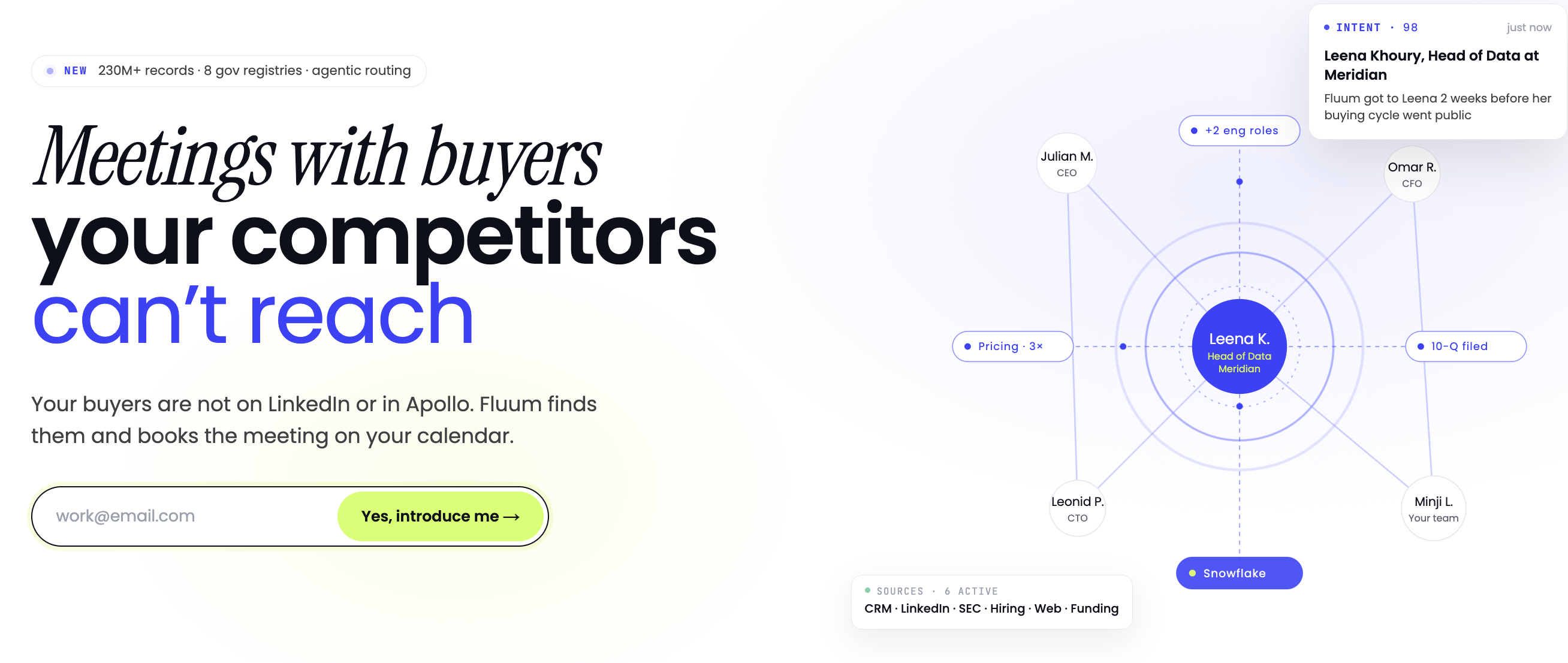
If you’re a senior leader or C-suite executive using financial data to identify your next category of buyers, talk to Aurora at Fluum and tell us who you’re looking to meet next. We’ll make sure to send you only what’s relevant — warm, double opt-in introductions to the exact decision-makers your financial data already told you to target.
Recommended Articles
Explore more from our content library: